Everyone in Ahmedabad knows Sabarmati Ashram. Almost nobody knows the one that came first.
Kochrab Ashram in Paldi is where Mahatma Gandhi actually began his Indian journey in May 1915, two years before Sabarmati even existed. It sat quiet and half-forgotten for decades until a 2024 restoration brought it back to life.
This guide covers the ashram’s real story, what you’ll see inside, current timings and entry fee, how to reach it, and where to eat nearby. Written for history lovers, Ahmedabad locals, families, and anyone building a Gandhi heritage trail through Gujarat.
Quick Facts: Kochrab Ashram at a Glance
| Detail | Information |
| Also known as | Satyagraha Ashram |
| Founded | May 1915, by Mahatma Gandhi |
| Location | Paldi Road, Kocharab, Paldi, Ahmedabad – 380006 (near V.S. Hospital) |
| Entry fee | Free |
| Timings | Roughly 11:00 AM – 6:30 PM (see timings section listings differ) |
| Time needed | 30–45 minutes |
| Managed by | Gujarat Vidyapith |
| Reopened after restoration | 12 March 2024 |
| Photography | Allowed |
| Best for | History lovers, students, families, heritage walkers |
Why Kochrab Ashram Matters More Than People Realise
Gandhi returned to India from South Africa in January 1915. He was 45, already famous for satyagraha abroad, and looking for a base to test those ideas on Indian soil.
He chose Ahmedabad a city with a deep handloom tradition, wealthy mill owners who might fund him, and a Gujarati-speaking population he could actually reach.
The ₹1 Bungalow
A barrister friend, Jivanlal Desai, offered his two-storey vacation bungalow in Kochrab village, then on the far outskirts of the city. The rent was one rupee a year.
Gandhi named it the Satyagraha Ashram a deliberate declaration that the method he had used against the British in South Africa was now coming home. It later became known as Kochrab Ashram simply to avoid confusion with Sabarmati.
25 People and a Rulebook
Around 25 men and women moved in, including Gandhi’s wife Kasturba and his nephew Maganlal Gandhi. Many had been with him in South Africa.
Gandhi drafted a set of ashram observances vows covering truth, non-violence, celibacy, control of the palate, non-stealing, and the removal of untouchability. These rules became the backbone of every Gandhian ashram that followed.
Residents spun khadi, cooked communally, cleaned their own toilets, and studied. It was less a retreat and more a working laboratory for a way of life Gandhi wanted to scale nationally.
The Decision That Nearly Shut It Down
In September 1915, Gandhi admitted an “untouchable” family Dudabhai, his wife Danibehn, and their infant daughter Lakshmi as full ashram members.
The backlash was immediate. Donors pulled out. Some ashram residents objected. Funds ran so low that Gandhi considered moving into a Dalit neighbourhood himself.
The rescue came anonymously: a wealthy visitor drove up, handed over ₹13,000, and left. It was mill owner Ambalal Sarabhai. That donation kept the ashram alive for a full year and Gandhi kept the family.
It’s the single most important thing that happened at Kochrab, and it’s why this small bungalow deserves more attention than it gets.
Why Gandhi Left
Kochrab was cramped, and a plague outbreak in the nearby village made the location risky. Gandhi wanted open land for farming and cattle.
In June 1917, the ashram shifted to the banks of the Sabarmati. Gandhi had spent roughly two years at Kochrab.
What You’ll See Inside Kochrab Ashram
The site spans a European-style two-storey bungalow, a garden, a separate kitchen block, and activity buildings around 5,000 sq m in total. The 2024 restoration cleaned up the structure, upgraded the displays, and added visitor facilities.
Here’s what’s worth your time:
1. The Main Bungalow
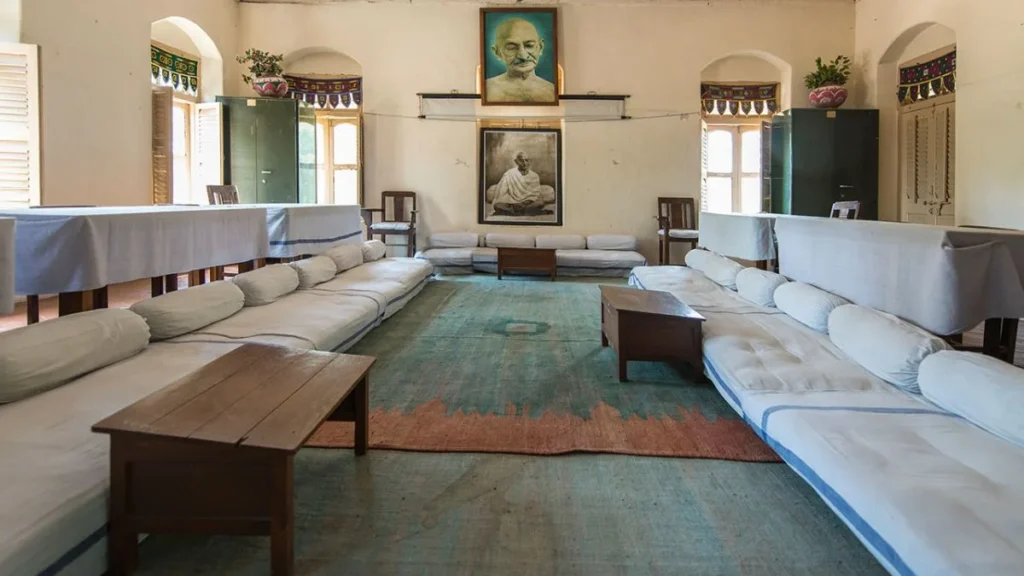
The colonial-era house itself, with its wooden staircase, high ceilings, and shaded verandah.
- Why visit: You get a genuine sense of scale this is a modest home, not a monument. Standing in these rooms makes the “25 people lived here” fact land properly.
- Best for: History lovers, architecture fans
- Time needed: 15 minutes
2. The Living Quarters & Gandhi’s Room
Simple rooms recreating how the ashramites lived floor seating, minimal furniture, a charkha.
- Why visit: The austerity is the point. Compare it mentally to Hriday Kunj at Sabarmati and you’ll see how consistent Gandhi stayed.
- Best for: Students, families with school-age kids
3. The Photograph & Document Gallery
Panels and photographs covering Gandhi’s return from South Africa, the founding of the ashram, and the early Ahmedabad years.
- Why visit: This is where the untouchability episode and the ashram vows are explained properly context you won’t get at busier sites.
- Best for: Anyone doing a school project or a serious heritage tour
4. The Garden & Courtyard
A calm, tree-shaded open space that most visitors walk straight past.
- Why visit: Genuinely peaceful, and the best spot for photos. Also the coolest place to sit in Ahmedabad’s afternoon heat.
- Best for: Couples, solo travellers, photographers
5. The Caretaker Conversations
Long-serving staff and guides at the ashram often walk visitors through the rooms informally.
- Why visit: Ask. The unrecorded details you’ll hear are better than any placard.
- Best for: Everyone just be polite and don’t rush them
Kochrab Ashram Timings and Entry Fee
Entry fee: Free. There is no ticket for Kochrab Ashram. Donations toward upkeep are welcome.
Timings read this carefully. Published hours are inconsistent across sources:
- Google listings currently show approximately 11:00 AM – 6:30 PM
- Older heritage and tourism listings show 9:00 AM – 6:00 PM or 9:00 AM – 5:30 PM
- Ahmedabad’s municipal heritage listing notes the ashram is closed on Mondays
Our practical advice: aim for a weekday between 11:00 AM and 4:00 PM, Tuesday to Saturday. That window is safe across every listing. Avoid Mondays entirely, and if you’re travelling a long distance specifically for this, call Gujarat Vidyapith or check Google’s live hours the morning of your visit.
Public holidays and Gandhi Jayanti (2 October) usually mean extended hours and much bigger crowds.
How to Reach Kochrab Ashram
The ashram sits on Paldi Road in Kocharab, near the V.S. Hospital area well inside the city, not on the outskirts anymore.
| From | Distance | Travel Time |
| Ahmedabad Junction (Kalupur) | ~6 km | 20–25 min by car |
| SVP International Airport | ~13 km | 30–40 min |
| Sabarmati Ashram | ~5 km | 15–20 min |
| Law Garden | ~2.5 km | 10 min |
- By auto or cab: The easiest option. An auto from Ashram Road or Ellisbridge costs roughly ₹60–₹120. Tell the driver “Kocharab Ashram, Paldi” some confuse it with Sabarmati, so be specific.
- By bus: AMTS and BRTS both serve the Paldi corridor. Paldi Char Rasta is the closest useful stop, a short walk away.
- By car: Parking is available on the premises, which is rare for a central Ahmedabad heritage site.
Pro tip: Pair Kochrab and Sabarmati Ashram in one morning. Do Kochrab first it’s chronologically correct and far less crowded, so you’ll actually absorb it before the tour-bus energy of Sabarmati.
Best Time to Visit Kochrab Ashram
- Best season October to March: Ahmedabad winters sit in a comfortable 15–30°C range, ideal for combining the ashram with a walking tour of Paldi and Ellisbridge.
- Avoid: April to June, when city temperatures regularly cross 40°C. The bungalow is shaded, but getting there isn’t pleasant.
- Best time of day: Late morning. Softer light for photos, thinner crowds, and you finish right in time for a Gujarati thali lunch nearby.
- Special date: 2 October (Gandhi Jayanti) brings programmes and a genuine sense of occasion but also crowds. Choose based on what you want from the visit.
Visitor Tips Before You Go
- Budget 30–45 minutes. It’s compact. Don’t plan a half-day around it.
- Remove footwear before entering the main buildings, and dress modestly.
- Photography is allowed, but keep it quiet and respectful people come here to reflect.
- Carry water, especially outside winter months.
- Ask for a guided walkthrough on arrival. Group visits are better booked in advance.
- Combine it with Sabarmati Ashram, Sanskar Kendra, or Gujarat Vidyapith for a proper Gandhi-in-Ahmedabad day.
Where to Eat Near Kochrab Ashram
You’re in Paldi–Ellisbridge one of Ahmedabad’s better neighbourhoods for an honest Gujarati thali. All four spots below are within a short auto ride.
Kasturi Dining Hall – Paldi
Walking distance from the ashram. Unlimited Kathiyawadi-leaning thali with rotating sabzis, kadhi-khichdi, and thick chaas.
- Must-try: Sev tameta nu shaak, khichdi kadhi, unlimited chaas
- Best for: Families, big appetites, budget travellers
- Approx. cost for two: ₹500–₹700
- Why visit: Closest proper thali to the ashram, and the refills keep coming.
Gopi Dining Hall – Ellisbridge
An Ahmedabad institution, roughly 1 km away, serving classic Gujarati thali for decades.
- Must-try: Seasonal thali with farsan, aamras in summer, the halwa
- Best for: First-time visitors wanting the traditional experience
- Approx. cost for two: ₹600–₹900
- Why visit: Old-school service, consistent recipes, zero pretension.
Gajanand Thal – Ambawadi
A little further out, mixing Kathiawadi, Punjabi and Gujarati on one menu.
- Must-try: Special thali, churma ladoo, methi thepla
- Best for: Students and groups splitting a bill
- Approx. cost for two: ₹400–₹600
- Why visit: Strong value, and Jain and Swaminarayan thalis are available.
Agashiye at The House of MG – Lal Darwaja
A splurge, about 4 km away, on the terrace of a restored heritage mansion.
- Must-try: The full seasonal thali, served course by course
- Best for: Couples, special occasions, out-of-town guests
- Approx. cost for two: ₹2,500–₹3,500
- Why visit: Heritage rooftop dining with a view toward the Sidi Saiyyed Mosque.
Prices are approximate and change seasonally.
Want more Ahmedabad food ideas? Read our guide to the famous foods in Ahmedabad and our pick of the best street food in Ahmedabad for everything from dabeli to a late-night khichdi.
Places to Visit Near
- Science City, Ahmedabad – A popular destination for interactive science exhibits, educational attractions and family-friendly experiences.
- Manek Chowk – A lively old-city destination known for traditional shopping, jewellery and famous street food, especially in the evening.
- Sidi Saiyyed Mosque – Visit this historic mosque to admire its iconic stone-carved Sidi Saiyyed Jali, one of Ahmedabad’s best-known architectural details.
- Sabarmati Riverfront – Enjoy a relaxing walk along the riverfront with landscaped promenades, open spaces and views of the Sabarmati River.
- NalSarovar Bird Sanctuary – A great option for nature and bird lovers, located outside Ahmedabad and known for its wetlands and migratory birds.
Frequently Asked Questions (FAQs)
Kochrab Ashram is famous as the first ashram Mahatma Gandhi established in India in 1915 after returning from South Africa.
No, entry to Kochrab Ashram is free for visitors. Donations may be accepted for maintenance.
Timings can vary. A safe time to visit is generally between 11:00 AM and 4:00 PM, Tuesday to Saturday. Check current timings before visiting.
Kochrab Ashram was established first in 1915, while Gandhi moved to Sabarmati Ashram in 1917. Kochrab is smaller and quieter.
Around 30–45 minutes is usually enough to explore the main areas, exhibits, living quarters and garden.
Yes. It offers an intimate look at Gandhi’s early life and the beginnings of his ashram movement in India.
Yes. The compact site, shaded areas and relatively easy pathways make it suitable for both children and elderly visitors.
Final Thoughts
Kochrab Ashram won’t take much of your day, and that’s exactly why more people should go. It’s free, it’s central, and it holds the beginning of a story that Sabarmati only continues. The restored bungalow, the vows drafted in those rooms, and the ₹13,000 that saved it all that’s a lot of history for 45 minutes.
Been to Kochrab Ashram recently? Tell us what the current timings looked like in the comments. Your experience can help other travellers plan their visit better. Travel Roach brings you practical travel guides and local heritage insights to make exploring Gujarat easier.
