On the morning of March 12, 1930, Mahatma Gandhi walked out of this ashram and did not come back. He was 60 years old. He was leading 78 followers on a march of 241 miles to the coastal village of Dandi, where he planned to pick up a handful of salt from the sea and break the most symbolically potent law of the British Empire. Before he left, he made a promise: he would not return to the Sabarmati Ashram until India had won Swaraj self-rule.
He never came back. India gained independence on August 15, 1947. Gandhi was assassinated on January 30, 1948. The ashram on the banks of the Sabarmati River has remained exactly as he left it his spinning wheel still in Hriday Kunj, his letters in the library, his sandals somewhere in the quiet rooms of the simple building where he thought, wrote, prayed, and planned the end of an empire.
Sabarmati Ashram also known as Gandhi Ashram, Satyagraha Ashram, and Harijan Ashram is one of the most important historical sites in India. It is free to enter. It is open 365 days a year. It is 5 kilometres from Ahmedabad’s city centre. And it is, without qualification, one of the most genuinely moving experiences available to any visitor to Gujarat. This TravelRoach guide covers the complete history, every key structure, the museum galleries, Gandhi’s vow, the Dandi March, the remarkable people who lived here, and everything you need to plan a meaningful visit.
Sabarmati Ashram – Quick Information
| Detail | Information |
| Official Name | Sabarmati Ashram (Gandhi Smarak Sangrahalaya) |
| Also Known As | Gandhi Ashram, Satyagraha Ashram, Harijan Ashram |
| Address | Gandhi Smarak Sangrahalaya, Hridaya Kunj, Old Wadaj, Ahmedabad, Gujarat 380027 |
| Official Website | gandhiashramsabarmati.org |
| Location | On the banks of the Sabarmati River, ~5 km north of Ahmedabad city centre |
| Gandhi Lived Here | 1917 to 1930 13 years, with Kasturba Gandhi |
| Area | 36 acres on the Sabarmati riverbank |
| First Established | May 25, 1915 at Kochrab Bungalow, Paldi (Gandhi’s first Ahmedabad ashram) |
| Moved to Current Site | June 17, 1917 |
| Entry Fee | Completely free for all visitors, Indian and foreign |
| Timings | 8:30 AM – 6:30 PM, open every single day of the year (365 days, all holidays included) |
| Museum Inaugurated | May 10, 1963 by Prime Minister Jawaharlal Nehru |
| Museum Galleries | Three: ‘Gandhi in Ahmedabad’, ‘Painting Gallery’, ‘My Life is My Message’ |
| The Dandi March | Launched from this ashram on March 12, 1930 — Gandhi walked 241 miles to Dandi |
| Gandhi’s Vow | He vowed not to return until India won Swaraj he never returned |
| Key Structure | Hriday Kunj — Gandhi’s personal residence; his bedroom, study, and spinning wheel |
| Why This Location | Deliberately chosen between a prison and a cemetery; Gandhi said a Satyagrahi ends in one or the other |
| Distance from City Centre | ~5 km (~15 minutes by auto/taxi) |
| Distance from Ahmedabad Junction | ~5 km (~15 minutes) |
| Distance from SVP Airport | ~14 km (~25 minutes) |
| Recommended Visit Duration | 1.5 to 2.5 hours for the full complex and museum |
Gandhi and Gujarat – The Indian Connection
Return from South Africa
Mohandas Karamchand Gandhi returned to India from South Africa in January 1915 after more than 21 years working as a barrister and civil rights organiser in Natal and Transvaal. He had left India a young lawyer in 1893. He returned a changed man transformed by his experiences of discrimination under colonial rule in South Africa, by his experiments with simple living and truth, and by the political and philosophical framework of Satyagraha (non-violent resistance) that he had developed and tested there.
He was 45 years old. His teacher and mentor, Gopal Krishna Gokhale, advised him to spend a year travelling through India before engaging in politics to understand the country as it was in 1915, not as he had left it in 1893. Gandhi listened. He spent a year in careful observation. And then he settled in Ahmedabad.
The choice of Ahmedabad was not accidental. Gandhi was Gujarati born in Porbandar, raised in Rajkot, educated in London, formed in South Africa. His return to Gujarat was a return to the culture and language and social context that he understood most intimately. And Ahmedabad the city of the Sabarmati, the mill town, the commercial and intellectual centre of Gujarat was where the Indian independence struggle would eventually find its most powerful physical symbols.
The Kochrab Ashram – The Beginning
Gandhi’s first ashram in Ahmedabad was established on May 25, 1915, at the Kochrab Bungalow in Paldi a property lent to him by his barrister friend and associate Jivanlal Desai. He called it the Satyagraha Ashram reflecting the two principles it was founded on: Satya (truth) and Agraha (firm resolve). The ashram was a residential community men, women, and children living together, working together, studying together, and practising the Gandhian principles of simple living, self-sufficiency, and non-violence.
When a plague outbreak in the Kochrab neighbourhood made the location unsuitable and Gandhi needed more space for farming and cottage industries, the search for a new site began. In 1917, a 36-acre stretch of open land on the banks of the Sabarmati River became available. Gandhi moved there in June 1917. This would be his home for the next thirteen years.
Also Read: Sarkhej Roza, Ahmedabad
Why Gandhi Chose This Location – Between a Prison and a Cemetery
The location of the Sabarmati Ashram was not chosen only for its practical advantages though those were real: space for farming, proximity to the river, a certain distance from the city’s commercial noise while still being accessible from it. Gandhi chose this location with a characteristic combination of the practical and the symbolic.
The Sabarmati Ashram stands between two institutions: the Sabarmati Central Jail (to the north) and a Hindu cremation ground (to the south). Gandhi found this geographical fact meaningful rather than morbid. He said that a Satyagrahi one who practises non-violent resistance would certainly end his or her life in one of two ways: in prison or in the graveyard. The ashram between these two destinations was, therefore, the right place for those preparing to live a life of principled resistance. It was not a philosophical joke. Between 1917 and 1930, dozens of ashram residents would be imprisoned for their participation in Gandhi’s campaigns. Gandhi himself would be arrested multiple times.
The river itself was part of the choice. The Sabarmati in 1917 was a living, flowing river the water visible and audible from the ashram’s edge. Gandhi believed deeply in the spiritual and practical value of natural settings for human community. The ashram’s riverside setting gave it the qualities of quietness, natural rhythm, and visual openness that Gandhi considered essential to the ashram’s purpose.
Thirteen Years at Sabarmati – What Gandhi Did Here
Daily Life in the Ashram
Life in the Sabarmati Ashram was structured around a set of practices that Gandhi considered inseparable: prayer, physical labour, study, community, and political work. The day began before dawn with prayers at the Upasana Mandir. The prayers were inter-faith drawing from the Bhagavad Gita, the Quran, Christian hymns, and other traditions reflecting Gandhi’s conviction that all religious paths pointed toward the same truth.
After prayers came physical work spinning on the charkha (spinning wheel), farming, cleaning, cooking. Gandhi insisted that every resident of the ashram, regardless of background or education, participate in physical labour. This was not punitive. It was his deepest political conviction in practice: that the dignity of manual work must be restored to a society that had been taught to look down on it by the combination of caste hierarchy and colonial education. The spinning wheel was the symbol of this conviction a professor who spun cotton was making a political statement about what labour meant.
The afternoons brought meetings, correspondence, and planning. The sheer volume of Gandhi’s correspondence from the Sabarmati years thousands of letters in multiple languages, preserved in the ashram library gives the most tangible impression of the scale of his simultaneous engagements: the independence movement, social reform, the caste system, women’s rights, educational philosophy, economic alternatives to industrialism, specific local injustices from across India and the world.
The 1918 Ahmedabad Mill Workers’ Strike
One of the most significant episodes of Gandhi’s Sabarmati years was the Ahmedabad Textile Workers’ Strike of 1918 the first major labour action Gandhi led in India. The mill workers of Ahmedabad were demanding a 35% wage increase; the mill owners were offering 20%. Gandhi supported the workers’ position. The strike continued for weeks. To galvanise the workers and demonstrate his personal commitment to the justice of their cause, Gandhi undertook his first hunger strike in India fasting until the dispute was resolved. The strike was ultimately settled in the workers’ favour with a 35% increase.
The Udyog Mandir within the ashram complex was founded in this period — a cottage industries institution that propagated the use of khadi (handspun cloth) as both an economic alternative to imported British textiles and a symbol of self-reliance. The slogan of the Udyog Mandir became ‘Swaraj through Khadi’ — the connection between the political goal of self-rule and the practical act of spinning your own cloth.
Major Campaigns Planned from Sabarmati
- Non-Cooperation Movement (1920-1922) – the national campaign of non-violent non-cooperation with British rule; significantly organised and directed from the Sabarmati Ashram
- Champaran and Kheda Satyagrahas – Gandhi’s first major Indian campaigns (indigo farmers in Bihar; peasants in Gujarat’s Kheda district) were conducted from the Sabarmati base
- Boycott of foreign cloth – the systematic burning of imported British textiles and promotion of khadi as the economic weapon of the independence movement
- Untouchability campaigns – Gandhi’s sustained advocacy for the rights of the communities he called Harijans (Children of God) and against the practice of untouchability in Hindu society
The Dandi March – The Day He Left and Never Returned
March 12, 1930 — The Departure
The most momentous single day in the history of Sabarmati Ashram was March 12, 1930 the morning Gandhi walked out with 78 followers to begin the Salt Satyagraha. The British Empire’s salt tax was one of the most universally hated aspects of colonial rule: salt is essential for life, and the British had made it illegal to produce or collect salt without paying the government tax. By walking to the sea and making salt from seawater, Gandhi intended to perform a simple, symbolic act of civil disobedience that every person in India however poor, however uneducated could immediately understand.
The morning of March 12 began with prayers at the Upasana Mandir. Then Gandhi addressed the assembled ashram community and the growing crowd of supporters and journalists who had gathered to witness the departure. He spoke simply about what they were doing and why. Then he picked up his walking stick and began to walk. Seventy-eight followers walked with him. Crowds lined the road. The news spread across the world.
Before leaving, Gandhi made his vow publicly: he would not return to the Sabarmati Ashram until India had won Swaraj. This promise was made in front of witnesses, before journalists, before the community he had lived with for thirteen years. It was not a casual statement. It was a commitment to the logic of the moment: if the Salt Satyagraha failed, there was no returning. If it succeeded, there would be a new India to return to.
The 241-Mile Walk to Dandi
The march covered 241 miles (approximately 388 kilometres) from Sabarmati to the coastal village of Dandi in Navsari district. Gandhi and his followers walked approximately 15 to 20 kilometres per day, stopping at villages along the route to speak, rest, and recruit new marchers. By the time they reached Dandi, thousands were walking with them. The march lasted 24 days. They reached Dandi on April 5, 1930.
On April 6, Gandhi picked up a handful of naturally deposited salt from the sea. This act this one handful of salt triggered a national uprising. People across India began making salt, buying salt from illegal sources, boycotting British salt. The colonial government’s response mass arrests of Congress leaders including Gandhi further galvanised public opinion. The Salt Satyagraha is now recognised by historians as one of the pivotal events in the history of non-violent resistance anywhere in the world.
Also Read: Kankaria Lake Ahmedabad
The Return That Never Came
Gandhi never came back to Sabarmati. After the Salt March, he was arrested and imprisoned. He was released, negotiated, imprisoned again. India’s independence movement passed through many more phases the Quit India movement of 1942, the final negotiations of 1946 and 1947. When independence came on August 15, 1947, Gandhi was in Bengal, working to stop the communal violence that accompanied Partition. He was assassinated by Nathuram Godse on January 30, 1948.
The ashram thus became a monument preserved in the state of his departure. The charkha in Hriday Kunj is the charkha he used. The correspondence in the library was written here. The Upasana Mandir where he prayed is the same prayer hall. The river is still visible from the ashram edge, as it was when he chose this location. Everything is as close to unchanged as time allows. And he is still not back.
What to See – The Structures of Sabarmati Ashram
Hriday Kunj — Gandhi’s Home
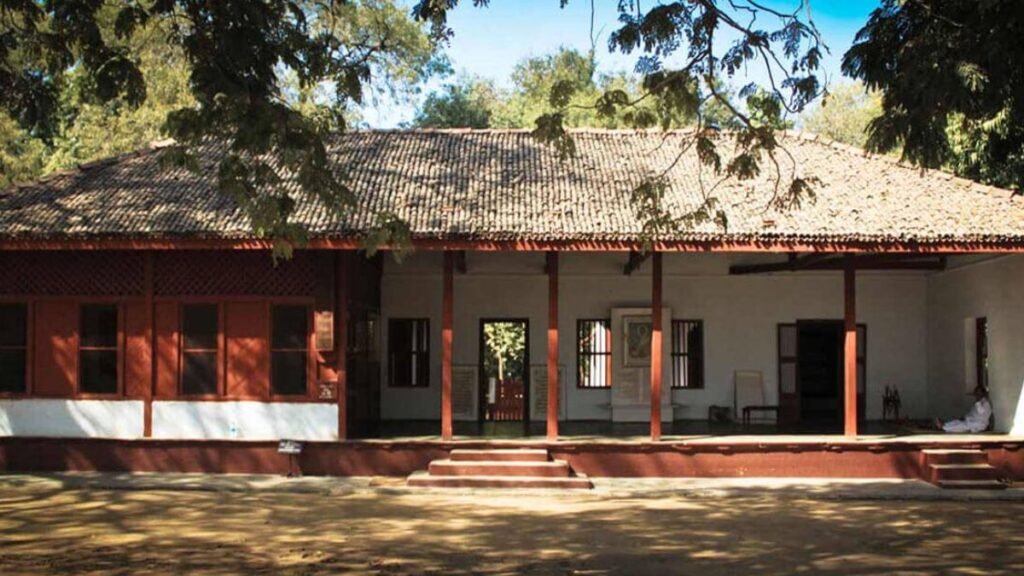
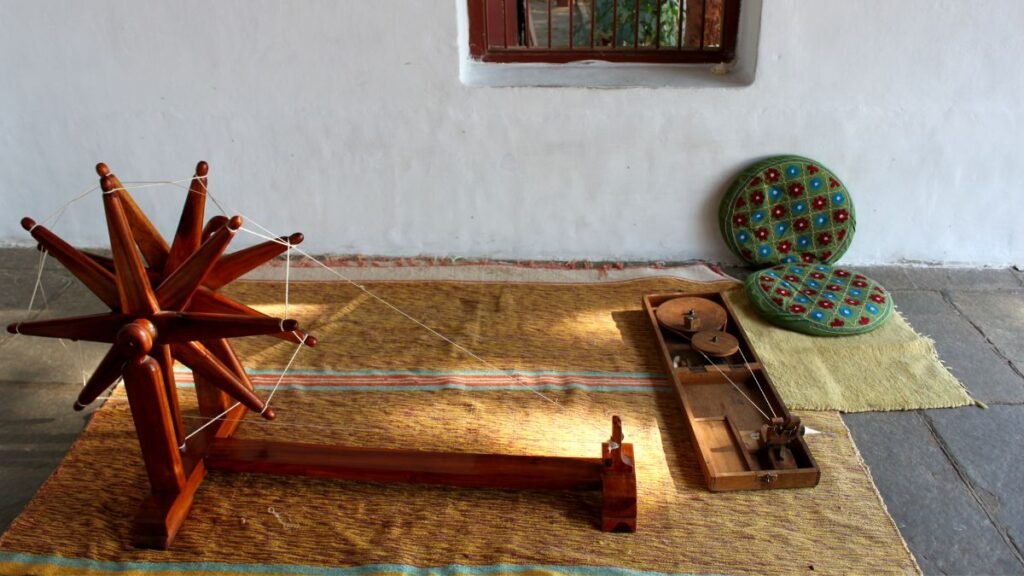
Hriday Kunj the name means ‘Heart’s Bower’ or ‘Sacred Heart Garden’ is the most important structure in the ashram complex and the emotional centre of any visit. It is Gandhi’s personal residence during the thirteen Sabarmati years: his bedroom, his study, his workroom. The rooms are small, simple, and almost entirely undecorated. The furniture is minimal. In the main room, Gandhi’s spinning wheel (charkha) stands where it always stood the object around which the entire political philosophy of his Ahmedabad years can be understood in a single glance.
Hriday Kunj is not a museum exhibit. It has been maintained as it was the rooms are open, the objects are the original ones, and the quality of the space is one of great quietness. Standing in the room where Gandhi wrote thousands of letters, spun yarn every morning, received visitors from across the world, and composed the thought that became the Bhagavad Gita for the 20th century this is one of the most concentrated heritage experiences in India.
Gandhi Smarak Sangrahalaya – The Museum
The museum at Sabarmati Ashram was designed by the renowned architect Charles Correa and inaugurated on May 10, 1963 by Prime Minister Jawaharlal Nehru. Charles Correa’s building with its characteristic open spaces and light courts is itself an architectural statement: the museum that holds Gandhi’s life should breathe and let in light rather than being sealed and dark. The building was one of Correa’s early major commissions and remains one of his finest works.
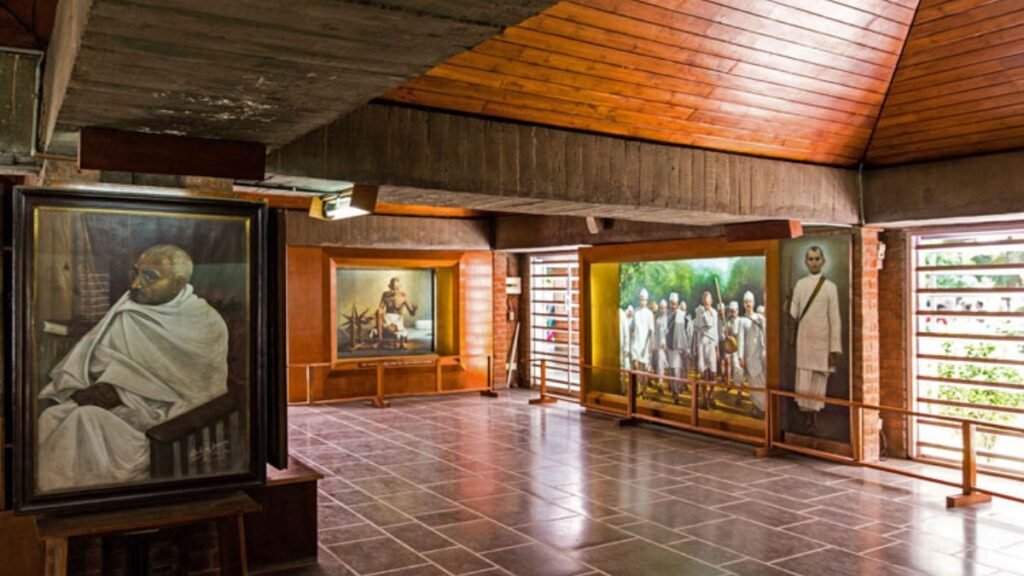
The museum is organised into three galleries:
- Gandhi in Ahmedabad – focusing on Gandhi’s thirteen years in the city; his relationships with local communities, industry, and political organisations; and the specific campaigns he led from Ahmedabad
- Painting Gallery – a collection of paintings depicting scenes from Gandhi’s life, by Indian artists of multiple traditions and periods
- My Life is My Message – the most philosophically significant gallery; presenting Gandhi’s core principles and their application in specific historical moments; organised around his own words
The museum also holds Gandhi’s personal letters thousands of them, in multiple languages. If you are a scholar or historian, the Sabarmati Ashram Library (also on the campus) provides access to one of the most important archives of 20th-century Indian political history.
Upasana Mandir – The Prayer Hall
The Upasana Mandir is the prayer hall where Gandhi conducted the ashram’s twice-daily prayers morning and evening. The prayers were inter-religious: passages from the Bhagavad Gita, the Quran, Christian hymns, Buddhist texts, and Jain prayers were all recited together by the ashram community. Gandhi’s insistence on inter-faith prayer practice was one of the most deliberate and politically significant aspects of ashram life a daily lived demonstration that religious divisions were not natural but manufactured.
The Upasana Mandir on March 12, 1930 was the site of the final prayer service before the Dandi March began. Today it remains a quiet, simple space — unchanged from its original form that carries the weight of that particular morning in its architecture.
Vinoba Mira Kutir – Two Extraordinary Residents
This building was the residence of two of the ashram’s most remarkable non-Gandhi members: Vinoba Bhave and Madeleine Slade. Vinoba Bhave who would go on to become one of India’s greatest Gandhian figures and the founder of the Bhoodan (land gift) movement lived at the Sabarmati Ashram from 1918 to 1921, in his early years as Gandhi’s disciple.
Madeleine Slade was the daughter of a British Admiral a woman who grew up in the heart of the very empire whose end Gandhi was working toward. She became deeply influenced by Gandhi’s philosophy, travelled to India, and took the name Mira Behn within the ashram community. She lived at Sabarmati from 1925 to 1933, working in the ashram’s daily activities, corresponding with her family, and becoming one of the most improbable expressions of the Gandhian idea that the values of justice and simplicity transcended national and imperial identity.
Magan Niwas – Maganlal Gandhi’s Residence
Maganlal Gandhi – Gandhi’s cousin and the most important person in the day-to-day management of the ashram lived in Magan Niwas. Maganlal was Gandhi’s most trusted associate in practical matters: it was Maganlal who managed the ashram’s operations, coordinated its agricultural and cottage industry activities, and maintained the community’s routine. Gandhi called him ‘the jewel of the ashram.’ Maganlal Gandhi died in 1928, two years before the Dandi March. Gandhi described his death as one of the great sorrows of his life.
Nandini – The Guest House
Nandini served as the ashram’s guest house the accommodation for the stream of distinguished visitors who came to Sabarmati to meet Gandhi, to observe the ashram’s life, and to be part of the conversations that were shaping India’s political future. The visitor list at Nandini through the 1917-1930 years includes politicians, writers, thinkers, foreign journalists, and people from across Indian society. The Sabarmati Ashram was not an isolated retreat it was one of the most politically active and internationally connected institutions in India during this period.
Udyog Mandir – Swaraj Through Khadi
The Udyog Mandir the cottage industries institution was founded in 1918 in direct response to the Ahmedabad mill workers’ strike. Its purpose was to promote khadi: handspun, handwoven cloth produced on the charkha as an economic alternative to machine-made imported textiles. The slogan ‘Swaraj through Khadi’ captured Gandhi’s conviction that political independence was inseparable from economic self-reliance that a nation dependent on its coloniser’s manufactured goods could not be truly free, regardless of who nominally held political power. The Udyog Mandir also became the model for khadi production organisations across India.
The Spinning Wheel – Gandhi’s Most Powerful Symbol
Among all the objects in the Sabarmati Ashram, the charkha the spinning wheel deserves special attention, because it is both the most ordinary and the most politically radical object in the complex.
Gandhi spun on his charkha every day. He encouraged and expected everyone in the ashram to spin. He promoted spinning across India as a national practice. His letters frequently discussed spinning. Photographs of Gandhi spinning became globally iconic images of the independence movement.
Why? Because the spinning wheel was the direct reversal of the economic logic of colonialism. The British Empire’s relationship with India involved importing Indian raw cotton, manufacturing it into cloth in British mills, and selling the finished cloth back to India at a profit destroying India’s traditional textile industry in the process. By spinning your own cotton into thread and weaving it into cloth, every Indian household was performing a tiny act of economic secession from this system. Every strand of khadi was a thread of Swaraj.
The charkha also appears at the centre of the Indian National Congress flag, which inspired the Ashok Chakra at the centre of the current Indian national flag. The wheel at the centre of the flag connects Gandhi’s spinning wheel to the Ashokan dharma chakra the wheel of righteous law. This continuity is not accidental. It is deliberate, and it is preserved in the flag that flies above every institution of the Republic.
Best Time to Visit Sabarmati Ashram
October to March – Best Season
The winter months offer the most comfortable visiting conditions for the ashram. Ahmedabad from October to February is pleasantly cool 15 to 25 degrees Celsius and the ashram’s extensive open grounds and riverside location are at their most pleasant for extended walking. The morning light in November and December on the ashram buildings and the river is particularly beautiful.
Early Morning – 8:30 to 10:30 AM
The ashram opens at 8:30 AM. The first two hours particularly on weekdays are the quietest and most meditative. The morning light on Hriday Kunj, the sound of the river, and the absence of the larger midday crowds create the conditions most conducive to the reflective experience the ashram deserves. Saturday and Sunday mornings can build significant crowds by 10 AM.
Open Every Day, All Year
One of Sabarmati Ashram’s most visitor-friendly attributes is its 365-day opening schedule. No other significant heritage site in Ahmedabad is open every day including all public holidays. Whether you arrive on Republic Day, Gandhi Jayanti, Diwali, or an ordinary Tuesday in June, the ashram is open from 8:30 AM to 6:30 PM. This makes it the ideal choice for visitors whose schedule does not conform to the weekly or seasonal closing patterns of most heritage sites.
Gandhi Jayanti – October 2
Gandhi’s birthday October 2 is the most significant date in the ashram’s calendar. Special programmes, prayers, spinning events, and commemorative activities mark the day. The atmosphere on Gandhi Jayanti at Sabarmati has a particular quality of collective memory and rededication. If you can plan your Ahmedabad visit around October 2, this is the most meaningful single day to be at the ashram.
How to Reach Sabarmati Ashram, Ahmedabad
| From | Distance | Mode | Approx. Time |
| Ahmedabad city centre / Lal Darwaja | ~5 km | Auto-rickshaw / Cab / Bus | 15–20 minutes |
| Ahmedabad Junction (Kalupur) | ~5 km | Auto-rickshaw / Cab | 15–20 minutes |
| Sabarmati Railway Station | ~2 km | Auto-rickshaw / Walking (25 min) | 8–10 minutes |
| SVP International Airport | ~14 km | Taxi / Cab | 25–30 minutes |
| Gandhinagar | ~30 km | Car / Bus | 45–60 minutes |
| Atal Bridge / Sabarmati Riverfront | ~4 km | Auto / Walking (45 min along river) | 12 minutes by auto |
By Auto-Rickshaw or Cab
The most convenient option from anywhere in Ahmedabad. Tell the driver ‘Gandhi Ashram’ or ‘Sabarmati Ashram’ all Ahmedabad auto drivers know it immediately. From the old city area, the fare is approximately ₹80 to ₹150 by auto. Ola and Uber are widely available. Parking is available near the ashram entrance.
By Bus – AMTS and BRTS
Ahmedabad city buses (AMTS) and the BRTS (Bus Rapid Transit System) both have routes passing near the ashram on Ashram Road. This is the most affordable public transport option. From Lal Darwaja or Paldi, multiple routes pass nearby. Ask locally for the bus stop nearest to ‘Gandhi Ashram’ the ashram’s location on Ashram Road is well-signed.
By Ahmedabad Metro
The Ahmedabad Metro network has been expanding. Check the current metro map for the nearest station to Ashram Road / Sabarmati area and complete the journey by auto from the station. The metro is the traffic-free, reliable option for visitors coming from the southern and eastern parts of the city.
Also Read: Manek Chowk Night Market, Ahmedabad
Nearby Attractions to Combine with Sabarmati Ashram
- Atal Bridge and Sabarmati Riverfront ~4 km | The same Sabarmati River that defines the ashram’s setting becomes a modern recreational and architectural attraction 4 km south the kite-shaped LED-lit pedestrian bridge and the Sabarmati Riverfront development. The contrast of the quiet, unchanged ashram and the busy modern riverfront is itself a kind of statement about Ahmedabad’s identity. Read our full TravelRoach guide.
- Sarkhej Roza ~8 km | The 15th-century Sufi dargah and royal complex the ‘Acropolis of Ahmedabad’ is the other great heritage monument in the city’s southwest. Comparing the Mughal-era Hindu-Islamic fusion architecture of Sarkhej with the deliberate simplicity of the Gandhian ashram covers a fascinating span of Ahmedabad’s layers of significance. Read our full TravelRoach guide.
- Manek Chowk Night Market ~8 km (old city) | Ahmedabad’s most famous street food night market. An evening at Manek Chowk after a morning at Sabarmati Ashram from Gandhi’s spinning wheel to double butter pav bhaji is as complete an Ahmedabad day as the city offers. Read our full TravelRoach guide.
- Kankaria Lake ~10 km | Ahmedabad’s great central lake with its heritage island palace, entertainment zone, and walking track. A pleasant contrast to the ashram’s quietness. Read our full TravelRoach guide.
- Adalaj ni Vav (Stepwell) ~20 km north | The 15th-century subterranean stepwell one of Gujarat’s finest heritage monuments. Easily combined with the ashram on a longer Ahmedabad heritage day.
Practical Tips for Visiting Sabarmati Ashram
- Allow at least 1.5 hours – and ideally 2 to 2.5 hours. The ashram is not large but it is rich in content. Rushing through Hriday Kunj and the museum in 45 minutes means missing the point of the visit entirely.
- Visit Hriday Kunj first – before the museum, before anything else. Stand in Gandhi’s room with the charkha. Let the simplicity register before the historical context is added by the museum galleries.
- The museum is architecturally significant – Charles Correa’s 1963 building is one of the finest works of modern Indian architecture. Pay attention to the spatial quality and the light as you move through the galleries.
- Read the letters – the museum displays Gandhi’s actual correspondence. Take time to read them rather than just looking at them as objects. The language, the directness, the range of subjects he addressed are extraordinary.
- Early morning is best – arrive at 8:30 AM for the opening on a weekday. The ashram is at its most meditative in the first hour.
- There is no entry fee – the visit is completely free. A donation box is available if you wish to contribute to the ashram’s maintenance.
- The grounds are open – walk all the way to the river edge. The view of the Sabarmati from the ashram bank where Gandhi would have stood looking at the same river is worth a quiet few minutes.
- Gandhi Jayanti (October 2) is the most significant day to visit – special programmes, prayers, and a unique atmosphere of collective remembrance.
Frequently Asked Questions (FAQs)
Sabarmati Ashram in Ahmedabad is famous as the home of Mahatma Gandhi from 1917 to 1930 the thirteen years during which he lived and worked here with his wife Kasturba Gandhi and the ashram community. The ashram is most specifically known as the launch site of the Dandi March (Salt Satyagraha) on March 12, 1930 one of the most celebrated acts of civil disobedience in world history when Gandhi and 78 followers walked 241 miles to the sea to make salt in defiance of the British salt tax. Before leaving, Gandhi made a famous vow that he would not return until India had won Swaraj; he never returned. The ashram is now a national monument, museum, and living institution.
Entry to Sabarmati Ashram is completely free for all visitors, both Indian and foreign, including all public holidays. The ashram is open every single day of the year (365 days) from 8:30 AM to 6:30 PM. There are no closed days, no seasonal closures, and no ticket required. A donation box is available at the entrance for those who wish to support the ashram’s maintenance. The museum and all buildings within the ashram are included in the free access.
Hriday Kunj meaning ‘Heart’s Bower’ is Gandhi’s personal residence within the Sabarmati Ashram, and the most important single structure on the campus. It contains Gandhi’s bedroom, his study, and his spinning wheel (charkha) the object that symbolised his entire political and economic philosophy. The rooms are small, spare, and almost entirely undecorated, maintained as close to their original state as possible. Standing in the room where Gandhi wrote thousands of letters, spun every morning, received visitors from across the world, and composed the thinking that changed India is one of the most concentrated heritage experiences in the country.
On March 12, 1930, Gandhi left Sabarmati Ashram to begin the Dandi March the 241-mile walk to the sea at Dandi village to make salt and break the British salt law. Before leaving, he made a public vow that he would not return to the Sabarmati Ashram until India had won Swaraj (self-rule). The Dandi March triggered a national uprising and mass arrests. Gandhi was imprisoned, negotiated, fought, and organised from different locations across India and later in prison for the rest of his life. India gained independence on August 15, 1947. Gandhi was assassinated on January 30, 1948. He never returned to Sabarmati.
The most important structures are: Hriday Kunj (Gandhi’s personal residence with his bedroom, study, and spinning wheel); the Gandhi Smarak Sangrahalaya (the museum designed by architect Charles Correa, inaugurated 1963, with three galleries); the Upasana Mandir (the inter-faith prayer hall where morning and evening prayers were held, and the site of the final prayers before the Dandi March); Vinoba Mira Kutir (residence of Vinoba Bhave and Madeleine Slade/Mira Behn); Magan Niwas (residence of Maganlal Gandhi); Nandini (the guest house for distinguished visitors); and Udyog Mandir (the khadi and cottage industries institution founded during the 1918 mill workers’ strike).
Sabarmati Ashram is approximately 5 km from Ahmedabad’s city centre and the Kalupur railway station area about 15 to 20 minutes by auto-rickshaw or cab. Tell the driver ‘Gandhi Ashram’ or ‘Sabarmati Ashram’ all Ahmedabad auto drivers know the location immediately. AMTS city buses and BRTS routes also pass on Ashram Road near the ashram. From Sabarmati Railway Station, the ashram is only about 2 km away. Parking is available near the entrance for those arriving by private vehicle.
The Dandi March (Salt Satyagraha) of 1930 is the single most historically significant event in Sabarmati Ashram’s history. On March 12, 1930, Gandhi and 78 followers set out from the ashram on a 241-mile walk to the coastal village of Dandi, where they picked up salt from the seashore to break the British salt tax law. This act of non-violent civil disobedience triggered a national mass movement, mass arrests of Congress leaders, and international attention that significantly accelerated India’s independence movement. Gandhi’s vow before leaving that he would not return until India won Swaraj and his subsequent non-return make the departure from Sabarmati on March 12, 1930 one of the most emotionally charged moments in the ashram’s history.
Final Thoughts
There are heritage sites in India where the scale makes you feel small. Palitana’s 863 temples. Laxmi Vilas Palace, four times the size of Buckingham Palace. The Somnath Jyotirlinga on its Arabian Sea cliff. These are the monuments of grandeur of the human impulse to make something that outlasts you in scale.
Sabarmati Ashram is none of those things. The rooms in Hriday Kunj are smaller than a good hotel room. The furniture is minimal. The building is plain. The view from the river edge is just a river. And yet this is the place where the British Empire ended. Where thirteen years of spinning and praying and letter-writing and fasting and organising produced the March 12, 1930 morning when a 60-year-old man with a walking stick set out for the sea.
The charkha is still there. The letters are still there. The river is still there. He is not. But the work he did here is still here too in the flag of the Republic, in the constitution, in the idea that a people can change their conditions by the quality of their conviction rather than the force of their arms.
Go to the ashram. Go in the morning. Sit in Hriday Kunj for as long as the security staff permit. Walk to the river edge. Stand there for a few minutes. Then go and eat something excellent from Manek Chowk, because Gandhi would have approved of enjoying what Ahmedabad does best, and Ahmedabad does food very well.
Have you visited Sabarmati Ashram? Share your experience the moment in Hriday Kunj, the letter that moved you most, the Gandhi Jayanti atmosphere in the comments. TravelRoach would love to hear from every visitor.
