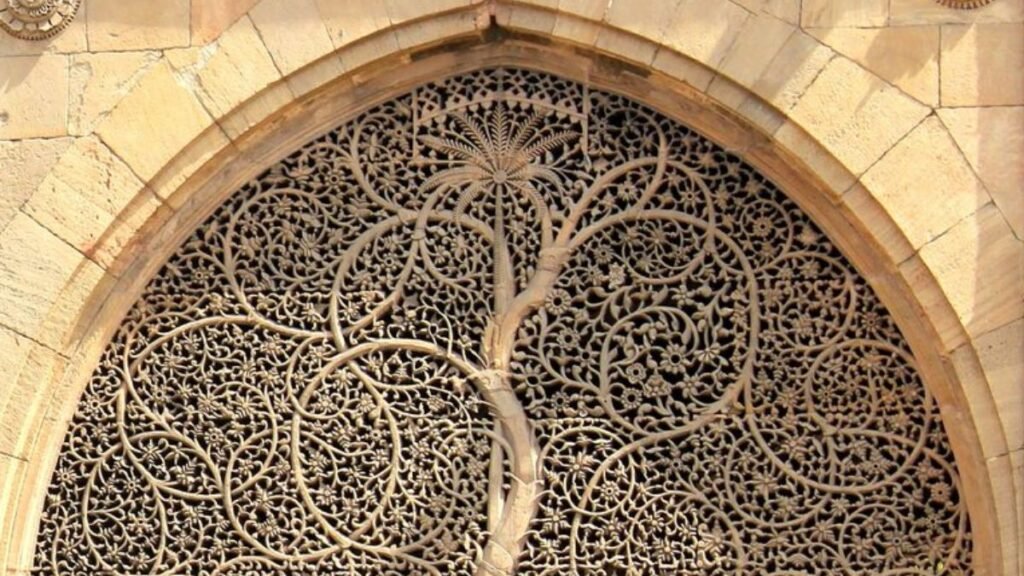
There is a mosque in the old city of Ahmedabad whose most famous window has no glass. It is made of stone a single slab of carved sandstone, approximately three metres wide and two metres high, through which you can see the street outside. The stone has been carved into a tree: branches intertwining, leaves and fronds curving outward, the whole design working outward from a central trunk to fill the arch with a pattern of such delicacy that it is widely described as resembling lace. This window the Tree of Life jali of the Sidi Saiyyed Mosque is the most celebrated piece of stone carving in Ahmedabad, possibly in all of Gujarat.
It is also the logo of IIM Ahmedabad. The Indian Institute of Management one of the world’s most prestigious business schools took the design of this 16th-century jali as its institutional symbol. Every diploma issued, every letterhead printed, every sign at the campus carries a version of the image first carved in a mosque in the old city in 1572.
The Sidi Saiyyed Mosque was built in the last year of the Gujarat Sultanate the final architectural statement of a medieval Islamic kingdom that had ruled Gujarat for more than 150 years before the Mughals arrived. It was commissioned by an African nobleman, Sidi Saiyyed, who came from the community of Abyssinian-origin people who had found significant roles in the Sultanate’s court and army. It was built by 45 skilled artisans who produced, in the ten jali windows of this small mosque, the finest stone latticework in the history of Indo-Islamic architecture.
This TravelRoach guide covers everything: the history of the Gujarat Sultanate and the historical moment of the mosque’s construction, the identity and story of Sidi Saiyyed and the Siddi community, the architecture and the ten jalis in detail, the Tree of Life and the IIM-A logo, how to visit, how to combine it with Ahmedabad’s other heritage, and practical tips for the best experience.
Sidi Saiyyed Mosque – Quick Information
| Detail | Information |
| Full Name | Sidi Saiyyed Mosque (also Siddi Saiyyed, Sidi Saeed, Siddi Sayyid) |
| Popular Name | Sidi Saiyad Ni Jali / Siddi Saiyyed Ni Jali |
| Location | Bhadra Road, Opposite Electricity House, Old City (Lal Darwaja), Ahmedabad, Gujarat 380001 |
| Built | 1572–1573 CE |
| Built By | Sidi Saiyyed an Abyssinian (Ethiopian)-origin nobleman in service of the Gujarat Sultanate |
| Who He Served | In the retinue of Bilal Jhajar Khan, general under Sultan Shams-ud-Din Muzaffar Shah III (last Sultan of Gujarat) |
| Historical Moment | Built in the LAST YEAR of the Gujarat Sultanate before the Mughal invasion of 1573 |
| Artisans | 45 skilled artisans |
| Style | Indo-Islamic fusion of Islamic geometric patterns and Hindu/Kalpa Vriksha motifs |
| Famous For | Ten intricately carved stone jali (latticework) windows especially the two ‘Tree of Life’ jalis on the western wall |
| The IIM-A Connection | The Tree of Life jali directly inspired the logo of the Indian Institute of Management Ahmedabad |
| Symbol of Ahmedabad | The Tree of Life jali is the official symbol of the city of Ahmedabad |
| Jali Dimensions | Each major jali approximately 3 metres wide × 2 metres high |
| Entry Fee | Free – no entry fee for all visitors |
| Open To | All visitors, regardless of religion it is an active mosque; respectful conduct required |
| Timings | Generally 6:00 AM – 6:00 PM (confirm locally; may close for prayer times) |
| Dress Code | Modest attire; remove footwear; women cover their heads inside |
| Part of | Ahmedabad UNESCO World Heritage City (inscribed 2017) |
| Distance from Kalupur Station | ~2 km (~10 minutes by auto) |
| Distance from Teen Darwaza | ~0.5 km (walking distance) |
| Distance from Manek Chowk | ~0.8 km (walking distance) |
| Distance from Sabarmati Ashram | ~7 km (~20 minutes by auto) |
The Last Year of the Gujarat Sultanate -Understanding the Historical Moment
The Gujarat Sultanate -150 Years of Ahmedabad’s Founding
To understand why the Sidi Saiyyed Mosque carries the weight it does, you need to understand the political moment of its construction. The mosque was built in 1572-73 CE -the very last year of the Gujarat Sultanate. The Gujarat Sultanate was the Islamic kingdom that had ruled Gujarat from approximately 1407 CE. Its founder, Sultan Ahmed Shah I, established Ahmedabad itself in 1411 -naming the new capital city after himself. The great mosques, the monuments, the streets, the pols, and the cultural character of old Ahmedabad were all shaped during the Sultanate’s 150-year existence.
The Sultanate patronised an extraordinary tradition of architecture -the Indo-Islamic style of Ahmedabad, which blended Islamic structural and decorative principles with the deep traditions of Hindu and Jain stone craftsmanship that Gujarat had developed over centuries. The result was a distinctive regional style: the ornate minars of the Jhulta Minar, the magnificent Jama Masjid, the stepwell tradition, and the jali work that reached its supreme expression at the Sidi Saiyyed Mosque.
The Final Year – Mughal Invasion and the End of the Sultanate
In 1572-73, the Mughal Emperor Akbar launched his campaign to annex Gujarat. The last Sultan Shams-ud-Din Muzaffar Shah III was defeated. The Gujarat Sultanate, which had shaped the city of Ahmedabad for 150 years, was dissolved. Ahmedabad became a Mughal provincial capital.
It is in this final year as the Sultanate was about to end that Sidi Saiyyed built his mosque. A marble tablet inside the mosque confirms this. The mosque is the architectural last breath of a kingdom: built by a man who served the last Sultan, completed as the empire that had patronised this entire tradition of building was about to cease to exist. The ten jalis of the Sidi Saiyyed Mosque are the Gujarat Sultanate’s final gift to the city it founded.
Also Read: Sabarmati Ashram, Ahmedabad
Sidi Saiyyed – The African Nobleman Who Built the Mosque
The Siddi Community – Africa’s Presence in Gujarat
Sidi Saiyyed was a member of the Siddi (also written Sidi, Siddhi) community -an African-origin people whose presence in the Indian subcontinent stretches back many centuries. The Siddis are descendants of Bantu-speaking Africans from the East African coast, principally from what is now Ethiopia, Mozambique, and Tanzania, who came to South Asia through multiple routes: as traders, as sailors on the Indian Ocean dhow network, as soldiers, as servants, and as enslaved people who subsequently won their freedom or rose to positions of authority.
The name Siddi is believed to derive from the Arabic ‘Sayyid’ an honorific title or from the Arabic ‘Sayyid al-Sudan’ (Lord of the Blacks). Siddi communities exist to this day in Gujarat (particularly in the Junagadh and Gir Somnath districts), in Karnataka, in Hyderabad, and in Pakistan’s Sindh and Makran coast. The Gujarat Siddis are known for their distinctive cultural practices including the Goma sacred music tradition, which blends African and Indian musical forms in a unique cultural expression.
In the medieval period, Siddi individuals found significant roles in the courts and armies of the Gujarat Sultanate and other Deccan and coastal Indian sultanates. They were respected as warriors, administrators, and naval commanders. Sidi Saiyyed was one such figure a man of African origin who had risen to a position of sufficient wealth, influence, and administrative standing to commission and build a mosque in the capital city of a major Indian sultanate.
From Ethiopia via Yemen to Gujarat
The specific account of Sidi Saiyyed traces his origin to Habshah the medieval Arabic name for Abyssinia (Ethiopia). He came to India via Yemen a route entirely consistent with the active Indian Ocean trade networks of the period that connected the East African coast through the Red Sea and Arabian Peninsula to the Gujarat coast. In Gujarat, he served under Bilal Jhajar Khan, the general of Sultan Shams-ud-Din Muzaffar Shah III’s army. Within the Sultanate’s service, he accumulated the resources and the status to build a mosque.
The mosque that Sidi Saiyyed built was not a statement of political ambition he did not build it in his own name in the manner of a ruler or a wealthy nobleman seeking prestige. It was a mosque: a place of prayer, intended for worship. The extraordinary jali work that distinguishes it reflects the quality of the artisans available to him and the quality of his own aesthetic ambition, but the building is fundamentally a devotional act. The 45 skilled artisans who worked under his commission produced, in the ten jali windows, the highest expression of a tradition that the Gujarat Sultanate had been developing for 150 years.
The Jalis – Stone That Looks Like Lace
What is a Jali?
Jali (also spelled jaali, jalli) is the term in Hindi and Urdu for a perforated stone or wood screen a lattice or grille made by carving patterns into a solid slab, creating a surface that allows light and air to pass through while maintaining visual separation between spaces. The jali tradition in Indian architecture spans Hindu, Jain, and Islamic buildings its origins lie in the need to filter harsh sunlight and provide privacy while maintaining ventilation, but its development produced one of the most distinctive and beautiful decorative traditions in the entire subcontinent.
In the Indo-Islamic architectural tradition of Gujarat, jali work reached its highest expression in the mosques and tombs of the Sultanate period and the highest expression of that tradition, by the consensus of art historians and architects, is in the two western-wall jalis of the Sidi Saiyyed Mosque.
The Ten Jalis – What They Show
The Sidi Saiyyed Mosque has ten semi-circular jali windows. Eight arched windows on the side walls carry jalis with intricate floral and geometric designs each one extraordinary by any standard of stone carving. The rear wall’s square panels are carved in geometric Islamic arabesques.
The most celebrated, most photographed, and most discussed are the two jali windows on the western rear wall the qibla wall (the wall facing Mecca) that is the devotional centre of any mosque. These two windows carry the design known as the Tree of Life: a naturalistic rendering of a palm tree with branches that spread outward and upward, intertwining with each other and with creeping plants and foliage, filling the entire arch with a pattern of extraordinary organic complexity and beauty.
The Tree of Life Jali – What Makes It Extraordinary
The two Tree of Life jalis are approximately 3 metres wide and 2 metres high. The stone is a single slab not assembled from multiple pieces but carved from a single piece of sandstone into the delicate lattice that you see. The branches and fronds that make up the design are connected to each other at enough points to maintain structural integrity, but the design creates the impression that the stone has become as light and flexible as plant matter. The effect described by multiple writers as resembling lace is achieved by removing stone rather than adding it: the artisan’s work was to take away, leaving behind only what was needed.
The design references multiple traditions simultaneously. The palm tree or tree form in Islamic art carries the association of the Tree of Life in the Quranic and broader Semitic tradition. The specific floral and branch forms echo the Kalpa Vriksha (wish-fulfilling tree) of Hindu iconography the divine tree that grants all wishes, a motif that runs through Hindu, Jain, and Buddhist visual traditions. The combination Islamic tree-of-life, Hindu Kalpa Vriksha, executed in the specific stone-carving tradition of 16th-century Gujarat is the artistic essence of what makes the Indo-Islamic style of Ahmedabad so distinctive.
The Unfinished Central Window
Visitors who look closely at the mosque’s western wall will notice that the central arch the position where you might expect the largest or most elaborate jali has no jali at all. It is an open arch. This absence is as much discussed as the presence of the two tree jalis. Multiple explanations have been proposed: that the central jali was never completed because the Gujarat Sultanate fell before the work could be finished; that Sidi Saiyyed died before completing his commission; or that the open arch was intentional a deliberate absence that frames the view through to the interior. The unfinished or absent central window has its own beauty: an opening where you expect stone, and light where you expect carving.
Also Read: Sarkhej Roza, Ahmedabad
The IIM-A Logo – The Jali’s Living Legacy
The Indian Institute of Management Ahmedabad established in 1961 and consistently ranked as one of the world’s leading business schools adopted the Tree of Life jali design as the basis for its institutional logo. The IIM-A campus, designed by the legendary American architect Louis Kahn, is itself a masterwork of brick architecture deeply influenced by the historic city around it. The choice of the Sidi Saiyyed jali as the institution’s visual identity was a deliberate act of cultural rootedness: the new institution of the independent Indian republic connecting itself explicitly to the 16th-century artistic heritage of the city in which it was founded.
Every IIM-A diploma. Every official IIM-A publication. The campus signs, the letterheads, the institutional communications all carry a version of the design first carved by 45 artisans in 1572 in service of an African nobleman in a medieval Islamic sultanate. The jali has travelled from the last year of the Gujarat Sultanate to the contemporary world as a living symbol of a city and its institutions. It is, by any measure, one of the more remarkable cultural journeys in Indian heritage.
Visiting Sidi Saiyyed Mosque – What to Expect and How to See It
The Experience – Small but Overwhelming
The first thing visitors notice about the Sidi Saiyyed Mosque is its scale: it is small. Significantly smaller than the Jama Masjid a few hundred metres away, smaller than the other major mosques of old Ahmedabad. A plain exterior. An unassuming approach through the old city street. And then you see the jali.
Standing before the Tree of Life jali for the first time produces a response that photographs do not prepare you for. The photograph is familiar it is everywhere, it is the symbol of the city, it is the IIM-A logo. But the object in three dimensions, in the specific quality of light that falls through the carved stone at different hours of the day, with the depth and shadow of the carved surface this is different from the image. The stone is not perfectly uniform. The light through the carved branches changes throughout the day. At certain hours, the light through the jali projects the tree pattern onto the mosque’s floor a shadow version of the design, moving as the sun moves.
Best Time of Day — Morning Light on the Jali
The Tree of Life jali faces west it is on the western qibla wall of the mosque. The light that falls through it from the east in the morning hours creates the most nuanced, directional illumination of the carved surface. The shadows in the carved channels are deepest and the relief of the design is most visible in morning light. The projection of the jali’s pattern onto the floor also happens in the morning when the eastern sun is at the right angle.
For photography, the morning (8 to 11 AM) is decisive. The afternoon light from the west, shining directly into the jali from outside, washes out the carved surface detail. The evening light creates dramatic shadows but less visual information in the lattice itself. Go in the morning.
The Mosque as Active Sacred Space
The Sidi Saiyyed Mosque is not a museum or a heritage monument accessible only for its visual qualities. It is an active mosque prayers are held here, particularly on Fridays. Non-Muslim visitors are welcome and regularly visit, but the mosque’s primary identity is as a place of Muslim worship. When you enter, enter as a respectful visitor in someone else’s sacred space. Remove footwear before entering. Women cover their heads inside the mosque. Speak quietly. Do not walk in front of worshippers during prayer. These are not formal restrictions but basic courtesies that reflect the mosque’s character and the community that cares for it.
The Old City Heritage Walk — Combining Sidi Saiyyed with Ahmedabad’s Heritage
The Sidi Saiyyed Mosque is in the heart of old Ahmedabad the walled city that was Ahmedabad from its founding in 1411 to the urban expansion of the 20th century, and which was inscribed as a UNESCO World Heritage City in 2017. The mosque is the ideal anchor for a half-day walking tour of the old city’s most significant heritage:
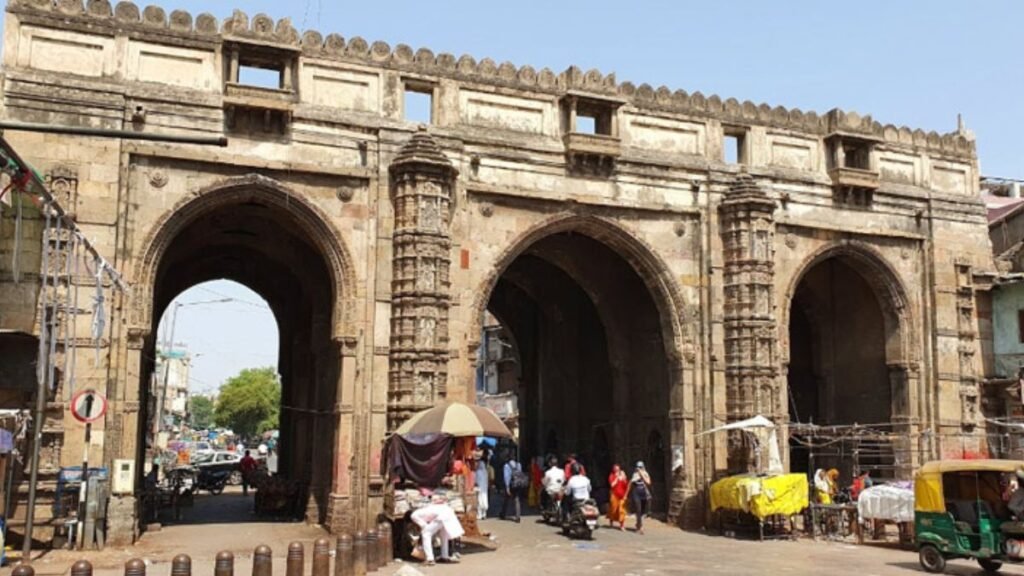
- Teen Darwaza (Three Gates) ~0.5 km | The magnificent triple-arched gateway built by Ahmed Shah I in 1415 three towering arched openings that once marked the ceremonial entrance to the Maidan Shah (royal enclosure). The gateway is the most dramatic single piece of Sultanate architecture in Ahmedabad.
- Bhadra Fort ~0.5 km | The citadel built by Ahmed Shah in 1411 at the same time as the city itself — the royal enclosure that anchored the original Ahmedabad. The Bhadra Fort complex houses the Bhadra Mata Temple and is one of the old city’s most historically significant sites.
- Jama Masjid ~0.6 km | Ahmedabad’s largest and most magnificent mosque — built in 1424 by Ahmed Shah I, with 260 pillars and 15 domes. The Jama Masjid is the architectural centrepiece of old Ahmedabad and the predecessor of the tradition that produced the Sidi Saiyyed jali.
- Manek Chowk ~0.8 km | By day a jewellery and textile market; by night, Ahmedabad’s famous street food market. The combination of the daytime heritage walk and the evening Manek Chowk street food experience is one of Ahmedabad’s finest contrasts. Read our full TravelRoach guide.
- Ahmedabad’s Pols Throughout the old city | The traditional walled residential neighbourhood clusters of old Ahmedabad complete with carved wooden facades, community gates, and the intricate social geography that earned the old city its UNESCO inscription. Best explored with a local heritage guide.
Also Read: Manek Chowk Night Market, Ahmedabad
How to Reach Sidi Saiyyed Mosque
| From | Distance | Mode | Approx. Time |
| Kalupur Railway Station | ~2 km | Auto-rickshaw / Walking (25 min) | 10 minutes by auto |
| Lal Darwaja Bus Stand | ~0.5 km | Walking | 7 minutes on foot |
| Manek Chowk | ~0.8 km | Walking | 10 minutes on foot |
| Teen Darwaza | ~0.5 km | Walking | 7 minutes on foot |
| Sabarmati Ashram | ~7 km | Auto / Taxi | 20 minutes |
| Ahmedabad Airport (SVP) | ~16 km | Taxi / Cab | 30–35 minutes |
| Gandhinagar | ~35 km | Car / Bus | 50 minutes |
The Sidi Saiyyed Mosque is in the Lal Darwaja area of old Ahmedabad on Bhadra Road, opposite the Electricity House. Navigate to ‘Sidi Saiyyed Mosque, Ahmedabad’ on Google Maps. From anywhere in old Ahmedabad, the mosque is walking distance or a very short auto-rickshaw ride. It is best reached on foot as part of an old city walking tour.
Practical Tips for Visiting Sidi Saiyyed Mosque
- Go in the morning – the best light for the jali falls in the morning hours (8 to 11 AM) when the eastern sun illuminates the carved surface from within. The shadow projection of the jali pattern onto the floor also happens in morning light.
- Remove footwear before entering – this is mandatory. Carry a cloth bag for your shoes if doing an extended old city walk.
- Women cover their heads inside – carry a dupatta or scarf; this is standard respectful practice in any mosque.
- Do not visit during Friday prayers if you want photography time – Friday midday sees the largest congregation; visit on non-Friday days or early mornings for quieter conditions.
- Do not touch the jali – the carved stone is 450 years old and fragile. The temptation to run your fingers over the lattice is understandable but please resist it.
- Combine with the old city walk – the mosque is the finest single point in a broader old Ahmedabad heritage walk covering Teen Darwaza, Bhadra Fort, Jama Masjid, and Manek Chowk. Allow 3 to 4 hours for the complete circuit.
- The best photographs are taken from outside the mosque – the two Tree of Life jalis are on the western wall and are photographed most effectively from the street outside, where you can see the full jali with the sky or street behind it.
Frequently Asked Questions (FAQs)
The Sidi Saiyyed Mosque in old Ahmedabad is famous for its extraordinary stone jali (latticework) windows specifically the two Tree of Life jalis on the western wall, which are considered the finest examples of carved stone latticework in Indo-Islamic architecture. Built in 1572-73 CE in the last year of the Gujarat Sultanate, the mosque was constructed by Sidi Saiyyed, an Abyssinian (Ethiopian)-origin nobleman in the service of the last Sultan. The Tree of Life jali design has become the symbol of the city of Ahmedabad and directly inspired the logo of the Indian Institute of Management Ahmedabad (IIM-A). Entry is free and the mosque is open to all visitors.
The Sidi Saiyyed Mosque was built in 1572-73 CE by Sidi Saiyyed a nobleman of Abyssinian (Ethiopian) origin who came to India from East Africa via Yemen and rose to prominence in the service of the Gujarat Sultanate. He served under Bilal Jhajar Khan, the general of the last Sultan Shams-ud-Din Muzaffar Shah III. Forty-five skilled artisans executed the construction. The mosque was completed in the final year of the Gujarat Sultanate’s existence the Mughal Emperor Akbar invaded and ended the Sultanate shortly after. A marble tablet inside the mosque confirms its construction date.
The Tree of Life jali is the most celebrated of the ten stone latticework windows at the Sidi Saiyyed Mosque. Located on the western rear wall (qibla wall), it depicts a naturalistic palm tree with branches spreading outward and upward, intertwining with each other and with parasitic plants and fronds, filling the entire three-metre-wide arch with an organic lattice of extraordinary complexity and beauty. The design references both the Islamic Quranic Tree of Life and the Hindu Kalpa Vriksha (wish-fulfilling tree) a fusion of traditions that characterises Indo-Islamic Ahmedabad architecture. Each major jali is approximately 3 metres wide and 2 metres high, carved from a single stone slab.
The Indian Institute of Management Ahmedabad adopted the Tree of Life jali design from the Sidi Saiyyed Mosque as its institutional logo. The choice reflects the institution’s deliberate cultural rootedness in the heritage of the city in which it was founded (1961). The IIM-A campus was designed by American architect Louis Kahn with a deep engagement with Ahmedabad’s historic brick and stone architectural traditions. The jali logo connects the new institution of independent India’s business education to the 16th-century artistic heritage of its host city, making the 450-year-old carving the face of one of the world’s leading business schools.
Yes – the Sidi Saiyyed Mosque is open to all visitors regardless of religion. Entry is completely free. It is an active mosque where Muslim prayers are held, particularly on Fridays. Non-Muslim visitors are welcome to enter and see the jali work. Standard respectful conduct applies: remove footwear before entering, women should cover their heads inside, speak quietly, and avoid walking in front of worshippers during prayer times. The mosque is at its quietest and most photography-friendly on weekday mornings when no congregational prayers are scheduled.
The Sidi Saiyyed Mosque is generally open from approximately 6:00 AM to 6:00 PM. It may close briefly during the five daily prayer times (namaz). For the most comfortable and unhurried visit, arrive in the morning between 8:00 and 11:00 AM on a non-Friday weekday. Friday midday sees the largest congregation for Juma prayers. There is no entry fee. Confirm current timings with a local guide or at the mosque, as hours may vary seasonally.
The Siddis (also written Siddi, Sidi, Siddhi) are an African-origin community in South Asia descendants of Bantu-speaking Africans who came to the Indian subcontinent through trade, as sailors, soldiers, servants, or as enslaved people who subsequently won freedom or rose to prominence. The name likely derives from the Arabic ‘Sayyid.’ In medieval Gujarat, Siddi individuals including Sidi Saiyyed found significant roles in the court and army of the Gujarat Sultanate. Siddi communities continue to live in parts of Gujarat (particularly Junagadh and Gir Somnath districts), Karnataka, and Pakistan’s Sindh coast, maintaining distinctive cultural practices that blend African and Indian traditions.
Final Thoughts
The Sidi Saiyyed Mosque is small. If you are not specifically looking for it in the old city of Ahmedabad, you might drive past. It does not have the scale of the Jama Masjid. It does not have the fame of Sarkhej Roza or the accessibility of Sabarmati Ashram. It is a small mosque on a busy old city road, and you need to know it is there to find it.
And then you see the jali.
The Tree of Life, carved by 45 artisans in 1572, in the last year of a kingdom. An Ethiopian man’s commission. Islamic devotion and Hindu iconography fused in a single stone slab. Light passing through branches that have been stone for 450 years. The logo of one of the world’s great business schools. The symbol of one of India’s oldest continuously inhabited cities.
The mosque is small. The jali is everything.
Go in the morning. Remove your shoes. Stand before the stone. Let the light come through the branches. You are looking at one of the finest things human hands have ever made.
Have you visited Sidi Saiyyed Mosque in Ahmedabad? Share your experience the morning light through the jali, the moment you saw the IIM-A logo in the stone, the old city walk you continued afterward in the comments. TravelRoach would love to hear from every Ahmedabad heritage explorer.
