Shaped like a 41-metre-high mound of salt, Dandi Kutir is one of the most striking museum buildings in Gujarat and one of the world’s most technologically advanced Mahatma Gandhi Museums dedicated to a single person: Mahatma Gandhi. Housed within the Mahatma Mandir complex in Gandhinagar, this isn’t a traditional museum of glass cases and placards; it’s an 82-minute immersive journey through Gandhi’s life using 3D holography, 360-degree projections, and interactive multimedia. This guide covers Dandi Kutir’s history, what to expect inside, timings, entry fees, and how to plan your visit.
About Dandi Kutir
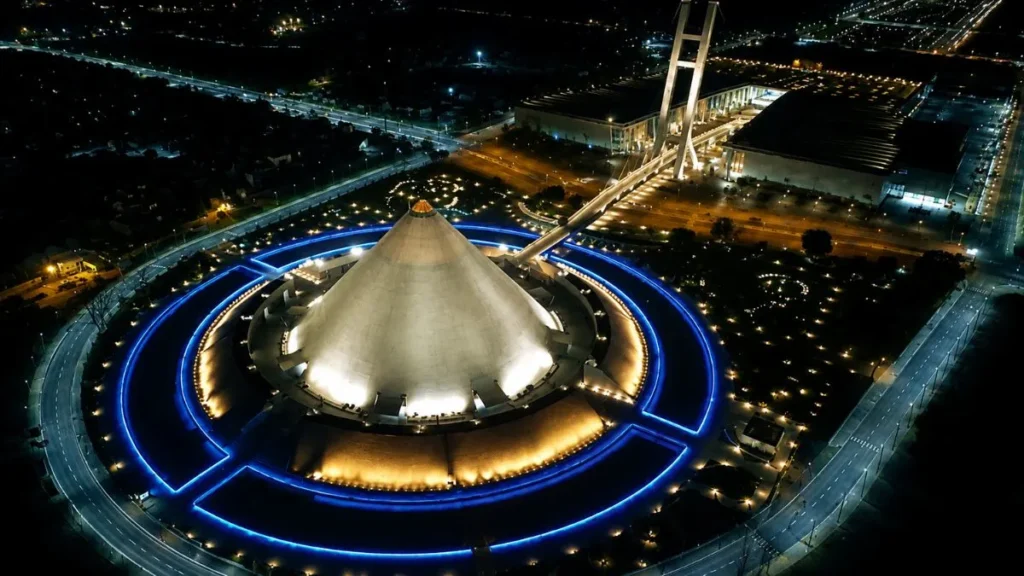
Dandi Kutir’s story begins with Mahatma Mandir, a massive convention centre built during Phase 1 between May 2010 and January 2011. The project cost roughly ₹135 crore and covers 34 acres. This makes it one of India’s largest convention centres. L&T designed and constructed the complex. Mahatma Mandir has hosted major events, including the Vibrant Gujarat Summit.
At the groundbreaking ceremony in 2010, organizers symbolically filled the foundation of what would become Dandi Kutir with sand from 18,099 villages across Gujarat. They also buried a time capsule beneath Mahatma Mandir containing a record of the state’s history. Phase 2, costing around ₹80 crore, added the salt-mound-shaped museum, along with a garden, suspension bridge, windmills, and expanded parking.
The building features a distinctive conical dome. Its design echoes the heap of salt that Gandhi famously produced during the 1930 Dandi March. This act of civil disobedience inspired the museum’s name.
What to Expect Inside
An 82-Minute Immersive Journey
Dandi Kutir offers a guided experience rather than a self-paced walkthrough. The tour lasts roughly 82 minutes and covers themed sections in sequence. A tour guide leads each group through the museum. Groups typically include around 50 visitors and begin every 30 minutes.
3D Holography and Multimedia Storytelling
The museum uses 3D mapping, holography, 360-degree projections, and audio-visual displays to create an immersive experience. These technologies bring Gandhi’s life and philosophy to visitors in an engaging way rather than presenting them through a purely academic approach.
Gandhi’s Life, From Porbandar to Dandi
The narrative traces Gandhi’s journey from his childhood in Porbandar, through his legal career in South Africa, to his central role in India’s freedom struggle, building up to the 1930 Dandi March. Along the way, it covers his core philosophies of Satyagraha (truth force), non-violence, and self-reliance through Khadi.
Artefacts, Paintings, and Memoirs
Beyond the multimedia halls, the museum also displays paintings, memoirs, and relics connected to Gandhi’s life and his role in the Civil Disobedience Movement.
Timings and Entry Fee
- Timings: Generally 10:30 AM to 5:00 PM, Tuesday to Sunday. However, the museum remains closed on Mondays.
- Entry Fee: Indian nationals generally pay ₹10, while foreign visitors pay around ₹200. However, some listings mention a fee of ₹10–20 for the full immersive experience.
- Free Entry: Persons with disabilities and school or college students may receive free entry. However, students typically need to submit a request on institutional letterhead.
- Guided Tours: Guided tours are available. For larger educational groups, advance booking may be required.
- Photography: Photography rules vary across different sections. Some areas allow photography without flash, while others prohibit it entirely. In addition, bags are generally not permitted inside.
- Time Needed: Plan for around 2 to 3 hours. This includes the 82-minute guided experience and time to explore the surrounding grounds.
Best Time to Visit
October to March is generally the ideal time to visit Dandi Kutir. During these months, Gandhinagar enjoys pleasant weather, making sightseeing more comfortable. Moreover, winter brings additional cultural fairs and events to the city. However, the museum remains comfortable throughout the year because it is air-conditioned. Therefore, visitors can enjoy Dandi Kutir even during the hotter summer months.
How to Reach Dandi Kutir Museum
Train: Gandhinagar Railway Station is remarkably close, just about 160 metres from the museum entrance.
Road: Located in Sector 13C, Gandhinagar, within the Mahatma Mandir complex, easily reached by auto-rickshaw or taxi from anywhere in the city.
Air: Sardar Vallabhbhai Patel International Airport in Ahmedabad is about 23 km away.
Who Should Visit Dandi Kutir
- History and independence-movement enthusiasts – a uniquely immersive, technology-driven take on Gandhi’s life story
- Families and students – genuinely engaging for children thanks to the multimedia format, and free for students with valid documentation
- Architecture and design lovers – the salt-mound-shaped dome is a striking piece of symbolic architecture in its own right
- Anyone visiting Gandhinagar – an easy, high-quality half-day stop right next to the railway station
Where to Eat Near Dandi Kutir
The wider Mahatma Mandir complex has food court options nearby. For a fuller meal, Gandhinagar and neighbouring Ahmedabad offer a wider range of dining. Check out our guides to famous foods in Ahmedabad and best street food in Ahmedabad for more options nearby.
Other Places to Visit Nearby
- Adalaj Ni Vav – A magnificent stepwell renowned for its intricate architecture and historic significance.
- Akshardham Temple, Gandhinagar – One of Gujarat’s most visited spiritual and architectural landmarks.
- Adalaj Trimandir – A peaceful spiritual complex near Gandhinagar, known for its beautiful surroundings and religious significance.
- Indroda Dinosaur and Fossil Park – A distinctive nature and fossil museum featuring dinosaur fossils and prehistoric exhibits in Gandhinagar.
Frequently Asked Questions (FAQs)
Entry is ₹10 for Indian nationals and ₹200 for foreign visitors. Persons with disabilities and school or college students can enter free, typically by submitting a request on institutional letterhead.
Dandi Kutir is generally open from 10:30 AM to 5:00 PM, Tuesday to Sunday, and closed on Mondays.
The core experience is a guided journey lasting around 82 minutes. Additionally, visitors can explore the surrounding grounds and browse the exhibits. Therefore, most visitors should allow 2 to 3 hours for the complete experience.
The building’s conical dome design symbolises the heap of salt Gandhi produced at the end of the 1930 Dandi March, the event that gives the museum its name.
Rules vary by section. Some areas permit photography without flash, while others prohibit it to protect the exhibits. In addition, visitors generally cannot carry bags inside the museum.
It’s remarkably close, just about 160 metres away, making it one of the most easily accessible major attractions from the station.
Final Thoughts
Dandi Kutir offers a genuinely different way to experience history less a museum you walk through and more one you’re immersed in, using technology to bring Gandhi’s life and philosophy vividly to life. Whether you’re a history buff or just want to see one of India’s most inventive museum designs, it’s an easy, worthwhile stop in Gandhinagar. Planning your Gandhinagar trip? Roach the road less traveled with Travel Roach drop your questions in the comments and we’ll help you plan the rest of your itinerary!
