Eighteen kilometres north of Ahmedabad, just off the busy highway that connects Gujarat’s commercial capital to its administrative one, there is a quiet village called Adalaj. And in that village, mostly hidden from the road, there is a hole in the ground that is one of the most beautiful things ever built in India.
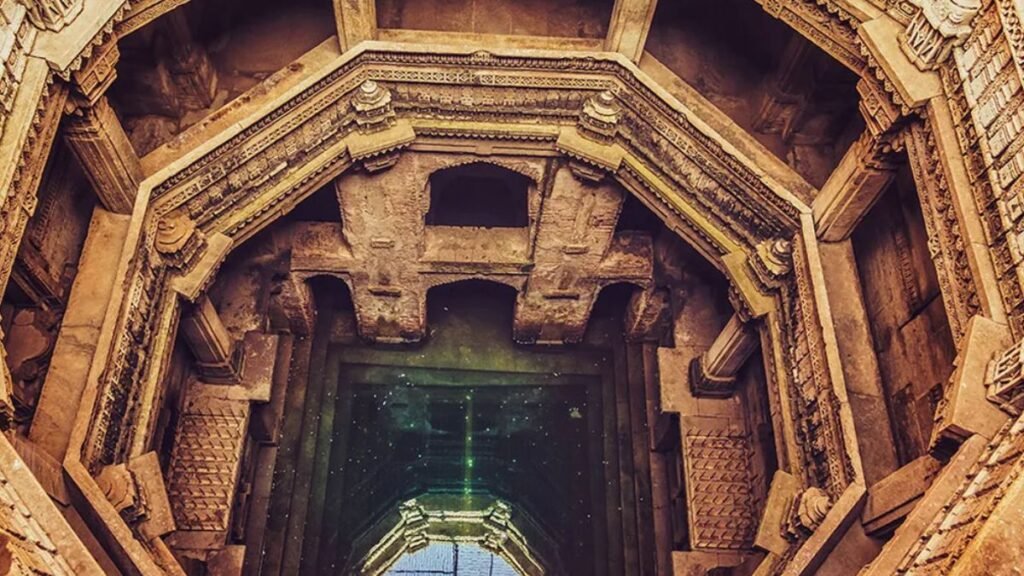
Adalaj ni Vav the Adalaj Stepwell is a five-storey subterranean structure built in 1498 CE from golden sandstone, carved floor to ceiling with apsaras and elephants, lotus rosettes and navagraha, the Tree of Life and the faces of gods. You descend into it and the air turns cool. The light falls through an octagonal shaft above and catches on pillar after pillar of extraordinary craftsmanship. The world above disappears. The city, the traffic, the heat all of it gone.
This TravelRoach guide covers everything about Adalaj ni Vav the tragic and beautiful story of Queen Rudabai, the architectural genius of the stepwell’s design, what to look for on each floor, the best time and photography tips, how to reach from Ahmedabad or Gandhinagar, nearby attractions, and practical visitor information.
Adalaj ni Vav – Quick Information
| Detail | Information |
| Also Known As | Adalaj Stepwell, Rudabai Stepwell, Rudabai ni Vav, Adalaj Vav |
| Location | Adalaj village, Gandhinagar district, Gujarat |
| Distance from Ahmedabad City Centre | ~16–20 km north (30–45 minutes by road) |
| Distance from Gandhinagar | ~5–15 km (15–20 minutes by road) |
| Highway | On / near the Ahmedabad–Gandhinagar Highway (SH-41) |
| Built | 1498–1499 CE |
| Commissioned By | Queen Rudabai, wife of Rana Veer Singh of the Vaghela dynasty |
| Completed Under | Sultan Mahmud Begada of the Gujarat Sultanate |
| Architectural Style | Solanki (Maru-Gurjara) style with Indo-Islamic fusion elements |
| Material | Yellow-ochre sandstone |
| Storeys | Five storeys deep |
| Entrances | Three staircases at the top, converging into one at the first landing |
| Special Feature | Interior is 5–6°C cooler than outside designed natural air conditioning |
| Cooling Design | Sunlight never directly touches the steps except at noon clever orientation |
| Entry Fee | Free (or nominal ASI fee confirm at gate on the day) |
| Timings | 6:00 AM – 6:00 PM (daily) |
| Managed By | Archaeological Survey of India (ASI) |
| Photography | Permitted in open areas no specific restriction on photography |
| Recommended Visit Duration | 45 minutes to 1.5 hours |
| Nearest Railway Station | Gandhinagar Capital Station (~10 km) or Ahmedabad Junction (~18 km) |
| Nearest Airport | Sardar Vallabhbhai Patel International Airport, Ahmedabad (~15 km) |
What is a Vav? Understanding Gujarat’s Stepwell Tradition
A vav or stepwell is a uniquely Indian type of water architecture in which a well is accessed not by a single vertical shaft but by a series of descending staircases and landings that allow people to reach the water level regardless of seasonal fluctuation. In the semi-arid regions of western India, where groundwater levels could drop dramatically during summer and rise during monsoon, the stepwell was a brilliant engineering solution.
In Gujarat alone, over 120 stepwells have been identified and documented built between the 5th and 19th centuries CE. They ranged from simple utility structures to extraordinary multi-storey monuments carved with the finest craftwork of their era. The vav was never just a water source. It was a community gathering space, a place of ritual and festival, a rest stop for travelling caravans, a cool retreat in summer, and a social centre where the life of a village or city unfolded across centuries.
Adalaj ni Vav represents the highest expression of this tradition a stepwell so elaborately carved and architecturally sophisticated that it functions simultaneously as a water reservoir, a summer palace, a pilgrimage site, and a monument to one of Gujarat’s most poignant royal stories.
The History and Story of Adalaj ni Vav
The Kingdom of Dandai Desh and Rana Veer Singh
In the late 15th century, the region around modern-day Adalaj was part of a small Hindu kingdom called Dandai Desh, ruled by a Vaghela Rajput chief named Rana Veer Singh. Like many rulers of semi-arid Gujarat, Rana Veer Singh was deeply conscious of the need to provide water security for his people. He commissioned the construction of a grand stepwell a vav that would serve not merely as a water source but as a monument of devotion to his kingdom and his subjects.
Construction of the vav began in 1498 CE. The design was ambitious five storeys descending into the earth, three entrance staircases, pillars and walls carved in the finest Solanki tradition by the most skilled craftsmen of the region. But before the work was complete, Rana Veer Singh was killed in battle in a conflict with the expanding Gujarat Sultanate under Sultan Mahmud Begada.
Queen Rudabai and Sultan Mahmud Begada
Sultan Mahmud Begada one of the most powerful and artistically sophisticated rulers of the Gujarat Sultanate heard of the half-finished stepwell and, encountering the widowed Queen Rudabai, was captivated by her intelligence and beauty. He proposed marriage. Rudabai, unwilling to simply refuse the powerful sultan but unwilling to break faith with her late husband, agreed on one condition: that the sultan complete the stepwell exactly as her husband had planned it.
Mahmud Begada accepted. He brought his own craftsmen to work alongside the original Vaghela builders. And here lies the architectural secret of Adalaj ni Vav – in the lower sections of the stepwell, where the Vaghela artisans had already worked, the carvings are purely Hindu and Jain in character. In the portions completed under Mahmud Begada’s patronage, Islamic floral arabesque patterns and geometric designs begin to appear alongside the Hindu deity figures. The result is a seamless, extraordinary fusion of three visual traditions Hindu, Jain, and Islamic in a single structure.
When the last stone was placed and the stepwell was complete, Rudabai according to the legend that has been told in Adalaj for over 500 years walked down to the water, prayed for her husband’s soul, and chose to end her life in the well rather than become the sultan’s wife. She remained faithful. The stepwell bears her name: Rudabai ni Vav.
The Six Masons and Their Graves
Adjacent to the stepwell, there are six graves the tombs of the six master masons who built Adalaj ni Vav. According to oral tradition, when Sultan Mahmud Begada was shown the completed stepwell, overwhelmed by its beauty, he asked the masons whether they could build another structure of equal magnificence. They replied that they could. Begada immediately ordered their execution preferring that no replica of this achievement would ever exist anywhere in the world. The six graves stand near the vav today, a sobering footnote to the extraordinary beauty of the structure they created.
Also Read : Kankaria Lake Ahmedabad
The Architecture of Adalaj ni Vav – What to See on Each Level
The Surface – Three Entrances and the Octagonal Opening
The first thing you notice at Adalaj ni Vav is the three staircases at the surface level, descending from three different directions east, north, and south into the earth. These three stairways converge at the first landing below ground. The octagonal opening at the top of the central well shaft is the engineering masterstroke of the structure: it allows light to filter down through all five levels, and air to circulate through the entire structure, creating the cooling effect that has made the vav famous.
The orientation of the structure is deliberate. Sunlight enters through the octagonal shaft at an angle that means it illuminates different levels at different times of day but it never falls directly on the steps or the water surface except at noon. This is not accidental. The builders calculated the path of the sun and designed the vav around it.
Level One – The Sanskrit Inscription and First Carvings
Descending the first staircase, you reach the first landing. On the wall of this level, set into a recess, is a marble slab with a Sanskrit inscription that records the history of the stepwell including the names of the patrons and the date of completion. This inscription is the primary historical document that confirms the 1498 date and the Vaghela dynasty’s involvement. If you can read Devanagari script or have a translation, this inscription repays close attention.
The pillars at this level show the beginning of the intricate carving programme that continues through all five floors. Look for the early Hindu deity figures Vishnu, Shiva, Brahma, Lakshmi carved into the brackets and walls of the first level. The craftsmanship here reflects the pure Solanki (Maru-Gurjara) tradition at its height.
Levels Two, Three, and Four – The Main Gallery of Carvings
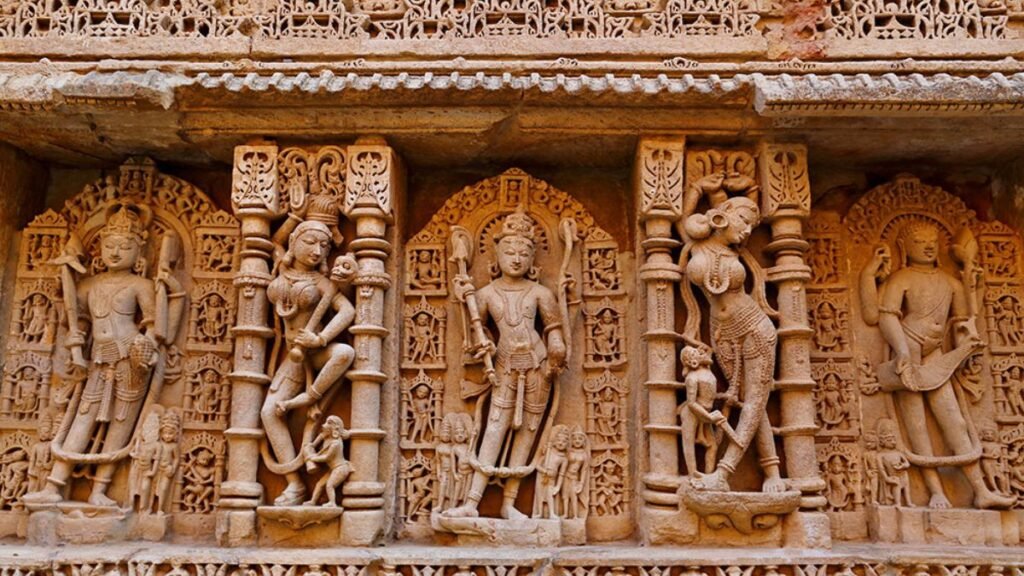
The middle floors of the stepwell are where the full ambition of the design becomes clear. Each level is spacious enough for large groups to gather this was by intention, since the vav was a social space as much as a functional one. The pillars on these levels are carved with an extraordinary density of imagery:
- Apsaras (celestial dancers) – elegant female figures in graceful poses, some shown dancing, some applying makeup, some playing musical instruments
- Navagraha (the nine planets) – a frieze of the nine celestial bodies, believed to guard the structure against malevolent cosmic forces
- Kalp Vriksha (the Tree of Life)- the mythological tree that grants all wishes, depicted on multiple pillars
- Ami Kumbhor (the pot of eternal water)- a symbol of abundance and continuity particularly associated with stepwells
- Elephants- the most common animal motif, considered auspicious and depicted in various sizes and poses
- Lotus rosettes – hundreds of carved lotus flowers in varying sizes and degrees of stylisation
- Geometric arabesque – the floral patterns introduced by Mahmud Begada’s craftsmen, interlacing with the Hindu motifs
- Peacocks, fish, horses, and other animals from daily life and mythology
- Scenes from village life – women carrying water pots, musicians, festivals
Each level is slightly different in its carving programme – as though each storey tells a different chapter of the same visual story. The change from Hindu-dominant to more syncretic decoration as you descend deeper reflects the historical layering of the stepwell’s construction.
Also Read: Atal Bridge Ahmedabad
Level Five – The Water Level
The fifth and deepest level is where the water was stored the functional core of the entire structure. At this depth, the air is noticeably cooler than at the surface 5 to 6 degrees Celsius lower, even on the hottest summer day. The light here is dim and diffuse, filtering down through the octagonal shaft from far above. The combination of cool air, filtered light, and the silence of the deep earth creates an atmosphere of extraordinary stillness.
In the centuries when the vav was in use, the water level here would have fluctuated with the seasons high after the monsoon, lower in the dry summer months. The five-storey design ensured that people could always reach the water regardless of the seasonal level. Today the well does not hold water but the depth and atmosphere of the fifth level remain unchanged.
The Cooling Genius – Natural Architecture Before Air Conditioning
Perhaps the greatest engineering achievement of Adalaj ni Vav is invisible to most visitors: the temperature. The combination of the deep underground location, the stone’s natural thermal mass, the octagonal shaft’s controlled light admission, and the air circulation created by the multiple stairways and landing openings keeps the interior of the stepwell 5 to 6 degrees cooler than the outside temperature at all times even during Gujarat’s most brutal May-June heat.
This was not an accidental side-effect of the design. The builders of Adalaj ni Vav understood the physics of convection, thermal mass, and air circulation. They built a natural air conditioning system into a five-storey sandstone structure in 1498. In the centuries before it was purely a heritage monument, the vav served as a genuine cool retreat during summer months travelers would rest here for hours, villages would gather here to escape the heat, festivals and ceremonies would be held in its cool chambers.
Photography Guide – How to Photograph Adalaj ni Vav
Adalaj ni Vav is one of Gujarat’s most photographed heritage sites and justifiably so. Here is how to make the most of your photography visit:
Best Time for Photography
Early Morning (6:30 AM to 9:00 AM): This is the golden window. The morning light enters the octagonal well shaft at a low angle and creates a stunning play of shadows and illumination on the carved pillars. The air inside glows with soft light. There are very few visitors at this hour, giving you clear sightlines for compositions.
Avoid Midday (11 AM to 3 PM): The midday sun enters the shaft directly and creates harsh, flat light inside. Outside the vav, the sun is intense. This is the least photogenic window.
Late Afternoon (4 PM to 6 PM): Second-best for photography. The light softens and the angle creates interesting shadows again. The vav is usually busy with visitors at this hour -good for people-photography and documentary shots, less ideal for architecture-only compositions.
Best Shots Inside the Vav
- Looking up from Level 5 through the octagonal shaft a classic composition that captures the full depth of the structure and the shaft of light descending from above
- Standing at the first landing looking down the full staircase the geometric symmetry of the descending steps and pillars is extraordinary
- Close-up of carved pillar sections the detail in individual carvings rewards a macro or close-focus shot
- The three staircases converging at the first landing photographed from above or below for a strong architectural composition
- Individual apsara figures in soft light the celestial dancer carvings are exquisite subjects for detailed photography
Note: Photography is generally permitted in all open areas of the stepwell. Avoid blocking narrow staircase lanes when school groups or large groups arrive step to the side and let the flow pass.
Best Time to Visit Adalaj ni Vav
October to March – Best Season
The winter months offer the most comfortable visiting conditions. Ahmedabad and Gandhinagar temperatures are pleasant in this period cool mornings, mild afternoons. The golden morning light in October to January is particularly beautiful for photography. November and December are peak tourist months but the site is not overwhelmingly crowded on weekdays.
April to June – Hot Outside, Cool Inside
Summer heat in this region is intense. However, the interior of Adalaj ni Vav remains 5 to 6 degrees cooler than the outside. If visiting in summer, arrive early in the morning (by 7 AM) and the experience inside the vav will be genuinely cool and peaceful. The grounds outside in midday heat are uncomfortable plan to be done by 10 AM.
Monsoon (July to September) – Atmospheric but Slippery
The monsoon season makes the area around Adalaj lush and green. The vav itself is dramatically beautiful in overcast monsoon light. However, the stone steps inside can be slippery when humidity is high. Wear non-slip shoes. The vav is open through monsoon it is a sturdy structure and well-maintained.
Weekday Mornings – Always Best
Regardless of season, the best time of day and week is a weekday between 6:30 AM and 10 AM. At this time the site is quiet, the light is beautiful, and you can spend time at each level without crowds. Weekend afternoon visits particularly on holiday weekends can be significantly busier.
Also Read: Nishkalank Mahadev Temple, Bhavnagar
How to Reach Adalaj ni Vav
| From | Distance | Mode | Approx. Time |
| Ahmedabad City Centre | ~16–20 km | Car / Auto / Uber / GSRTC Bus | 30–45 minutes |
| Gandhinagar | ~5–15 km | Car / Auto / Bus | 15–20 minutes |
| SVP International Airport, Ahmedabad | ~15 km | Taxi / Cab | 20–30 minutes |
| Gandhinagar Capital Station (Railway) | ~10 km | Train + Auto/Taxi | — |
| Ahmedabad Junction (Kalupur) | ~18 km | Train + Auto/Taxi | — |
| Thol Lake Bird Sanctuary | ~20 km | Car / Taxi | 30 minutes |
| Akshardham Temple, Gandhinagar | ~7–15 km | Car / Auto | 15–20 minutes |
By Car or Taxi (Recommended)
The most convenient way to reach Adalaj ni Vav from Ahmedabad is by private car, hired taxi, or ride-share app (Uber/Ola). Tell the driver ‘Adalaj ni Vav’ or ‘Adalaj Stepwell’ it is well-known. The drive from central Ahmedabad takes approximately 30 to 45 minutes depending on traffic. Take the Ahmedabad-Gandhinagar Highway (SH-41) northward and exit at Adalaj village. The stepwell is clearly signed from the main road.
By GSRTC Bus
State Transport buses run frequently between Ahmedabad’s Geeta Mandir/Paldi bus stands and Gandhinagar. These buses pass through Adalaj or stop at Adalaj village confirm with the conductor. From the main bus stop, the stepwell is a short auto-rickshaw or walking distance away.
By Auto-Rickshaw
Shared and private auto-rickshaws from Ahmedabad to Adalaj are available from areas like Gandhinagar circle and Memnagar in north Ahmedabad. Private auto fare from Ahmedabad: approximately ₹200 to ₹350 one way depending on negotiation. Uber autos and cabs also cover the route reliably.
From the Airport
Sardar Vallabhbhai Patel International Airport is approximately 15 km from Adalaj ni Vav. If arriving in Ahmedabad and planning Adalaj as the first stop before checking into a hotel, this works well the stepwell is en route between the airport and Gandhinagar. A taxi from the airport to Adalaj takes 20 to 30 minutes.
What to Combine with Your Adalaj ni Vav Visit
Adalaj is perfectly positioned between Ahmedabad and Gandhinagar, making it easy to combine with multiple nearby attractions in a single day. Here are the best combinations:
The Gandhinagar Heritage Loop
- Adalaj ni Vav (morning, 1–1.5 hours) → Akshardham Temple, Gandhinagar (~7–15 km, 2–3 hours) → Indroda Nature Park / Dinosaur Museum (~10 km from vav, 1–2 hours) → Dandi Kutir Museum (Gandhinagar, 1.5 hours)
The Ahmedabad Heritage Day
- Adalaj ni Vav (morning) → Sabarmati Ashram (~18 km, 45 minutes) → Old City Heritage Walk, Manek Chowk, Sidi Saiyyed Mosque → Evening street food at Manek Chowk
The Birdwatcher’s Circuit
- Adalaj ni Vav (early morning) → Thol Lake Bird Sanctuary (~20 km, 2–3 hours for birdwatching) — Read our full guide on TravelRoach
Nearby Attractions in Detail
- Akshardham Temple, Gandhinagar ~7–15 km | A stunning modern temple complex built by the BAPS Swaminarayan Sanstha. Peaceful gardens, intricate stone carvings, and an impressive main shrine. One of Gandhinagar’s most visited sites.
- Indroda Nature Park (Dinosaur and Fossil Park) ~10 km | One of India’s largest dinosaur fossil parks, with life-size dinosaur models, geological exhibits, and a botanical garden. Excellent for families with children.
- Dandi Kutir, Gandhinagar ~12 km | A state-of-the-art museum dedicated to the life and philosophy of Mahatma Gandhi. One of the finest Gandhi museums in India. Allow 2 hours.
- Sabarmati Ashram, Ahmedabad ~18 km | Gandhi’s historic ashram on the Sabarmati River. A moving, peaceful, and important heritage site. The spinning wheel, the personal belongings, and the riverfront setting are deeply thoughtful.
- Dada Harir Stepwell, Ahmedabad ~22 km from Adalaj | Another 15th-century stepwell in Ahmedabad’s old city slightly smaller but equally beautiful. Visiting both on the same day gives a fascinating comparison of the same architectural tradition.
- Thol Lake Bird Sanctuary ~20 km | Gujarat’s Ramsar-certified wetland with 160+ bird species. Excellent for birdwatching from October to February. Read our full guide on TravelRoach.
- Manek Chowk Night Market ~20 km (central Ahmedabad) | Ahmedabad’s most famous late-night street food market. End your heritage day with double butter pav bhaji and kulfi falooda. Read our full guide on TravelRoach.
Practical Tips for Visiting Adalaj ni Vav
- Arrive at 7 AM – the stepwell opens at 6 AM and the early morning light inside the shaft is extraordinary. By 10 AM on weekends, visitor numbers can be significant.
- Wear non-slip footwear – the sandstone steps inside the vav can be polished smooth and are slippery when humidity is high. Avoid flat-soled smooth shoes. Walking shoes or sneakers are ideal.
- Step down slowly – at each landing, pause and let your eyes adjust to the changing light before descending further. The visual experience deepens as you go down.
- Look up from every level – the view looking upward from the lower floors through the carved pillars and toward the octagonal shaft is as striking as any downward view.
- Carry your own water – there are no food or beverage stalls inside the stepwell complex. There is a small ASI garden outside with seating.
- Bring a good camera – phone cameras struggle in the low-light lower floors. A camera with good low-light performance or a wide-aperture lens will give you far better results.
- No flash photography on the carvings – flash can damage the sandstone pigments that remain in certain sections of the carving. Use natural light or low-light mode.
- Read the Sanskrit inscription – the marble slab inscription on Level 1 tells the story of the patrons and the date. A translation is available online and worth reading before your visit.
- Combine with Champaner-Pavagadh for a full heritage day – if you are spending more time, Pavagadh Hill and the UNESCO Champaner ruins (160 km from Adalaj) complete the picture of Gujarat’s medieval architectural golden age.
Frequently Asked Questions (FAQs)
Adalaj ni Vav – also called Adalaj Stepwell or Rudabai Stepwell is a five-storey subterranean stepwell built in 1498 CE in the village of Adalaj near Gandhinagar, Gujarat. It is famous for three things: its extraordinary carved stonework blending Hindu, Jain, and Islamic architectural traditions in a single structure; the remarkable natural cooling design that keeps the interior 5 to 6 degrees cooler than the outside temperature; and the tragic legend of Queen Rudabai, who commissioned the stepwell and chose to end her life in the well rather than marry Sultan Mahmud Begada after he completed it.
Adalaj ni Vav is generally free to enter it is maintained by the Archaeological Survey of India as a protected monument of national importance. Some visitors report a small nominal ASI fee at the gate, so it is advisable to confirm on arrival. The stepwell is open daily from 6:00 AM to 6:00 PM including weekends and most public holidays. No advance booking is required. The best time to visit is on a weekday morning between 6:30 AM and 10 AM, when the light is best and visitor numbers are lowest.
Adalaj ni Vav is approximately 16 to 20 km north of Ahmedabad city centre about 30 to 45 minutes by road depending on traffic. It is located in Adalaj village just off the Ahmedabad-Gandhinagar Highway (SH-41). From Gandhinagar, it is only 5 to 15 km about a 15 to 20-minute drive. It is also approximately 15 km from Sardar Vallabhbhai Patel International Airport, making it easy to visit before or after a flight.
Adalaj Stepwell is called Rudabai ni Vav because it was commissioned by Queen Rudabai, the wife of Rana Veer Singh of the Vaghela dynasty. After Rana Veer Singh was killed in battle, his half-finished stepwell was completed by Sultan Mahmud Begada of the Gujarat Sultanate. According to the legend that has been told in Adalaj for over 500 years, Rudabai agreed to marry the sultan only on the condition that he complete the stepwell — and then, upon its completion, chose to end her life in the well rather than break faith with her late husband. The stepwell bears her name as a tribute to her devotion and sacrifice.
Adalaj ni Vav is architecturally unique for several reasons. It is the only major stepwell in India that represents a clear fusion of three distinct visual traditions Hindu deity carvings and motifs, Jain cosmic symbols and geometric patterns, and Islamic floral arabesque designs in a single coherent structure. This fusion directly reflects its construction history: the lower levels were built by Vaghela craftsmen in the Hindu-Jain Solanki style, while the upper and later sections incorporate Islamic elements introduced by Sultan Mahmud Begada’s artisans. No other stepwell in India has this precise architectural layering.
Absolutely and perhaps especially so. Adalaj ni Vav is primarily a heritage and architecture destination rather than a pilgrimage site. The extraordinary stonework, the play of light through the octagonal shaft, the experience of descending five floors underground into cool air while surrounded by centuries-old carvings, and the historical story of its construction are all compelling even for those with no particular religious interest. It is one of India’s finest examples of medieval engineering and artistic synthesis, and it is genuinely moving to stand in. Allow at least an hour.
Yes Adalaj ni Vav is ideally positioned for combination with multiple nearby attractions. From Ahmedabad, combine it with Sabarmati Ashram, the Dada Harir Stepwell (another 15th-century vav in the old city), and the Manek Chowk Night Market for a complete Ahmedabad cultural day. From Gandhinagar, combine with Akshardham Temple, Indroda Nature Park (Dinosaur Museum), and Dandi Kutir Museum for a full Gandhinagar loop. The Thol Lake Bird Sanctuary is also approximately 20 km away and makes an excellent morning add-on for birdwatchers.
Final Thoughts
Adalaj ni Vav is one of those places that cannot be adequately described only experienced. Words can tell you that it is five storeys deep and carved from sandstone. They can tell you that it is 5 degrees cooler inside than out, that the octagonal shaft lets in morning light at an angle calculated by builders who died 500 years ago, that the third pillar from the left on the second level has an apsara whose face is still perfect. But they cannot convey what it actually feels like to walk down those three staircases as they converge into one, to feel the air change, to look up and see the carved columns rising above you toward a distant oval of sky.
This is what Gujarat’s heritage quietly offers not the grand spectacle but the still revelation. The story of Rudabai is carved into every stone. The genius of its builders is in the cooling breeze you feel before you even see it.
