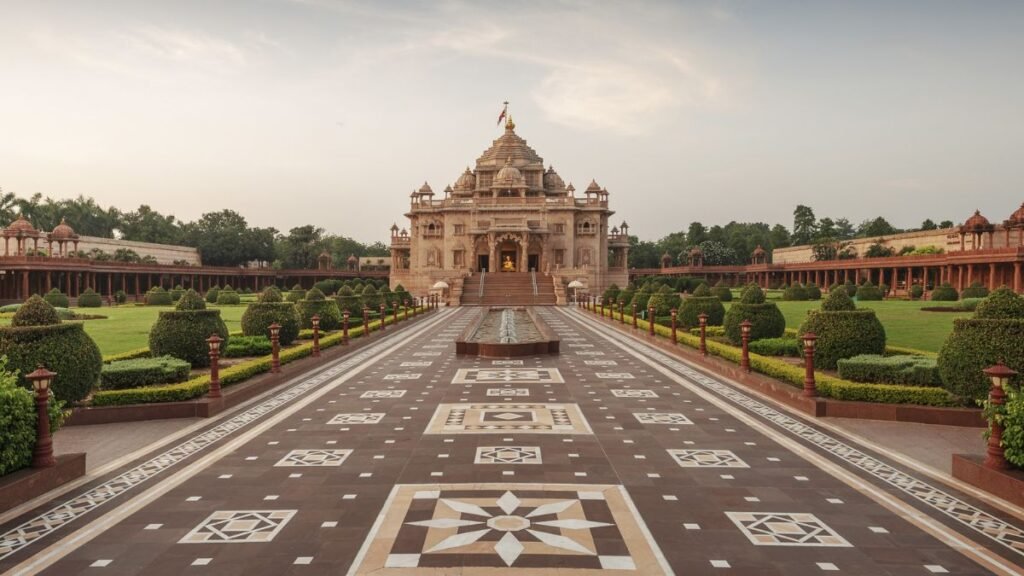
In Sector 20 of Gandhinagar Gujarat’s quiet, tree-lined capital city there stands a temple that changes how you think about what human hands can build when they are guided by faith. The Swaminarayan Akshardham Temple is 108 feet tall, constructed entirely from 6,000 tonnes of pink sandstone from Rajasthan, with not a single piece of steel or iron in its structure. Every pillar, every dome, every surface is hand-carved. It took 13 years to complete, consumed 8 million hours of volunteer labour, and was inaugurated on October 30, 1992.
It stands on 23 acres on the banks of the Sabarmati River in the heart of Gandhinagar. It is dedicated to Bhagwan Swaminarayan the 18th and 19th-century saint who founded one of Hinduism’s most vibrant modern traditions and whose influence on Gujarati religious and cultural life cannot be overstated. And it is free to enter for darshan completely, unconditionally free.
This TravelRoach guide covers everything: the story of Bhagwan Swaminarayan and the BAPS tradition, the architectural genius of the monument, the exhibitions within the complex, the strict rules about electronics (no phones, no cameras this is firmly enforced), the dress code, timings, how to reach from Ahmedabad, and how to plan a complete and deeply rewarding visit.
Swaminarayan Akshardham Gandhinagar – Quick Information
| Detail | Information |
| Full Name | Swaminarayan Akshardham (Gandhinagar) |
| Organisation | BAPS – Bochasanwasi Akshar Purushottam Swaminarayan Sanstha |
| Dedicated To | Bhagwan Swaminarayan (1781–1830) founder of Swaminarayan Hinduism |
| Inaugurated | October 30, 1992 by Pramukh Swami Maharaj |
| Inspired By | Yogiji Maharaj (4th spiritual successor of Swaminarayan; 1892–1971) |
| Created By | Pramukh Swami Maharaj (5th spiritual successor; 1921–2016) |
| Construction Period | ~13 years (construction began December 1979) |
| Location | Sector 20, Gandhinagar, Gujarat on the banks of the Sabarmati River |
| Estate | 23 acres |
| Temple Height | 108 feet (a sacred number in Hinduism 108 Upanishads, 108 names of deities) |
| Temple Dimensions | 108 ft tall × 240 ft long × 131 ft wide |
| Construction Material | 6,000 tonnes of pink sandstone from Rajasthan (Bansipahadpur quarries) |
| Steel or Iron Used | None – entirely traditional construction for maximum longevity |
| Architectural Principles | Nagara style, Sthaapatya Shastra, Pancharatra Shastra, Vastu Shastra |
| Volunteer Hours | ~8 million hours by 4,000+ volunteers |
| Artisans | Over 7,000 stone carvers and craftsmen |
| Central Idol | 7-foot gold-leafed murti (idol) of Bhagwan Swaminarayan |
| Darshan Entry Fee | Free – no charge for main temple darshan |
| Exhibitions | Nominal charges for Sahajanand Darshan, Neelkanth Darshan film, Sanskruti Vihar boat ride |
| Darshan Timings | Tuesday to Sunday: 9:30 AM – 7:30 PM |
| Closed | Every Monday |
| Photography / Phones | STRICTLY PROHIBITED inside the complex phones and cameras must be left at cloakroom |
| Dress Code | Modest — cover shoulders and knees; no shorts or sleeveless |
| Dining | Premvati Food Court inside the complex pure vegetarian food |
| Distance from Ahmedabad City | ~30 km (~45–60 minutes) |
| Distance from Ahmedabad Airport | ~22 km (~35 minutes) |
| Distance from Gandhinagar Station | ~2 km (~10 minutes) |
| Website | akshardham.com/gujarat |
Bhagwan Swaminarayan – The Saint This Temple Honours
A Life of Extraordinary Spiritual Journey
Bhagwan Swaminarayan was born on April 2, 1781, in the village of Chhapaiya in what is now Uttar Pradesh. He was born as Ghanshyam Pande the second son of Hariprasad and Premvati Pande into a devout Brahmin family deeply rooted in the Vaishnava tradition. From his earliest childhood, accounts of his life describe him as possessing unusual spiritual awareness, deep compassion, and an extraordinary capacity for meditation.
At the age of eleven, following the death of his parents, Ghanshyam left his home and set out on an extraordinary seven-year journey across India as a young ascetic, taking the name Nilkanth Varni. He walked entirely on foot through most of the Indian subcontinent: the Himalayas, Nepal, Jagannath Puri in the east, the forests of Central India, the coasts of South India, and eventually Gujarat. He is said to have covered approximately 12,000 kilometres on foot during this period, practising intense austerities and deepening his spiritual understanding.
In 1799, Nilkanth Varni arrived in Gujarat and was initiated into the Uddhav Sampraday by the saint Ramanand Swami in Loj (now in Amreli district). He was given the name Sahajanand Swami. After the passing of Ramanand Swami, he was appointed the spiritual head of the sampraday. In 1801, he revealed his divine identity and established the Swaminarayan Sampraday the tradition that bears his name. He travelled extensively across Gujarat, building temples and establishing a spiritual community. He passed from the mortal world on June 1, 1830, at the age of 49, at Gadhada in Botad district of Gujarat.
The BAPS Tradition
The BAPS Bochasanwasi Akshar Purushottam Swaminarayan Sanstha is one of the major denominations within the Swaminarayan tradition, founded in 1907 and currently one of the most globally active and institutionally well-organised Hindu organisations in the world. The BAPS tradition holds that Swaminarayan is the supreme being (Purushottam) and that his spiritual successors (Akshar) maintain a direct living connection to him across generations.
Pramukh Swami Maharaj under whose guidance and direction the Akshardham temple at Gandhinagar was conceived and built was the fifth spiritual successor in this lineage. He led the BAPS for over 50 years (1971 to 2016) and personally oversaw the construction of over 1,100 temples worldwide, including the Akshardham at Gandhinagar (1992) and the famous Akshardham in New Delhi (2005). His successor, Mahant Swami Maharaj, continues to lead the BAPS today.
What Does ‘Akshardham’ Mean?
The name Akshardham combines two Sanskrit words: Akshar and Dham. ‘Akshar’ means eternal, imperishable that which does not decay or end. In the BAPS theological framework, Akshar also refers to the highest spiritual state achievable by a soul: the eternal abode of God. ‘Dham’ means abode, dwelling place, or home.
Akshardham is therefore the eternal divine abode the home of God that transcends time and space. The temple is understood not merely as a building dedicated to a deity but as a physical manifestation of this eternal divine abode on earth a place where the divine is not distant or abstract but present and immediate. Entering Akshardham is, for devotees, a symbolic act of entering the divine realm.
This theological concept gives the architecture its purpose. Everything about the building its height, its proportion, its direction, its carving programme, its material, its freedom from industrial materials is an attempt to express in stone the qualities of the eternal. The choice of Sthaapatya Shastra (ancient Hindu architectural science), which specifies proportions and orientations believed to create the conditions for divine presence, is not merely traditional. It is a sincere attempt to make the architecture itself an act of devotion.
The Architecture – A Stone Monument Built to Last 1,000 Years
6,000 Tonnes of Pink Sandstone and No Steel
The most immediately striking fact about the Akshardham monument is its construction: 6,000 tonnes of pink sandstone quarried from Bansipahadpur in Rajasthan, hand-carved by over 7,000 artisans, and assembled without a single piece of steel or iron. This is not merely traditional aesthetics. It is a conscious architectural decision based on a profound understanding of material science: pink sandstone, when properly jointed and maintained, is capable of structural integrity for centuries. Iron and steel, embedded in stone, corrode over time and cause the surrounding stone to crack. By using no metal, the builders of Akshardham have given the monument a theoretical lifespan of 1,000 years.
This decision echoes the construction principles of India’s greatest ancient temples Khajuraho, the Brihadeeswarar in Tamil Nadu, the temples of Bhubaneswar, and Angkor Wat in Cambodia (which also inspired the Akshardham design). Those temples, built without industrial materials, have lasted 1,000 years and more. The builders of Gandhinagar Akshardham made a deliberate choice to build with the same timeless logic.
The Architectural Tradition – Nagara Style and Sthaapatya Shastra
The Akshardham monument at Gandhinagar is built in the Nagara style of Hindu temple architecture the northern Indian tradition characterised by a curvilinear or beehive-shaped shikhara (spire) above the inner sanctum. The Nagara style is the dominant temple architecture of North and Western India, the tradition of the Solanki temples of Gujarat (Modhera, Rani Ki Vav’s adjacent architecture), and the great temples of Odisha and Madhya Pradesh.
The design follows the Sthaapatya Shastra the ancient Hindu science of temple construction which specifies in detail the proportions, orientations, spatial relationships, and material requirements for temples designed to create the conditions for divine presence. The Sthaapatya Shastra represents thousands of years of accumulated understanding about how built form affects human consciousness, and the Akshardham at Gandhinagar embodies this knowledge in every measurement.
The Monument – Key Architectural Features
- 108 feet tall – the number 108 is one of the most sacred in Hinduism; 108 Upanishads, 108 beads in a rosary (mala), 108 names of the divine
- 7 sculpted foundation pillars – the entire monument rests on seven elaborately carved pillars
- 210 single-piece stone beams – massive spans of carved stone without any metal reinforcement
- 57 intricately carved window grills – each one a different pattern of stone lattice
- Multiple domes – the temple’s skyline is a composition of primary and subsidiary domes in the classical Nagara tradition
- Eight ornate zarokhas , ornamental balconies and projections that add depth and shadow to the facade
- 90+ intricately carved pillars – each pillar a different carving programme; no two are identical
- A 7-foot, gold-leafed murti of Bhagwan Swaminarayan at the centre of the sanctum the devotional focal point of the entire complex
What the Carvings Depict
The carved surfaces of Akshardham Gandhinagar are a comprehensive visual encyclopaedia of Indian spiritual and cultural heritage. The carving programme was executed by artisans from across India and the 7,000 craftsmen brought together for the project represented a revival of traditional stone-carving skills that had been declining through the 20th century.
- Deities of the Hindu pantheon – Vishnu, Shiva, Brahma, Lakshmi, Saraswati, and their associated figures and narratives
- Scenes from the life of Bhagwan Swaminarayan – his birth, his childhood, his Nilkanth Varni journey across India, his teachings
- Episodes from Hindu scriptures – the Ramayana, the Mahabharata, and the Puranas
- Cultural and social imagery – scenes from Indian village life, music, dance, seasonal celebrations
- Animals and natural forms – elephants, horses, peacocks, lotus flowers, and other motifs from the natural world
- Geometric and floral patterns – the traditional ornamental vocabulary of Hindu temple carving
The Complex – What to See and Experience
Main Mandir – Free Darshan
The central experience of any Akshardham visit is darshan of the main mandir standing before the 7-foot, gold-leafed murti of Bhagwan Swaminarayan within the inner sanctum of the 108-foot monument. This darshan is completely free. The atmosphere within the sanctum incense, the sound of devotional prayers, the presence of hundreds or thousands of devotees in concentrated prayer has a quality of peace and spiritual concentration that visitors consistently describe as genuinely transformative.
Proceed through the outer gardens and courtyards to the main monument entrance. Remove your footwear at the designated area. Maintain silence or a low voice within the mandir itself. The darshan experience is complete when you have circumambulated the inner sanctum and spent time before the central murti.
Sahajanand Darshan – Life of Swaminarayan Exhibition
Sahajanand Darshan is an indoor exhibition presenting the life and teachings of Bhagwan Swaminarayan through life-like dioramas, sculptures, and narrative displays. The exhibition traces his journey from his birth in Chhapaiya to his seven-year Nilkanth Varni walk, his arrival in Gujarat, his establishment of the Swaminarayan Sampraday, his temple-building activity, and his spiritual teachings. A nominal charge applies. This exhibition is particularly valuable for visitors who want to understand the person the temple honours before or after the darshan.
Neelkanth Darshan – The Large-Format Film
A large-format film presentation of the life of Swaminarayan as Nilkanth Varni the young ascetic who walked 12,000 kilometres across India on foot at the age of 11 to 18. The film is a visually compelling introduction to the Swaminarayan narrative and is shown in a dedicated theatre within the complex. Nominal charge applies. Best viewed before the main darshan to provide narrative context for the person whose murti you are about to see.
Sanskruti Vihar – Boat Ride Through Indian Civilisation
Sanskruti Vihar is a guided boat ride through an exhibition presenting the cultural and civilisational heritage of India covering ancient art, architecture, philosophy, science, and social traditions. The boat moves through a series of dioramas and displays that trace Indian civilisation from its ancient roots through the medieval period. Nominal charge applies. Popular with families and school groups. Best experienced with children for its educational value.
Gardens and Fountains
The 23-acre complex is landscaped with beautifully maintained gardens and fountains that create a peaceful environment for walking, sitting, and contemplation. The garden design reflects the BAPS aesthetic of calm and order clean paths, manicured greenery, and decorative water features. The gardens are included in the free darshan access and are excellent for photographs of the monument from different angles and distances.
Premvati Food Court – Pure Vegetarian Dining
The Premvati Food Court inside the complex serves pure vegetarian (satvik) meals prepared without onion, garlic, or non-vegetarian ingredients in accordance with BAPS food principles. The food court is available for breakfast, lunch, and evening snacks during operating hours. Clean, affordable, and well-managed a practical dining option within the complex after the darshan and exhibitions.
Important Rules – Read This Before You Go
No Cameras, No Mobile Phones Strictly Enforced
This is the most important practical information about visiting Akshardham Gandhinagar: mobile phones, cameras, and all electronic devices are STRICTLY PROHIBITED inside the complex. This rule is firmly and consistently enforced by security staff at the entrance gate. A free cloakroom is available at the entrance to deposit your phone, camera, and any large bags before entering. Queues at the cloakroom can be long on weekends and festival days factor 20 to 30 extra minutes into your schedule for cloakroom deposit and collection.
This rule is non-negotiable. Do not attempt to carry a phone inside. Security checks at the gate are thorough. Visitors who arrive on Saturdays or Sundays and did not read this information in advance consistently report frustration at the cloakroom queue time. Plan for it.
Dress Code – Modest Attire
Akshardham is a place of active devotional worship. Visitors must wear modest attire covering the shoulders and knees. No shorts, no sleeveless shirts, no revealing clothing. If you arrive without appropriate clothing, shawls or coverings may be available near the entrance but it is better to dress appropriately before leaving home. This is a Hindu temple, not a tourist site.
Other Important Rules
- Remove footwear at the designated area before entering the mandir
- No leather items inside the temple premises
- Maintain silence or a low voice within the main mandir
- No food or beverages inside the mandir or exhibition areas
- Closed every Monday plan around this
- During festivals and peak season (October to March), expect significant crowds on weekends arrive early
Best Time to Visit Akshardham Gandhinagar
October to March – Best Overall Season
The winter months offer the most pleasant visiting conditions. The weather in Gandhinagar from October to February is cool and comfortable 15 to 28 degrees Celsius ideal for the extended outdoor time in the gardens and the outdoor approach to the monument. Morning visits from 9:30 AM to 12:30 PM in this season are the most pleasant. The monument in winter morning light particularly the pink sandstone catching the low winter sun is exceptional for visual appreciation even without photography.
Weekday Mornings – Best for Peaceful Darshan
Tuesday to Friday mornings between 9:30 and 11:30 AM offer the most peaceful darshan experience. The cloakroom queues are manageable, the main mandir is not overcrowded, and you can spend unhurried time in the gardens and exhibitions. Weekend visits (particularly Saturdays in October to February) are significantly busier.
Festival Periods – Navratri, Diwali, Janmashtami
The temple is particularly vibrant during major Hindu festivals. Navratri, Diwali, and the anniversaries associated with Bhagwan Swaminarayan’s life draw large crowds and special programmes. The atmosphere during these periods is deeply devotional and celebratory but come prepared for larger queues and earlier arrival times.
Avoid Monday (Closed)
The temple complex is closed every Monday. Plan your visit for Tuesday to Sunday. Confirm current operating days at akshardham.com/gujarat before travelling from a distance.
How to Reach Akshardham Temple, Gandhinagar
| From | Distance | Mode | Approx. Time |
| Ahmedabad city centre | ~30 km | Car / Taxi / Metro to Gandhinagar + Auto | 45–60 minutes |
| Ahmedabad Junction (Railway) | ~31 km | Car / Taxi | 50–60 minutes |
| Ahmedabad Airport (SVP) | ~22 km | Taxi / Cab | 35–45 minutes |
| Gandhinagar Capital Station | ~2 km | Auto-rickshaw / Walking (20 min) | 10 minutes |
| Adalaj ni Vav (Stepwell) | ~15 km | Car / Taxi | 20 minutes |
| Thol Lake Bird Sanctuary | ~20 km | Car | 25–30 minutes |
| Gandhi Ashram (Sabarmati) | ~30 km | Car / Taxi | 45 minutes |
By Road – Car or Taxi from Ahmedabad
Akshardham Gandhinagar is approximately 30 km from Ahmedabad city centre about 45 to 60 minutes by road depending on traffic. Take the Ahmedabad-Gandhinagar Highway (SH-41) northward and follow signs to Sector 20, Gandhinagar. The temple is clearly signed in the area. Free parking is available in the temple complex parking area.
By Ahmedabad Metro
The Ahmedabad Metro system has expanded toward Gandhinagar in recent years. Check the current Ahmedabad Metro route map for the nearest metro station to Akshardham Gandhinagar from the nearest metro station, local autos or a short taxi ride complete the journey. The metro is the most traffic-free way to cover the Ahmedabad-Gandhinagar distance.
By Bus – GSRTC and BRTS
GSRTC state buses and city bus services run between Ahmedabad and Gandhinagar. From the Gandhinagar bus stand, hire a local auto-rickshaw to the temple (approximately ₹50 to ₹80 for a short ride). This is the most affordable public transport option.
By Train
Gandhinagar Capital Railway Station is approximately 2 km from the temple a short auto-rickshaw ride. From Ahmedabad Junction, multiple train services run to Gandhinagar Capital. The journey takes approximately 30 to 40 minutes.
Nearby Attractions to Combine with Akshardham
- Adalaj ni Vav (Stepwell) ~15 km | The magnificent 15th-century five-storey stepwell one of Gujarat’s finest heritage monuments and a must-visit in combination with Akshardham. Read our full TravelRoach guide.
- Indroda Nature Park (Dinosaur Museum) ~8 km | One of India’s largest dinosaur fossil parks, with life-size dinosaur models, geological exhibits, and a botanical garden. Excellent for families with children.
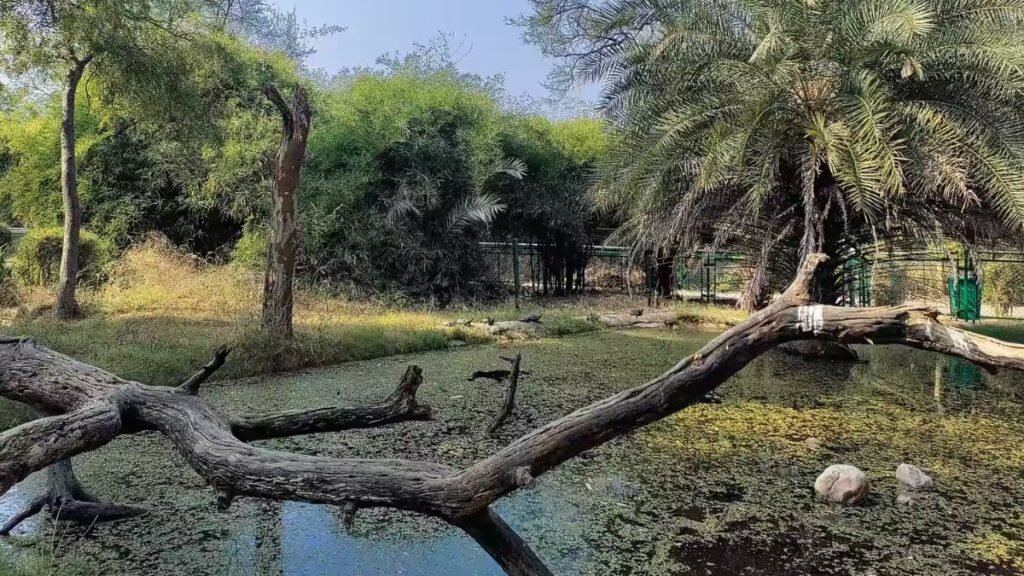
- Thol Lake Bird Sanctuary ~20 km | A Ramsar-designated wetland with 160+ bird species. Gujarat’s finest birdwatching destination in the Ahmedabad-Gandhinagar corridor. Read our full TravelRoach guide.
- Sabarmati Ashram (Gandhi Ashram) ~30 km (Ahmedabad) | Mahatma Gandhi’s historic ashram and the site of the spinning wheel. One of India’s most peaceful and meaningful heritage sites.
- Dandi Kutir Museum, Gandhinagar ~5 km | A state-of-the-art museum dedicated to Gandhi’s life and philosophy. One of the finest Gandhi museums in India. Allow 2 hours.
- Atal Bridge and Sabarmati Riverfront ~30 km (Ahmedabad) | The famous kite-shaped LED-illuminated pedestrian bridge over the Sabarmati. One of Ahmedabad’s most visited modern attractions. Read our full TravelRoach guide.
Practical Tips for Visiting Akshardham Gandhinagar
- Leave your phone and camera at the cloakroom – this is non-negotiable and strictly enforced. Do not waste time at security trying to negotiate. The cloakroom is free.
- Arrive early on weekends- — on Saturdays and Sundays between October and February, arrive by 9:30 AM when the complex opens. The cloakroom queue and entrance crowd build significantly after 10:30 AM.
- Dress modestly before leaving home – avoid the inconvenience of being turned away or having to borrow a covering at the gate. Covered shoulders and knees are the minimum requirement.
- Watch the Neelkanth Darshan film first if possible – the large-format presentation of Swaminarayan’s life provides excellent context for the main darshan. Understanding the person before standing before his murti deepens the experience significantly.
- Allow at least 3 to 4 hours – darshan, the Sahajanand Darshan exhibition, the film, the Sanskruti Vihar boat ride, the gardens, and the food court together require a full half-day. Many visitors spend 4 to 5 hours.
- The temple is closed on Mondays – verify before leaving.
- Carry cash for exhibition tickets – the nominal charges for the exhibitions are paid at counters inside the complex; digital payment may be available but cash is reliable.
- Combine with Adalaj ni Vav – the stepwell is 15 km from Akshardham and the combination of these two extraordinary heritage experiences makes for one of the finest half-day heritage circuits in Gujarat.
Frequently Asked Questions (FAQs)
Swaminarayan Akshardham in Gandhinagar is a large Hindu temple complex dedicated to Bhagwan Swaminarayan, inaugurated on October 30, 1992, and managed by the BAPS (Bochasanwasi Akshar Purushottam Swaminarayan Sanstha). The temple’s central monument is 108 feet tall, built entirely from 6,000 tonnes of pink sandstone from Rajasthan without a single piece of steel or iron, following ancient Sthaapatya Shastra architectural principles. The complex spans 23 acres in Sector 20, Gandhinagar, and includes the main mandir with a 7-foot gold-leafed murti of Swaminarayan, cultural exhibitions, gardens, a large-format film theatre, and a food court.
Yes – darshan of the main Akshardham mandir is completely free. There is no entry fee for visiting the temple, gardens, and general complex areas. However, the specific cultural exhibitions and experiences within the complex including Sahajanand Darshan (life of Swaminarayan exhibition), the Neelkanth Darshan large-format film, and the Sanskruti Vihar boat ride have nominal separate charges. Confirm current exhibition prices at the ticket counters inside the complex. Parking is also free.
No. Mobile phones, cameras, and all electronic devices are strictly prohibited inside the Akshardham complex. This rule is non-negotiable and is firmly enforced by security staff at the entrance gate. A free cloakroom is available at the entrance to deposit your phone and any large bags before entering. Plan an extra 20 to 30 minutes for cloakroom deposit and collection, especially on weekends when queues can be long.
Akshardham Gandhinagar is open Tuesday to Sunday from 9:30 AM to 7:30 PM. It is closed every Monday. Darshan of the main mandir is available throughout the operating hours. The cultural exhibitions and film presentations have their own show timings within the complex operating hours check the current schedule at akshardham.com/gujarat. During major festivals and special occasions, hours may be extended. Always confirm current timings before a long-distance visit.
Akshardham Gandhinagar (1992) preceded Akshardham Delhi (2005) and was in many ways the prototype from which the Delhi complex was designed. Both are BAPS Swaminarayan temples, both built from pink sandstone without steel, both following the Sthaapatya Shastra architectural tradition, and both dedicated to Bhagwan Swaminarayan. Akshardham Delhi is significantly larger it holds the Guinness World Record for the largest Hindu temple complex and has more elaborate water shows and exhibitions. Akshardham Gandhinagar is more intimate in scale and, many devotees feel, more peaceful in atmosphere. The Gandhinagar temple was the precursor and the Delhi complex was built by the same BAPS organisation under Pramukh Swami Maharaj’s leadership.
From Ahmedabad, Akshardham Gandhinagar is approximately 30 km about 45 to 60 minutes by road depending on traffic. Take the Ahmedabad-Gandhinagar Highway (SH-41) northward toward Sector 20, Gandhinagar. Free parking is available. By Ahmedabad Metro, take the metro to the nearest Gandhinagar station and complete the journey by auto-rickshaw. By train, take a service from Ahmedabad Junction to Gandhinagar Capital Station (~2 km from the temple). GSRTC buses run regularly between Ahmedabad and Gandhinagar.
The central monument of Akshardham Gandhinagar is specifically built to be 108 feet tall. The number 108 is one of the most sacred numbers in Hindu tradition. It appears throughout Hindu and yogic practice: there are 108 Upanishads (ancient philosophical texts), 108 beads in a traditional mala (prayer rosary), 108 names of major deities including Vishnu and Shiva, and 108 sacred pilgrimage sites in various traditions. The diameter of the sun is approximately 108 times the diameter of the earth. By building the temple to precisely this height, the architects embedded the sacred number into the very scale of the monument making the building itself a devotional act.
Final Thoughts
There are monuments in Gujarat that impress you with their age. Rani Ki Vav is 1,000 years old. The Modhera Sun Temple is 1,000 years old. Sarkhej Roza is 500 years old. These buildings carry the weight of centuries in their stones.
Akshardham Gandhinagar is only 33 years old. And yet it carries something that the ancient monuments sometimes cannot: the presence of a living tradition. When you stand before the gold-leafed murti of Bhagwan Swaminarayan in the pink sandstone sanctum of the 108-foot monument, you are not standing in a museum. You are standing in a place of continuous, active, daily devotion that connects hundreds of thousands of people across Gujarat and across the world to a set of values and a way of life that they have chosen.
The no-phones rule is not an inconvenience. It is an invitation. Come without your screen. Look at the carvings with your eyes. Stand in the garden in the morning light. Have darshan without documenting it. Let the monument be 108 feet tall and pink and completely present. That is the Akshardham experience and it works precisely because you cannot post it.
Have you visited Akshardham Gandhinagar? Share your darshan experience, your favourite carving, or the moment the garden made you stop in the comments TravelRoach would love to hear from every visitor.
