In 1955, Le Corbusier the Swiss-French architect who designed Chandigarh and is widely regarded as one of the most influential architects in history visited a complex of tombs, mosques, pavilions, and a large stone-stepped lake in a village seven kilometres southwest of Ahmedabad. He walked through its cloistered galleries, stood by its reflective water, and studied the play of light through its stone lattice screens. Then he made a comparison that has defined the place ever since: he said that the composition of Sarkhej Roza reminded him of the Acropolis of Athens.
The Acropolis of Ahmedabad. That is the name that has stuck. And it is not merely a European architect’s romantic projection it captures something genuinely true about what Sarkhej Roza is. Like the Acropolis, it is a complex of multiple structures arranged around a central open space with deep civic, spiritual, and royal significance. Like the Acropolis, it brings together multiple functions worship, commemoration, governance, and daily gathering in a single place. And like the Acropolis, it is the kind of place that makes you understand, at a glance, how a civilisation thought about itself.
This TravelRoach guide covers everything the extraordinary Sufi saint at the centre of Sarkhej’s story, the five-generation construction timeline, the unique Indo-Saracenic architecture and what to look for, the lake and its stone steps, Le Corbusier’s famous visit, entry fees and timings, how to reach, photography tips, and how to combine Sarkhej Roza with Ahmedabad’s finest heritage experiences.
Sarkhej Roza – Quick Information
| Detail | Information |
| Full Name | Sarkhej Roza (Sarkhej Mosque and Tomb Complex) |
| Location | Makarba village, ~7 km southwest of Ahmedabad, Gujarat – PIN 380051 |
| Route | Near Sarkhej-Gandhinagar Highway, Post Jeevraj Park, Makarba, Sarkhej |
| Famous As | The Acropolis of Ahmedabad – Le Corbusier’s description, 1955 |
| What it Contains | Mosque, mausoleums (tombs), palace, pavilions, and Ahmed Sar Lake (17 acres) |
| Dedicated To | Shaikh Ahmed Khattu Ganj Baksh — Sufi saint, spiritual mentor of Ahmedabad’s founder |
| Construction Period | 1445 CE to 1584 CE built across five generations of Gujarat Sultanate rulers |
| Architects | Azam Khan and Muazzam Khan – two Persian brothers (buried near Vasna, Ahmedabad) |
| Architectural Style | Indo-Saracenic – fusion of Islamic, Hindu, and Jain architectural traditions |
| Original Area | 29 hectares (72 acres) now 14 hectares (34 acres) due to encroachment |
| Ahmed Sar Lake | 6.9 hectares (17 acres) surrounded by stone steps; dug by Sultan Mahmud Begada |
| Dargah Height | 105 feet – the largest mausoleum in Gujarat |
| Status | Monument of National Importance Archaeological Survey of India |
| Entry Fee — Indian | Nominal ASI fee (~₹25); confirm at the gate |
| Entry Fee — Foreign | ~₹300; confirm at the gate |
| Timings | 9:00 AM to dusk (approximately 6:00 PM) open daily |
| Best Photography Time | Early morning light through jalis creates mosaic floor patterns |
| Distance from Ahmedabad Centre | ~7–10 km (~20–25 minutes by road) |
About Sarkhej Roza – Three Institutions in One Place
Sarkhej Roza is unlike any other monument in Gujarat because it is not one thing it is three, layered on top of each other and fused into a whole. It is a dargah a Sufi shrine where a beloved saint is buried and venerated. It is a royal complex where the sultans of Gujarat built their most personal tombs, palaces, and pleasure gardens. And it is a civic gathering place where the stone-stepped lake, pavilions, and open platforms were used by common people for daily life, festival, and celebration.
In the historian’s framing: the mosque and dargah represent the spiritual realm, the royal tombs and palace represent the political realm, and the lake and pavilions represent the social realm. These three dimensions spiritual, royal, social coexist in a single 14-hectare complex in a way that was entirely deliberate. Sarkhej Roza was the heartbeat of early Ahmedabad’s cultural life for over a century. Le Corbusier understood this. His Acropolis comparison was not about buildings it was about the idea that a civilisation expresses itself most completely when it puts its gods, its kings, and its ordinary people in the same place.
Shaikh Ahmed Khattu Ganj Baksh – The Saint Who Made Ahmedabad
The Extraordinary Life of Ganj Baksh
To understand Sarkhej Roza, you must first understand the man at its centre: Shaikh Ahmed Khattu Ganj Baksh. He is one of the most fascinating figures in Gujarat’s history a Sufi mystic born in Delhi in 1336, separated from his family as a child in a dust storm, raised by a Maghribi Sufi teacher, educated in Islamic mysticism and theology, and eventually sent to settle in Gujarat at the request of Zafar Khan, the governor who would become the first sultan of the Gujarat Sultanate.
Ganj Baksh’s life contains one of the extraordinary anecdotes of medieval Indian history: when the Central Asian conqueror Timur (Tamerlane) attacked Delhi in 1398, Ganj Baksh was captured. According to the Badauni chronicle, Ganj Baksh managed to convince Timur to spare the city of Delhi from total destruction a negotiation conducted by a Sufi mystic with one of the most feared military commanders of the medieval world. Whether or not the full story is historically precise, it speaks to the extraordinary spiritual authority that Ganj Baksh had accumulated by that point.
After Delhi, Ganj Baksh settled in Gujarat first at Anhilwara Patan, the old capital. He became the closest friend, confidant, and spiritual mentor of Sultan Ahmed Shah I the ruler who would found Ahmedabad. According to Sufi tradition, it was Ganj Baksh who persuaded Ahmed Shah to establish his new capital on the banks of the Sabarmati at the site that became Ahmedabad. The city of Ahmedabad, in a very real sense, exists because of a Sufi saint’s advice.
In his later years, Ganj Baksh retired to Sarkhej approximately 7 km from the city he had helped create seeking the peace and solitude that a lifetime of royal courts and spiritual leadership had not fully provided. He died there in 1445. The sultan he had guided built him a tomb.
Also Read: Adalaj ni Vav, Gandhinagar
The Dargah – Largest Mausoleum in Gujarat
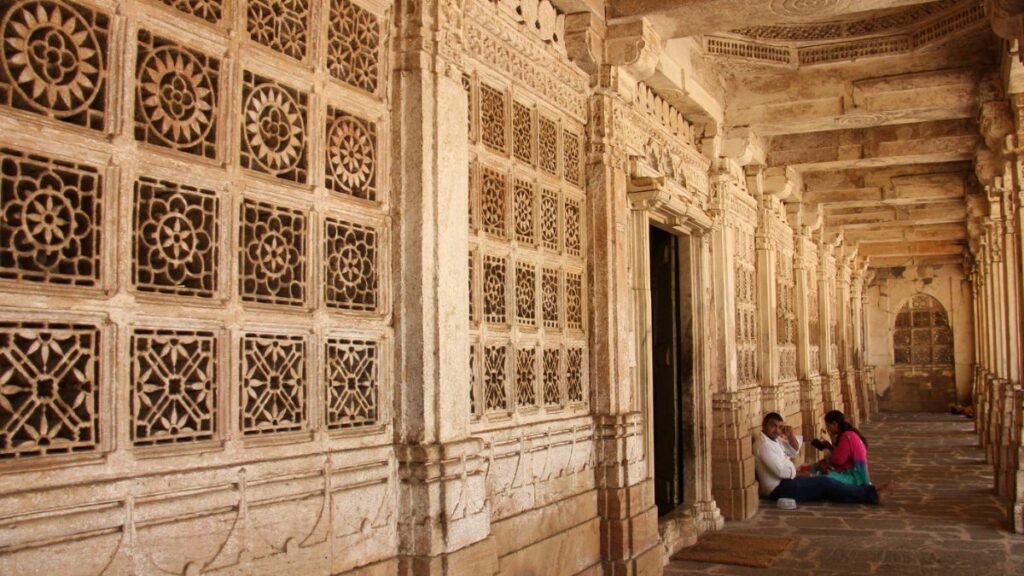
The dargah (mausoleum) of Shaikh Ahmed Khattu Ganj Baksh is the largest mausoleum in Gujarat standing 105 feet tall. Entering the Sarkhej Roza complex from the eastern gateway on the northern bank of the lake, the dargah is the building to the right with a stone pavilion in front of it. Its entire outer length is filled with stone trellis (jali) work of extraordinary delicacy carved stone screens that filter light into the interior and create constantly shifting mosaic patterns on the floor throughout the day.
Inside, around the tomb itself, is a beautifully cut open metal screen an enclosure of decorated metalwork that frames the saint’s resting place. The tomb of Sheikh Salahuddin Ganj Baksh’s spiritual heir and closest disciple is also within the dargah. Together, the two tombs make this the spiritual heart of the entire complex.
One of the most moving aspects of the dargah is that it is visited equally by both Hindu and Muslim communities from the surrounding areas. This was true when the complex was built and remains true today. Ganj Baksh’s spiritual reputation transcended religious community boundaries he was revered by all who came to Sarkhej, and that tradition of inter-faith devotion has continued for nearly six centuries.
The History of Sarkhej Roza – Built Across Five Generations
Phase 1 – The Original Dargah (1445–1451)
When Ganj Baksh died in 1445, Sultan Muhammad Shah II began constructing a mosque and mausoleum in his honour at Sarkhej. The completion of these structures was carried out by Muhammad Shah’s successor, Sultan Qutb-ud-Din Ahmed Shah II, in 1451. This original phase created the core spiritual components of the complex – the dargah of the saint and the mosque in the Indo-Saracenic architectural vocabulary that would define the whole site.
Phase 2 – The Grand Expansion (Second Half of the 15th Century)
Sultan Mahmud Begada one of the most significant rulers of the Gujarat Sultanate and the same king who built the extraordinary Champaner-Pavagadh complex transformed Sarkhej from a tomb-mosque into a complete royal retreat. He excavated the Ahmed Sar Lake, surrounding it with cut stone steps and a richly decorated supply sluice. He built a palace and harem on the south-west corner of the lake. He added pavilions, platforms, and a small private mosque. And directly opposite the dargah of Ganj Baksh, he built his own mausoleum a statement of personal connection to the saint that placed the sultan’s eternal resting place in view of his spiritual guide’s for all of history.
Under Mahmud Begada’s patronage, Sarkhej became what it would remain for decades: a place of repose and meditation, a summer retreat for the royal family, and the cultural heart of Ahmedabad. The jharokhas (projecting balconied windows) of the pavilions looked out over the lake. The stone steps of the ghat descended to the water. The gardens filled the air with fragrance. The cloisters provided shade. Sarkhej was, at its height, one of the most sophisticated pleasure complexes in 15th-century India.
Phase 3 – The Mughal Addition (1584)
The final phase of construction came not from the Gujarat Sultans but from their conquerors. In 1584, when Akbar’s Mughal forces defeated the last Gujarat Sultan, Muzaffar III, the event was commemorated by the addition of a country house and garden to the Sarkhej complex. This addition made by the victorious Mughal administration added a further layer of architectural and historical complexity to the site, completing the sequence of rulers who each left their mark on the same sacred ground.
The Architecture of Sarkhej Roza – What to See and Why
The Indo-Saracenic Style Three Traditions, One Language
The architecture of Sarkhej Roza is the finest example of the early Indo-Saracenic architectural style in Gujarat and one of the finest in India. The term Indo-Saracenic describes the fusion of two broad traditions: Islamic (Saracenic) principles of geometry, symmetry, and scale brought to Gujarat through Persian architectural influence and indigenous Indian construction techniques and decorative vocabulary drawn from Hindu and Jain temple-building traditions.
At Sarkhej, this fusion is visible in specific, identifiable ways. The overall spatial planning of the complex its symmetrical arrangement around a central axis, its use of enclosed courts and water follows Islamic architectural principles. But the construction method is almost entirely Indian: the trabeated (post and beam) system rather than arch-based construction, flat roofs rather than barrel vaults, and the proliferation of carved brackets and jharokhas that are the hallmarks of the Solanki and Maru-Gurjara temple traditions. The ornamental vocabulary is entirely geometric and floral in compliance with Islamic prohibition on representational imagery but the carving quality and technique is that of Hindu and Jain craftsmen trained in Gujarat’s long stone-carving tradition.
The result is a building language that is genuinely new not a compromise between two traditions but an original synthesis. The credit for developing this language belongs to the two Persian brothers Azam Khan and Muazzam Khan, who brought the spatial conceptual framework and fused it with local craft knowledge.
The Jalis – Light Made Tangible
The most immediately striking feature of Sarkhej Roza’s architecture is the extraordinary carved stone jali pierced stone trellis screens that cover entire wall sections, fill arched openings, and function simultaneously as structural members, light filters, and decorative surfaces. The jalis at Sarkhej are among the finest examples of this form anywhere in India.
The physical effect of the jalis is the magic of the complex. When morning or afternoon light passes through the carved geometric and floral patterns, it projects a constantly shifting mosaic of shadow and light onto the interior floors and opposite walls. The effect changes with every movement of the sun. At certain times of day particularly in the early morning the entire interior of a chamber becomes covered in the patterned light-shadow projection of the jali above it. This is not accidental. The architects of Sarkhej Roza understood light as a design material and worked with it as consciously as they worked with stone.
Beyond the aesthetic function, the jalis also serve a climatic purpose they provide ventilation while maintaining shade, creating a natural cooling effect in the interior spaces. In Gujarat’s climate, this was not decorative luxury but functional necessity. The jali is the building’s lung.
Also Read: Kankaria Lake Ahmedabad
Jharokhas – Windows That Tell a Story
Throughout the pavilions and palace sections of the complex, jharokhas projecting balconied windows with corbelled stone supports and carved surrounds provide views of the lake and the surrounding structures. At Sarkhej, the jharokhas serve multiple functions: they frame specific views of the water and the dargah for the occupants of the pavilions; they provide shade and ventilation through their overhanging forms; and they contribute to the sense of grandeur and visual richness that makes the complex feel inhabited and alive even in partial ruin.
The stone latticework on the jharokha screens is particularly fine the interlocking joinery in several sections was achieved without mortar, relying entirely on the precision of fit. This is craftsmanship at the highest level of the Gujarati stone-carving tradition.
The Ahmed Sar Lake – Heart of the Civic Space
Sultan Mahmud Begada’s excavation of the Ahmed Sar Lake was the act that transformed Sarkhej from a spiritual site into a complete living complex. The lake 6.9 hectares (17 acres) of water is surrounded on all sides by flights of cut stone steps descending to the water’s edge, in the tradition of the great Gujarat stepwells (vavs) but at a far larger civic scale. A richly decorated supply sluice controls the water level. The stone steps were the democratic element of Sarkhej used by everyone from the royal family in the pavilions above to the common people and pilgrims who gathered at the water’s edge for washing, prayer, and daily life.
Today, the lake is less full than in its historical height but still present its stone steps intact, its reflective surface catching the light of the buildings around it. Standing at the top of the stone steps and looking across the water to the pavilions and palace on the far side, with the dargah dome reflected in the water, you see the composition that stopped Le Corbusier in 1955 and made him reach for the word Acropolis.
The Mosque – Simple Grace Unrivalled
The mosque at Sarkhej Roza sometimes called the Jama Masjid of Sarkhej spreads over approximately 4,300 square yards and is described in historical accounts with an extraordinarily high assessment: ‘It is the perfection of simple grace, unrivalled in India except by the Moti Mosque at Agra.’ This is high praise the Moti Mosque at the Agra Fort is one of the most celebrated Mughal buildings in existence.
What is unusual about the Sarkhej mosque is what it lacks: no minarets, no arched gateways, no dome visible from outside. The exterior effect is plain almost austere. But inside, the mosque is surrounded on three sides by a riwaq (cloistered gallery) and opens on the fourth toward the mihrab (prayer niche indicating the direction of Mecca). The emphasis, as in all great mosque interiors, is on the spiritual direction the qibla wall with its mihrab and everything else is arranged to support and amplify that singular focus. The mosque also features an integrated rainwater harvesting system an early example of sustainable water management in religious architecture.
Le Corbusier and the Acropolis Comparison
In 1955, Le Corbusier was in Ahmedabad working on several architectural commissions including the Millowners’ Association Building and the Shodhan Villa, which are among the finest examples of his late modernist work. Ahmedabad was at that time engaged in a remarkable patronage relationship with the most significant architects of the 20th century including Le Corbusier and Louis Kahn and the visit to Sarkhej Roza appears to have been part of that engagement with the city’s architectural heritage.
Le Corbusier’s comparison of Sarkhej Roza with the Acropolis of Athens was made in this specific intellectual context not as a tourist’s casual remark but as a practising architect’s considered observation. What he saw was the same quality of spatial organisation that makes the Acropolis architecturally extraordinary: multiple structures of different scales and functions arranged in relationship to each other and to their landscape, creating a whole that is greater than the sum of its parts. The spiritual, the royal, and the civic each with its own building form, yet integrated into a unified spatial experience.
The label ‘Acropolis of Ahmedabad’ is now permanent it appears in heritage documentation, in travel guides, and in academic papers on Indian architectural history. It serves as a reminder that the quality Le Corbusier recognised in Sarkhej in 1955 was not accidental or modest. It was the deliberate achievement of architects and patrons who understood what architecture was for.
What to See at Sarkhej Roza – A Walking Guide
The Eastern Gateway
Enter the complex through the covered eastern gateway on the northern bank of the Ahmed Sar Lake. This gateway is the formal arrival threshold the transition from the ordinary world outside to the sacred and royal space of the Roza within. Take a moment here before proceeding. The complex opens before you.
The Dargah of Ganj Baksh (Right of Gateway)
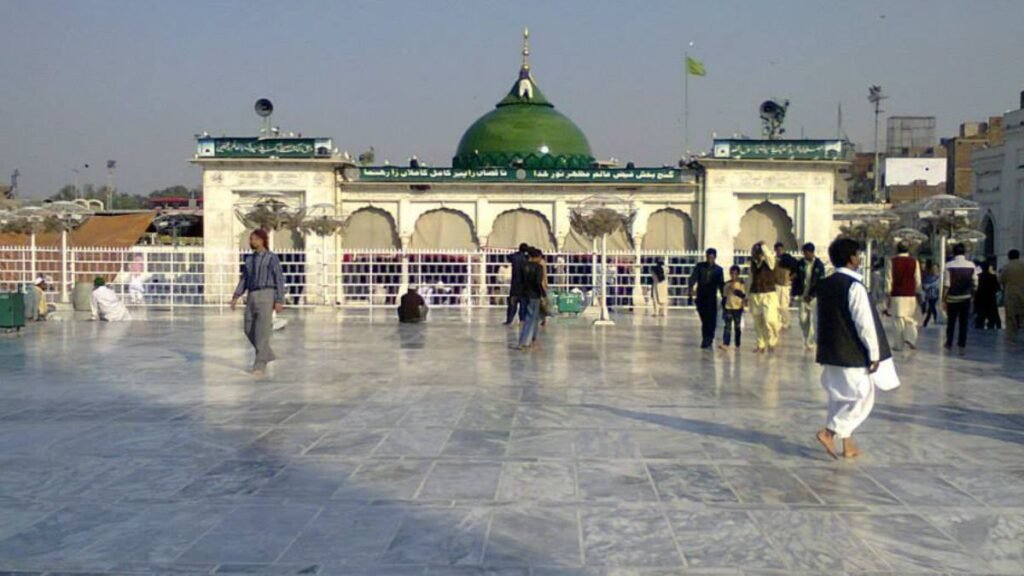
The first significant structure to your right is the dargah of Shaikh Ahmed Khattu Ganj Baksh the 105-foot mausoleum that is the reason this entire complex exists. The stone pavilion in front of the dargah is a transition space covered, shaded, and beautifully proportioned. Study the jali work on the dargah’s exterior walls. Go inside to the inner chamber and the metal screen around the tomb. Observe the mosaic patterns on the floor created by light through the carved screens. This is where the complexity begins to reveal itself.
The Royal Tombs (Left of Gateway)
Across the courtyard to the left of the entrance are two connected mausoleums with a porch between them. The east mausoleum contains the tombs of Sultan Mahmud Begada and his son, Muzaffar Shah II. The west mausoleum contains the tomb of Rajabai Muzaffar’s queen. The outer walls of these tombs are adorned with intricately carved jalis, and in the right light, the jali patterns create a spectacular mosaic on the interior floor. The patio between the tombs a small open-air courtyard opens directly to the central tank through a stairway. This patio is used today for small cultural gatherings and music performances.
The Mosque
Beyond the dargah, across a large courtyard surrounded by cloisters, is the mosque. Walk the entire cloistered gallery before entering the main prayer hall. The cloister columns are carved with the same interlocking precision as the rest of the complex. Inside the prayer hall, locate the mihrab the niche in the qibla wall and note how the entire building focuses your attention toward it. The integration of the rainwater harvesting system is visible in the architectural floor plan of the mosque complex.
The Lake and Stone Steps
From the mosque side, descend to the stone steps of the Ahmed Sar Lake. The stone ghats flights of steps surrounding the entire perimeter of the 17-acre lake are one of the great civic engineering achievements of 15th-century India. Walk along the lakeside and look back toward the dargah and pavilions reflected in the water. This is the view that Le Corbusier described. Find the perspective from which the composition clicks into place the dargah to one side, the royal pavilions and palace ruins to the other, the water between.
The Palace and Queen’s Pavilion
The ruined palace and harem on the south-west corner of the lake are the most atmospheric section of the complex for those interested in the passage of time and the texture of ruined grandeur. The Queen’s Pavilion here offers the finest jharokha details in the entire complex the projecting windows with their carved screens giving filtered views of the lake and the dargah beyond. The interplay of jharokha, colonnade, and jali tracery at this corner of the complex is the architectural experience that the specialists come specifically for.
Best Time to Visit Sarkhej Roza
October to February – Best Season
The winter months offer the most comfortable visiting conditions. Ahmedabad’s mornings are cool and clear, the light is directional and golden, and extended exploration of the outdoor spaces the lakeside steps, the courtyards, the cloistered galleries is entirely pleasant. The best winter visits are early morning (9 to 11 AM) when the light enters the jali-covered interiors at an angle that creates the full mosaic floor pattern effect.
Early Morning – The Non-Negotiable Rule for Photography
Sarkhej Roza’s most celebrated photographic experience depends entirely on directional light and specifically on morning light entering the pierced stone jali screens and projecting their geometric patterns onto interior floors and opposite walls. This effect is only available in the two to three hours after sunrise. For photographers, arriving at 9 AM when the gates open and working through the dargah and tombs in the first morning hours is the essential Sarkhej approach.
Festivals – Urs and Ramadan
The dargah of Ganj Baksh is a living place of devotion and the most spiritually charged time to visit is during the Urs (death anniversary celebration) of the saint, or during Ramadan when both the dargah and the mosque are most actively visited. The Urs at Sarkhej is an atmospheric gathering of devotees, music (qawwali), and collective prayer that transforms the complex from a heritage site into a living religious celebration.
Avoid Peak Afternoon (April to October)
Ahmedabad’s afternoon heat is significant from April through October. Sarkhej Roza’s outdoor spaces the lake steps, the courtyards, the palace ruins are fully exposed to the sun. Visiting in these conditions is uncomfortable and the light is flat and harsh for photography. If visiting in the hot season, restrict your visit to the first two hours after opening (9 to 11 AM).
How to Reach Sarkhej Roza, Ahmedabad
| From | Distance | Mode | Approx. Time |
| Ahmedabad city centre (CG Road / Law Garden) | ~7–10 km | Auto / Cab (Uber/Ola) | 20–25 minutes |
| Manek Chowk (Old City) | ~9 km | Auto / Cab | 20–30 minutes |
| Ahmedabad Junction Railway Station | ~8 km | Auto / Cab | 20–25 minutes |
| SVP International Airport | ~12–15 km | Taxi / Cab | 25–30 minutes |
| Kankaria Lake | ~9 km | Auto / Cab | 20 minutes |
| Adalaj ni Vav | ~20 km | Car / Cab | 35–40 minutes |
| Atal Bridge (Sabarmati Riverfront) | ~9 km | Auto / Cab | 20–25 minutes |
| Gandhinagar | ~30 km | Car / Bus | 45–50 minutes |
By Auto-Rickshaw or Cab (Recommended)
The most convenient way to reach Sarkhej Roza from anywhere in Ahmedabad is by auto-rickshaw or ride-share app (Uber or Ola). Ask for ‘Sarkhej Roza’ or ‘Sarkhej Mosque’ every Ahmedabad driver knows it. The complex is accessible via the Sarkhej-Gandhinagar Highway. The address for maps navigation is: Sarkhej Roza, Makarba, Sarkhej, Ahmedabad – 380051.
By AMTS / BRTS Bus
Ahmedabad city buses run to the Sarkhej area via the Sarkhej-Gandhinagar Highway. From the bus stop, the complex is a short walk or auto-rickshaw ride. This is an affordable public transport option for solo visitors familiar with the city bus system.
Travel Tips for Sarkhej Roza
- Arrive at opening time (9 AM) for the best photography the morning light through the jalis creates the mosaic floor patterns that make Sarkhej one of the finest architectural photography destinations in Ahmedabad.
- Walk slowly – Sarkhej Roza rewards unhurried exploration. Each section reveals something that a quick pass-through misses: a jali pattern, a carved bracket detail, a view framed by a jharokha, a floor mosaic in the light.
- Read the bilingual panels – the complex has information panels displayed on the walls (both in English and Gujarati/Hindi) that explain the history, architectural details, and significance of each section. Use them.
- Respectful dress and behaviour at the dargah – the dargah of Ganj Baksh is a living place of Muslim worship and devotion. Remove footwear before entering. Men and women should cover their heads when inside the sanctum. Speak softly and respect the devotees.
- The patio between the royal tombs – the small open courtyard between Mahmud Begada’s tomb and Rajabai’s tomb is a beautiful, quiet space that most visitors pass through quickly. Sit here for a few minutes. The proportions and the filtered light from the surrounding jalis are extraordinary.
- Photography is generally permitted – but do not photograph worshippers at the dargah without permission. No flash inside the dargah.
- Combine with Manek Chowk for an Ahmedabad heritage day – the old city is ~9 km away and offers Sidi Saiyyed Mosque, Bhadra Fort, Teen Darwaza, and the Manek Chowk Night Market as additional heritage experiences.
- The library at Sarkhej Roza – the complex has a small but growing library for readers interested in the history of Sarkhej. If you are seriously interested in the heritage, ask the site management about accessing it.
Also Read: Manek Chowk Night Market, Ahmedabad
Nearby Attractions to Combine with Sarkhej Roza
- Manek Chowk Night Market ~9 km | Ahmedabad’s iconic late-night street food market — double butter pav bhaji, Asharfi Kulfiwala, chocolate sandwiches. A perfect evening after an architectural morning at Sarkhej. Read our full guide on TravelRoach.
- Sidi Saiyyed Mosque (Jali Mosque) ~10 km | Famous for its Tree of Life stone lattice window — one of India’s most celebrated architectural details. An essential companion to Sarkhej Roza for those interested in Gujarat’s Islamic stone-carving traditions.
- Atal Bridge and Sabarmati Riverfront ~9 km | Ahmedabad’s modern kite-shaped pedestrian bridge with a glass floor and LED lighting. From Sarkhej’s 15th century jalis to Atal Bridge’s 21st century steel — a complete Ahmedabad architectural journey. Read our full guide on TravelRoach.
- Kankaria Lake ~9 km | Ahmedabad’s most popular family entertainment destination zoo, toy train, tethered balloon ride, and the annual Kankaria Carnival. Read our full guide on TravelRoach.
- Adalaj ni Vav ~20 km | Gujarat’s most beautiful stepwell a five-storey subterranean structure with extraordinary Indo-Islamic stone carvings. The jali and step traditions of Sarkhej are closely related to those of Adalaj. Both on the same day make an exceptional architectural comparison.
- Sabarmati Ashram ~10 km | Mahatma Gandhi’s historic riverside ashram. A profound and peaceful complement to the royal and spiritual heritage of Sarkhej.
Frequently Asked Questions (FAQs)
Sarkhej Roza is a 15th-century Sufi mosque and tomb complex located 7 km southwest of Ahmedabad in Makarba village. It contains the dargah (mausoleum) of Shaikh Ahmed Khattu Ganj Baksh the Sufi saint who was the spiritual mentor of Sultan Ahmed Shah, the founder of Ahmedabad along with royal tombs, a mosque, pavilions, and a 17-acre lake. It is called the Acropolis of Ahmedabad because the globally renowned architect Le Corbusier, visiting in 1955, compared the spatial composition of the complex multiple structures of different functions arranged harmoniously around a central water body to the Acropolis of Athens in Greece.
Shaikh Ahmed Khattu Ganj Baksh was a Sufi mystic born in Delhi in 1336. He became the spiritual mentor and closest advisor of Sultan Ahmed Shah I the founder of Ahmedabad and according to tradition, it was his advice that led Ahmed Shah to establish his capital on the Sabarmati River at the site that became Ahmedabad. Ganj Baksh retired to Sarkhej in his later years and died there in 1445. His mausoleum at Sarkhej Roza the largest in Gujarat at 105 feet became the spiritual centre around which the entire complex was built by successive Gujarat Sultans.
Sarkhej Roza is the finest example of early Indo-Saracenic architecture in Gujarat a unique fusion of Islamic, Hindu, and Jain architectural traditions. The overall spatial planning follows Islamic principles of geometry and symmetry; the construction method uses the Indian trabeated (post and beam) system with flat roofs; the carving quality reflects Hindu and Jain craftsmen’s mastery of stone; and the decorative vocabulary uses geometric and floral patterns (in accordance with Islamic prohibition on representational imagery). The notable features include extraordinary carved stone jalis (pierced screens) that create mosaic light-shadow patterns, jharokhas (projecting balconied windows), and the 17-acre lake surrounded by cut stone steps. The complex has no minarets unlike typical Islamic architecture.
Sarkhej Roza charges a nominal ASI (Archaeological Survey of India) entry fee — approximately ₹25 for Indian visitors and ₹300 for foreign nationals. Confirm the current fee at the site gate as it may be revised. The complex is open from 9:00 AM to dusk (approximately 6:00 PM) daily. Photography is generally permitted. Drone photography requires prior permission from ASI authorities.
Sarkhej Roza is approximately 7 to 10 km from Ahmedabad’s city centre — about 20 to 25 minutes by auto-rickshaw or cab. Take an Uber, Ola, or local auto-rickshaw and ask for ‘Sarkhej Roza’ or use the map address: Sarkhej Roza, Makarba, Sarkhej, Ahmedabad – 380051. AMTS city buses also run to the Sarkhej area via the Sarkhej-Gandhinagar Highway. The complex is best reached on a clear morning when the light on the jali carvings is at its most spectacular.
The best photography at Sarkhej Roza is in the early morning specifically in the first two to three hours after opening (9 to 11 AM in winter). This is when directional light enters the carved stone jali screens and projects their geometric and floral patterns onto interior floors and opposite walls as a constantly shifting mosaic. This light effect unique to Sarkhej in its scale and complexity is only available in morning light. It is the defining architectural photography experience of the complex. Bring a camera capable of working in mixed natural light.
Yes, absolutely. Sarkhej Roza is an ASI-protected Monument of National Importance and is open to visitors of all faiths and backgrounds. While the dargah (tomb) of Ganj Baksh is an active place of Muslim devotion, the complex has been visited by people of all religions including Hindus who revere the saint since its founding. Non-Muslim visitors should observe respectful dress and behaviour at the dargah specifically: remove footwear before entering, cover the head inside the sanctum, speak softly, and do not photograph active worshippers. The rest of the complex the tombs, mosque, palace, pavilions, and lake are open to all visitors without restriction.
Final Thoughts
Most visitors to Ahmedabad know the old city Manek Chowk’s midnight food, Sidi Saiyyed’s Tree of Life, the Atal Bridge’s LED nights on the Sabarmati. Sarkhej Roza sits seven kilometres outside all of that, in a village that most Ahmedabad taxi drivers know and most tourist itineraries miss. It should not be missed.
This is the place that made Ahmedabad possible the saint who told a sultan to build a city here is buried in it. This is where the finest Indo-Saracenic stone carving in early Gujarat was accomplished. This is where the light comes through a 600-year-old jali at 9 AM on a winter morning and writes geometries on the floor that no one planned and no one could have improved on.
Le Corbusier called it the Acropolis of Ahmedabad in 1955. He was right then and he is right now. Come early. Walk slowly. Let the light do what it has been doing for six centuries.
