In the 1830s and 1840s, drought hit Nawanagar hard. The ruler, Jam Ranmal II, responded the way good rulers of the period often did: he commissioned a large public work so that people who had lost their harvests could earn a living.
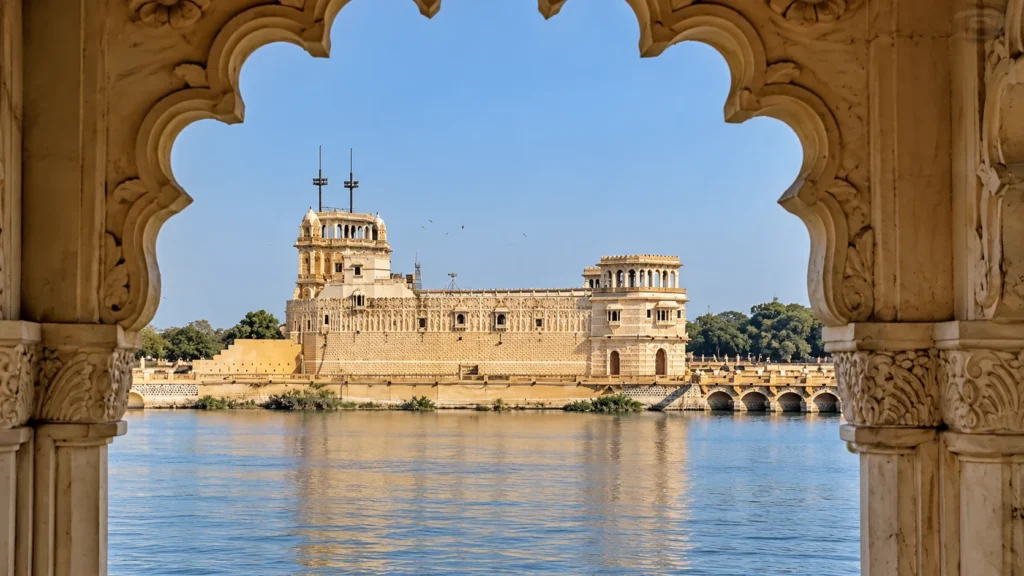
The result sits in the middle of Jamnagar today. Ranmal Lake also called Lakhota Lake is a man-made reservoir built to hold water through dry years, and at its centre, on an island reached by a stone causeway, stands Lakhota Palace: a round, bastioned fort with the lake as its moat.
Nearly two centuries later, it’s the city’s evening living room. Joggers on the promenade, families at the food stalls, migratory birds on the water, a fountain show after dark.
This guide covers the lake, the Lakhota Museum inside the fort, timings and fees (which conflict badly across sources), birdwatching, and how to build a Jamnagar evening around it.
Quick Facts at a Glance
| Detail | Information |
| Also known as | Lakhota Lake, Lakhota Talav |
| Location | Centre of Jamnagar, Gujarat |
| Built by | Jam Ranmal II, ruler of Nawanagar |
| Built as | Water reservoir and famine relief work |
| Lakhota Palace / Fort | Island fort, locally Lakhota Kotha, built c. 1839–45 |
| Name origin | Believed to derive from one lakh koris spent on construction |
| Museum | Converted to a museum in 1946; run by Gujarat State Archaeology & Museums |
| Earthquake | Damaged in 2001; restored and reopened in 2018 |
| Collection | Artefacts from the 9th to 18th centuries |
| Birds | Around 75 species recorded, with winter migrants |
| Lake timings | Reported around 5:00 AM – 10:00 PM |
| Museum timings | Sources conflict see below |
| Distance from Jamnagar railway station | Approx. 4 km |
| Distance from Jamnagar Airport | Approx. 10 km |
| Best time to visit | November to February |
The Story: A Famine, a Fort and a Lakh of Koris
This is a better origin story than most royal monuments get.
Nawanagar the princely state whose capital is today’s Jamnagar suffered prolonged drought across the 1830s and 1840s. Accounts place the hard years at roughly 1834 to 1846.
Jam Ranmal II ordered the construction of a lake and a fort as a famine relief work paid labour for people whose livelihoods had collapsed. The lake would store water for future dry years. The fort, built between roughly 1839 and 1845, included a circular tower for storing rations.
The name, “Lakhota,” is believed to come from the one lakh koris the currency of Nawanagar that the construction cost.
What this means for a visitor: you’re not looking at a pleasure palace. You’re looking at a drought-response project that happened to be beautiful and that still does its original job of holding water in the middle of a dry city.
Lakhota Palace: The Island Fort
Lakhota Palace stands on an island in the middle of the lake, reached by a stone causeway from the north shore.
The design is defensive Look for:
- Semi-circular bastions and a round central form
- Turrets
- Musket loops in the walls
- Cannons
The fort was built so that the lake itself worked as a natural moat It stored the royal arsenal, and its position made it very difficult to approach which is exactly why it was chosen.
The guard room is the first thing you meet inside, stocked with weapons and relics from the fort’s working life, before you reach the archaeological displays.
Watch your step The causeway and surrounding areas can be wet, and the museum’s internal steps are steep.
The Lakhota Museum: What’s Inside
The fort was converted into an archaeological museum in 1946, and it’s now managed by the Gujarat State Archaeology and Museum Department.
The collection spans the 9th to 18th centuries, and includes:
- Weaponry appropriate for a former arsenal
- Manuscripts
- Pottery and ceramics from across the period
- Sculptures
- Murals depicting the battles of the Jadeja Rajputs, the ruling dynasty
- Whalebone and a whale skeleton the exhibit most children remember
- Paintings and frescoes on the interior walls
The 2001 earthquake damaged the fort badly It was restored and reopened in 2018 so if you’ve read older descriptions calling it closed or crumbling, they’re out of date.
A second museum: Gujarat Tourism also describes a brand-new history museum on the east side of the lake, separate from the fort. They’re different buildings. If you’re told “the museum” is closed, check which one.
The collection is small Budget 45 minutes to an hour. It’s a good museum, not a large one.
Timings and Fees: Verify Before You Go
This is where published information falls apart. Here’s what different sources say.
Lake and promenade:
- 5:00 AM – 10:00 PM, entry reported at ₹10 per person
- Another listing gives 6:00 AM – 10:00 PM, open all week
Musical fountain show:
- Reported at 8:30 – 9:00 PM, around ₹25 per person
Lakhota Museum this is where it gets messy:
| Source says | Timings | Closed | Fee (Indian / foreign) |
| Listing A | 10:30 AM – 2:00 PM and 2:30 – 5:30 PM | Wednesday | — |
| Listing B | 10:30 AM – 2:00 PM and 2:30 – 5:30 PM | Open all week | ₹2 / ₹50 |
| Listing C | 1:00 PM – 9:00 PM (an hour earlier in winter) | — | ₹25 / ₹100 |
These can’t all be right The weekly closure is the one that matters most turning up on the wrong day wastes the trip.
What to do:
- Confirm museum timings and closure day locally before you go
- Visit between roughly 10:30 AM and 2:00 PM the window that overlaps across most listings
- Carry cash in small denominations for separate lake, museum and fountain tickets
- Remember the lake and the museum run on different schedules the promenade is open far longer
What to Do at Ranmal Lake
1. Walk the Promenade
Why: The tree-lined promenades have been substantially upgraded, with a fence and several gateways, paved paths, benches and a proper running track. Morning and evening, it’s where Jamnagar exercises.
Best for: Everyone
Tip: Walk the full loop at least once the fort looks different from every side.
2. Birdwatching
Why: Around 75 bird species have been recorded here, and winter brings migratory birds onto the water. For an urban lake in the middle of a city, that’s a genuinely good count.
Best for: Birdwatchers, photographers
Carry: Binoculars
Best time: Early morning, November to February
3. Boating
Why: Boat rides on the lake give you a close look at the fort from the water the angle that best shows how it was meant to be defended.
Best for: Families, couples
4. The Musical Fountain Show
Why: An evening fountain show, reported at around 8:30–9:00 PM, with the lake and fort lit up at night.
Best for: Families with children
5. The Food Stalls
Why: Stalls around the lake do kulfi, chaat, tea and Jamnagar street snacks. This is where the city actually spends its evenings.
Best for: Everyone
How to Reach Ranmal Lake
Ranmal Lake is in the centre of Jamnagar, so reaching it is straightforward.
Within the City
Any auto driver knows Lakhota Talav It’s central, and many other old-city sights are within walking distance.
By Train
Jamnagar Railway Station is roughly 4 km away, a short auto ride.
By Air
Jamnagar Airport is roughly 10 km away. It’s also the airport many pilgrims use for Dwarka, about 145 km further west.
By Road
- From Rajkot: approx. 90 km, about 2 hours
- From Dwarka: approx. 130–145 km
- From Porbandar: approx. 140–150 km
- From Ahmedabad: approx. 300–320 km
Best Time to Visit
November to February is the season, and it’s the peak window for migratory birds too.
- November–February (Winter) – Best overall. Cool evenings, migrants on the water, comfortable for walking the promenade.
- July–September (Monsoon) – The lake fills and the city greens up. Humid.
- March–June (Summer) – Hot during the day. The lake is at its best at dawn and after sunset.
Best time of day:
- Early morning – birds, joggers, soft light on the fort
- Late morning – the museum, in the window most sources agree on
- Evening – the promenade, the food stalls and the fountain show
One lake, three visits Most locals would tell you it’s a different place at each of those times.
Where to Eat
You’re in the right place. The lake itself is one of Jamnagar’s best informal eating spots.
Around the lake Kulfi, chaat, tea and snacks from the stalls. Cheap, cheerful and genuinely good in the evening.
Jamnagar specialities to look for:
- Kachori – Jamnagar has a real reputation for it
- Ghughra – the local fried pastry snack
- Kathiawadi thali – bajra rotla with garlic chutney, sev tameta, kadhi and chhaas
The old city Around Darbargadh and Bedi Gate you’ll find sweet shops and farsan stores worth wandering through.
Restaurants – A full range of Gujarati thali houses and restaurants across the city. Roughly ₹300–700 for two.
Driving in from the east? Our best restaurants in Rajkot guide covers the nearest big food city, about 90 km away.
Places to Visit Near Ranmal Lake
| Place | Why Visit | Best For | Distance |
| Bala Hanuman Temple | Famous for continuous Ram Dhun chanting maintained since 1964 | Devotees, everyone | ~0.5 km |
| Khambhalia Gate | One of the old city’s historic gates | Heritage lovers | ~1.5 km |
| Bhujiyo Kotho | A distinctive old fortified tower in the city | History readers | ~2 km |
| Darbargadh | The former royal palace complex of the Jams of Nawanagar | Heritage lovers | ~2.5 km |
| Willingdon Crescent | Colonial-era crescent of arcaded buildings | Photographers | ~3 km |
| Khijadiya Bird Sanctuary | Wetland sanctuary with major winter bird numbers | Birdwatchers | ~15 km |
The Nawanagar Connection: Ranjitsinhji
Worth knowing if you’ve read our other Saurashtra guides.
Nawanagar, the state that built this lake, was later ruled by Jam Ranjitsinhji the celebrated cricketer after whom the Ranji Trophy is named.
He was also the close friend after whom the Wankaner royal family named Ranjit Vilas Palace which is why he appears in our Royal Oasis Wankaner guide. The princely families of Saurashtra were a closely connected world.
Jamnagar as a Gateway
Many travellers pass through Jamnagar without stopping it’s the nearest airport for a lot of the Dwarka pilgrimage traffic. That’s a mistake. The lake and old city are worth an evening at least.
If you’re heading west to Dwarka, read our Dwarkadhish Temple guide for darshan timings and the 1–5 PM closure, and the Nageshwar Jyotirlinga guide for the rest of the circuit.
If you’re a birdwatcher, Ranmal Lake plus Khijadiya makes Jamnagar a genuine birding base. Our Porbandar Bird Sanctuary guide covers another urban wetland further down the coast.
Suggested Jamnagar Day
6:30 AM – Ranmal Lake at dawn birds and the promenade. 8:30 AM – Breakfast with kachori. 10:30 AM – Lakhota Museum, in the window most sources agree on. 12:00 PM – Bala Hanuman Temple. 1:00 PM – Kathiawadi thali lunch. 3:30 PM – Darbargadh, Bhujiyo Kotho and the old city. 6:00 PM – Back to Ranmal Lake for sunset, food stalls and boating. 8:30 PM – Musical fountain show.
Frequently Asked Questions (FAQs)
Yes. Ranmal Lake, Lakhota Lake and Lakhota Talav are different names for the same man-made lake in central Jamnagar.
Ranmal Lake was commissioned by Jam Ranmal II as a famine-relief project. It provided employment during droughts and helped store water for dry periods.
Museum timings can vary between sources and may change. Commonly reported hours include 10:30 AM–2:00 PM and 2:30–5:30 PM. It is best to confirm locally before visiting.
Lake entry is commonly reported at around ₹10, while museum fees may vary. Additional charges may apply for attractions such as the fountain show.
The museum features historical artefacts, including weapons, manuscripts, pottery, sculptures and murals. A whale skeleton is also among its notable exhibits.
Yes. Ranmal Lake attracts several bird species, particularly during winter. Early mornings between November and February are generally suitable for birdwatching.
Final Thoughts
Ranmal Lake in Jamnagar began as a king’s answer to drought paid work for hungry people, a reservoir for the next dry year, and an island fort that cost a lakh of koris. Today, it’s a popular place where locals and visitors walk, enjoy food, and watch the sunset. Travel Roach brings you practical travel insights to help you explore places like this with useful local information.
Come at dawn for the birds, late morning for the museum (after confirming the timings), and evening for the kulfi and the lights on the water.
Have you visited the Lakhota Museum recently? Tell us the current timings and closure day in the comments published information is so inconsistent that reader updates are genuinely the most useful thing this page can have.
