In the winter of 1984, India’s greatest ornithologist Salim Ali, the Birdman of India visited a wetland on the coast of Jamnagar in Gujarat. In a single day, he recorded 104 species of birds. One hundred and four. In one day.
The place was Khijadia Bird Sanctuary. And in the four decades since Salim Ali’s visit, the count of species recorded there has grown to over 310 making it one of the most biodiverse bird habitats in North-West India, one of Gujarat’s four Ramsar Wetlands of International Importance, and one of the finest birdwatching destinations in the entire Indian subcontinent.
What makes Khijadia exceptional is not just the numbers but the reason behind them: the sanctuary exists at the precise intersection of two completely different water environments a freshwater lake on one side and the saline coastal mudflats of the Gulf of Kutch on the other. This dual ecosystem attracts species that would never otherwise share the same landscape. Flamingos wade in the salt marshes while cranes feed in the freshwater shallows a few hundred metres away. Endangered Indian skimmers skim the creeks while Dalmatian pelicans congregate in numbers that represent a significant fraction of the entire south-west Asian population.
This TravelRoach guide covers everything: the sanctuary’s extraordinary dual ecosystem, all the key bird species, entry fees, timings, the best time to visit, how to reach from Jamnagar, photography tips, and how to combine Khijadia with the Marine National Park and other Jamnagar attractions.
Khijadia Bird Sanctuary – Quick Information
| Detail | Information |
| Full Name | Khijadiya Bird Sanctuary (also Khijadia Wildlife Sanctuary) |
| Location | Khijadiya Village, ~10–14 km northeast of Jamnagar, south coast of Gulf of Kutch |
| Area | 605 hectares |
| Declared Sanctuary | November 6, 1982 |
| Ramsar Status | India’s 49th Ramsar Wetland Site designated February 2, 2022 (World Wetlands Day) |
| Significance | Gujarat’s largest bird sanctuary; one of North-West India’s most important bird habitats |
| Recognition | Jamnagar Best Tourism Village 2023 |
| Total Bird Species | 310+ species (125 waterbird species); 165,000+ individual waterbirds counted |
| Globally Threatened Species | 8 globally threatened/near-threatened species present (IUCN/BirdLife International) |
| Unique Ecosystem | Two distinct water types: freshwater lake (Part 1) + saline marshes and Gulf of Kutch mudflats (Part 2) |
| Rivers | At the watershed of Ruparel and Kalindi rivers |
| Connected to | Marine National Park (India’s first) on one side |
| Entry Fee — Indian | ₹40 per person |
| Entry Fee — Foreign | ₹200 per person |
| Camera Charges | May apply separately – confirm at gate |
| Visiting Hours | Sunrise to sunset; best birdwatching 6:00 AM – 10:00 AM and 4:00 PM – sunset |
| Best Season | November to February (peak migratory season); September to March overall |
| Historic Record | Salim Ali recorded 104 species in a single day visit in 1984 |
| Distance from Jamnagar | ~10–14 km (~20–30 minutes by road) |
| Distance from Rajkot | ~76 km (~1.5 hours) |
| Distance from Ahmedabad | ~268 km (~4.5 hours) |
| Nearest Railway Station | Jamnagar Junction (~12–17 km) |
| Nearest Airport | Jamnagar Airport (~10–15 km) |
The Dual Ecosystem – Why Khijadia is Extraordinary
The Accidental Miracle – How Khijadia’s Ecosystem Was Created
The story of Khijadia’s extraordinary ecosystem begins with an unintended engineering outcome. In the pre-Independence era, a check dam was constructed on the Ruparel River near the Jamnagar coast intended to store freshwater before it flowed into the sea. What happened next was not planned. The dam began collecting both fresh rainwater flowing down from the inland and occasional saltwater from the sea and over time, a unique dual habitat emerged: part freshwater lake, part saline coastal wetland, all within a single 605-hectare sanctuary.
This accidental creation of a dual water environment turned out to be one of the most ecologically valuable wetlands in North-West India. Two completely different water types each supporting a completely different community of birds exist side by side at Khijadia. Species that could not otherwise share territory converge here because each finds its preferred habitat within a few hundred metres of the other’s. The check dam that created this landscape was not built for birds. But the birds came anyway, in their hundreds of thousands.
Also Read: Thol Lake Bird Sanctuary
Part 1 – The Freshwater Lake
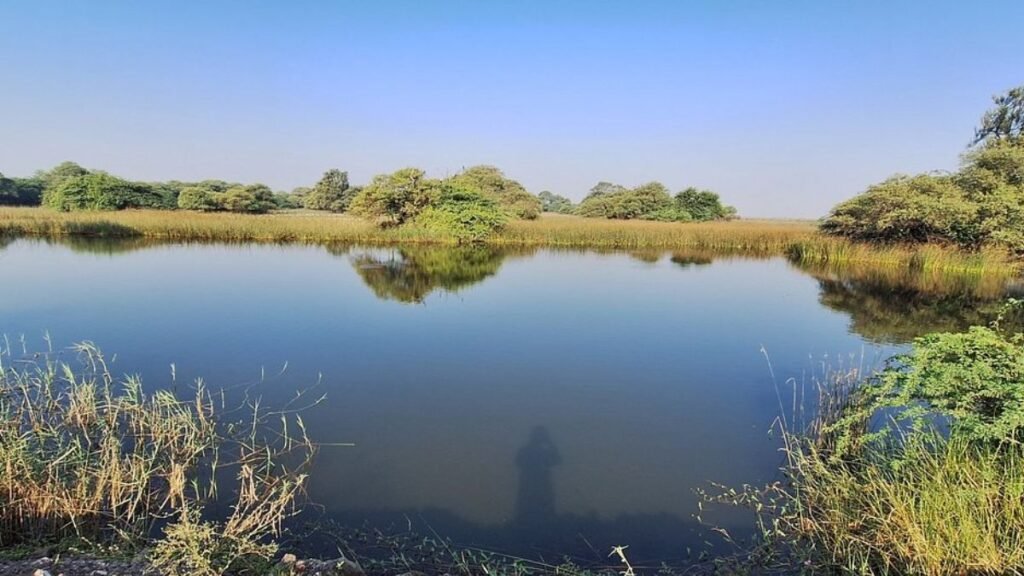
The freshwater side of Khijadia is a seasonal shallow lake fed by the Ruparel and Kalindi rivers and monsoon rainfall. This half of the sanctuary attracts the classic freshwater waterbirds ducks of multiple species, storks, ibises, spoonbills, cranes, and the vast congregation of common cranes for which Khijadia is internationally significant. The freshwater side also supports herons, egrets, kingfishers, waders, and a wide variety of smaller birds in the marginal vegetation around the lake edge.
The freshwater lake is the more accessible and visually dramatic half of the sanctuary for most visitors the open water allows sightlines across the congregation of birds at rest, feeding, and in flight. Morning light on the freshwater lake in November and December is the classic Khijadia photography shot.
Part 2 – The Saline Side and Gulf of Kutch Interface
The saline side of Khijadia is where the sanctuary meets the Gulf of Kutch a landscape of inter-tidal mudflats, salt pans, mangrove scrub, and tidal creeks that is completely different in character from the freshwater lake. This half attracts the coastal and marine bird specialists: flamingos wading in the shallows, Indian skimmers skimming the creek surfaces, Pallas’s Fish Eagles hunting from mangrove perches, and Dalmatian Pelicans gathering in numbers that represent a significant fraction of the entire south-west Asian population of the species.
The saline side of Khijadia connects directly with the Marine National Park India’s first Marine National Park, protecting the coral reefs and marine biodiversity of the Gulf of Kutch on one boundary of the sanctuary. A large creek from the Gulf on the northern side brings marine influence deep into the sanctuary, supporting mangroves and diverse marine life alongside the bird habitat.
The Flora – 180+ Species Including a Critically Endangered Tree
The botanical diversity of Khijadia matches its ornithological richness. Over 180 plant species have been recorded, including the critically endangered Indian Bdellium-tree (Commiphora wightii) a species of global conservation concern. Mangroves, aquatic plants, salt marsh grasses, and coastal scrub vegetation together create the multi-layered habitat structure that supports the sanctuary’s extraordinary biodiversity. The sanctuary also contributes to the maintenance of hydrological regimes, erosion protection along the Gulf of Kutch coastline, and nutrient cycling in the coastal ecosystem.
Birds of Khijadia – 310 Species and 8 Globally Threatened
Khijadia Bird Sanctuary is among the finest birdwatching destinations in India. The 310+ recorded species include both the spectacular flamingos, pelicans, cranes in their thousands and the rare. Eight bird species recorded at Khijadia are listed by IUCN and BirdLife International as Globally Threatened or Near Threatened. Here is what to look for:
Globally Threatened and Vulnerable Species
| Species | IUCN Status | Notes at Khijadia |
| Pallas’s Fish-Eagle | Endangered | Resident and wintering bird. Often perches in mangroves overlooking the creeks. A spectacular large raptor. |
| Indian Skimmer | Endangered | Skims creek and river surfaces with its distinctive orange lower mandible. Particularly visible in the saline/creek sections. |
| Dalmatian Pelican | Vulnerable | Khijadia regularly supports >1% of the south and south-west Asian population — a globally significant figure. |
| Common Pochard | Vulnerable | Wintering duck species. Seen on the freshwater lake in winter. Distinctive chestnut head of the male. |
| Common Crane | Least Concern but critical here | Khijadia supports >20% of south and south-west Asian population. Enormous crane congregations are one of the most spectacular sights. |
| Greylag Goose | Least Concern but critical here | Khijadia supports >2% of south-west Asian population. Large pale goose flocks. |
| Black-necked Stork | Near Threatened | Rare and impressive wading bird with distinctive black and white plumage and red legs. |
| Asian Openbill Stork | Least Concern | Notable for the gap in its bill adapted for extracting snails. Common at Khijadia. |
The Flamingos – Khijadia’s Most Photogenic Residents
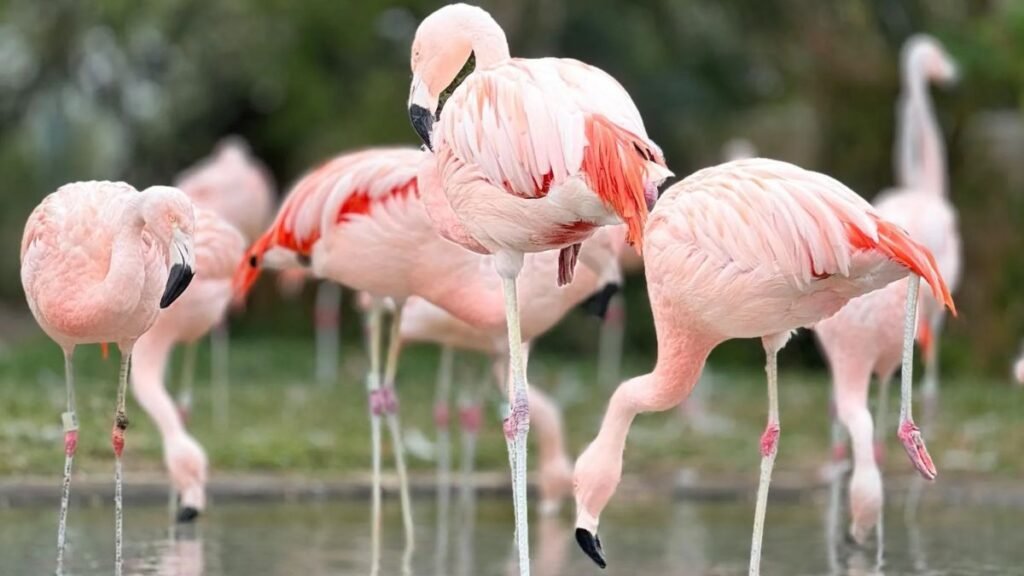
Both Greater and Lesser Flamingos congregate at Khijadia, particularly on the saline side of the sanctuary. In peak winter, flamingo flocks can number in the thousands, turning entire sections of the shallow salt marsh into a shimmering pink landscape. Flamingos at Khijadia are visible from the trail and the watchtowers often at close enough range for excellent photography. Early morning light on a flamingo congregation is one of the finest wildlife photography opportunities in Gujarat.
Common Cranes – A Global Congregation
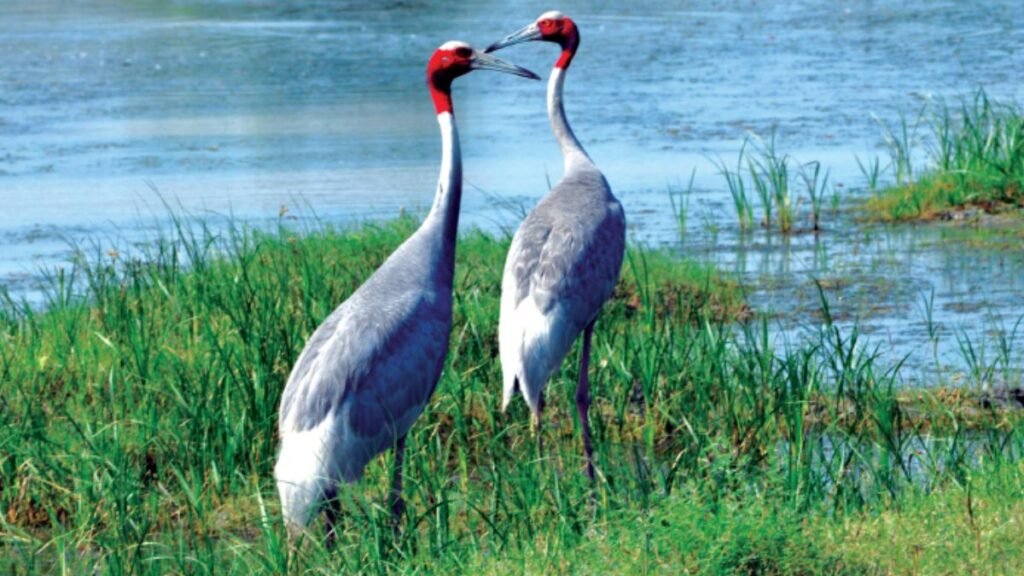
The Common Crane figures at Khijadia are extraordinary from a global conservation perspective: the sanctuary regularly supports more than 20% of the entire south and south-west Asian population of the species. This makes Khijadia one of the most important wintering grounds for Common Crane outside of Africa and Europe. A congregation of several thousand cranes coming in to roost at dusk over the freshwater lake is one of the most spectacular wildlife sights in India.
Key Bird Groups by Habitat
| Habitat | Key Bird Groups | Species Examples |
| Freshwater Lake | Ducks, Cranes, Herons | Common Crane, Greylag Goose, Common Pochard, Pintail, Garganey, Shoveler, Purple Heron, Grey Heron, Great Egret |
| Salt Marsh / Saline | Flamingos, Waders, Shorebirds | Greater Flamingo, Lesser Flamingo, Avocet, Black-winged Stilt, Sandpipers, Dunlin, Knot |
| Creeks and Mangroves | Eagles, Skimmers, Kingfishers | Pallas’s Fish-Eagle, Indian Skimmer, Collared Kingfisher, Darter, Little Cormorant, Great Cormorant |
| Open Water | Pelicans, Storks, Ibises | Dalmatian Pelican, Black-necked Stork, Asian Openbill, Black-headed Ibis, Eurasian Spoonbill |
| Marginal Vegetation | Warblers, Pipits, Munias | Various migrant warblers, Baya Weaver, Zitting Cisticola, Plain Prinia |
| Open Land and Banks | Raptors, Lapwings | Marsh Harrier, Montagu’s Harrier, Red-wattled Lapwing, Yellow-wattled Lapwing |
Visiting Khijadia – How the Experience Works
The Two Parts and the Trail
The sanctuary is divided into two distinct sections reflecting its dual ecosystem. The access road and the nature trail take visitors through both parts giving you the full experience of the freshwater lake on one side and the saline marshes on the other. The trail is well-maintained with designated birdwatching paths, strategically positioned watchtowers, and seating areas at key vantage points.
From the public transport drop-off at Khijadiya village, it is approximately 3 km to the sanctuary interior on foot an easy walk that passes through the village and begins the birdwatching even before you formally enter the sanctuary. Most birds start appearing as soon as you leave the village and approach the water.
Watchtowers and Observation Points
Multiple watchtowers are positioned at key points along the nature trail, allowing elevated views over the wetland that significantly improve birdwatching particularly for distant waterbird concentrations. The towers are the best spots for photographing large congregations of cranes, flamingos, and pelicans in wide-angle compositions that show the full scale of the gathering.
Duration of Visit
Most birdwatchers spend 2 to 3 hours at Khijadia covering both the freshwater lake trail and the saline side walk. Serious birders and ornithologists may spend a full day. For casual nature lovers and photographers focusing on the most spectacular concentrations (flamingos, cranes, pelicans), the first 2 hours of a morning visit are typically the most productive and satisfying.
Also Read: Mahuva Beach Bhavnagar
Best Time to Visit Khijadia Bird Sanctuary
November to February – Peak Migratory Season (Best)
This is the unmistakably best window for visiting Khijadia. The winter months bring the full complement of migratory species from Central Asia, Siberia, and Europe — including the massive Common Crane congregations (representing over 20% of the south-west Asian population), Dalmatian Pelicans, Common Pochards, Greylag Geese, and the full suite of migratory waders and ducks. The weather is cool and pleasant for walking. Light is clear and golden in the mornings. November, December, and January are the absolute peak months.
September to October – Early Season
Many migratory species begin arriving in September and October. The sanctuary is active and the early-arriving species can be seen in smaller numbers. The weather is transitioning from monsoon warmth to winter cool. This is a good window for visitors who cannot make the peak season but still want a productive birdwatching experience.
March – Late Season
By February the migration is beginning to reverse, and by March most of the winter visitors are departing. The sanctuary is quieter but not empty resident species remain active and some late-departing migrants are still present. The Flame of the Forest and other late-winter plants add visual interest to the surrounding landscape.
April to August – Off-Season
The summer and monsoon months see significantly reduced bird activity at Khijadia most migratory species have departed, and the wetland ecology changes with the monsoon flood-and-retreat cycle. Some resident breeders are active, but it is not a productive birdwatching window for most visitors. The sanctuary is technically open but the birdwatching experience is significantly diminished.
Best Time of Day – Year-Round
The golden rule for Khijadia as for virtually all birdwatching destinations is to arrive early. The two-hour window from sunrise (approximately 6 AM in winter) to 8 AM is the most productive for both bird activity and photography. Birds are feeding, calling, and moving in the early morning. The light is directional and warm ideal for photography. By mid-morning, many species move to roosting positions and activity drops. A second productive window occurs in the late afternoon, approximately 4 PM to sunset.
How to Reach Khijadia Bird Sanctuary
| From | Distance | Mode | Approx. Time |
| Jamnagar city | ~10–14 km | Auto-rickshaw / Taxi / Local Bus + 3 km walk | 20–30 minutes |
| Jamnagar Railway Station | ~12–17 km | Taxi / Auto + 3 km walk | 25–35 minutes |
| Jamnagar Airport | ~10–15 km | Taxi | 20–25 minutes |
| Rajkot | ~76 km | Car / Bus to Jamnagar + local transfer | 1.5 hours |
| Ahmedabad | ~268 km | Car / Bus to Jamnagar + local transfer | 4.5 hours |
| Dwarka | ~130 km | Car | 2.5 hours |
| Porbandar | ~115 km | Car | 2 hours |
Step 1 — Reach Jamnagar
By Air: Jamnagar Airport has regular flights to Mumbai and connects to major Indian cities. From the airport, the sanctuary is 10 to 15 km take a taxi directly. Jamnagar Airport is one of the closest airports to any major bird sanctuary in Gujarat.
By Train: Jamnagar Junction is well-connected to Ahmedabad (~5 hours), Rajkot (~1 hour), Mumbai, and other cities. From Jamnagar station, hire a taxi or auto for the sanctuary (~12 to 17 km).
By Road: Jamnagar is on the Rajkot-Jamnagar highway. From Rajkot (76 km), the drive takes approximately 1.5 hours. From Ahmedabad (268 km), approximately 4.5 hours. GSRTC buses run frequently between Rajkot and Jamnagar.
Step 2 – Jamnagar to Khijadiya Sanctuary
From Jamnagar city, Khijadiya Bird Sanctuary is approximately 10 to 14 km accessible by local bus to Khijadiya village (from where it is a 3 km walk to the sanctuary interior) or by direct taxi/auto-rickshaw to the sanctuary gate. Taking a taxi directly to the sanctuary gate is strongly recommended for early morning visits when you want to arrive before sunrise and minimize wasted time.
Photography Guide for Khijadia Bird Sanctuary
Equipment Recommendations
- Telephoto lens – 300mm to 500mm is the minimum for satisfactory bird photography at Khijadia. A 400mm f/5.6 or 500mm f/6.3 prime lens, or a 100-400mm zoom, gives the reach needed for the waterbirds that may be 50 to 200 metres from the trail.
- Bean bag or monopod – the watchtowers and trail edges are the shooting positions; a bean bag over the tower railing or a monopod stabilises long telephoto shots of distant subjects.
- Extra batteries – cold winter mornings drain batteries quickly; bring two fully charged batteries minimum.
- Bring a pair of binoculars – even as a photographer, binoculars for initial scanning before raising the camera saves time and improves your hit rate significantly.
Best Photography Shots at Khijadia
- Flamingo flocks in the saline shallows – best in early morning light when the pink birds are lit from behind or from the side, creating backlit silhouettes or rim-lit feather detail
- Common Crane roost – arriving at dawn when thousands of cranes call and lift simultaneously from the freshwater lake is one of the most spectacular wildlife photography opportunities in India
- Dalmatian Pelican close-ups – these large, distinctive birds at Khijadia can be photographed at reasonably close range from the watchtowers
- Indian Skimmer in flight – challenging but rewarding; the distinctive flight profile and orange bill make the skimmer immediately identifiable even in flight silhouette
- Wide-angle landscape shots – the junction of the freshwater lake and the saline marsh, with birds distributed across both, makes for compelling wide-angle compositions that no single telephoto shot can capture
The Birdman of India and Khijadia
In 1984 just two years after the sanctuary was officially declared Salim Ali visited Khijadia Bird Sanctuary. Salim Ali is one of the most celebrated naturalists in Indian history: the first person to conduct systematic bird surveys of India, the author of the landmark ‘Handbook of the Birds of India and Pakistan,’ and the recipient of the Padma Bhushan and Padma Vibhushan for his contribution to ornithology. He is universally called the Birdman of India.
On a single day at Khijadia in 1984, Salim Ali recorded 104 species of birds. This is not just an impressive number it is a statement about the quality of the sanctuary’s habitat. Expert birdwatchers typically consider seeing 50 to 70 species in a single day at a premier wetland to be an excellent result. To record 104 in one day is extraordinary. It placed Khijadia on the national and international birdwatching map and laid the foundation for the conservation attention it has received in the decades since. Today, with over 310 species recorded across multiple visits and seasons, Khijadia’s legacy continues to grow.
Ramsar Status and Conservation Significance
On February 2, 2022 World Wetlands Day Khijadia Bird Sanctuary was designated as India’s 49th Ramsar Wetland Site under the Ramsar Convention on Wetlands. This makes it one of four Ramsar sites in Gujarat, alongside Thol Lake Wildlife Sanctuary, Wadhwana Wetland, and Nal Sarovar Bird Sanctuary.
The Ramsar designation reflects Khijadia’s global ecological importance across multiple criteria:
- More than 1% of the south and south-west Asian population of Dalmatian Pelican a globally vulnerable species is regularly supported at the sanctuary
- More than 2% of the Greylag Goose population of the same region
- More than 20% of the Common Crane south and south-west Asian population making Khijadia one of the most important Common Crane wintering sites in Asia
- 8 bird species listed as Globally Threatened or Near Threatened by IUCN/BirdLife International are present
- 165,000+ individual waterbirds counted exceeding the Ramsar threshold for sites of international importance
- 180+ plant species, including the critically endangered Indian Bdellium-tree (Commiphora wightii)
The ecological functions of Khijadia also extend beyond birdlife the wetland contributes to the maintenance of hydrological regimes for the Jamnagar coastal area, provides erosion protection along the Gulf of Kutch coastline, and plays a role in nutrient cycling that benefits the broader marine ecosystem of the Gulf.
Travel Tips for Khijadia Bird Sanctuary
- Arrive at sunrise – this is non-negotiable for the best experience. The first two hours of daylight are when birds are most active, most vocal, and most visible. 6 AM entry in winter puts you in position for the morning crane and flamingo activity.
- Carry binoculars – essential for identifying species at distance on the open water and for scanning the sky for raptors. 8×42 or 10×42 binoculars are ideal.
- Wear muted, earthy colours – avoid bright clothing that disturbs birds and reduces sighting distances. Greens, browns, and khakis are standard birdwatching attire.
- Walk slowly and speak quietly – the birds are the entire point of Khijadia. Noise and rapid movement cause disturbance that reduces sightings for you and for everyone else on the trail.
- Carry all water and snacks – food stalls and shops are limited at the sanctuary. Pack enough provisions for the full visit, especially for early morning trips before any nearby stalls are open.
- Download the eBird and Merlin Bird ID apps before visiting – these free tools significantly enhance the identification experience and allow you to contribute your sightings to the global bird database.
- Hire a local guide – the Forest Department and local naturalists offer guided birdwatching tours of Khijadia. A knowledgeable guide dramatically increases the number of species you identify and the depth of the experience.
- Check camera fee policy at the gate – professional camera equipment may attract an additional charge. Confirm current policy when purchasing your entry ticket.
- Combine with Marine National Park – the Marine National Park, directly adjacent to Khijadia, offers a completely different but equally extraordinary natural experience — coral reefs, marine life, and the unique ecology of the Gulf of Kutch.
Also Read: Dwarka Tourism Guide 2026
Nearby Attractions to Combine with Khijadia
- Marine National Park, Jamnagar – Adjacent to the sanctuary | India’s first Marine National Park, protecting coral reefs and marine biodiversity in the Gulf of Kutch. Famous for its inter-tidal coral ecosystems that can be walked across at low tide. Narara Island is a highlight teeming with marine life including octopus, sea anemones, starfish, and various fish species accessible in shallow water.
- Lakhota Lake and Lakhota Fort – Jamnagar city centre | A picturesque lake in the heart of Jamnagar with a historic island fort. The fort houses a museum of local history and the lake itself attracts waterbirds a pleasant evening add-on to a Khijadia morning visit.
- Ranjit Sagar Lake (Balachdi) – Near Jamnagar | A lake and surrounding area that attracts additional bird species. Worth visiting in combination with Khijadia for a comprehensive Jamnagar birdwatching day.
- Dwarka ~130 km | One of the Char Dham pilgrimage sites the sacred city of Lord Krishna. Dwarkadhish Temple, Bet Dwarka (Lord Krishna’s island residence), and Shivrajpur Beach (Gujarat’s Blue Flag beach). Read our full guides on TravelRoach.
- Nal Sarovar Bird Sanctuary ~180 km via Ahmedabad | Gujarat’s other major Ramsar wetland, famous for flamingos and migratory ducks. A full birdwatching circuit of Gujarat’s Ramsar sites could include both Khijadia and Nal Sarovar.
Frequently Asked Questions (FAQs)
Khijadia Bird Sanctuary in Jamnagar is famous for being one of North-West India’s most important bird habitats home to 310+ recorded bird species including 8 globally threatened or near-threatened species. It is Gujarat’s largest bird sanctuary and India’s 49th Ramsar Wetland Site (designated February 2, 2022). The sanctuary is particularly renowned for its unique dual ecosystem freshwater lake on one side, saline coastal marsh and Gulf of Kutch mudflats on the other which attracts both freshwater and marine bird species simultaneously. It supports over 20% of the south-west Asian Common Crane population and over 1% of the Dalmatian Pelican population figures of global conservation significance.
The entry fee for Khijadia Bird Sanctuary is approximately ₹40 per person for Indian visitors and ₹200 per person for foreign tourists. Additional camera charges may apply for professional equipment confirm at the gate when purchasing your entry ticket. The sanctuary is generally open from sunrise to sunset, with the best birdwatching in the two hours after sunrise (approximately 6:00 AM to 8:00 AM in winter) and in the late afternoon before sunset.
The best time is November to February, when migratory species from Central Asia, Siberia, and Europe are present in their maximum numbers. This is when the Common Crane congregations (over 20% of the south-west Asian population), Dalmatian Pelicans, flamingo flocks, and the full suite of winter ducks are visible. The best time of day is from sunrise (approximately 6 AM in winter) for the first two hours when birds are most active and the light is best for photography. The famous ornithologist Salim Ali visited Khijadia in 1984 and recorded 104 species in a single day.
From Jamnagar city centre, the sanctuary is approximately 10 to 14 km about 20 to 30 minutes by road. Hire a local taxi or auto-rickshaw directly to the sanctuary gate (strongly recommended for early morning visits). Local buses run from Jamnagar to Khijadiya village, from where it is a 3 km walk to the sanctuary interior. From Jamnagar Railway Station (12 to 17 km away) and Jamnagar Airport (10 to 15 km away), taxis are readily available and can take you directly to the sanctuary.
Khijadia Bird Sanctuary is home to 8 globally threatened or near-threatened bird species according to IUCN and BirdLife International. The most significant are: Pallas’s Fish-Eagle (Endangered) a large raptor seen in the mangroves and creeks; Indian Skimmer (Endangered) skims the creek surfaces with its distinctive orange bill; Dalmatian Pelican (Vulnerable) Khijadia supports over 1% of the south-west Asian population; Common Pochard (Vulnerable) a wintering duck; and Black-necked Stork (Near Threatened) a large and impressive wading bird with distinctive black and white plumage and red legs.
Yes. On February 2, 2022 World Wetlands Day Khijadia Bird Sanctuary was designated as India’s 49th Ramsar Wetland Site under the international Ramsar Convention on Wetlands. This makes it one of four Ramsar sites in Gujarat, alongside Thol Lake Wildlife Sanctuary, Wadhwana Wetland, and Nal Sarovar Bird Sanctuary. The Ramsar designation reflects Khijadia’s global ecological importance it supports internationally significant populations of multiple waterbird species and provides critical habitat for 8 globally threatened or near-threatened species.
Yes and this combination is strongly recommended. Khijadia Bird Sanctuary and the Marine National Park (India’s first Marine National Park) share a boundary the sanctuary connects directly with the Marine National Park on one side. While Khijadia specialises in birdlife and wetland ecology, the Marine National Park offers the coral reef ecosystems and marine biodiversity of the Gulf of Kutch particularly the inter-tidal walks to Narara Island, where you can observe corals, octopuses, sea anemones, starfish, and diverse coastal fish species in shallow water. Together, they represent the complete range of Jamnagar’s extraordinary coastal and wetland natural heritage.
Final Thoughts
When Salim Ali the man who spent a lifetime cataloguing India’s birds, who had visited virtually every significant bird habitat in the subcontinent chose to visit Khijadia Bird Sanctuary and recorded 104 species in a single day, he was telling us something. Not just about the number of birds, but about the quality of the place that brings them.
The accidental check dam that created the dual freshwater-saline ecosystem. The 165,000 individual waterbirds counted in winter surveys. The >20% of south-west Asian Common Cranes arriving each November. The flamingos that turn entire sections of the salt marsh pink. The Dalmatian Pelicans that gather here in proportions significant to the global population. The endangered Indian Skimmer cutting the creek surfaces at dawn.
Gujarat has magnificent wildlife destinations Gir’s lions, Velavadar’s blackbucks, the Rann’s flamingos. Khijadia is their equal in the birdwatching world. It is just less famous. Arrive early, carry binoculars, walk slowly, and let 310 species do the rest.
