Five times a day, a man from a designated family climbs 78 metres of ancient stone and changes a flag.
That flag roughly 52 yards of cloth, carrying the sun and moon is the most visible ritual at Dwarkadhish Temple, and families book the Dhwaja Arohan ceremony months in advance for the privilege of offering it. It’s the detail that captures what this place is: a temple where the daily routine has been running, more or less unbroken, for centuries.
Known also as Jagat Mandir, this is one of the Char Dham and one of the seven Sapta Puri sacred cities a five-storey structure on 72 pillars, dedicated to Krishna in his form as Dwarkadhish, King of Dwarka.
This guide covers darshan timings, the aarti schedule, the flag ceremony, dress code and prohibited items, how to reach, and how to build the full Dwarka circuit around it.
Quick Facts at a Glance
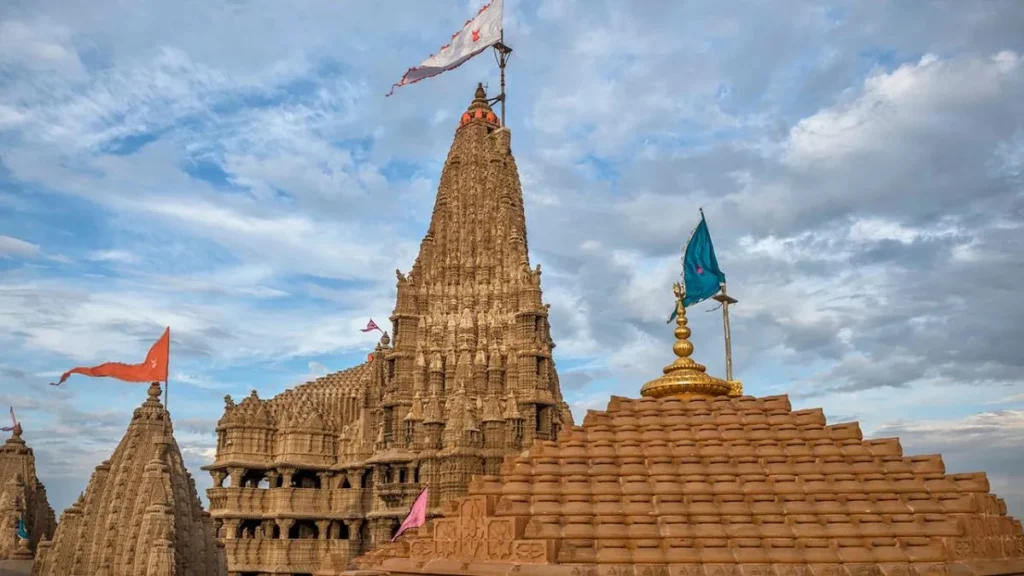
| Detail | Information |
| Also known as | Jagat Mandir, Nija Mandir |
| Location | Dwarka, Devbhumi Dwarka district, Gujarat – 361335 |
| Deity | Krishna, worshipped as Dwarkadhish “King of Dwarka” |
| Significance | One of the Char Dham; one of the Sapta Puri |
| Structure | Five storeys, supported by 72 pillars |
| Shikhara height | Approx. 78 metres (some sources say 72 m) |
| Origins | Archaeological findings suggest 200 BCE at the earliest |
| Tradition holds | Built by Vajranabh, Krishna’s great-grandson, 2,500+ years ago |
| Present structure | Rebuilt and enlarged in the 15th–16th century |
| Managed by | Dwarka Peeth |
| Darshan timings | 6:30 AM – 1:00 PM and 5:00 PM – 9:30 PM |
| Entry fee | Free |
| Photography | Not permitted phones and leather items also prohibited |
| Distance from Dwarka Junction | Approx. 2 km |
Darshan Timings and the Aarti Schedule
Darshan timings: 6:30 AM to 1:00 PM, then 5:00 PM to 9:30 PM, daily.
(One listing gives a 6:00 AM opening rather than 6:30. Arrive by 6:15 if you want the Mangala Aarti and you’ll be safe either way.)
The Daily Aarti and Ritual Sequence
The temple performs six aartis daily, each marking a stage in the Lord’s divine routine.
| Ritual | Approximate Time |
| Mangala Aarti | 6:30 AM – the most auspicious |
| Abhishek Snan | 8:00 – 9:00 AM (sacred bath) |
| Shringar Aarti | 10:30 – 10:45 AM |
| Anosar – darshan closes | 1:00 – 5:00 PM |
| Sandhya Aarti | Around 7:00 – 7:30 PM |
| Shayan Aarti | Around 8:30 PM |
Verify before you travel. Reported aarti times differ slightly between sources, and the schedule shifts during festivals. Temple authorities have introduced e-donation and live aarti streaming, so official channels are the place to check.
If you can only attend one: the Mangala Aarti at 6:30 AM. It’s the most auspicious, the queue is shortest, and the light in the courtyard is at its best.
The Dhwaja: The Flag Changed Five Times a Day
This is the ritual visitors remember.
A large ceremonial flag, commonly described as around 52 yards long and bearing the sun and moon, flies from the shikhara. The temple changes the flag five times every day, and each ceremony features a new flag.
Devotees book the Dhwaja Arohan ceremony in advance, and the offering is considered deeply auspicious. Bookings can run far ahead, particularly around festivals.
Want to take part? Contact the temple administration well in advance. This is not something you can arrange on the day.
Want to watch? You don’t need to book. Ask at the temple for the day’s flag-change times and position yourself in the courtyard with a clear view of the spire.
(A note on accuracy: most sources state five changes daily; at least one says three. Five is the figure reported consistently across the majority, and it’s what temple-focused sources use.)
Dress Code and Prohibited Items
Read this before you leave your hotel These rules are enforced, and getting caught out costs you queue time.
Prohibited inside:
- Cameras – photography and videography are not permitted
- Mobile phones
- Leather items – belts, wallets, bags
- Footwear
Lockers are available for phones, cameras and leather goods. Use them on arrival rather than discovering the rule at the entrance.
Dress code:
- Men: Shirts and trousers, or traditional attire. No shorts.
- Women: Sarees, salwar kameez or other modest clothing. No sleeveless tops, no shorts.
- Traditional attire is recommended for both.
Practical tips:
- Carry small change for the footwear counter and offerings
- Keep your footwear token safe you’ll need it on exit
- Follow the guided exit route; the temple manages flow deliberately
- Separate queues operate for general and VIP darshan in both sessions
The History: 200 BCE, or 5,000 Years?
Both, depending on what you’re asking.
Tradition says: The temple was established by Vajranabh, the great-grandson of Krishna, more than 2,500 years ago, over the site of Krishna’s own residence in his city of Dwarka.
Archaeology says: Findings suggest an original temple on this site dating to 200 BCE at the earliest.
What you’re looking at: The present structure was rebuilt and enlarged in the 15th–16th century. It has survived multiple invasions and restorations.
The submerged city: Archaeological work off the Dwarka coast has revealed submerged remains believed by many to relate to the ancient city. This is one of the most-discussed underwater archaeological sites in India.
The honest summary: the site is genuinely ancient, the standing building is medieval, and the tradition reaches much further back than either. All three are true at once, and pages that flatten them into a single date are doing you a disservice.
What to See Inside
1. The Jagat Mandir and the 72 Pillars
Why it matters: The main shrine Nija Mandir rises five storeys on 72 carved pillars, with intricate work across the walls and a shikhara reaching roughly 78 metres. Look up from the courtyard and take a moment before joining the queue.
Best for: Everyone
2. The Sanctum and the Idol
Why it matters: You climb stairs to reach the sanctum. The idol of Dwarkadhish is elaborately decorated with jewellery, flowers and fine clothing, and the dress and ornaments change several times through the day so a morning and evening darshan genuinely look different.
Best for: Devotees
Note: Darshan itself is brief. Absorb what you can.
3. The Two Gates
Why it matters: The temple has two principal entrances, traditionally called Moksha Dwara (the gate of liberation) and Swarga Dwara (the gate to heaven). The Swarga Dwara side leads down towards the Gomti, where 56 steps descend to the ghat.
Best for: Anyone interested in temple layout
Note: Accounts differ on which gate serves entry versus exit. Follow the temple’s guided route on the day.
4. The Subsidiary Shrines
Why it matters: The complex holds shrines to Balaram, Pradyumna and Aniruddha Krishna’s family along with smaller shrines to Shiva, Hanuman and others. Most visitors rush past them.
Best for: Slow pilgrims
5. Gomti Ghat
Why it matters: Steps lead down to the Gomti, where pilgrims take a ritual dip before or after darshan. Sandhya Aarti at the ghat is held around 6:30 PM and is a genuinely beautiful thing to watch.
Best for: Everyone
Tip: Pair the ghat aarti at ~6:30 PM with the temple’s Sandhya Aarti at ~7:00 PM.
How to Reach Dwarkadhish Temple
Train
Dwarka Junction is roughly 2 km from the temple the easiest arrival of any Char Dham site. It sits on the Ahmedabad–Okha line with connections from Rajkot, Jamnagar and Ahmedabad.
Air
- Porbandar Airport – approx. 110 km, about 2.5 hours
- Jamnagar Airport – approx. 145 km, about 3 hours
- Rajkot (Hirasar) – the alternative for wider connections
Road
- From Jamnagar: approx. 145–160 km
- From Porbandar: approx. 100–110 km
- From Rajkot: approx. 230–240 km
- From Somnath: approx. 230–250 km
- From Ahmedabad: approx. 440–450 km, 8–9 hours
Bus
GSRTC and private operators run regularly to Dwarka from Ahmedabad, Rajkot, Jamnagar and Somnath.
Within Dwarka
Autos are plentiful. The temple is the centre of town everything else is measured from it.
Best Time to Visit
October to March is the season.
- October–March (Winter) – Best overall. Comfortable coastal weather for the wider Dwarka circuit.
- July–September (Monsoon) – Humid, with the Gomti running. Fewer crowds outside festival dates.
- April–June (Summer) – Hot and humid. Stick to the morning and evening darshan windows.
Festival Calendar
| Festival | When | Crowds |
| Janmashtami | August | Extremely high – midnight celebrations, lakhs attend |
| Holi | March | Very high |
| Kartik Purnima | November | Very high – thousands take a Gomti dip |
| Sharad Purnima | October | High – special night darshan |
| Diwali | October/November | High |
| Rath Yatra | June/July | High – chariot procession through town |
Janmashtami at Dwarka is one of the great religious experiences in India and one of the most crowded. Book accommodation months ahead.
Where to Eat in Dwarka
Dwarka is a pilgrimage town: overwhelmingly vegetarian, no alcohol, thali-dominated.
Near the temple – Thali restaurants and simple eateries cluster around the approach roads. Unlimited veg thali runs roughly ₹250–450 for two.
Dwarka’s pendas – The town is known for milk sweets, and penda is what to buy, as prasad or to carry home.
Kathiawadi staples – Bajra rotla with garlic chutney, sev tameta, kadhi and chhaas.
Prasad counters operate inside the complex. Devotees can offer flowers, coconuts or sweets at designated counters.
One practical note: carry bottled or filtered water. Groundwater across this belt is saline.
If you’re driving the Saurashtra coast, our best restaurants in Rajkot guide covers the region’s biggest food city.
The Complete Dwarka Circuit
Dwarkadhish is the centre here’s everything that orbits it.
| Place | Why Visit | Distance |
| Rukmini Devi Temple | Krishna’s queen’s temple, famous for the jal daan water tradition | ~2–3 km |
| Gomti Ghat & Sudama Setu | Riverside ghats, 56 steps, and the pedestrian bridge | Adjacent |
| Bhadkeshwar Mahadev | Shore temple best reached at low tide | ~1–2 km |
| Nageshwar Jyotirlinga | One of the twelve Jyotirlingas, with an underground sanctum | ~17 km |
| Bet Dwarka | Island temple complex, ferry from Okha | ~30 km |
| Dwarka Lighthouse | Climb for Arabian Sea views | ~1–2 km |
| Madhavpur Beach | Where Krishna is said to have married Rukmini | ~139 km |
Suggested 2-Day Dwarka Itinerary
Day 1
6:30 AM – Dwarkadhish Mangala Aarti.
8:00 AM – Explore the complex, the 72 pillars, the subsidiary shrines.
9:30 AM – Gomti Ghat snan and the 56 kunds.
11:00 AM – Sudama Setu.
12:30 PM – Thali lunch. (Temple closes 1–5 PM.)
4:30 PM – Bhadkeshwar Mahadev at low tide.
6:30 PM – Gomti Ghat Sandhya Aarti.
7:00 PM – Dwarkadhish Sandhya Aarti.
Day 2
6:00 AM – Nageshwar Jyotirlinga.
8:00 AM – Drive to Okha.
9:00 AM – Ferry to Bet Dwarka.
1:00 PM – Return, lunch in Dwarka.
3:30 PM – Rukmini Devi Temple and jal daan.
6:00 PM – Sunset at the lighthouse or Gomti Ghat.
Frequently Asked Questions (FAQs)
Dwarkadhish Temple is generally open from 6:30 AM to 1:00 PM and 5:00 PM to 9:30 PM. Darshan remains closed from 1:00 PM to 5:00 PM during Anosar. Timings may change during festivals.
No, darshan at Dwarkadhish Temple is free. Separate queues may be available for general and VIP darshan. Donations and offerings are optional.
No, photography and videography are not allowed inside the temple. Mobile phones, cameras and certain items must be deposited in lockers before entering.
Visitors are expected to wear modest and traditional clothing. Shorts and revealing outfits should be avoided. Footwear must also be removed before entering the temple.
The temple’s large ceremonial flag is changed five times a day. Devotees can book the Dhwaja Arohan ceremony in advance, while visitors can also watch the ceremony without booking.
According to tradition, the temple was established by Vajranabh, Krishna’s great-grandson. The present structure largely dates from the 15th–16th century, with earlier temple remains associated with the site.
Plan around 30–45 minutes for darshan during quieter periods. However, allow up to two hours if you also want to explore the temple complex and nearby Gomti Ghat. Additionally, extra time can help you enjoy the surroundings without rushing your visit.
Final Thoughts
Dwarkadhish Temple in Dwarka is the anchor of one of Hinduism’s four great pilgrimages, so a little planning can make your visit easier. First, come for the 6:30 AM Mangala Aarti, then leave your phone and belt in the locker before entering. Also, note the 1 PM to 5 PM closure and try to watch at least one flag-changing ceremony during your visit. Meanwhile, Travel Roach helps you plan the rest of your Dwarka journey with useful travel tips, local insights and practical information.
Have you made the Dwarka yatra? Share your darshan timings and which aarti moved you most in the comments. Reader reports, along with Travel Roach guides, can help everyone planning a trip to Dwarka.
