You have already seen it. If you have used a ₹100 note in the last few years, you have held an image of it in your hands. The reverse of the Indian hundred-rupee note introduced in 2019 carries the image of Rani Ki Vav, the Queen’s Stepwell in Patan, Gujarat. Every time the note changes hands, one of India’s greatest architectural achievements travels with it.
Rani Ki Vav is a UNESCO World Heritage Site inscribed in 2014 that UNESCO itself describes as ‘the most developed and ornate example’ of stepwell architecture in India. Built in the 11th century by Queen Udayamati of the Solanki dynasty as a memorial to her husband King Bhimdev I, it is 65 metres long, 20 metres wide, and 27 metres deep, with seven levels of descending galleries that together hold more than 500 principal sculptures and over 1,000 minor ones. It was designed UNESCO’s own description as ‘an inverted temple highlighting the sanctity of water.’
It was then buried. The Saraswati River flooded and deposited centuries of silt over the entire structure, hiding it completely from view. It was rediscovered and excavated in the 20th century and restored by the Archaeological Survey of India in the 1980s. What the excavators found was extraordinary: the sculptures had been protected by the silt. They were near-perfect. The Queen’s Stepwell had been preserved by the very thing that buried it.
This TravelRoach guide covers the complete story: Queen Udayamati’s memorial, the inverted-temple architecture, the seven levels and their sculptures, the ₹100 note, the 3D projection show, entry fees, timings, how to reach from Ahmedabad, and how to combine Rani Ki Vav with the Modhera Sun Temple in a single perfect day.
Rani Ki Vav – Quick Information
| Detail | Information |
| Full Name | Rani-ki-Vav (The Queen’s Stepwell) |
| Name Meaning | ‘Rani’ = Queen | ‘ki’ = of | ‘Vav’ = Stepwell (Gujarati) |
| Location | Patan, Patan District, North Gujarat on the banks of the Saraswati River |
| UNESCO Status | World Heritage Site inscribed 2014 |
| UNESCO Description | ‘The most developed and ornate example of stepwell architecture in India’ |
| Design Concept | An inverted temple highlighting the sanctity of water |
| Built | 11th century CE approximately 1063 CE |
| Commissioned By | Queen Udayamati of the Solanki (Chaulukya) dynasty |
| Built in Memory Of | King Bhimdev I (Bhima I) her husband; Solanki king who ruled c.1022–1064 CE |
| Architectural Style | Maru-Gurjara the same style as the Modhera Sun Temple |
| Dimensions | ~65 metres long × ~20 metres wide × ~27 metres deep |
| Seven Levels | Seven descending gallery levels with sculptural panels of high artistic quality |
| Total Sculptures | More than 500 principal sculptures + over 1,000 minor ones |
| Sculptural Themes | Religious, mythological, and secular deities, apsaras, Dashavatara, secular life |
| Buried | Saraswati River flooded; silt covered the entire structure for centuries |
| Rediscovered / Restored | Restored in the 1980s by the Archaeological Survey of India (ASI) |
| ₹100 Note | The image of Rani Ki Vav appears on the reverse of the Indian ₹100 note since 2019 |
| Evening Show | 3D Projection Mapping Show runs daily in two evening slots |
| Entry Fee — Indian | ₹40 per adult; ₹20 for children |
| Entry Fee — Foreign | ₹600 per adult |
| Timings | 8:00 AM – 6:00 PM (daily) |
| Managed By | Archaeological Survey of India (ASI) |
| Best Time to Visit | October to March; early morning (8–10 AM) for best light and fewest crowds |
| Distance from Ahmedabad | ~125 km (~3 hours by road) |
| Distance from Mehsana | ~55 km (~1 hour) |
| Distance from Modhera Sun Temple | ~35 km (~45 minutes) |
| Nearest Railway Station | Patan Railway Station (~3 km from the stepwell) |
| Nearest Airport | SVP International Airport, Ahmedabad (~125 km) |
The History of Rani Ki Vav – A Queen’s Memorial and a Lost Wonder
The Solanki Dynasty and Anahilwad Patan
To understand Rani Ki Vav, you must first understand the world that created it. In the 11th century, Patan then called Anahilwad Patan was one of the most important and prosperous cities in western India. It was the capital of the Solanki (Chaulukya) dynasty the rulers who presided over what is widely regarded as the golden age of Gujarat’s art and architecture. The Modhera Sun Temple, the extraordinary stepwells of the region, and Rani Ki Vav itself are all products of this dynasty’s extraordinary cultural ambition.
King Bhimdev I (Bhima I) ruled the Solanki kingdom from approximately 1022 to 1064 CE a reign that included the construction of several significant architectural monuments. His queen was Udayamati a woman of evident intelligence, devotion, and administrative capability. When Bhimdev I died in approximately 1064 CE, Udayamati undertook a memorial of exceptional ambition: a stepwell on the banks of the Saraswati River that would honour her husband’s memory and serve the practical needs of the city simultaneously.
Also Read: Adalaj ni Vav, Gandhinagar
Queen Udayamati’s Commission
The construction of Rani Ki Vav was Queen Udayamati’s act of devotion to her husband’s memory and simultaneously an act of genuine public service. In the water-scarce landscape of Gujarat, a stepwell of this scale would have been a vital community resource. But Udayamati did not build a merely functional water structure. She built what UNESCO would, nearly a thousand years later, call the most developed and ornate example of this architectural form in the entire country.
The scale of the commission tells you something about the resources and authority that Udayamati commanded. The stepwell is 65 metres long, 20 metres wide, and 27 metres deep. It required thousands of skilled craftsmen over years of work. The sculptural programme 500-plus principal figures and more than a thousand minor ones — represents a sustained, systematic engagement with the entire visual theology of Shaiva and Vaishnava Hinduism. This was not simply a memorial. It was a statement about what a great civilisation could achieve.
Buried – And Preserved by What Buried It
Sometime after its construction, the Saraswati River flooded. Silt fine sediment carried by the floodwaters gradually covered the entire stepwell. Over centuries, the filling was complete: the galleries, the sculpture panels, the well shaft itself all buried. Patan’s residents knew a stepwell had been there, but its exact location and condition were lost to memory.
In the 20th century, archaeologists began systematic work on the site. The excavation that followed and the major restoration undertaken by the Archaeological Survey of India in the 1980s revealed something extraordinary: the silt that had buried the stepwell had also protected it. The sculptures, sealed from exposure and weathering for centuries, were in near-perfect condition. The carvings that emerged from the silt were as sharp and detailed as if they had been completed recently. The flood that buried Rani Ki Vav had inadvertently become its greatest conservator.
The Inverted Temple -Understanding the Architecture
Why ‘Inverted Temple’?
UNESCO’s description of Rani Ki Vav as ‘designed as an inverted temple highlighting the sanctity of water’ is one of the most illuminating phrases in all of heritage architecture commentary – because it perfectly captures the conceptual logic of the structure.
In a conventional Hindu temple, the sacred intensifies as you ascend ground level, plinth, hall, inner sanctum, and finally the shikhara (spire) that reaches toward the sky at the highest point. The vertical axis of a temple moves upward toward divinity. At Rani Ki Vav, the logic is precisely inverted. The sacred intensifies as you descend from the surface level entrance, down through seven galleries of increasing sculptural richness, toward the well at the deepest point. The water at the bottom is the most sacred element of the entire structure. The architecture goes downward into the earth rather than upward into the sky.
This inversion is not merely formal it carries a theological statement. Water is the source. Water was here before the world took its current form. To descend toward water is to descend toward the sacred origin. The seven levels of Rani Ki Vav, each richer in sculpture than the one above, enact this journey: the deeper you go, the closer you are to the sacred centre.
The Architecture – Seven Levels and Maru-Gurjara Mastery
The stepwell is oriented east-west, allowing the morning sun to enter the galleries at specific angles. The structure is divided into seven distinct levels each a landing with a gallery of sculptural panels, supported by pillars in the Maru-Gurjara architectural tradition. The Maru-Gurjara style is the same style that produced the Modhera Sun Temple: characterised by intricately carved pillars, heavy decorative brackets, projected balconies (called gudhamandapa), and a density of ornamental detail that rewards extended, patient examination.
The latticework patterns of the carving at Rani Ki Vav have been noted by art historians as echoing the patterns of Patan’s famous Patola silk the extraordinary double ikat textile for which the city has been renowned for centuries. Whether this connection was intentional or coincidental is debated, but the visual resonance between the stone lattice and the silk lattice of the city’s other great art form is unmistakable.
The Dimensions – Scale in Context
The physical scale of Rani Ki Vav needs to be understood to fully appreciate the ambition of the enterprise. At 65 metres long, 20 metres wide, and 27 metres deep, it is among the largest stepwells in India. Standing at the surface level and looking down the full length of the descending galleries to the well shaft at the far end is a visual experience of genuine grandeur the receding perspective of pillars and carved panels, the shadows deepening as you look further down, the sense of a world building itself underground while you stand at its edge.
The Sculptures – 500 Principal Figures and India’s Greatest Gallery
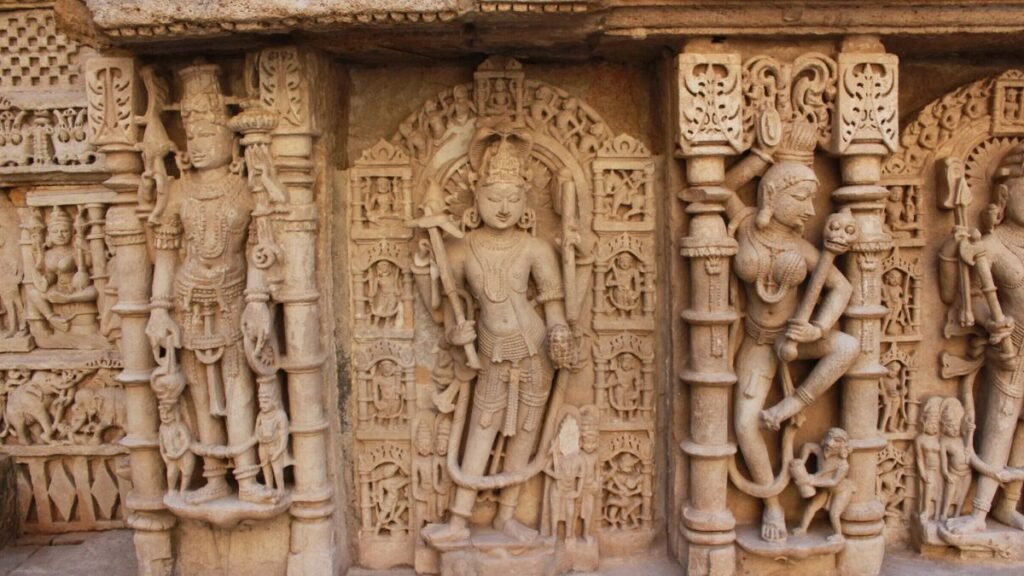
The sculptures of Rani Ki Vav are, by any measure, among the finest examples of medieval Indian stone carving in existence. More than 500 principal sculptures and over 1,000 minor ones are distributed across the seven gallery levels, presenting a comprehensive visual theology drawn from the Hindu religious tradition.
Also Read: Sarkhej Roza, Ahmedabad
The Themes – A Complete World in Stone
The sculptural programme at Rani Ki Vav encompasses three main thematic areas:
- Religious and devotional imagery deities of the Hindu pantheon in their multiple forms and manifestations; Brahma, Vishnu, Shiva, Lakshmi, Saraswati, Parvati, and their associated figures
- Mythological narratives – scenes from the Ramayana, the Mahabharata, and the Puranas; the sculptural panels at Rani Ki Vav reference specific episodes from these canonical texts in ways that would have been immediately legible to an 11th-century literate audience
- Secular imagery – women of the court in 16 different postures of beauty and daily life; musicians, dancers, and figures from everyday Solanki-era life captured in extraordinary detail
The Dashavatara – The 10 Avatars of Vishnu
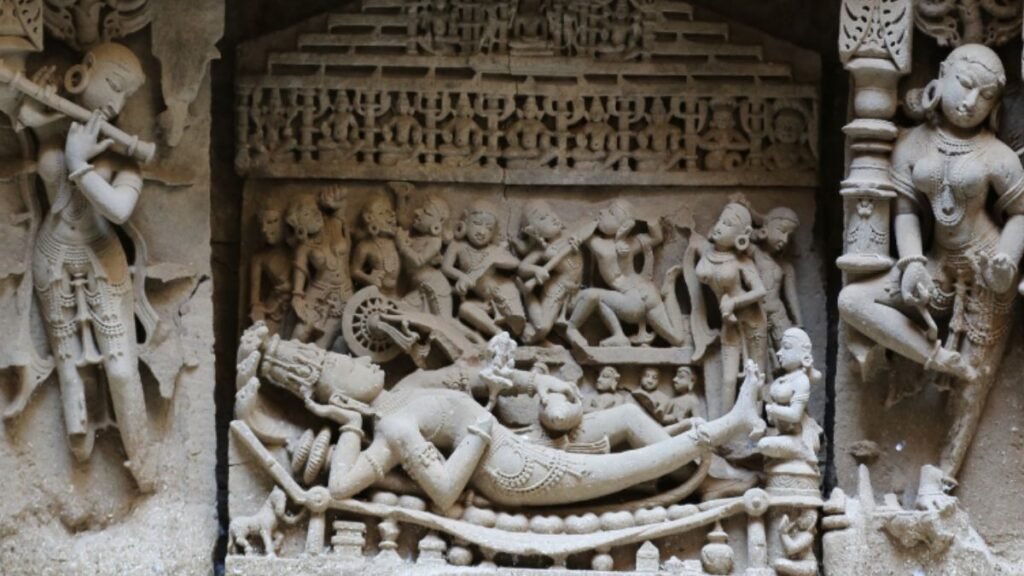
The sculptural centrepiece of Rani Ki Vav is the depiction of the Dashavatara the 10 avatars (incarnations) of Lord Vishnu. This complete cycle, presented in Rani Ki Vav’s gallery panels with exceptional artistic quality, is considered one of the most accomplished Dashavatara sequences in Indian sculpture. The 10 avatars Matsya (fish), Kurma (tortoise), Varaha (boar), Narasimha (man-lion), Vamana (dwarf), Parashurama, Rama, Krishna, Buddha, and Kalki are each depicted with the distinctive attributes, postures, and narrative contexts that identify them in the iconographic tradition.
The presence of a complete Dashavatara at Rani Ki Vav reinforces the inverted-temple concept: the stepwell is not merely a functional water structure with decorative carvings. It is a complete sacred space organised around the cosmological logic of Vaishnavism water as the primordial element from which all creation emerges, and the avatars of Vishnu as the divine responses to the challenges of creation across cosmic time.
The Apsaras – Celestial Maidens in 16 Postures
Among the most celebrated individual sculptures at Rani Ki Vav are the apsaras — divine celestial maidens depicted in 16 different postures. These figures, carved with extraordinary delicacy and sensuality, represent the aesthetic pinnacle of Solanki sculptural achievement. Each apsara figure is in a different posture: one applying kajal (eye makeup), one adjusting her anklet, one looking at her reflection, one playing music. The variety and naturalism of these postures the way the sculptor has captured the easy grace of a woman in the act of her own daily beauty ritual is something that photographs convey imperfectly. You need to stand before them.
The Nagakanya – Serpent Maidens
Nagakanyas female figures emerging from serpent forms, associated in Hindu mythology with the nagas (divine serpents) who are intimately connected with water, fertility, and the underground world appear at multiple points in the stepwell’s sculptural programme. Their presence is particularly appropriate at Rani Ki Vav: the nagakanyas are the guardians of the water realm, the divine feminine of the underground world that the stepwell is designed to access. In the context of the inverted temple, the nagakanyas serve as the divine inhabitants of the sacred space that descends below.
Rani Ki Vav on the ₹100 Note – India’s Most Widely Seen Heritage Monument
In 2019, the Reserve Bank of India introduced a revised ₹100 banknote. On its reverse is printed the image of Rani Ki Vav a clear, beautiful rendering of the stepwell’s descending galleries and sculptural panels. This decision effectively made Rani Ki Vav one of the most frequently viewed heritage monuments in India far more people have looked at the image on the note than have visited Patan in person.
The choice of Rani Ki Vav for the ₹100 note was a recognition of its extraordinary significance as a symbol of Indian cultural achievement. It is a structure built by a woman, designed around the concept of water as sacred, and decorated with one of the most comprehensive and beautiful sculptural programmes in the country. On the note, it represents not just Gujarat’s heritage but India’s.
For visitors who make the journey to Patan, the note is a useful reference point for the scale and character of what they are about to see and a reminder that the stepwell has been, in a sense, in everyone’s pocket for years.
The 3D Projection Mapping Show – Rani Ki Vav After Dark
In recent years, a 3D Projection Mapping Show has been introduced at Rani Ki Vav an evening light and projection installation that uses the stepwell’s architecture as its canvas, illuminating the galleries and sculptures with light, colour, and narrative. The show runs daily in two evening time slots and is open to all visitors at the site.
The projection mapping show transforms the experience of the stepwell in the evening light — the stone surfaces that are grey and static in daylight become living with colour, the sculptural figures appear to move, and the layers of the structure that are hard to read in a single visit become legible as a coherent architectural narrative.
For visitors who want to experience Rani Ki Vav in both its daytime and evening character the morning for the sculpture in natural light, the evening for the projection show this makes a full day in Patan genuinely worthwhile. Confirm current show timings and schedule at the Gujarat Tourism website (gujarattourism.com) before visiting.
Best Time to Visit Rani Ki Vav
October to March – Best Season
The winter months offer the most comfortable visiting conditions. North Gujarat is pleasant from October to February 15 to 25 degrees Celsius perfect for extended time in the stepwell’s open galleries. The morning light in October to January is particularly beautiful for photography: soft and directional, it catches the carved surfaces at an angle that reveals their depth and texture far better than the flat midday light.
Early Morning – Always Best
Rani Ki Vav is at its finest in the first two hours after it opens (8 to 10 AM). The light enters the galleries at a low angle, creating shadow plays on the carved panels that fundamentally change the visual character of the sculptures. The air is cool. The site is at its least crowded. Professional photographers and serious heritage visitors consistently cite early morning as the only time of day at which the stepwell’s full visual complexity can be properly experienced.
April to June – Hot but Early Mornings are Fine
North Gujarat summer can be intense. The stepwell itself being largely below ground offers some relief from the heat, but the surface-level approach and the walk between galleries can be uncomfortable in May and June. If visiting in summer, arrive precisely at 8 AM for the opening, complete your visit by 10:30 AM, and use the Modhera Sun Temple visit as the natural afternoon add-on after resting through midday.
Monsoon (July to September) – Atmospheric but Can Be Crowded
The monsoon months bring lush green surroundings to Patan and a dramatic quality to the light. The stepwell itself looks extraordinary in overcast diffuse light. However, weekend visits during monsoon can be significantly crowded as Gujarati families use the school holidays for heritage day trips. Weekday monsoon visits offer a more meditative experience of the site.
How to Reach Rani Ki Vav, Patan
| From | Distance | Mode | Approx. Time |
| Ahmedabad | ~125 km | Car / Bus (direct GSRTC service) | 3 hours |
| Mehsana | ~55 km | Car / Bus / Train + local transfer | 1 hour |
| Modhera Sun Temple | ~35 km | Car / Taxi | 45 minutes |
| Patan Railway Station | ~3 km | Auto-rickshaw from station | 10 minutes |
| Gandhinagar | ~140 km | Car | 3 hours |
| Ahmedabad Airport | ~125 km | Flight + Taxi/Bus | ~3 hours |
By Road – From Ahmedabad (The Most Common Route)
From Ahmedabad, Patan is approximately 125 km about 3 hours by road. Take the Ahmedabad-Mehsana National Highway (NH-947) northward to Mehsana (70 km), then follow the state road west to Patan (55 km from Mehsana). Google Maps navigation to ‘Rani Ki Vav, Patan’ is accurate. The road from Mehsana to Patan passes through agricultural landscape and becomes more interesting as you approach the town.
By Bus
GSRTC state buses run from Ahmedabad to Patan the journey takes approximately 3.5 hours. Buses also run from Mehsana to Patan (1 hour). From Patan bus stand, Rani Ki Vav is approximately 1 to 2 km take a local auto-rickshaw.
By Train
Patan Railway Station is approximately 3 km from Rani Ki Vav. Trains from Mehsana to Patan are available (Mehsana is on the Ahmedabad-Delhi mainline with frequent services). From Patan station, take an auto-rickshaw to the stepwell (approximately 10 minutes, ₹50 to ₹80).
Also Read: Top Heritage Sites in Gujarat: UNESCO, Stepwells & Forts
The Ahmedabad-Modhera-Patan Day Circuit
The most popular and most rewarding way to visit Rani Ki Vav is as part of the Ahmedabad-Modhera-Patan day circuit one of Gujarat’s finest single-day heritage experiences. Depart Ahmedabad early morning, visit the Modhera Sun Temple (another Solanki-era masterpiece, 35 km from Patan) in the morning, drive to Patan for Rani Ki Vav in the afternoon, and return to Ahmedabad in the evening. Both sites are products of the same dynasty and the same artistic tradition seeing them together on a single day gives the complete picture of Solanki achievement.
What Else to See in Patan
- Patan Patola Museum In Patan city | Patan is famous for the Patola — the extraordinarily intricate double ikat silk textile produced by a handful of families in the city using a technique of such complexity that a single saree can take 6 months to a year to complete. The Patan Patola Museum offers demonstrations of the weaving technique. The visual connection between the Patola’s geometric patterns and the stone lattice of Rani Ki Vav is one of Patan’s most beautiful artistic resonances.
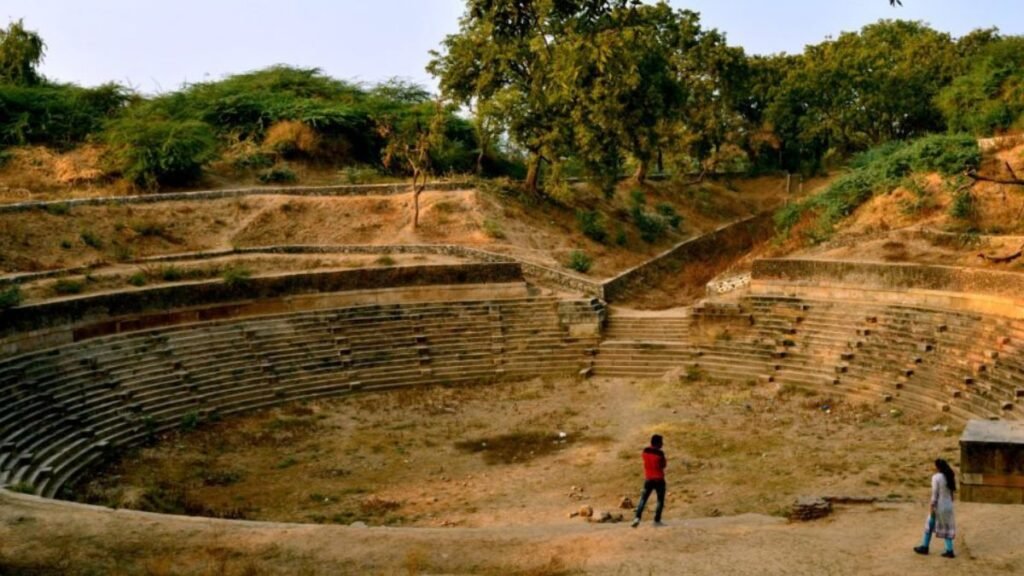
- Sahasralinga Talav ~2 km from Rani Ki Vav | A medieval artificial water tank built by the Solanki king Siddharaj Jaisingh in the 11th-12th century. The tank once had 1,000 lingams at its edge — hence the name Sahasralinga (a thousand lingams). The ruins of the tank and its surrounding structures are significant and the site is often combined with a Rani Ki Vav visit on the same trip.
- Patan Jain Temples Patan city | Multiple ancient Jain temples scattered through the city, some dating to the Solanki period. Patan was an important centre of Jainism and its temples reflect the remarkable Solanki architectural tradition in their Jain expression.
- Hemchandracharya Jain Knowledge Temple Patan | Dedicated to Hemchandracharya the great 12th-century Jain scholar-saint, grammarian, philosopher, and polymath who was associated with Patan and with the Solanki court. One of medieval India’s most extraordinary intellects.
- Modhera Sun Temple ~35 km | The other great Solanki-era monument a sun temple built in 1026 CE, approximately the same period as Rani Ki Vav. The carvings, the spatial organisation, and the architectural tradition are directly related. The Modhera Sun Temple is now the site of the famous Uttarayan and Modhera Dance Festival. Essential viewing in combination with Rani Ki Vav.
Practical Tips for Visiting Rani Ki Vav
- Arrive at 8 AM – this is non-negotiable for the best photographic and visual experience. The morning light in the galleries at 8 to 9 AM is categorically different from midday. The site is also at its quietest.
- Wear comfortable, non-slip shoes – the galleries involve descending multiple levels on stone steps that can be polished and slippery, particularly in damp monsoon conditions.
- Do not rush – allow at least 1.5 to 2 hours for a thorough visit. Each gallery level has its own sculptural programme that rewards slow examination. The temptation to walk straight down to the well and back up should be resisted.
- Look at the individual sculptures closely – the apsara figures in particular deserve extended attention. Details that are invisible from 3 metres are extraordinary at arm’s length. Bring your eyes as close as the barriers allow.
- The 3D Projection Show is in the evening – if combining a daytime Rani Ki Vav visit with the evening show, plan to spend the midday hours in Patan (Patola Museum, Sahasralinga Talav) and return for the show.
- Carry a camera with good low-light capability – the lower gallery levels are in shadow even in morning light; a camera with good ISO performance or a wide-aperture lens captures what phones often miss.
- Combine with Modhera Sun Temple – the two sites are 35 km apart and represent the same Solanki artistic tradition. Seeing both on the same day is one of Gujarat’s finest heritage experiences.
- No food or drink allowed on the stepwell premises – the ASI maintains strict rules; eat and drink before entering or after leaving.
Frequently Asked Questions (FAQs)
Rani Ki Vav the Queen’s Stepwell is an 11th-century subterranean stepwell in Patan, Gujarat, built by Queen Udayamati of the Solanki dynasty as a memorial to her husband King Bhimdev I. It was inscribed on the UNESCO World Heritage List in 2014 as ‘the most developed and ornate example of stepwell architecture in India.’ UNESCO describes it as ‘designed as an inverted temple highlighting the sanctity of water’ the architecture descends into the earth across seven gallery levels, intensifying in sculptural richness as it approaches the well at the deepest point. It contains more than 500 principal sculptures and over 1,000 minor ones, including a complete cycle of the 10 avatars of Vishnu and extraordinary figures of apsaras, nagakanyas, and deities.
Rani Ki Vav is managed by the Archaeological Survey of India. The entry fee is ₹40 per adult and ₹20 for children for Indian citizens, and ₹600 per adult for foreign nationals. The site is open from 8:00 AM to 6:00 PM daily. The best time to visit is in the first two hours after opening (8 to 10 AM) when the morning light enters the galleries at its most beautiful angle, the temperatures are coolest, and the site is at its least crowded. A separate 3D Projection Mapping Show runs in the evening check Gujarat Tourism for current show times.
Since 2019, the reverse of the Indian ₹100 banknote carries the image of Rani Ki Vav. The Reserve Bank of India selected Rani Ki Vav for this honour in recognition of its extraordinary significance as a UNESCO World Heritage Site and a symbol of India’s architectural and cultural achievement. The choice also reflects the structure’s character: built by a queen, designed around the sanctity of water, and decorated with India’s finest medieval sculptural programme. The ₹100 note has effectively made Rani Ki Vav one of the most widely viewed heritage monuments in India present in everyone’s pocket even if they have never visited Patan.
UNESCO describes Rani Ki Vav as ‘designed as an inverted temple highlighting the sanctity of water.’ This refers to the architectural logic of the stepwell: in a conventional Hindu temple, the sacred intensifies as you ascend ground level, plinth, hall, inner sanctum, and the spire at the highest point. At Rani Ki Vav, this logic is precisely reversed the sacred intensifies as you descend. The seven gallery levels grow richer in sculptural content as they descend toward the well at the deepest point. The water is the most sacred element. To approach the water, you must descend through progressively more sacred space as though the earth itself is the temple and the water at its heart is the sanctum sanctorum.
From Ahmedabad, Rani Ki Vav is approximately 125 km about 3 hours by road. Take the Ahmedabad-Mehsana National Highway northward to Mehsana, then follow the state road west to Patan. GSRTC buses run from Ahmedabad to Patan (approximately 3.5 hours). By train, take a service from Ahmedabad to Mehsana Junction (approximately 1.5 hours) and then a connecting train or bus to Patan (55 km from Mehsana). Patan Railway Station is 3 km from the stepwell take a local auto-rickshaw. The most popular approach is the Ahmedabad-Modhera-Patan day circuit: visit Modhera Sun Temple in the morning and Rani Ki Vav in the afternoon.
Yes and this combination is strongly recommended. Modhera Sun Temple is approximately 35 km from Rani Ki Vav and is the other great Solanki-era architectural monument in North Gujarat, built in 1026 CE. Both sites are products of the same dynasty, the same Maru-Gurjara architectural tradition, and the same extraordinary period of Gujarati artistic achievement. Seeing them both in a single day gives you the complete picture of what the Solanki dynasty produced. The recommended itinerary: depart Ahmedabad early, visit Modhera Sun Temple in the morning, drive to Patan for lunch and an afternoon visit to Rani Ki Vav, and return to Ahmedabad in the evening. This is one of Gujarat’s finest single-day heritage experiences.
The most celebrated sculptural highlights at Rani Ki Vav include: the Dashavatara (complete cycle of Vishnu’s 10 avatars) one of the most accomplished Dashavatara sequences in Indian medieval sculpture; the apsaras in 16 different postures divine celestial maidens captured with extraordinary delicacy and naturalism, each in a different attitude of beauty or daily life; the nagakanya (serpent maidens) associated with the water realm; standing figures of Vishnu in various forms; and the beautiful secular figures of women at their toilette. Individual sculptures that are widely photographed include the apsara applying kajal to her eyes, the figure looking into a mirror, and the complete Dashavatara panel. Always look at both the overall composition and the close detail many of Rani Ki Vav’s finest moments are in the small things.
Final Thoughts
The next time you hold a ₹100 note, look at what is printed on the back. That is a stepwell in Patan, Gujarat, built by a queen in the 11th century, buried by a river flood, preserved perfectly by the silt that covered it, excavated in the 20th century, and inscribed on the UNESCO World Heritage List in 2014. It descends 27 metres into the earth. It has more than 500 sculptures. It was designed as an inverted temple. It has been sitting in your pocket.
Go to Patan. Go early in the morning when the light enters the galleries. Descend slowly through the seven levels. Stop at the apsara applying kajal to her eyes. Look at the Dashavatara panel. Stand at the well shaft and look back up at the galleries above you. That is a thousand years of craftsmanship looking back at you. It is worth every kilometre of the journey from Ahmedabad.
