There is a story in Gujarat that every Vaishnava devotee knows. It is the story of an old man named Bodana a simple, devoted pilgrim from a small town called Dakor in Kheda district. Every Kartik Purnima, through the years of his life, Bodana walked on foot from Dakor to Dwarka a journey of over 200 kilometres just to have darshan of Lord Krishna at the Dwarkadhish Temple. He walked this path year after year until his legs could no longer carry him.
And then, in the miracle that the tradition preserves with great care, Lord Krishna moved by the absolute sincerity of this one old man’s love did not wait for Bodana to come to him. He came to Bodana. He left Dwarka in the middle of the night, helped the old man load his idol onto a bullock cart, drove the cart himself to near Dakor, and rested under a neem tree on the way. That neem tree, to this day, has one sweet branch.
Shri Ranchhodraiji Maharaj Temple in Dakor is the house this story built. Constructed in 1772 on the banks of Gomti Lake in the heart of Kheda district, it is one of Gujarat’s most beloved Krishna temples drawing tens of thousands of devotees every Purnima (full moon) and lakhs during the Kartik Purnima Mela. The temple’s idol a 1-metre black stone image of Lord Ranchhodraiji is said to be the original Dwarka idol that Bodana brought home. This TravelRoach guide tells you the full story and everything you need to plan a meaningful visit.
Ranchhodraiji Temple Dakor – Quick Information
| Detail | Information |
| Full Name | Shri Ranchhodraiji Maharaj Temple (also Dakor Temple / Dakor Mandir) |
| Location | Dakor, Thasra Taluka, Kheda District, Central Gujarat PIN 388225 |
| Setting | On the banks of Gomti Lake, in the heart of Dakor’s main bazaar |
| Deity | Lord Ranchhodraiji a form of Lord Krishna |
| Name Meaning | ‘Ranchhod’ = one who left the battlefield; ‘Rai’ = king the king who left war to save his people |
| Idol | Black touchstone; 1 m tall × 45 cm wide; four arms in Vishnu form; right hand in Abhaya Mudra |
| Idol Adornment | Richly adorned with gold, jewels, and expensive clothes; throne gifted by the Gaekwad of Baroda |
| Temple Built | 1772 AD |
| Built By | Gopal Jagannath Tamabekar (Ambekar) a banker of the Peshwa’s court in Poona |
| Architecture | Surrounded by fort wall; 8 domes; 24 turrets; central dome 27 m high; tallest temple in Kheda district |
| Flag and Finial | Golden kalash (finial) and white silken flag at the top |
| Managed By | Dakor Temple Trust (Committee of Vaishnava devotees; registered as Public Religious Trust in 1952) |
| Entry Fee | Free – no entry fee for darshan |
| Darshan Timings (Morning) | Approximately 5:30 AM – 12:30 PM |
| Darshan Timings (Evening) | Approximately 3:00 PM – 9:30 PM |
| Best Time to Visit | October to March; every Purnima (full moon) is significant |
| Main Festival | Kartik Purnima Mela – full moon of Kartik month (October–November); lakhs attend |
| Sacred Lake | Gomti Lake (Gomati Talav) – adjacent to the temple |
| Distance from Anand | ~43 km (~1 hour) |
| Distance from Nadiad | ~35 km (~45 minutes) |
| Distance from Ahmedabad | ~90 km (~2 hours) |
| Distance from Vadodara | ~60 km (~1.5 hours) |
| Nearest Major Railway | Nadiad (~35 km) and Anand (~43 km) |
| Branch Line | Umreth Station (branch line terminus) ~7–8 km from Dakor |
| Nearest Airport | Vadodara Airport (~78 km); Ahmedabad Airport (~90 km) |
‘Ranchhodrai’ – The King Who Left the Battlefield
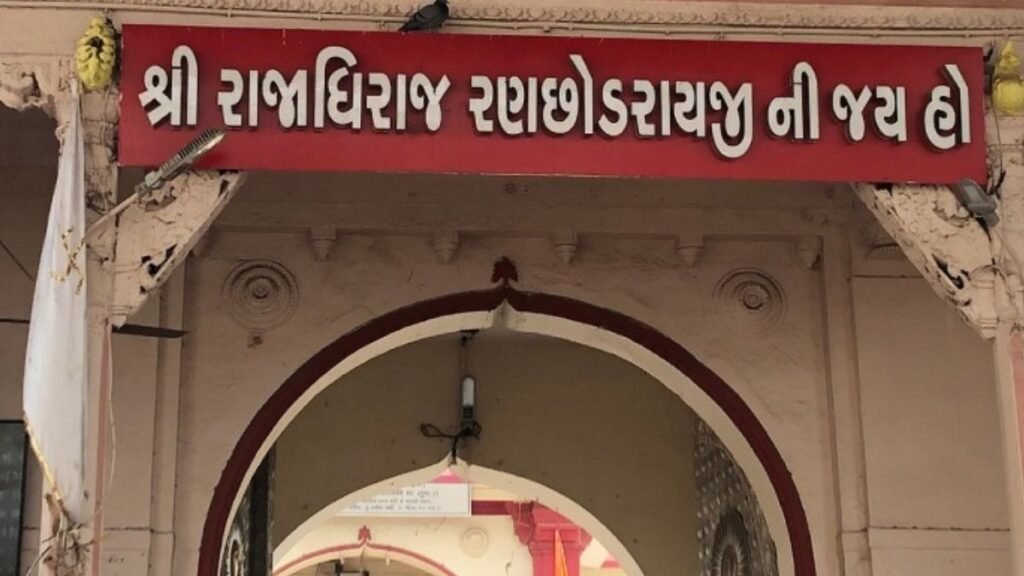
Before entering the story, the name itself deserves explanation because ‘Ranchhodrai’ is one of the most revealing of all Krishna’s many names in the Vaishnava tradition.
The name breaks into two parts: Ranchhod + Rai. ‘Ranchhod’ comes from ‘Rann’ (battlefield) and ‘chhod’ (to leave) literally, one who left the battlefield. ‘Rai’ means king. Ranchhodrai is therefore ‘the king who left the battlefield.’
This name refers to a specific episode in Krishna’s biography. Mathura the city of Krishna’s birth was repeatedly attacked by Jarasandha, the powerful king of Magadha, who sought revenge for the killing of his son-in-law Kamsa. Rather than engage in endless, destructive war that would cost countless lives among his people, Krishna made the pragmatic and compassionate decision to relocate the entire Yadava community from Mathura to a new city he founded on the sea coast: Dwarka. By leaving the battlefield of Mathura not from cowardice but from wisdom Krishna saved his people from repeated siege.
In the spiritual interpretation, the name carries an even deeper meaning: Ranchhodrai is the one who abandons the battlefield of the world (the constant struggle of material existence) and retreats to a higher ground just as the devotee is invited to leave behind the battlefield of ego and desire and take shelter in the divine. The name is simultaneously historical and metaphorical. It is also uniquely Gujarati Krishna as Ranchhodrai is a form and a name deeply associated with Gujarat’s Vaishnava culture.
Also Read: Bet Dwarka: Complete Travel Guide to Lord Krishna’s Sacred Island in Gujarat
The Full Legend of Bodana – How the Lord Came to Dakor
Ancient Dakor – From Dankpur to the Present
Dakor’s spiritual history predates its Vaishnava identity. In ancient times, the area was a dense jungle known as Hidamba van, and the town itself was called Dankpur named after the sage Dankarishi (Dank Rishi) who performed intense penance here to please Lord Shiva. Dankarishi’s tapasya was rewarded, and he established the Dunkanath Mahadev Temple on the banks of the Gomati Lake a Shiva temple that still stands in Dakor today as one of its most ancient sacred structures.
Over time, as Vaishnavism grew in Gujarat and the stories of Bodana spread, Dakor transformed from a Shaiva pilgrimage centre into one of Gujarat’s most important Vaishnava shrines. The ancient name Dankpur gave way to ‘Dakor’ believed to be derived from ‘Dankor’ or ‘Daakhor’ and the town’s identity became entirely intertwined with the legend of the devoted pilgrim and the merciful Krishna who walked through the night to honour him.
Bodana – The Pilgrim Who Walked
Bodana was a Vaishnava devotee of Dakor whose devotion to Lord Krishna was absolute, simple, and consistent. Every year, on the occasion of Kartik Purnima the full moon of the Hindu month of Kartik, which falls in October or November Bodana walked on foot from Dakor to Dwarka. This was not a short pilgrimage. Dwarka, on the far western tip of Gujarat’s Saurashtra coast, is well over 200 kilometres from Dakor. Bodana walked this distance barefoot, carrying nothing but his devotion every Kartik Purnima, year after year.
As Bodana aged, the journey became physically beyond him. He could no longer walk to Dwarka. But he could not simply stop going the annual Dwarka darshan was the organising rhythm of his devotional life. One Kartik Purnima, he arrived in Dakor with a bullock cart. The other residents of Dakor were curious. Why had he brought a cart?
Bodana answered simply: he had brought the cart to carry Lord Krishna back to Dakor with him.
The Night at Dwarka – Krishna Breaks His Own Doors
Bodana reached Dwarka and was received at the temple in the normal way of a pilgrim. The hereditary priests the Gugli Brahmins were suspicious of the cart but did not prevent him from entering. That evening, they locked and sealed the inner sanctum of the Dwarkadhish Temple as usual and retired for the night.
At midnight, something unprecedented happened. Lord Krishna broke open the locked and sealed doors of his own sanctum from the inside. He woke Bodana and told him to load the idol onto the bullock cart. And then in one of the most intimate and moving moments in all of Gujarat’s Vaishnava oral tradition Lord Krishna himself climbed onto the driver’s seat of the bullock cart and drove it through the night toward Dakor.
When they reached the vicinity of Dakor at a spot near Bileshwar Mahadev on the Dakor-Nadiad road Krishna stopped the cart and rested under a neem tree, holding and touching one of its branches. He woke Bodana to take over the driving for the final stretch. Since that night, it is said, that neem tree has had one branch that is sweet while all its other branches remain bitter, as neem branches are. The tree and its sweet branch have become a sacred landmark associated with the legend, the subject of a beloved Gujarati bhajan (devotional song).
The Pursuit – Gugli Brahmins Arrive in Dakor
When the Gugli Brahmins of Dwarka discovered the following morning that the idol was gone, they understood what had happened. They chased Bodana and arrived in Dakor demanding the return of the idol. Bodana, facing the arrival of the Brahmins who had every traditional claim to the idol, was frightened. But Lord Krishna told him to hide and assured him that he would handle the situation.
Bodana died before the matter was fully resolved. His wife Gangabai was left a widow in poverty without means or resources to satisfy the Brahmins’ demand for the idol’s return or its equivalent value in gold.
Lord Krishna then directed Gangabai: weigh me and give the Gugli Brahmins gold equal to my weight, and they will return to Dwarka satisfied.
Gangabai was a pauper. She had only one small gold ornament a nose-ring. The weighing scale was set up at what is now known as the Gangabai Tula in Dakor. The idol of Ranchhodraiji was placed on one side of the scale. By divine miracle, the idol became as light as Gangabai’s single gold nose-ring. The weight balance was achieved with one small ornament.
The Gugli Brahmins, though disappointed, accepted the divine resolution. But Lord Krishna also gave them a consolation: within six months, they would find a replica idol in the Sevaradhan Vav (a stepwell at Dwarka) to replace the one he had brought to Dakor. The impatient Brahmins looked for the replica slightly earlier than told and found it a little smaller than the original. The original, they accepted, now belonged to Dakor. And it has remained here ever since.
Also Read: Kalika Mata Temple, Pavagadh Hill
Sacred Sites of the Legend in Dakor
The legend of Bodana and Gangabai is not merely told in Dakor it is commemorated in sacred sites throughout the town:
- Gangabai Tula – The sacred weighing scale where Gangabai’s nose-ring balanced the Lord’s weight; a site of pilgrimage and contemplation
- Padukaji – The sacred footprints of Lord Krishna preserved near the temple; worshipped by devotees who have darshan of the footprints before or after the main temple
- Bileshwar Mahadev – On the Dakor-Nadiad road; the Shiva shrine near the neem tree where Krishna rested during the midnight journey
- The Neem Tree -The tree with one sweet branch that has been touched by Krishna’s hand, associated with a beloved Gujarati bhajan
- Gomti Lake (Gomtighat) – The sacred lake on whose banks both the ancient Dunkanath Temple and the present Ranchhodraiji Temple stand
The Temple – Architecture, Idol, and Atmosphere
The Structure – 8 Domes and 24 Turrets
The present Ranchhodraiji Temple was built in 1772 AD by Gopal Jagannath Tamabekar (also referred to as Ambekar) a shroff (banker/moneylender) in the court of the Peshwa in Poona and a member of the Gaekwad banking establishment. He was inspired by the legend of Lord Ranchhodraiji and dedicated his wealth to constructing a temple worthy of the deity who had walked through the night for his devotee.
The temple is surrounded by a fort wall creating a fortified sacred compound that in its scale and defensive architecture reflects the martial-devotional aesthetic of 18th-century Gujarat. Within the walls, the main temple building features 8 domes and 24 turrets, with the central dome rising to a height of 27 metres making it the tallest temple in Kheda district. A golden kalash (finial) crowns the dome. A white silken flag flies above visible from a considerable distance, identifying the temple across the roofline of Dakor town.
The Sacred Idol – Black Touchstone and the Abhaya Mudra
At the centre of the temple’s inner sanctum stands the idol of Lord Ranchhodraiji described as one of the finest examples of black touchstone (syama shila) idol carving in Gujarat. The idol is 1 metre tall and 45 centimetres wide a substantial, commanding presence in the sanctum. It has four arms in the classical Vishnu form holding the conch (shankha), the lotus (padma), the discus (chakra), and the mace (gada). The lower right arm is raised in the Abhaya Mudra the gesture of protection and fearlessness, the divine gesture that says: do not be afraid.
The idol’s expression is described by devotees and observers as youthful more in the manner of Krishna the divine youth than Dwarkadhish the cosmic king. This reflects the particular character of the Ranchhodrai form: it is Krishna in his most approachable, most intimate, most human-adjacent manifestation. He is the Lord who drove a bullock cart through the night for an old man. He is the deity of personal love and practical compassion.
The idol is richly adorned gold, jewels, and expensive clothing that are changed with the seasons and on festival occasions. The throne on which the idol stands was gifted by the Gaekwad of Baroda an ornate masterpiece of Gujarati woodcarving that places the god on a seat of royal and artistic excellence.
The Gomti Lake and the Temple Setting
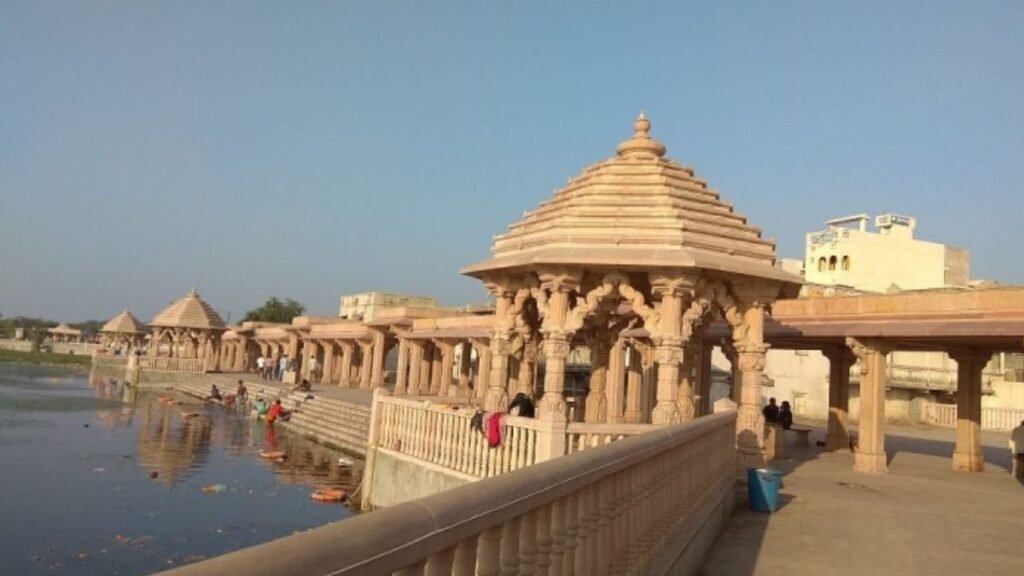
Ranchhodraiji Temple is inseparable from the Gomti Lake (Gomati Talav) on whose banks it stands. The lake a large, sacred tank in the heart of Dakor town is itself a place of pilgrimage, bathing, and ritual. The Gomtighat on the lake edge is where devotees take a sacred bath before entering the temple. The combination of the grand temple dome reflected in the lake water and the surrounding bazaar of Dakor’s market creates a temple-town atmosphere that is one of Central Gujarat’s most distinctive sacred landscapes.
Boating (naukavihar) is available on the Gomti Lake a pleasant activity for families and groups who want to see the temple from the water. The lake and the temple together create the defining visual of Dakor: the white silken flag against the golden kalash, the domes reflected in the still water, the sounds of the bazaar filtered through the evening aarti bells.
Every Purnima – The Monthly Pilgrimage
One of the most distinctive aspects of Ranchhodraiji Temple is the intensity of its monthly Purnima (full moon) observance. While most temples have their major crowds on annual festivals, Dakor receives substantial pilgrim numbers on every single Purnima throughout the year twelve times annually, thousands of devotees make the journey specifically for the Purnima darshan.
This monthly pilgrimage tradition is directly connected to Bodana’s story: the Kartik Purnima was the occasion of his annual Dwarka walk. In his memory and in his spirit, devotees continue the Purnima pilgrimage tradition walking, travelling by bus, coming from Ahmedabad, Anand, Nadiad, Vadodara, and dozens of smaller towns across Central Gujarat to stand before the Lord on the full moon night.
The Purnima at Dakor is particularly atmospheric at dusk and after dark the temple is illuminated, the Gomti Lake reflects the lights, and the devotional crowd creates a concentrated energy that transforms the ordinary market town into something genuinely sacred. If you visit Dakor on a Purnima evening, arrive by late afternoon and prepare to stay through the evening darshan session.
Festivals at Ranchhodraiji Temple
Kartik Purnima Mela – The Biggest Annual Event
The Kartik Purnima the full moon of the Kartik month (October or November) is the most important annual festival at Dakor. This is the occasion that Bodana walked to Dwarka for, year after year, through his entire devotional life. It is the occasion on which Krishna brought the idol from Dwarka to Dakor. The Kartik Purnima at Dakor is therefore not merely a festival but a commemoration of the founding miracle of the temple itself.
The Kartik Purnima Mela at Dakor draws lakhs of pilgrims from across Gujarat and beyond. The town fills with devotees in the days around the full moon night. The temple operates extended darshan hours. The Gomti Lake is the site of special lighting ceremonies diya-floating (deep-daan) on the water is particularly beautiful on the Kartik Purnima night. The bazaar around the temple comes alive with vendors, pilgrims, and the extraordinary collective devotional energy of a major Gujarati pilgrimage mela.
Janmashtami – Krishna’s Birth Anniversary
Janmashtami the birth anniversary of Lord Krishna, typically falling in August or September is one of the major festival events at Dakor. The temple is decorated with flowers, lights, and garlands. Special programs continue through the day and into the midnight hour when the moment of Krishna’s birth is commemorated with aarti and celebration. The Ranchhodraiji manifestation of Krishna youthful, personal, intimate gives Janmashtami at Dakor a particularly warm and immediate character.
Holi and Rang Panchami
Holi and particularly Rang Panchami the fifth day after Holi, celebrated with particular intensity in the Vaishnava tradition are colourful, exuberant festival days at Dakor. The association of Holi with Krishna’s playful, joyous character makes the celebration here especially enthusiastic and true to the Ranchhodrai spirit.
Other Vaishnava Festivals
All the major dates of the Vaishnava calendar are observed at Dakor with appropriate ceremonies: Ram Navami (birth of Lord Rama), Navratri, Diwali, Annakut (Govardhan Puja), and the other Ekadashi and Dwadashi observances of the Pushtimarg and related traditions.
Best Time to Visit Ranchhodraiji Temple Dakor
October to March – Best Overall Season
Winter months are the most comfortable for Dakor visits. Central Gujarat temperatures from October to February are pleasant 18 to 28 degrees Celsius ideal for the temple visit, the Gomti Lake walk, and exploring the associated sacred sites around town. The Kartik Purnima falls in this period, making October and November particularly significant.
Every Purnima – Monthly Pilgrimage Calendar
If you want to experience Dakor at its most devotionally alive, time your visit to coincide with any Purnima (full moon night). The atmosphere on Purnima evenings illuminated temple, full Gomti Lake, evening aarti with thousands of pilgrims is entirely different from a regular weekday visit. Check the Hindu calendar for the current month’s Purnima date before planning.
Kartik Purnima (October / November) – The Greatest Gathering
The Kartik Purnima Mela is the most important single event at Dakor. If attending, book accommodation in Anand or Nadiad (the nearest towns with good hotel options) well in advance — Dakor itself has limited accommodation and it fills up completely during Kartik Purnima. The full moon night itself is extraordinary but the approach roads can be very congested.
Early Morning on a Weekday – Quietest Darshan
For a calm, contemplative darshan without crowd pressure, visit on a weekday morning (Tuesday to Thursday) between 6 and 9 AM. This gives you the morning opening aarti, unhurried access to the sacred idol, time for the Gomtighat bath, and the smaller associated sacred sites of Dakor all in the cool, quiet morning hours.
How to Reach Ranchhodraiji Temple, Dakor
| From | Distance | Mode | Approx. Time |
| Anand | ~43 km | Car / Bus / Train + local transfer | 1 hour |
| Nadiad | ~35 km | Car / Bus / Train + local transfer | 45 minutes |
| Ahmedabad | ~90 km | Car / Bus | 2 hours |
| Vadodara | ~60 km | Car / Bus | 1.5 hours |
| Umreth Station (Branch Line) | ~7–8 km | Train to Umreth + Auto | 15 minutes from station |
| Gandhinagar | ~105 km | Car | 2.5 hours |
| Ahmedabad Airport | ~90 km | Flight + Taxi/Bus | 2 hours |
| Vadodara Airport | ~78 km | Flight + Taxi | 1.5–2 hours |
By Road (Most Common Option)
Dakor is easily accessible by road from all major Central Gujarat cities. From Ahmedabad, take the Ahmedabad-Vadodara National Highway and exit toward Anand, then continue to Dakor (~90 km total). From Vadodara (~60 km), the drive is direct on the state highway. GSRTC state buses run to Dakor from Ahmedabad, Vadodara, Anand, and Nadiad. Private buses and shared autos from Anand and Nadiad are also available. Dakor is on NH-59.
By Train
Nadiad Junction and Anand Junction are the nearest major railway stations both on the main Ahmedabad-Mumbai Western Railway line with frequent trains from Ahmedabad, Vadodara, Surat, and Mumbai. From Nadiad or Anand, hire a local taxi or take an ST bus to Dakor (35 to 43 km respectively). For those specifically wanting a rail arrival, Umreth Railway Station on a branch line is only 7 to 8 km from Dakor but train services on this branch are limited and infrequent.
Things to See and Do in Dakor
- Main Darshan – Lord Ranchhodraiji | The primary experience of any Dakor visit standing before the 1-metre black stone idol in its four-armed Vishnu form, right hand raised in Abhaya Mudra, adorned in gold and jewels. Allow time for quiet darshan without rushing to the next site.
- Gomti Lake and Gomtighat | The sacred lake on whose banks the temple stands. Take the ritual bath at Gomtighat before temple darshan. Walk the lakeside in the early morning or evening when the water reflects the temple domes. Boating (naukavihar) is available for families.
- Gangabai Tula | The sacred weighing scale associated with the miracle of Gangabai’s nose-ring. A site of deep devotional significance that commemorates the most intimate moment of the Bodana legend the Lord making himself as light as a widow’s last ornament.
- Padukaji | The sacred footprints of Lord Krishna. Darshan of the Lord’s footprints is considered highly auspicious and is traditionally the first or last act of the Dakor pilgrimage.
- Dunkanath Mahadev Temple | The ancient Shiva temple from Dakor’s pre-Vaishnava era; one of the oldest structures in the town. Worth a short visit for the historical dimension it adds to the pilgrimage.
- Shardamatha | A religious institution in Dakor offering spaces for devotional study and community. Particularly active during festival seasons.
- Bileshwar Mahadev and the Neem Tree | On the Dakor-Nadiad road; the Shiva shrine and the neem tree where Krishna rested during the midnight journey. For devotees who know the legend intimately, visiting this spot is deeply meaningful it is the exact place where the divine stopped to rest on the way to keeping a promise to one old man.
Also Read: Gira Waterfalls, Dang
Practical Tips for Visiting Dakor
- Remove footwear at the temple entrance – storage facilities are available. The temple is active and devotional in character throughout the day.
- Dress modestly – men in full trousers and covered shoulders; women in saree or salwar kameez with head covered inside the sanctum.
- Arrive early morning for peaceful darshan – the temple opening (5:30 to 6 AM) is when the morning aarti creates the day’s most atmospheric experience and queue times are shortest.
- On Purnima days – arrive by 4 PM to navigate parking and queue; the evening darshan session on Purnima is the spiritual high point but draws the largest crowds.
- During Kartik Purnima Mela – book accommodation in Anand or Nadiad well in advance; the town fills completely; expect very long queues for darshan on the main Purnima night.
- Explore the Gomti Lake before or after darshan – the lake walk is particularly beautiful in the early morning when mist sits over the water and the temple dome catches the first light.
- Visit the Gangabai Tula and Padukaji – these are within the temple complex or very close to it and add essential context to the main darshan.
- Carry cash – the Dakor bazaar around the temple is a traditional market; digital payments are available at some stalls but cash is universally useful here.
Nearby Attractions to Combine with Dakor
- Anand ~43 km | The dairy cooperative capital of India — the birthplace of the AMUL story and the White Revolution. Visit the AMUL Dairy in Anand for a fascinating tour of India’s most successful cooperative enterprise. Also home to Vallabh Vidyanagar, a planned educational town.
- Vadodara (Baroda) ~60 km | Laxmi Vilas Palace (one of India’s largest private palaces), Baroda Museum, Sayaji Baug, and the EME Temple. A full cultural city worth a separate day. Read our full TravelRoach guide.
- Champaner-Pavagadh Archaeological Park ~100 km | UNESCO World Heritage Site with 15th-century Islamic architecture and the Kalika Mata Temple atop Pavagadh Hill. Add to a Dakor + Vadodara 2-day circuit.
- Adalaj ni Vav (Stepwell) ~80 km | The magnificent 15th-century five-storey stepwell near Gandhinagar. Read our full TravelRoach guide.
- Manek Chowk Night Market, Ahmedabad ~90 km | Ahmedabad’s famous late-night street food market. Combine with a day visit to Dakor for a complete Central Gujarat day. Read our full TravelRoach guide.
Frequently Asked Questions (FAQs)
Ranchhodraiji Temple in Dakor, Kheda district, is famous for being one of Gujarat’s most beloved Krishna temples one where the deity is worshipped in his most intimate and compassionate manifestation as Ranchhodraiji, the Lord who left the battlefield to save his people and who walked through the night to honour his devoted pilgrim Bodana. The temple is renowned for its remarkable legend: the idol in the sanctum is said to be the original Dwarka idol of Krishna that he himself placed on a bullock cart and drove to Dakor for his aging devotee. The temple draws thousands of pilgrims on every Purnima (full moon) throughout the year, and lakhs during the famous Kartik Purnima Mela.
Ranchhodrai is one of Lord Krishna’s most distinctive names in the Gujarati Vaishnava tradition. It breaks into two parts: ‘Ranchhod’ comes from ‘Rann’ (battlefield) and ‘chhod’ (to leave) meaning ‘one who left the battlefield.’ ‘Rai’ means king. Ranchhodrai is therefore ‘the king who left the battlefield.’ This name commemorates Krishna’s decision to relocate the Yadava community from Mathura (repeatedly attacked by King Jarasandha) to the newly founded city of Dwarka choosing the protection of his people over the pride of unending war. In deeper spiritual interpretation, it represents the invitation to leave behind the battlefield of material existence and seek refuge in the divine.
Bodana was a devoted Vaishnava of Dakor who walked on foot from Dakor to Dwarka over 200 km every Kartik Purnima to have darshan of Lord Krishna. As he aged, he arrived at Dwarka one year with a bullock cart, saying he had come to take Lord Krishna to Dakor. That midnight, Krishna broke open the sealed doors of his own sanctum, woke Bodana, and drove the bullock cart through the night to Dakor resting under a neem tree on the way (which has had one sweet branch ever since). When the Dwarka priests discovered the idol was gone, they pursued Bodana to Dakor. After Bodana died, his widow Gangabai was left in poverty. By divine miracle, when the idol was placed on a weighing scale, it became as light as Gangabai’s single gold nose-ring. The idol remained in Dakor. Today, the Gangabai Tula (the weighing scale) and the Padukaji (Krishna’s footprints) are sacred sites in Dakor commemorating this legend.
Ranchhodraiji Temple Dakor is open for darshan approximately from 5:30 AM to 12:30 PM in the morning session and from 3:00 PM to 9:30 PM in the evening session. There is a midday break for ritual maintenance. Entry for darshan is completely free no ticket required. During Purnima days and major festivals like Kartik Purnima Mela and Janmashtami, darshan hours may be extended. Always confirm current timings by checking the official temple website at www.ranchhodraiji.org before your visit.
From Ahmedabad, Dakor is approximately 90 km about 2 hours by road. Take the Ahmedabad-Vadodara National Highway toward Anand and follow the road to Dakor from there. GSRTC state buses run from Ahmedabad to Dakor directly. By train, take a fast service from Ahmedabad to Nadiad Junction (~35 km from Dakor) or Anand Junction (~43 km from Dakor), then hire a local taxi or take an ST bus to Dakor. If coming from Vadodara, Dakor is approximately 60 km away about 1.5 hours by road.
The Kartik Purnima Mela at Dakor is the most important annual event at Ranchhodraiji Temple a major religious fair held on the full moon (Purnima) of the Hindu month of Kartik, which falls in October or November. This is the Purnima that Bodana walked to Dwarka for every year and the occasion on which Lord Krishna drove the bullock cart to Dakor in the founding miracle of the temple. The mela draws lakhs of pilgrims from across Gujarat and beyond, with continuous extended darshan, lamp-floating ceremonies on the Gomti Lake, and a vibrant fair atmosphere around the temple. Book accommodation in Anand or Nadiad well in advance as Dakor fills up completely during the mela.
Yes – Dakor is one of the most practical day trips from Ahmedabad in Central Gujarat. At approximately 90 km, the drive takes about 2 hours. An ideal Dakor day trip itinerary: morning departure from Ahmedabad, arrival for morning darshan, Gomtighat bath, Gangabai Tula and Padukaji visits, lunch in Dakor town, and an afternoon visit to the Dunkanath Mahadev Temple. Return to Ahmedabad in the evening or stay for the evening darshan session if visiting on a Purnima day, which makes the trip significantly more atmospheric and worthwhile. The trip can be extended into a 2-day circuit by combining with Vadodara (60 km from Dakor).
Final Thoughts
There is a reason that every Purnima, thousands of people from the towns and villages of Central Gujarat get into buses or cars and drive to Dakor. They are not going to see a famous building or a celebrated architectural masterpiece. They are going to stand before a god who once drove a bullock cart through the night because an old man loved him.
That is the story Ranchhodraiji Temple tells. Not the story of divine power or cosmic creation but the story of what happens when devotion is total and love is answered in kind. The Lord who left the battlefield. The Lord who drove through the night. The Lord who let himself be weighed against a widow’s single nose-ring and found it sufficient.
Visit Dakor on a Purnima evening. Go to the Gomtighat first. Wash your face in the lake water. Walk to the temple as the lamps are lit. Stand before the four-armed black stone idol with the Abhaya Mudra raised. And let the story hold you for a moment.
Have you visited Ranchhodraiji Temple Dakor? Share your darshan experience, your Kartik Purnima memory, or your Purnima evening story in the comments TravelRoach would love to hear from every Central Gujarat pilgrim!
