At the far western tip of Kutch, where the district of Lakhpat touches the Kori Creek and the Arabian Sea is within earshot, there is a lake that Hindu tradition places in the company of Mansarovar in Tibet, Pushkar in Rajasthan, and Sidhpur’s Bindu Sarovar. Narayan Sarovar the Lake of the Divine Vishnu is one of the Panch Sarovar: the five most sacred lakes in Hinduism, each one associated with the divine in a way that ordinary water bodies are not.
The sacredness of Narayan Sarovar is layered and ancient. The Shiv Purana mentions it. The Shrimad Bhagwat links the lake to Lord Vishnu. The Ramayan acknowledges its sanctity. The sacred River Saraswati, lost to the surface world, is said to have joined the sea here, blessing the confluence of this lake and the sea with her invisible divine presence. The water of the lake is believed to have emerged from the toe of Lord Narayan’s right foot giving the lake the quality of tirtha water in the most literal mythological sense: water that has been in contact with the divine.
What makes Narayan Sarovar additionally remarkable is what surrounds it: a wildlife sanctuary with chinkaras and desert foxes, the extraordinary ghost town of Lakhpat Fort four kilometres away, the Koteshwar Mahadev Temple at the western edge of the Indian mainland with the Arabian Sea directly below it, and the particular quality of remoteness that belongs to the westernmost inhabited edge of India the silence before Pakistan, the quiet before the sea. This TravelRoach guide covers everything a visitor needs for the complete Narayan Sarovar experience.
Narayan Sarovar — Quick Information
| Detail | Information |
| Full Name | Narayan Sarovar – the Lake of the Divine Vishnu (Narayan = Vishnu, Sarovar = lake) |
| Location | Lakhpat Taluka, Kutch District, Gujarat on the Kori Creek near the Arabian Sea |
| Sacred Status | One of the Panch Sarovar – the five holiest lakes in Hinduism |
| The Five Panch Sarovar | Mansarovar (Tibet), Narayan Sarovar (Kutch), Bindu Sarovar (Sidhpur), Pampa Sarovar (Karnataka), Pushkar Sarovar (Rajasthan) |
| Mentioned In | Shiv Purana, Shrimad Bhagwat, Vishnu Purana, Ramayana |
| The Legend | Water emerged from the toe of Lord Narayan’s right foot; the sacred Saraswati River is said to have joined the sea here |
| The Sacred Confluence | Freshwater lake meets the Arabian Sea/Kori Creek this sacred union of freshwater and seawater is especially holy |
| The Temple Complex | Seven shrines dedicated to various forms of Lord Vishnu, within a fortified walled courtyard |
| Main Shrines | Narayan Temple, Lakshminarayan Temple, Trikamray (Trivikramray) Temple, and four other shrines |
| Temple Age | Estimated 12th-13th century |
| Vallabhacharya Connection | Mahaprabhuji (Vallabhacharya) visited during his lifetime; Seat No. 63 of the 84 Bethaks (Pushtimarg tradition) |
| Wildlife Sanctuary | Narayan Sarovar Chinkara Wildlife Sanctuary chinkara, desert fox, desert cat, jungle cat, migratory birds |
| Entry Fee | Free -no entry fee for the lake or temple complex |
| Temple Timings | 6:00 AM – 12:00 PM and 4:00 PM – 9:00 PM (open all days) |
| Pilgrimage Activity | Holy dip in the lake, darshan at all seven shrines, morning and evening aarti |
| Adjacent Temple | Koteshwar Temple (Lord Shiva) -4 km northwest, at the western edge of the Indian mainland |
| Adjacent Heritage | Lakhpat Fort ~4 km; a walled ghost town with mosques, a Gurudwara, and historic maritime trade history |
| Most Important Festival | Kartik Purnima (November full moon) largest annual fair; holy dip; thousands of pilgrims |
| Other Festivals | Narayan Sarovar Fair (November), Koteshwar Mahadev Fair (February), Chaitra month fair |
| Accommodation | Basic guest houses near the complex; better hotels in Nakhatrana or Bhuj |
| Distance from Bhuj | ~150–158 km via Naliya (~4–5 hours by road) |
| Distance from Koteshwar Temple | ~4 km |
| Distance from Lakhpat Fort | ~4 km |
| Distance from Mata no Madh | ~50 km |
| Distance from Mandvi Beach | ~135 km |
| Nearest Airport | Bhuj Airport (~150 km) |
| Nearest Railway | Bhuj Railway Station (~150 km) |
The Panch Sarovar — Understanding Narayan Sarovar’s Sacred Rank
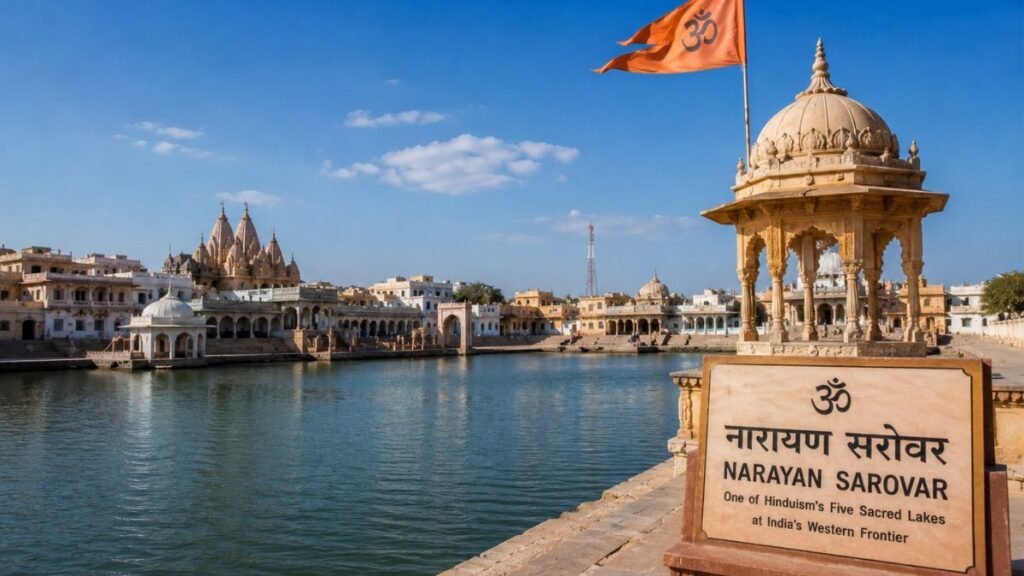
The Panch Sarovar concept places Narayan Sarovar within a specific and elevated category in the sacred geography of Hinduism: the five holiest lakes, each one of which is not merely a body of water but a point of cosmic significance, a place where the divine has made its presence in water permanently available to the seeker. The five are:
- Mansarovar – in Tibet, on the Roof of the World, at the foot of Mount Kailash where Lord Shiva resides; the highest and most physically demanding of the five to reach
- Narayan Sarovar – in Lakhpat, Kutch, at the western edge of the Indian subcontinent; associated with Lord Vishnu/Narayan
- Bindu Sarovar – in Sidhpur, North Gujarat; also a Panch Sarovar and the site of the Matru Gaya pilgrimage, where sons perform rituals for deceased mothers
- Pampa Sarovar -in Karnataka, associated with the Ramayana (Sugriva’s kingdom was nearby); a lake of immense antiquity in Kannada devotional tradition
- Pushkar Sarovar – in Rajasthan, associated with Lord Brahma; one of the most actively visited pilgrimage sites in western India
That Narayan Sarovar is placed in this company alongside Mansarovar in the Himalayas, which requires days of high-altitude journey to reach, and Pushkar, which draws millions annually gives it a scriptural prestige that its geographical remoteness in western Kutch does not diminish. For devout Hindus for whom the Panch Sarovar pilgrimage circuit carries meaning, Narayan Sarovar is not a regional curiosity but one of the five most cosmically significant water bodies in their tradition.
The Legends — Water from the Divine Foot
The Creation Legend
The most fundamental and most widely known legend of Narayan Sarovar traces the lake’s very existence to a divine act of mercy. According to the tradition preserved in the Puranas and in local oral memory, the region of western Kutch was once afflicted by severe drought a drought so severe that it caused profound suffering to human and animal populations across the land. The people, the animals, and even the celestial beings pleaded with Lord Vishnu (Narayan) for relief.
Lord Narayan responded. From the toe of his right foot the foot of the divine, the part of the body understood in the Hindu tradition as most directly blessed for pilgrims who perform pada-seva (service of the feet of the divine) water emerged. This water did not merely fill a lake. It became the sacred Sarovar whose name carries the memory of its divine origin: Narayan’s water, Narayan Sarovar. The water formed the lake that exists to this day, and it is this origin that gives the lake its claim to sacred status in the first place.
Also Read: Aina Mahal, Bhuj, Kutch
The Sacred River Saraswati
A second, complementary legend associates Narayan Sarovar with the Saraswati River the great river of Vedic times that once flowed through northwestern India and is believed to have eventually disappeared underground while still carrying its divine charge through the water table. According to this tradition, the sacred Saraswati, in her journey to the sea, merged with the ocean at or near the location of Narayan Sarovar. This makes the site not merely the location of a sacred lake but also the confluence (sangam) of the divine river with the sea a site of multiplied sanctity, where two forms of sacred water (the Saraswati and the lake) meet the sea.
The concept of sangam of sacred rivers meeting, or of sacred water meeting the sea is among the most powerful spatial categories in Hindu sacred geography. The Sangam at Prayagraj (the Triveni Sangam) is the most famous, but countless sacred sites across India derive their holiness from the meeting of waters. Narayan Sarovar’s position at the point where its holy freshwater meets the Arabian Sea’s saltwater is understood in exactly this tradition: as a junction point where multiple forms of the divine are simultaneously present.
Vallabhacharya and the 84 Bethaks
A third significant tradition at Narayan Sarovar connects the site to Mahaprabhuji Vallabhacharya the 15th-16th century Vaishnava saint and philosopher who founded the Pushtimarg devotional tradition, one of the most significant Vaishnava lineages in India and particularly in Gujarat and Rajasthan. Vallabhacharya undertook multiple journeys across India as part of his spiritual mission, and the 84 specific locations where he sat, taught, or performed worship during these journeys are known as Bethaks (seats) each one considered a sacred site for Pushtimarg followers.
Narayan Sarovar is Seat No. 63 of Mahaprabhuji’s 84 Bethaks. For followers of the Pushtimarg tradition which encompasses a significant portion of Gujarat’s Vaishnava community visiting this seat carries the same weight as visiting any of the other 83 Bethaks scattered across India. The site thus draws not only general Hindu pilgrims but specifically Pushtimarg devotees undertaking the circuit of Mahaprabhuji’s seats.
The Temple Complex — Seven Shrines in a Fortified Courtyard
The temple complex at Narayan Sarovar is enclosed within a fortified walled courtyard a protective architectural format that is common at major pilgrimage sites and that gives the complex a defined, contained sacred quality. Stone steps lead from the lake itself up to the complex, so that the pilgrimage sequence begins with the holy dip in the lake and then proceeds, through the steps and the gate, into the temple enclosure. The physical journey from water to shrine replicates the spiritual journey from purification to devotion.
Within the courtyard stand seven shrines each dedicated to a different aspect or form of Lord Vishnu, and each an integral part of the complete pilgrimage circuit. The most significant shrines include:
- The Narayan Temple – the principal shrine of the complex, dedicated to Lord Narayan (Vishnu) in his primary form; this is the centrepiece darshan of the entire pilgrimage
- The Lakshminarayan Temple – dedicated to the divine couple of Vishnu and Lakshmi together; the paired deity form that represents the complementary relationship of divine power (Vishnu) and divine abundance (Lakshmi)
- The Trikamray (Trivikramray) Temple – dedicated to the Trivikrama form of Vishnu, in which the deity took three giant steps to encompass the entire universe, defeating the demon king Bali; one of Vishnu’s most celebrated cosmic acts
The temples are estimated to date from the 12th to 13th century CE though the site’s sacred significance is considerably older than the surviving temple structures, which have been built and rebuilt across the centuries. The architectural style reflects the regional Kutchi temple building tradition: relatively simple stone structures focused on the quality of the sacred space rather than on elaborate exterior ornament. The crystal-clear waters of the lake are visible from the temple courtyard, and fish and turtles move freely in the sacred lake both indicators of the untouched ecological sanctity of the water.
The Pilgrimage Experience — What to Do at Narayan Sarovar
The Holy Dip — The Central Act
The primary and most sacred act at Narayan Sarovar is the holy dip the ritual immersion in the sacred lake that is the defining pilgrimage activity at all the Panch Sarovar. Pilgrims believe that bathing in Narayan Sarovar’s waters cleanses accumulated karma from multiple lifetimes, purifies the soul, and brings peace, prosperity, and spiritual blessings. The water’s quality in this tradition is not merely hygienic but cosmological it is the water that emerged from the foot of the divine, that has been in continuous sacred relationship with those who have prayed here for centuries.
The holiest time for the dip is the early morning particularly at sunrise, and particularly during Kartik Purnima (the full moon of the Kartik month, typically in November), which is the most auspicious time for the Narayan Sarovar pilgrimage. The lake has designated bathing ghats where pilgrims descend into the water in a respectful, orderly manner.
Darshan of All Seven Shrines
After the holy dip, the complete pilgrimage involves performing darshan at each of the seven shrines within the fortified temple complex. The circuit of the seven shrines moving from one to the next in the prescribed sequence is understood as a complete devotional act that addresses the multiple aspects of Vishnu’s divine identity. Many pilgrims also perform pradakshina (circumambulation) of the main Narayan Temple as part of their darshan protocol.
Morning and Evening Aarti
The temple complex observes the standard Vaishnava schedule of morning and evening aarti (the ritual of offering light to the deity, accompanied by devotional music and prayer). Attending either aarti the morning aarti at dawn or the evening aarti at dusk adds a temporal and communal dimension to the pilgrimage that individual darshan alone cannot provide. The sound of the bells and the light of the lamps at the lakeside shrine in the early morning or in the darkening evening is one of Narayan Sarovar’s most powerful and most quietly moving experiences.
Feeding the Fish
The fish in Narayan Sarovar’s sacred lake protected by the sanctity of the water and by the pilgrimage tradition’s understanding that all life within a sacred lake is inviolable are accustomed to human presence and will approach the lakeside to be fed. Pilgrims and visitors feed the fish as a devotional act the fish in a sacred lake are often understood as the deity’s own creation, and feeding them is a form of seva (service). The turtles that also inhabit the lake move among the fish with the same unhurried quality.
Also Read: Kashtabhanjan Dev Temple Sarangpur
Koteshwar Temple — Four Kilometres to the Sea
Four kilometres northwest of Narayan Sarovar, where the land ends and the Arabian Sea begins, stands the Koteshwar Mahadev Temple a Shiva temple at what is effectively the western edge of the Indian mainland. The combination of a major Vishnu pilgrimage (Narayan Sarovar) and a major Shiva temple (Koteshwar) within 4 kilometres of each other reflects the complementary relationship of the two great traditions of Hinduism in this particular sacred landscape.
The Koteshwar Temple overlooks the Arabian Sea directly. The temple is built at the very edge of the cliff or rocky shoreline where the land terminates. The sound of the sea is constant. The view the open Arabian Sea stretching westward to the horizon, with the Kori Creek’s tidal channels visible in other directions is extraordinary. The temple’s lingam is believed to be a svayambhu (self-manifested) form of Shiva not carved by human hands but self-generated from the earth.
Visiting Koteshwar in conjunction with Narayan Sarovar is standard practice for pilgrims making the journey to the far western Kutch. The Koteshwar Mahadev Fair in February draws its own large congregation of Shiva devotees. Standing at Koteshwar and looking west at the open sea, knowing that the next land in that direction is the Arabian Peninsula, gives the location a particular quality of geographical finality.
Lakhpat Fort — The Ghost Town Beside the Sacred Lake
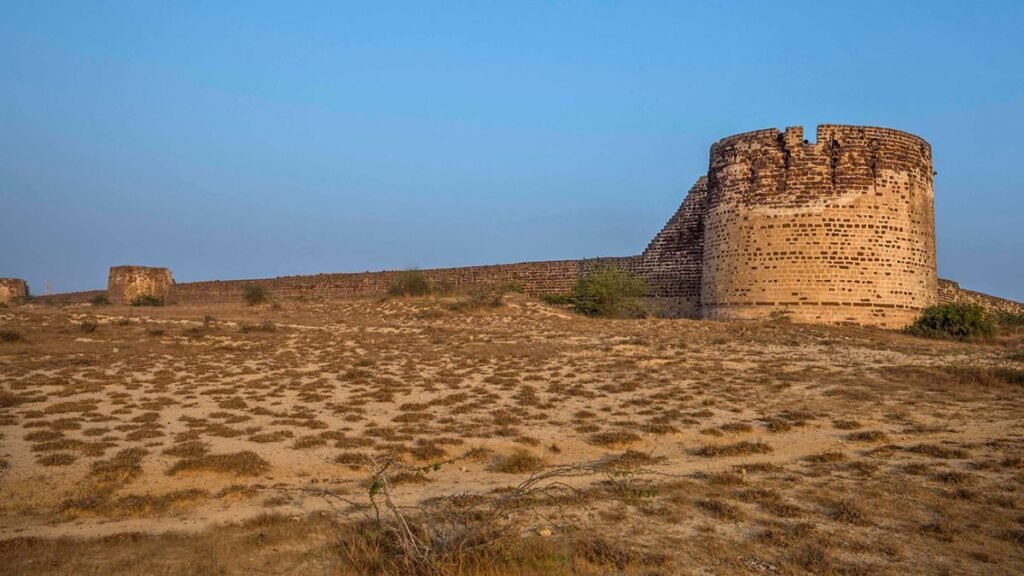
Lakhpat Fort approximately 4 kilometres from Narayan Sarovar is one of Kutch’s most historically significant and most visually striking sites: a walled town that once held 10,000 families, a major port, and a thriving maritime trade economy, and that now stands substantially empty, its walls intact but its streets quiet.
Lakhpat was historically a major port town on the Kori Creek one of the most important trading stations on the maritime route connecting Gujarat’s coast to the Persian Gulf, the Red Sea, and the Arabian Sea. Its fort walls, still largely standing, enclose a ghost town of ruined houses, active mosques, and a Gurudwara (Sikh gurdwara) associated with Guru Nanak Dev Ji the founder of Sikhism is said to have visited Lakhpat during one of his journeys, giving the site significance that extends beyond the Hindu pilgrimage tradition to the Sikh community.
The 2001 Bhuj earthquake damaged Lakhpat Fort significantly, but the walls and several structures survive. Walking through the fort’s empty streets the houses ruined, the trade gone, the port silted up when the Kori Creek’s geography changed is one of the most haunting heritage experiences in all of Kutch. Combine this with the spiritual atmosphere of Narayan Sarovar 4 kilometres away and the Arabian Sea view from Koteshwar, and the western Kutch circuit becomes one of the most multi-layered single-day journeys in Gujarat.
Narayan Sarovar Chinkara Wildlife Sanctuary
The protected landscape surrounding Narayan Sarovar is home to the Narayan Sarovar Chinkara Wildlife Sanctuary a reserve protecting the wildlife of the arid desert and dry grassland ecosystem of western Kutch. The sanctuary’s name reflects its primary indicator species: the chinkara (Indian Gazelle, Gazella bennettii), a small, elegant antelope adapted to arid desert conditions.
Other species present in the sanctuary include the desert fox, desert cat, jungle cat, porcupine, and various reptiles. During the winter months (October to March), migratory birds visit from across Central Asia and beyond, making the sanctuary particularly rewarding for birdwatchers during this period. The dry grasslands and thorny scrub that cover the sanctuary area represent the specific biodiversity of Kutch’s arid ecology not as dramatic as the Rann or Gir’s forest, but quietly interesting for those who look.
The coexistence of the wildlife sanctuary and the sacred lake complex is characteristic of the relationship between sacred sites and biodiversity in India: the religious prohibition on harming life within the sacred precincts extends, in practice, to the broader landscape around the temple and lake. The fish in the lake, the animals in the sanctuary, and the birds that rest in the trees of the sacred complex are all part of an ecology that the pilgrimage tradition has, over centuries, inadvertently helped to protect.
Festivals at Narayan Sarovar
Kartik Purnima — The Most Important
Kartik Purnima — the full moon of the Kartik month (typically November) is the most auspicious time for the Narayan Sarovar pilgrimage and the occasion of the largest annual fair at the site. On Kartik Purnima, the Ganges River is believed to reach all sacred bodies of water in India meaning that a holy dip in Narayan Sarovar on this day carries the same merit as bathing in the Ganga itself. Thousands of pilgrims converge from across Kutch, Gujarat, and beyond for the Kartik Purnima fair, the night-time rituals, and the dawn holy dip that is the central devotional act of the celebration.
Narayan Sarovar Fair — November
The annual Narayan Sarovar Fair, typically held in November in association with Kartik Purnima and the days surrounding it, brings together vendors, pilgrims, and cultural programmes in a traditional rural fair format. The fair provides the annual supply of sacred paraphernalia (prayer items, sacred thread, offerings), food, and handicrafts for both local pilgrims and visiting devotees.
Koteshwar Mahadev Fair — February
The Koteshwar Mahadev Fair at the adjacent Koteshwar Temple in February draws pilgrims specifically for the Shiva tradition’s celebrations. For those making the Narayan Sarovar pilgrimage in February, combining it with the Koteshwar fair creates a complete Vaishnava-Shaiva devotional day that reflects the complementary sacred geography of the western Kutch pilgrimage circuit.
Chaitra Month Fair
A second major fair period at Narayan Sarovar falls in the Chaitra month of the Hindu calendar (March-April), providing pilgrims who cannot attend the November festival a second major annual opportunity to visit during a period of heightened sacred significance.
Best Time to Visit Narayan Sarovar
October to February — Best Overall Season
The winter months are the most comfortable for the western Kutch journey. Temperatures from October to February are pleasant 15 to 27 degrees Celsius and the drive through Kutch is enjoyable in the cool, clear air. The Narayan Sarovar Wildlife Sanctuary has the highest wildlife activity and the most migratory birds during this period. November offers the added dimension of the Kartik Purnima fair and the most significant annual pilgrimage atmosphere. December and January combine comfortable weather with the Rann Utsav festival in the broader Kutch region.
For Festivals — November and February
Kartik Purnima (November) is the single most important time for the Narayan Sarovar pilgrimage. If experiencing the sacred lake at its most devotionally charged is a priority, plan specifically for this date. February offers the Koteshwar Mahadev Fair and more moderate temperatures than the approaching summer.
Avoid Summer Strictly — March to June
Western Kutch summers are extreme temperatures in the Lakhpat area regularly exceed 42 to 45 degrees Celsius from April to June. The 150 km drive from Bhuj, mostly through open desert, becomes genuinely physically challenging. If a summer visit is unavoidable, depart Bhuj by 5 AM to arrive at Narayan Sarovar before the heat becomes prohibitive, complete the darshan by 9 AM, and return before noon.
How to Reach Narayan Sarovar, Kutch
| From | Distance | Mode | Approx. Time |
| Bhuj | ~150–158 km via Naliya | Car / Taxi (via Nakhatrana-Naliya road) | 4–5 hours |
| Bhuj Airport | ~150 km | Taxi (arrange in advance) | 4–5 hours |
| Bhuj Railway Station | ~150 km | Taxi / Private Car | 4–5 hours |
| Koteshwar Temple | ~4 km | Car / Auto / Walking | 10 minutes |
| Lakhpat Fort | ~4 km | Car / Auto | 10 minutes |
| Mata no Madh (Ashapura Mata) | ~50 km | Car | 1 hour |
| Mandvi Beach | ~135 km | Car | 3.5 hours |
| Ahmedabad | ~400+ km | Car / Flight to Bhuj + Taxi | 7+ hours |
Narayan Sarovar is best reached by private car or hired taxi from Bhuj. There is no convenient public bus directly to Narayan Sarovar; the nearest major bus connectivity ends at Nakhatrana or Naliya, from where local transport covers the remaining distance. From Bhuj, the standard route is via Nakhatrana and Naliya, then the final desert road to Lakhpat/Narayan Sarovar. Navigate to ‘Narayan Sarovar, Lakhpat, Kutch’ on Google Maps. The road is generally well-maintained on the main highway sections but may have some stretches of less maintained surface approaching Lakhpat.
Accommodation Near Narayan Sarovar
Accommodation options near Narayan Sarovar itself are basic a small number of dharamshala facilities and simple guest houses serve pilgrims who need to stay overnight near the lake. For comfortable hotel accommodation, the options are in Nakhatrana (a town along the route, with simple hotels) or in Bhuj (150 km away, with a range of hotel options from budget to mid-range). Given the 4-5 hour drive from Bhuj, many visitors choose to make Narayan Sarovar a day trip from Bhuj, combining it with Koteshwar Temple and Lakhpat Fort in a single long day.
For visitors attending the Kartik Purnima fair, accommodation near the site fills completely; plan either to arrive before dawn on the fair day and return to Bhuj the same day, or book accommodation in Nakhatrana or Bhuj well in advance.
Also Read: Nishkalank Mahadev Temple, Bhavnagar
Nearby Attractions on the Western Kutch Circuit
- Koteshwar Mahadev Temple 4 km | The Lord Shiva temple at the western edge of the Indian mainland, overlooking the Arabian Sea. The svayambhu lingam, the sea views, and the spiritual contrast with Narayan Sarovar’s Vishnu tradition make Koteshwar a non-negotiable companion stop.
- Lakhpat Fort ~4 km | The ghost town with intact fort walls, active mosques, and the Gurudwara associated with Guru Nanak Dev Ji. One of Kutch’s most haunting and most historically layered heritage sites. Read our full TravelRoach guide.
- Mata no Madh ~50 km | The temple of Goddess Ashapura Mata the Kuldevi (clan goddess) of the Jadeja Rajput clan that has historically ruled Kutch. A significant Shakti temple that rounds out the western Kutch sacred circuit.
- Aina Mahal & Prag Mahal, Bhuj ~150 km | Kutch’s royal heritage the Palace of Mirrors and the Italian Gothic palace, both in Bhuj’s Darbargadh complex. Read our full TravelRoach guide.
- White Rann of Kutch ~160 km via Bhuj | The extraordinary salt desert, most spectacular under the full moon during the Rann Utsav festival. A complete Kutch experience pairs Narayan Sarovar with the Rann.
Practical Tips for Visiting Narayan Sarovar
- Plan a full day from Bhuj – the 150 km drive takes 4-5 hours each way. Allow 2-3 hours at the complex (holy dip + all seven shrines + Koteshwar + Lakhpat) for a total of 10-12 hours on the road and at the site. Start from Bhuj by 5 AM.
- Carry sufficient water and food – facilities between Naliya and Narayan Sarovar are very limited. Pack enough water (at least 3 litres per person) and food for the entire round trip.
- Appropriate attire for the holy dip – bring dry clothes to change into after the lake dip. The dip is performed in clothes or in pilgrim-appropriate attire; changing facilities are available near the ghats.
- Dress modestly throughout – covered shoulders and knees for both the lake and the temple complex; remove footwear at all temple entrances.
- Kartik Purnima requires advance planning – if visiting for the November full moon fair, book transport and accommodation at least 2-3 weeks in advance; the Bhuj-Narayan Sarovar road becomes significantly busier with pilgrim vehicles.
- Wildlife viewing – keep alert during the drive through the Narayan Sarovar Wildlife Sanctuary area; chinkaras are most commonly seen in the early morning. Birdwatching is best in October-February.
- Combine Koteshwar and Lakhpat on the same day -both are within 4 km of Narayan Sarovar and together with the lake form the complete western Kutch spiritual and heritage experience.
Frequently Asked Questions (FAQs)
Narayan Sarovar is a sacred lake in the Lakhpat Taluka of Kutch District, Gujarat, considered one of the Panch Sarovar the five holiest lakes in Hinduism alongside Mansarovar (Tibet), Bindu Sarovar (Sidhpur), Pampa Sarovar (Karnataka), and Pushkar Sarovar (Rajasthan). Its name means ‘Lake of the Divine Vishnu’ (Narayan = Vishnu, Sarovar = lake). The lake is mentioned in the Shiv Purana, Shrimad Bhagwat, Vishnu Purana, and Ramayana. According to tradition, the water emerged from the toe of Lord Narayan’s right foot during a divine response to a severe drought; the sacred River Saraswati is also said to have joined the sea here. The lake’s freshwater meeting the Arabian Sea/Kori Creek is considered a sacred confluence of particular holiness.
The Narayan Sarovar pilgrimage follows a traditional sequence: a holy dip (snan) in the sacred lake, believed to cleanse sins and purify the soul; darshan at each of the seven shrines within the fortified temple complex (including the Narayan Temple, Lakshminarayan Temple, and Trikamray/Trivikramray Temple); participation in the morning or evening aarti; and feeding the fish in the sacred lake. Many pilgrims extend their circuit to include Koteshwar Mahadev Temple (4 km, where Lord Shiva’s svayambhu lingam is enshrined at the western edge of India) and Lakhpat Fort.
The best overall season is October to February when temperatures are comfortable (15 to 27 degrees Celsius). November is especially significant because Kartik Purnima (the full moon of the Kartik month) the most auspicious time for the Narayan Sarovar pilgrimage falls in this period. A holy dip on Kartik Purnima is believed to carry the same merit as bathing in the Ganga. February offers the Koteshwar Mahadev Fair. The summer months (April to June) should be strictly avoided as temperatures in western Kutch can exceed 45 degrees Celsius.
From Bhuj, Narayan Sarovar is approximately 150 to 158 km via Nakhatrana and Naliya a drive of 4 to 5 hours. There is no direct public bus service; a private car or hired taxi from Bhuj is the most practical option. Navigate to ‘Narayan Sarovar, Lakhpat, Kutch’ on Google Maps. The recommended approach is to start from Bhuj by 5 AM for an all-day itinerary that includes the holy dip, all seven temple shrines, Koteshwar Temple, and Lakhpat Fort, returning to Bhuj by evening. The nearest airport and railway station are both in Bhuj.
Narayan Sarovar is Seat No. 63 of the 84 Bethaks of Mahaprabhuji Vallabhacharya the 15th-16th century Vaishnava saint who founded the Pushtimarg devotional tradition. The 84 Bethaks mark the locations where Mahaprabhuji sat, taught, or worshipped during his journeys across India. Visiting these seats is a significant pilgrimage act for followers of the Pushtimarg sect, which has a large following in Gujarat. Narayan Sarovar’s status as both a Panch Sarovar and a Mahaprabhuji Bethak gives it a dual significance for the Vaishnava community.
Koteshwar Temple, approximately 4 km northwest of Narayan Sarovar, is a Shiva temple situated at the western edge of the Indian mainland, directly overlooking the Arabian Sea. The temple enshrines a svayambhu (self-manifested) lingam of Lord Shiva and is one of the most westerly places of Hindu worship in India. The combination of Koteshwar Temple and Narayan Sarovar in a single visit a Shiva temple at the western edge of the land and a Vishnu lake 4 km inland reflects the complementary sacred geography of western Kutch. The Koteshwar Mahadev Fair in February draws its own large congregation.
Yes -Lakhpat Fort, approximately 4 km from Narayan Sarovar, is one of Kutch’s most historically significant and most visually haunting sites and absolutely worth combining with the Narayan Sarovar visit. Lakhpat was historically a major port town on the Kori Creek, with 10,000 families and a thriving maritime trade economy. It is now a largely empty ghost town with intact fort walls, active mosques, and a Gurudwara associated with Guru Nanak Dev Ji, the founder of Sikhism. The combination of Narayan Sarovar’s sacred lake, Koteshwar’s sea-edge Shiva temple, and Lakhpat’s ghost-town history in a single 4 km radius creates the complete western Kutch heritage-and-pilgrimage experience.
Final Thoughts
The far western edge of Kutch where the desert ends at the Kori Creek and the Arabian Sea begins carries a particular quality of spiritual geography that is not easy to articulate but is immediately felt by those who make the journey. The land grows quiet here. The nearest large city is 150 kilometres away. The next country is over the horizon. The wildlife sanctuary’s chinkaras move through the thorny scrub. The fish in the sacred lake circle the ghats.
Among the five Panch Sarovar, Narayan Sarovar is the most remote and the least crowded. Mansarovar is in Tibet. Pushkar draws millions. Narayan Sarovar draws thousands serious pilgrims, determined travellers, and those who want the particular experience of reaching the edge of the subcontinent and finding, there, at the last piece of land before the sea, a lake that the Puranas say began with a divine act of mercy during a drought long ago.
Take the holy dip. Have darshan at all seven shrines. Walk to Koteshwar and stand at the sea. Walk through Lakhpat’s empty streets. Drive back through the sanctuary as the sun goes down and watch for chinkaras by the roadside.
