The story of the Aina Mahal the Palace of Mirrors in Bhuj begins not with a king’s commission but with a shipwreck. Somewhere off the East African coast, in the 18th century, a Kutchi craftsman named Ram Singh Malam was in the water. His ship had gone down. He was rescued by Dutch sailors and taken to the Netherlands. He would not return to Kutch for approximately 18 years.
In those 18 years in Europe, Ram Singh mastered things that no Kutchi craftsman had encountered before: the Dutch art of Delftware tile-making those distinctive blue-and-white glazed tiles that defined Dutch domestic architecture; the Venetian techniques of glass-blowing and mirror work; the mechanical arts of clock-making and the construction of automated toys. When he finally returned to Kutch, he brought all of this with him a one-man transfer of European craft technology to the semi-arid western edge of India.
When Maharao Lakhpatji of Kutch gave Ram Singh the commission to build a palace at Darbargadh in Bhuj, the result was the Aina Mahal a building unlike anything else in Gujarat, possibly unlike anything else in India. The Hall of Mirrors at its heart, with thousands of tiny Venetian mirrors covering walls and ceilings and Dutch Delft tiles lining the floors, is one of the most extraordinary interior spaces in the heritage of the Indian subcontinent. This TravelRoach guide covers the full story, the architecture, the museum, the 2001 earthquake and its aftermath, entry fees, timings, and everything you need to plan a meaningful visit.
Aina Mahal — Quick Information
| Detail | Information |
| Full Name | Aina Mahal (Palace of Mirrors / Mirror Palace) |
| Location | Darbargadh, Bhuj, Kutch District, Gujarat |
| Address | Ashapura Road, Hamirsar Link, Bhuj, Gujarat |
| Also Known As | Palace of Mirrors; Glass Palace; Hall of Mirrors |
| Adjacent To | Prag Mahal (Italian Gothic palace) |
| Setting | Northeast of Hamirsar Lake, within the Darbargadh Palace complex, old Bhuj |
| Built | c. 1750 — 18th century |
| Commissioned By | Maharao Lakhpatji ruler of Kutch State, Jadeja dynasty |
| Architect / Designer | Ram Singh Malam (Ramsinh Malam) |
| Architectural Style | Indo-European fusion of Indian, Dutch, and Venetian Gothic elements |
| Cost of Construction | 80 lakh koris (old Kutchi currency) |
| Key Feature | Hall of Mirrors walls and ceilings covered with thousands of tiny Venetian mirrors |
| Floors | Two storeys (upper storey damaged in 2001 earthquake; lower floor open) |
| 2001 Earthquake | Severely damaged the upper storey; restoration in 2003 |
| Current Status | Lower floor open as Maharao Madansinhji Museum |
| Museum Collections | Royal artifacts, Kutch embroidery, jewelled swords, 15.2m royal procession scroll, Dutch clock, celestial globes, mechanical toys, royal paintings |
| Entry Fee | ~₹25–50 for Indians; ~₹100–200 for foreign nationals (confirm at gate) |
| Timings | 9:00 AM – 12:00 PM and 3:00 PM – 6:00 PM (approximate; confirm locally) |
| Closed | Thursdays and public holidays |
| Photography | Permitted without flash (flash photography prohibited) |
| Heritage Status | Declared heritage site by Gujarat Government |
| Distance from Bhuj Station | ~2–3 km (~10 minutes by auto) |
| Distance from Bhuj Airport | ~3–5 km (~10 minutes) |
| Distance from Prag Mahal | Adjacent same Darbargadh complex |
| Distance from Smritivan | ~5–6 km (~15 minutes) |
Ram Singh Malam – The Craftsman Who Changed Kutch
The Shipwreck That Created a Palace
Ram Singh Malam’s story is one of the most extraordinary individual biographies in the history of Gujarat’s heritage. He was a craftsman from Kutch the region’s tradition of skilled artisanship was already deep and rich before he left who found himself shipwrecked in the open ocean off the East African coast. Rescued by Dutch sailors, he was brought aboard and eventually taken to the Netherlands.
In the 18th century, the Dutch Republic was one of the most technically and artistically sophisticated societies in Europe. Delft was the centre of the blue-and-white glazed tile-making tradition that had taken a Chinese technique and made it specifically, distinctively European. The Dutch had mastered glass-blowing, mirror-making, and clock-making to a degree that was not matched elsewhere in the world. Amsterdam was a global centre of trade, scholarship, and craft. Ram Singh Malam, arriving from the shipwreck of his previous life, spent approximately 18 years absorbing as much of this world as he could.
Also Read: Smritivan, Bhuj, Kutch
Eighteen Years in Europe
The specific disciplines Ram Singh Malam mastered during his European years define the character of Aina Mahal:
- Delftware tile-making – the technique of creating the blue-and-white glazed ceramic tiles that had been developed in Delft, Netherlands, influenced by Chinese porcelain but distinctively European in its stylistic grammar. The tiles that floor the Aina Mahal’s central rooms are a direct product of this European training.
- Venetian glass and mirror work – the techniques of Murano-style glass blowing and the creation of highly reflective mirrors; at the time, Venetian mirror technology was the most advanced in the world and its products were among the most luxurious objects available to European courts.
- Clock-making – the mechanical arts of creating precise timekeeping instruments; Ram Singh brought Dutch clock-making techniques back to Kutch and produced some of the earliest European-style clocks in the region.
- Enamelling – the technique of fusing powdered glass to metal or ceramic surfaces to create durable, colourful decorative finishes.
- Mechanical toys – the construction of intricate automated figures and devices that performed specific actions; these were among the most prized luxury objects in 18th-century European courts.
Return to Kutch – The Commission
When Ram Singh Malam finally returned to Kutch after his extraordinary European education, he came back to a different world from the one he had left. He carried technical knowledge that no other craftsman in the region possessed. Word of his skills reached Maharao Lakhpatji the ruler of Kutch and a man known for his genuine enthusiasm for art, architecture, and literature. Lakhpatji gave Ram Singh the commission that would become his masterpiece: a palace at Darbargadh in Bhuj that would incorporate everything he had learned.
Ram Singh rose to the commission. Working with local Kutchi craftsmen whom he trained in the techniques he had mastered he created a building that was unlike anything the Indian subcontinent had seen: an interior of European mirror-and-tile opulence within an Indian palace structure, supervised entirely by a Kutchi craftsman using techniques absorbed from a Dutch shipwreck rescue and 18 years of European apprenticeship.
The Palace – Architecture and What to See
The Hall of Mirrors – The Centrepiece
The Hall of Mirrors at the core of the Aina Mahal is the most celebrated and most visually extraordinary interior space in all of Kutch’s heritage. The walls and ceiling of the hall are covered with thousands of tiny Venetian mirrors individually placed, each one set in an ornamental frame of gilded plasterwork. When the hall is lit by the Venetian-glass chandeliers that hang from the mirrored ceiling the effect is dazzling to the point of disorientation. Every light source is multiplied hundreds of times. Every reflected image creates another reflection. The room becomes a world of light and repetition in which the boundary between the real and the reflected dissolves.
The experience of standing in the Aina Mahal’s Hall of Mirrors is unlike any other room in Gujarat. It is not simply beautiful it is genuinely strange, in the best sense: a space that the 18th-century European aesthetic of the mirror room, translated through a Kutchi craftsman’s interpretation, has made into something that is neither fully European nor fully Indian but completely its own.
The Dutch Delftware Floors
Below the mirrored walls and ceilings, the floors of the main rooms are laid with blue-and-white Delftware tiles the same style of ceramic that Ram Singh Malam mastered in the Netherlands. These tiles, with their distinctive cobalt blue patterns on white glaze, provide a deliberate visual contrast to the mirrored surfaces above: where the ceiling is all glitter and reflection, the floor is calm, geometric, and cool. The combination creates a room that is simultaneously exhilarating and grounded.
The Delftware tiles at Aina Mahal represent one of the earliest and most complete examples of Dutch ceramic technique in India. They were entirely produced locally, under Ram Singh’s supervision, using the methods he had brought back from Europe. In the craft history of the Indian subcontinent, they are a uniquely interesting artifact: Indian materials and Indian labour producing a distinctly Dutch product in a Kutchi palace.
Venetian-Glass Chandeliers
The Venetian-glass chandeliers that light the Hall of Mirrors are both functional and thematic. Their Venetian-style shades and glass components represent another of Ram Singh’s European acquisitions the glass-blowing techniques of Murano applied to produce luxury lighting for an Indian royal court. The chandeliers, when lit, multiply their own light through the mirrored surfaces around them, creating the kaleidoscopic luminescence that gives the Hall its name and its effect.
Also Read: Shivrajpur Beach Dwarka
The Golden Bed and Royal Eccentricities
Aina Mahal houses several extraordinary objects that speak to the personal character of Maharao Lakhpatji a ruler known for his flamboyance and his genuine love of objects and experiences. The bed with gold legs is one of these: a piece of furniture where the structural supports the legs of the bed are made of solid gold. The story associated with this bed reflects Lakhpatji’s character: he was in the habit of using a royal bed for exactly one year and then auctioning it off, replacing it annually with a new one.
This practice luxurious, extravagant, and slightly eccentric is precisely the kind of detail that makes historical figures come alive. The gold-legged bed is not merely an opulent object. It is an expression of a personality: a ruler who did not accumulate possessions but used them to their limit and then released them into the world.
The Clock Collection – Dutch Time in Kutch
Among the most historically significant objects in the Aina Mahal is a Dutch clock described by museum historians as one of the earliest specimens of Dutch clockmaking in India. Ram Singh Malam brought the art of European clock-making back from his Netherlands years, and the clocks he produced and collected for Maharao Lakhpatji’s court represent an extraordinary early encounter between European mechanical precision and Kutchi royal culture. The clock collection also includes French and English pieces a small but significant collection of European horology that arrived at Bhuj through the singular circumstance of one craftsman’s shipwreck.
The 15.2-Metre Royal Procession Scroll
One of the most remarkable objects in the Maharao Madansinhji Museum within the Aina Mahal is a scroll 15.2 metres (approximately 50 feet) long depicting the Royal Procession of Maharao Shri Pragmalji Bahadur a detailed, multi-figure painted narrative of a Kutch state procession. The scroll is displayed in the museum section and provides one of the most comprehensive visual records of what a Kutch royal procession looked like the people, the costumes, the animals, the protocols, and the order of precedence in the 19th-century Kutch court.
The Museum Collections
The Maharao Madansinhji Museum within the Aina Mahal holds a rich and varied collection of Kutch royal heritage:
- Royal paintings and photographs of the Kutch royal family across generations
- Kutch jewellery – one of India’s most distinctive regional jewellery traditions
- Jewelled swords and royal weaponry
- Ivory-inlaid furniture and decorative objects
- Finest samples of Kutch embroidery – the extraordinary needlework tradition that has made Kutch textiles famous across the world
- Manuscripts from the royal library
- The Dutch clock (one of the earliest in India) and French and English celestial globes
- Intricately engineered mechanical toys from the Ram Singh collection
- The Harding lithograph series ‘The Rake’s Progress’ – displayed in the palace
Also Read: Rann Utsav 2026 Full Guide
The 2001 Earthquake and the Aina Mahal Today
The 2001 Bhuj earthquake magnitude 7.7, January 26, Republic Day inflicted severe damage on the Aina Mahal. The upper storey of the two-storey palace was largely destroyed by the earthquake’s force. The mirrored interiors thousands of individually placed pieces were damaged. The tiles, the chandeliers, the gilded plasterwork all suffered.
In 2003, restoration work began a complex, painstaking process of reassembling a palace whose decorative programme was itself the product of techniques that had to be relearned and re-executed. The restoration effort has been partly successful: the lower floor, including the primary mirrored hall, has been restored to a significant degree and is currently open to visitors. The upper floor damage is still apparent and the palace does not present itself in its pre-earthquake completeness.
Visiting the Aina Mahal today requires this awareness. What you see is a palace in recovery extraordinary in what it shows, and sobering in what the 2001 earthquake took. The Hall of Mirrors is still magnificent. The Dutch tiles are still intact in the main rooms. The museum collection is still rich. But the building as Ram Singh Malam completed it — the full two-storey expression of his European-Indian fusion vision has not been fully restored. Aina Mahal rewards the visitor who comes with understanding, not just expectation.
Best Time to Visit Aina Mahal
October to February — Best Season
The winter months are the most comfortable for a Bhuj visit. Kutch district from October to February has cool, pleasant weather 12 to 25 degrees Celsius ideal for extended heritage sightseeing. The Hall of Mirrors in the soft winter morning light has a particular quality: the low sun angle creates longer, more interesting shadow patterns in the mirror surfaces, and the Dutch tiles appear at their most saturated in colour. This is also the Rann Utsav season the famous festival in the White Rann of Kutch typically running from November to February making a Bhuj heritage visit a natural complement to the Rann experience.
Morning — Always Best
The first session of the day opening at 9:00 AM is the best time to visit Aina Mahal. The light entering from the palace windows in the morning illuminates the mirrors and the Venetian chandeliers at the most dynamic angle of the day. The mirror room’s effect is most spectacular when there is both natural light and chandelier light working together. Afternoon visits, after the midday closure, are also possible but the morning session offers the better light conditions.
April to June – Hot, Morning Only
Kutch summer can be extreme temperatures exceeding 40 to 45 degrees Celsius. The palace interiors offer some shelter from the sun, but the approach and the Bhuj city navigation in afternoon summer heat are uncomfortable. If visiting in summer, plan exclusively for the 9:00 AM morning session and complete your Darbargadh visit by 11:30 AM.
How to Reach Aina Mahal, Bhuj
| From | Distance | Mode | Approx. Time |
| Bhuj city centre | ~1–2 km | Auto-rickshaw / Walking | 5–10 minutes |
| Bhuj Railway Station | ~2–3 km | Auto-rickshaw / Taxi | 10 minutes |
| Bhuj Airport (BHJ) | ~3–5 km | Taxi | 10–15 minutes |
| Prag Mahal | Adjacent | Walking | 2 minutes |
| Hamirsar Lake | ~0.5 km | Walking | 5 minutes |
| Smritivan (Bhujiyo Hill) | ~5–6 km | Auto / Taxi | 15 minutes |
| Rann of Kutch (Dhordo) | ~80 km | Car | 1.5 hours |
| Ahmedabad | ~320–330 km | Car / Bus / Train | 5.5–6 hours |
Aina Mahal is in the Darbargadh area of old Bhuj one of the most central and accessible locations in the city. All Bhuj auto drivers know it. From anywhere in Bhuj, navigate to ‘Aina Mahal, Bhuj’ on Google Maps or simply say ‘Darbargadh’ to a local driver.
Bhuj Heritage Circuit – Combining Aina Mahal with Nearby Attractions
Aina Mahal combines naturally with several other Bhuj heritage attractions into a complete city heritage day:
- Prag Mahal Adjacent | The Italian Gothic palace built in 1865 by the same Darbargadh complex a completely different architectural tradition from Aina Mahal, but sharing the same royal patronage. The contrast between the intimate, mirrored Indo-European aesthetic of Aina Mahal and the soaring clock tower of Prag Mahal is one of Bhuj’s most interesting heritage juxtapositions.
- Kutch Museum ~1 km | The oldest museum in Gujarat, within the old city of Bhuj. The collections cover Kutch tribal culture, archaeology, natural history, and historical artifacts with depth and range.
- Hamirsar Lake ~0.5 km | The central lake of Bhuj, with its historic island and the surrounding heritage buildings. A pleasant walking addition to the Darbargadh visit.
- Smritivan Earthquake Memorial Museum ~5–6 km | India’s largest memorial museum, on Bhujiyo Hill, dedicated to the victims of the 2001 earthquake that also damaged Aina Mahal. Visiting both in the same trip gives you the complete story of January 26, 2001 and its impact on Bhuj. Read our full TravelRoach guide.
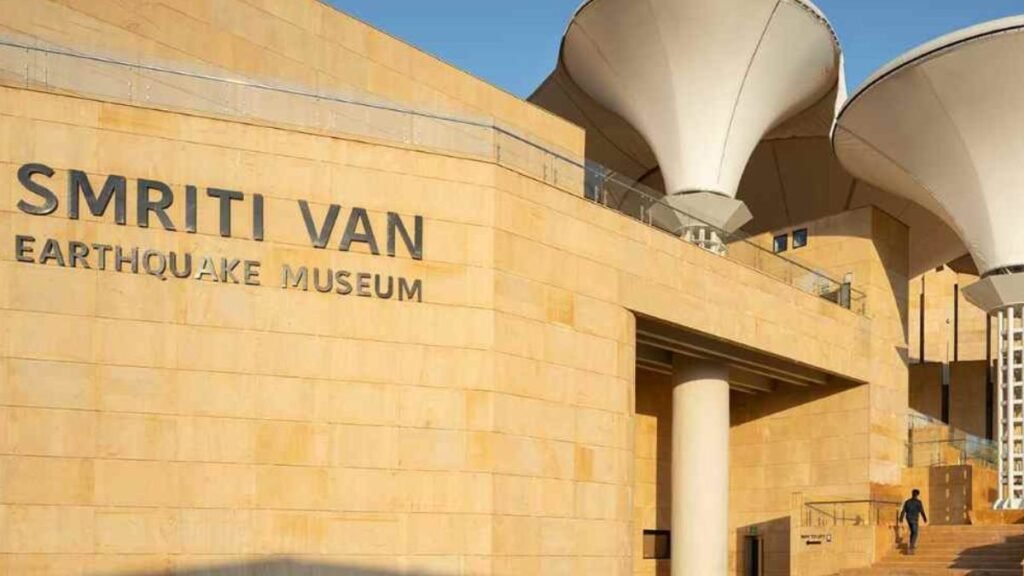
- Bhujia Fort (Bhujio Dungar) ~5–6 km | The 300-year-old fort on the hill shared with Smritivan. Views across Bhuj city.
Practical Tips for Visiting Aina Mahal
- Confirm timings and closure days before visiting – the museum follows a two-session schedule with a midday break and is closed on Thursdays and public holidays. Check the current schedule before making the trip from distant accommodations.
- No flash photography -the mirror surfaces and delicate tiles are affected by repeated flash exposure. Cameras without flash are permitted and the mirror hall is genuinely worth photographing at length.
- A guide significantly enriches the visit – local guides available at the entrance can explain the specific objects, the Ram Singh story in more detail, and the significance of individual exhibits in the museum collection. A 30 to 45 minute guided tour is worth the modest guide fee.
- Combine with Prag Mahal in the same visit -the two palaces are adjacent and both deserve attention. Prag Mahal’s clock tower offers views over Bhuj city that complement the interior-focused experience of Aina Mahal.
- Allow 1 to 1.5 hours -for the Hall of Mirrors, the museum collection, and the outer courtyard areas. Rushing through the mirrored hall misses the point of the space.
- The 2001 earthquake damage is visible -approach the visit with historical awareness. The palace in its current partially restored state is still extraordinary, but it is not the complete building that Ram Singh Malam finished. Understanding what was lost deepens the experience of what remains.
- Best combined with Smritivan on the same day -the earthquake memorial and the earthquake-damaged palace together tell the complete story of the 2001 disaster and its meaning for Bhuj’s heritage.
Frequently Asked Questions (FAQs)
Aina Mahal the Palace of Mirrors in Bhuj, Kutch, is famous for its extraordinary Hall of Mirrors: a room whose walls and ceilings are covered with thousands of tiny Venetian mirrors, creating a dazzling kaleidoscopic effect when lit by Venetian-glass chandeliers. Built in the 18th century by Maharao Lakhpatji of the Jadeja dynasty, it was designed by Ram Singh Malam a Kutchi craftsman who survived a shipwreck, spent 18 years in the Netherlands mastering Dutch tile-making, Venetian mirror work, and clock-making, and returned to build this unique fusion of European and Indian craftsmanship. The palace also houses the Maharao Madansinhji Museum with Kutch royal artifacts, jewellery, weapons, a 15.2-metre royal procession scroll, and one of the earliest Dutch clocks in India.
Aina Mahal was commissioned by Maharao Lakhpatji of the Jadeja dynasty and designed by Ram Singh Malam (Ramsinh Malam). Ram Singh’s story is extraordinary: he was a Kutchi craftsman who was shipwrecked off the East African coast, rescued by Dutch sailors, and taken to the Netherlands. He spent approximately 18 years in Europe mastering Delftware tile-making, Venetian glass and mirror work, clock-making, enamelling, and the construction of mechanical toys. When he returned to Kutch, Maharao Lakhpatji gave him the commission that became the Aina Mahal. Ram Singh trained local Kutchi craftsmen in his acquired European techniques and created an interior of Dutch-tiled floors and Venetian-mirrored ceilings that remains unique in the heritage of the Indian subcontinent.
Aina Mahal charges a nominal admission fee approximately ₹25 to ₹50 per person for Indian nationals and ₹100 to ₹200 for foreign nationals (confirm current rates at the ticket counter as fees may have been updated). The museum is open in two sessions: 9:00 AM to 12:00 PM and 3:00 PM to 6:00 PM. It is closed on Thursdays and on public holidays. Flash photography is not permitted inside cameras without flash are allowed. A guide is available at the entrance for an additional fee and is recommended for a richer understanding of the palace’s history and exhibits.
The 2001 Bhuj earthquake (January 26, 2001; magnitude 7.7) severely damaged the Aina Mahal. The upper storey of the two-storey palace was largely destroyed. The mirrored interiors, Venetian chandeliers, and decorative plasterwork suffered significant damage. Restoration work began in 2003 and has partially recovered the lower floor, including the primary Hall of Mirrors. The palace does not currently present its full pre-earthquake completeness the damage to the upper storey remains visible. The lower floor, with the Hall of Mirrors, the Dutch tile rooms, and the museum, is open to visitors.
Aina Mahal is located in the Darbargadh area of old Bhuj one of the most central and easily accessible locations in the city. From anywhere in Bhuj (railway station, airport, hotels), a short auto-rickshaw ride of 5 to 15 minutes brings you to the palace. All Bhuj auto drivers know Aina Mahal; telling the driver ‘Darbargadh’ or ‘Aina Mahal’ is sufficient. The palace is adjacent to Prag Mahal and northeast of Hamirsar Lake both useful landmarks for navigation. From Bhuj Airport, a taxi takes approximately 10 to 15 minutes.
Yes – and this combination is strongly recommended. Prag Mahal is directly adjacent to Aina Mahal in the same Darbargadh complex literally a few minutes walk between the two entrances. The two palaces are architecturally and historically complementary: Aina Mahal (18th century, Indo-European with Dutch and Venetian influences) and Prag Mahal (built 1865, Italian Gothic Revival with its soaring clock tower) together present the full breadth of the Kutch royal family’s architectural ambitions and cultural engagements across two centuries. Allow a total of 2 to 3 hours for both palaces.
The Dutch Delftware tiles and Venetian mirrors in the Aina Mahal are historically significant because they represent one of the earliest and most complete transfers of specific European craft techniques to an Indian palace context and because this transfer happened through the most unlikely possible route: the 18-year European education of a shipwrecked Kutchi craftsman. The blue-and-white Delftware tiles were produced locally under Ram Singh’s supervision using techniques he had mastered in the Netherlands. The Venetian mirrors were created using glass-blowing skills acquired in Europe. Together, they make the Aina Mahal a uniquely hybrid artifact of 18th-century Indo-European cultural exchange not a palace decorated with imported European goods, but a palace whose European character was created in Kutch by a Kutchi craftsman using skills he brought home from a shipwreck.
Final Thoughts
Heritage sites accumulate their significance in different ways. Some through age. Some through scale. Some through the events they witnessed. Some through the people who made them.
Aina Mahal’s significance is primarily through the person who made it. Ram Singh Malam’s story shipwreck, rescue, 18 years in Europe, return, commission, masterpiece is as compelling as the palace itself. The mirrors he installed, the tiles he supervised, the clocks he collected, the chandeliers he designed: every element of the Hall of Mirrors is a direct physical consequence of one person’s extraordinary journey between Kutch and the Netherlands in the 18th century.
The earthquake took part of it. The upper storey is gone. The palace is not what it was when Ram Singh finished it. But the Hall of Mirrors remains the mirrored walls and Dutch tiles and Venetian chandeliers doing the same thing they have always done: multiplying light until the room becomes something between a palace and a jewel.
Go to Aina Mahal. Stand in the Hall of Mirrors and look at yourself reflected back from hundreds of surfaces at once. Then remember that this room was made by a man who survived a shipwreck and spent 18 years learning how to build it. Some journeys produce extraordinary things.
Have you visited Aina Mahal? Share your experience the mirror hall in its best light, the Dutch tiles, the museum object that surprised you most in the comments. TravelRoach would love to hear from every Kutch heritage explorer.
