In the small village of Sarangpur in Botad district between Bhavnagar and Ahmedabad, in the flat agricultural heartland of central Saurashtra there is a temple that draws pilgrims from across India every single week. Not just on major festivals. Every Saturday, thousands of people make the journey to Sarangpur. Some come from nearby Bhavnagar and Botad. Some from Ahmedabad. Some from as far as Mumbai, Delhi, and cities across Gujarat and Rajasthan. They come to stand before an idol that devotees have believed, for nearly two centuries, is not merely a statue but a living divine presence.
Shree Kashtabhanjan Dev Hanumanji Mandir known across Gujarat simply as ‘Sarangpur Hanumanji’ or ‘Sarangpur Hanuman Mandir’ is dedicated to Lord Hanuman in his form as Kashtabhanjan: the Destroyer of All Sorrows. The temple was established in the early 19th century by Gopalanand Swami, a direct disciple of Lord Swaminarayan, and is managed today by the Swaminarayan Sampraday’s Vadtal Gadi. The idol is considered Swayambhu self-manifested, not carved by human hands.
This TravelRoach guide covers the full story: the meaning of Kashtabhanjan, Gopalanand Swami and the temple’s Swaminarayan connection, the famous Utara ritual, darshan timings, the free meals offered to all pilgrims, how to reach Sarangpur, the best time to visit, accommodation, rules of the temple, and all practical information for a meaningful and well-prepared pilgrimage.
Kashtabhanjan Dev Hanumanji Temple -Quick Information
| Detail | Information |
| Full Name | Shree Kashtabhanjan Dev Hanumanji Mandir |
| Also Known As | Sarangpur Hanuman Mandir; Kashtbhanjan Dev Hanuman Temple |
| Location | Sarangpur village (also spelled Salangpur), Barwala Taluka, Botad District, Gujarat |
| PIN Code | 364250 |
| Official Website | salangpurhanumanji.org |
| Deity | Lord Hanuman worshipped as Kashtabhanjan (Destroyer of All Sorrows) |
| Idol Type | Swayambhu believed to be self-manifested, not made by human hands |
| Religious Affiliation | Swaminarayan Sampraday – Vadtal Gadi |
| Established | Early 19th century by Gopalanand Swami (direct disciple of Lord Swaminarayan) |
| Managed By | Shree Kashtabhanjan Dev Hanumanji Temple Trust (Vadtal Gadi) |
| Entry Fee | Completely free – no entry ticket or payment required |
| Darshan Opening | 6:00 AM (Mangala Darshan) |
| Morning Aarti | 6:30 AM (Mangala Aarti) |
| Regular Darshan Duration | 1–2 hours |
| Peak Festival Darshan | May take 8–10 hours during Hanuman Jayanti |
| Most Auspicious Days | Saturday (busiest and holiest); Tuesday also significant |
| Special Ritual | Utara – prayer ritual for removing negative energy and mental stress; online booking available |
| VIP Darshan | Available – limited slots; book online at salangpurhanumanji.org or at temple counter |
| Free Meals | Bhojnalaya (Langar / Anna Kshetra) provides free vegetarian meals daily to all devotees |
| Accommodation | Yatri Niwas and Dharamshalas inside/near the temple; online booking available |
| Distance from Botad | ~12 km (~20–25 minutes by auto or taxi) |
| Distance from Bhavnagar | ~82 km (~2 hours) |
| Distance from Ahmedabad | ~160 km (~3.5–4 hours) |
| Distance from Rajkot | ~120 km (~3 hours) |
| Nearest Railway Station | Botad Railway Station (~12 km from the temple) |
| Nearest Airport | Bhavnagar Airport (~82 km); Ahmedabad Airport (~160 km) |
‘Kashtabhanjan’ – The Destroyer of All Sorrows
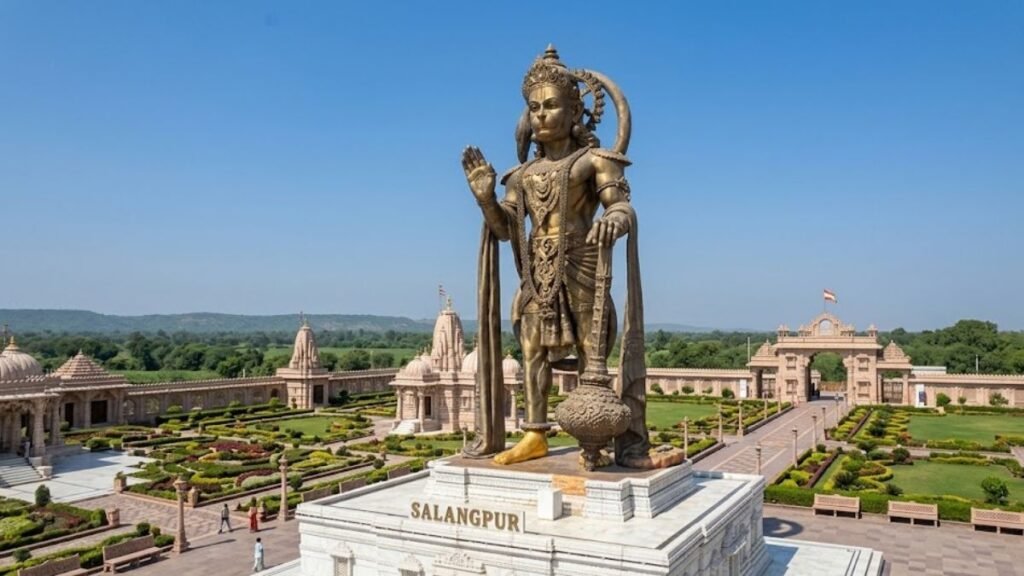
The name by which Lord Hanuman is worshipped at Sarangpur Kashtabhanjan is one of the most compassionate and human-centred of all his divine epithets. The name combines two Sanskrit words: Kasht (suffering, sorrow, trouble, hardship) and Bhanjan (destroyer, remover, one who breaks apart). Kashtabhanjan is therefore the one who destroys all suffering the divine who stands specifically for those who are burdened, afraid, in pain, or overwhelmed by the difficulties of life.
This name places Lord Hanuman not in his role as the heroic warrior of the Ramayana the one who leaps across oceans and burns Lanka but in his role as the most accessible, most compassionate, most directly responsive deity in the Hindu pantheon. Hanuman in the Kashtabhanjan form is the deity you call when you have tried everything else. When the problem is too large, the fear too deep, the suffering too long. He is the one who answers quickly, who does not require elaborate ritual knowledge, and whose response to sincere devotion has been documented in personal testimony across centuries.
The specific association of Kashtabhanjan with the removal of mental disorders, fear, anxiety, and negative energies has made Sarangpur Hanumanji a place of particular significance for people suffering from psychological distress a significance that exists outside the mainstream medical framework but within a deeply human tradition of seeking divine intervention when the mind itself seems under siege.
Also Read: Nishkalank Mahadev Temple, Bhavnagar
History and Establishment – Gopalanand Swami and the Swaminarayan Connection
Gopalanand Swami – The Founding Saint
The Kashtabhanjan Dev Hanumanji Mandir at Sarangpur was established in the early 19th century by Gopalanand Swami one of the most celebrated and spiritually accomplished saints of the Swaminarayan Sampraday. Gopalanand Swami was a direct disciple of Lord Swaminarayan himself (1781 to 1830) one of the inner circle of spiritual associates who were present during Swaminarayan’s lifetime and who carried his mission forward after his passing.
Gopalanand Swami is revered in the Swaminarayan tradition for his extraordinary spiritual powers, his deep scholarship, and his practical compassion. He established several important temples and sacred sites across Gujarat. At Sarangpur, he had a divine vision that led him to this specific village in the Botad region a vision in which Lord Hanumanji himself appeared and designated the location as the site of his divine presence.
The Self-Manifested Idol – Swayambhu
According to the temple’s sacred tradition, the idol of Kashtabhanjan Dev Hanumanji at Sarangpur is Swayambhu self-manifested at the site, not carved by human craftsmen. This designation carries profound devotional significance: a Swayambhu idol is understood to be the actual divine presence materialised in physical form rather than a human artistic representation of the divine. When devotees bow before the idol at Sarangpur, they believe they are in the direct presence of Lord Hanuman himself not before an image of him.
The temple tradition holds that Lord Hanumanji himself promised to dwell at this spot and to help all devotees who come with pure devotion and sincere faith. This promise understood as made directly to Gopalanand Swami in the founding vision is the basis of the extraordinary confidence that Sarangpur pilgrims bring to the temple. They are not coming to petition an image. They are visiting the address of a divine being who has specifically promised to be here.
The Swaminarayan Sampraday – Management and Tradition
The Kashtabhanjan Dev Hanumanji Temple at Sarangpur is under the management of the Swaminarayan Sampraday’s Vadtal Gadi one of the two main branches of the Swaminarayan religious organisation, based at the Vadtal temple in Kheda district of Gujarat. This affiliation shapes several aspects of the temple’s character: the emphasis on seva (service) and maryada (disciplined conduct), the strict rules around food (only satvik vegetarian food on the premises), the clean and organised management of the large pilgrim facility, and the integration of Vaishnava devotional practices alongside the Hanuman-specific rituals.
The temple is managed by the Shree Kashtabhanjan Dev Hanumanji Temple Trust under the Vadtal Gadi’s oversight, with an emphasis on the three principles that define the Swaminarayan institutional approach: seva (service), maryada (discipline), and bhakti (devotion).
The Utara Ritual – The Temple’s Most Distinctive Practice
The aspect of Sarangpur Hanumanji Temple that is most widely discussed and most distinctive and that brings a specific segment of its pilgrims from the greatest distances is the Utara ritual.
What is Utara?
Utara is a traditional ritual performed by the temple priests in which a coconut is circled around the body of a devotee specifically around the head and upper body and then broken. The ritual is understood as an act of removing negative energy, fear, mental disturbance, and the influence of forces that are causing suffering. It is a form of spiritual healing or cleansing that is specifically associated with the Kashtabhanjan form of Hanuman.
The ritual draws from a deep strand of Indian religious practice in which certain temples and certain deities are understood to have specific power over the forces of darkness, negativity, and mental disturbance not metaphorically but in a direct, practical sense. In this tradition, Sarangpur’s Hanumanji is believed to be particularly powerful against fear, anxiety, and the kind of suffering that does not have a readily identifiable cause.
Who Comes for Utara?
People come to Sarangpur for Utara from across India not just from Gujarat. They come when family members have been struggling with unexplained fear, anxiety, or mental distress. They come when a child has had persistent nightmares. They come when someone has been experiencing distress that doctors have not been able to explain. They come, in short, at the intersection of medical uncertainty and spiritual hope bringing to the temple the problems that feel too large, too strange, or too persistent for conventional remedies.
The temple does not claim to replace medical treatment. Devotees and temple management both acknowledge that serious mental health conditions require professional care. The Utara ritual is offered as a spiritual complement an act of faith that many devotees report as bringing peace, relief, and clarity that had been absent. The boundary between the spiritual and the psychological is not always clear, and at Sarangpur, tens of thousands of years of combined human testimony says that something genuinely helpful happens in this temple.
How to Book Utara
The Utara ritual requires prior booking. Devotees can book online at salangpurhanumanji.org under the Darshan and Rituals section, or book in person at the temple counter on arrival. A nominal fee applies for the Utara ritual. It is performed by experienced temple priests at designated times. Confirm current schedules and booking procedures at the official website before visiting.
Also Read: Top 5 Jain Pilgrimage Sites in Gujarat You Must Visit
The Idol and the Temple Atmosphere
The Living Presence – What Devotees Experience
Visitors to Kashtabhanjan Dev Hanumanji Temple consistently describe a quality of the space that is not easily captured in architectural or historical terms. The moment you enter the main hall and approach the idol, the atmosphere changes. The air feels different charged, still, concentrated. Many devotees describe tears arising spontaneously. Others describe a deep, unexpected peace as though a weight has been set down. The collective devotion of thousands of pilgrims who have stood in this exact spot, over nearly two centuries, seems to have left something in the space itself.
The idol of Kashtabhanjan Dev Hanumanji is a striking figure the divine form of Hanuman captured in the Swayambhu idol with its unique expression of fierce compassion. The combination of the idol’s divine energy and the specific tradition of the Utara ritual creates a temple atmosphere unlike any other Hanuman temple in Gujarat. Sarangpur is not merely devotional. It is, by the account of those who come here, palpably alive.
The Mangala Aarti – The Morning Opening
The day at Sarangpur Hanumanji begins at 6:00 AM with the Mangala Darshan the opening of the temple doors to the first light of the day. By 6:30 AM, the Mangala Aarti begins. The sound of bells, conch shells, and the chanting of Hanuman Chalisa fills the main hall. The first rays of the morning sun, according to devotees who have been present, fall directly on the idol creating a luminous effect that is one of the most celebrated moments in the temple’s daily cycle.
If you are planning a visit to Sarangpur Hanumanji, the morning aarti is the single most powerful experience the temple offers. Arrive by 5:45 AM to ensure you are inside when the doors open. The queue at this hour on weekdays is manageable and the atmosphere of concentrated devotion in the early morning is at its most undiluted.
Darshan at Sarangpur Hanumanji – Complete Information
| Session / Day | Details | Notes |
| Mangala Darshan | 6:00 AM – temple opens | The most peaceful; first light on the idol |
| Mangala Aarti | 6:30 AM | Bells, conch shells, Hanuman Chalisa chanting; the spiritual peak of the morning |
| Regular Darshan (day) | 6:00 AM to evening | Temple open most of the day; confirm current schedule at salangpurhanumanji.org |
| Regular Days (Mon–Fri) | Darshan: 1–2 hours | Manageable queues on weekday mornings |
| Saturday | Most crowded; most auspicious | Arrive early queue can be several hours |
| Tuesday | Also auspicious | Larger than average crowd |
| Hanuman Jayanti | Darshan may take 8–10 hours | Plan all day; arrive early morning for reasonable queue time |
| VIP Darshan | Limited slots available | Book online at salangpurhanumanji.org or at temple counter |
| Utara Ritual | By appointment | Book online or at counter; nominal fee applies |
| Entry Fee | Completely free | No ticket for regular darshan |
Free Meals for All Devotees – The Bhojnalaya
One of the most practically meaningful expressions of the temple’s Swaminarayan-rooted seva (service) ethic is the Bhojnalaya the free vegetarian meal facility provided for all devotees who visit Sarangpur Hanumanji. Every day, during lunch hours, the temple’s Anna Kshetra (food service) provides freshly cooked, pure vegetarian meals at no cost to every single pilgrim who visits. The meal is simple, wholesome, and completely free.
No devotee goes hungry at Sarangpur Hanumanji. This unconditional hospitality which in the Indian religious tradition is considered itself a form of divine seva extends to pilgrims of all backgrounds, from all regions, regardless of caste, community, or financial means. The meal facility reflects the temple’s core commitment to service as devotion and practical compassion as the highest religious act.
If you are planning a full-day visit to Sarangpur, the Bhojnalaya lunch is both nourishing and memorable a shared meal in a place of faith, served by volunteers who consider the act of serving food a form of worship.
Festivals at Kashtabhanjan Dev Hanumanji Temple
Hanuman Jayanti – The Most Important Annual Festival
The birth anniversary of Lord Hanuman Hanuman Jayanti, observed on the full moon day of the Chaitra month (March or April) is the most important annual festival at Sarangpur Hanumanji Temple. On this day, lakhs of pilgrims from across Gujarat and beyond make the journey to Sarangpur. The temple operates continuous darshan from the very early morning hours, and the queue for the main sanctum can take 8 to 10 hours from entry to exit. The entire village and its approach roads are transformed by the scale of the gathering.
If attending Hanuman Jayanti at Sarangpur, plan to arrive the previous evening to secure accommodation and position for the morning darshan. Book the Yatri Niwas at salangpurhanumanji.org at least 10 to 15 days in advance. Carry your own food and water as the approach roads become significantly congested. The atmosphere of Hanuman Jayanti at Sarangpur the mass chanting, the all-night devotional programme, the morning aarti with lakhs of devotees is one of the most extraordinary devotional experiences available in Gujarat.
Saturdays – The Weekly Festival
At Sarangpur Hanumanji, every Saturday is in practice a festival day. Saturday is the most auspicious day for Hanuman worship in the Hindu tradition and at Sarangpur, the combination of auspiciousness and the temple’s particular reputation for responding to devotion makes Saturday the busiest day of every week throughout the year. Thousands of pilgrims arrive every Saturday from Bhavnagar, Botad, Ahmedabad, and dozens of surrounding towns and villages. On Saturday, anticipate larger queues and plan accordingly arrive early in the morning for the most comfortable darshan experience.
Ram Navami, Navratri, and Diwali
Ram Navami the birth anniversary of Lord Rama is particularly significant at a Hanuman temple given Hanuman’s absolute devotion to Rama. Navratri draws the temple’s Vaishnava character to the fore, with devotional programmes and garba. Diwali is celebrated with special illumination of the temple complex and extended darshan. All major Hindu festival dates throughout the year see increased pilgrim numbers at Sarangpur.
Best Time to Visit Sarangpur Hanumanji Temple
October to March – Best Season
The winter months offer the most comfortable conditions for visiting Sarangpur. Central Gujarat is pleasant from October to February 18 to 28 degrees Celsius ideal for the road journey and for extended time at the temple complex. The morning darshan in November, December, and January, when the air is cool and crisp, is particularly pleasant. October to March is also when Saturday crowds are more comfortable to navigate, as the heat does not compound the physical demands of a long queue.
Tuesdays and Weekday Mornings – Quiet Darshan
For a genuinely peaceful and unhurried darshan, visit on a Tuesday to Thursday morning between 6 and 9 AM outside of festival weeks. The temple is active, the morning aarti creates a devotionally charged atmosphere, and the queue is manageable without the multi-hour wait of Saturdays. This window gives you the full spiritual experience of Sarangpur without the crowd intensity.
Saturdays – Best for the Full Pilgrimage Atmosphere
If you want to experience Sarangpur Hanumanji at its most alive with the gathered energy of thousands of simultaneous pilgrims, the sustained chanting, and the collective devotion visit on a Saturday. Arrive by 5:30 AM for the morning aarti. Be prepared for a long queue. The experience of a full Saturday at Sarangpur Hanumanji, from the dawn aarti through the afternoon Bhojnalaya meal, is something that regular pilgrims describe as a complete devotional immersion that no weekday visit can quite replicate.
Avoid April to June Afternoons
Central Saurashtra summer heat can be intense. Arriving for afternoon darshan in May or June, when temperatures can exceed 40 degrees Celsius, is uncomfortable. If visiting in summer, exclusively plan for early morning (before 9 AM) and use the shaded temple interior and the Bhojnalaya for shelter during the hottest hours.
Also Read: Mahuva Beach Bhavnagar
How to Reach Kashtabhanjan Dev Hanumanji Temple, Sarangpur
| From | Distance | Route | Approx. Time |
| Ahmedabad | ~160 km | Ahmedabad → Bavla → Dhandhuka → Barwala → Sarangpur | 3.5–4 hours |
| Bhavnagar | ~82 km | Bhavnagar → Palitana → Botad → Sarangpur | 2 hours |
| Rajkot | ~120 km | Rajkot → Jasdan → Botad → Sarangpur | 3 hours |
| Botad town | ~12 km | Local auto / taxi / bus | 20–25 minutes |
| Vadodara | ~300 km | Vadodara → Ahmedabad → Dhandhuka → Barwala → Sarangpur | 6 hours |
| Ahmedabad Airport | ~160 km | Flight + Taxi/Bus to Sarangpur | 3.5–4 hours |
| Bhavnagar Airport | ~82 km | Flight + Taxi | 2 hours |
| Botad Railway Station | ~12 km | Train to Botad + Auto/Taxi | 20–25 minutes from station |
By Road – Most Common Option
Sarangpur is most easily reached by private car or hired taxi. From Ahmedabad, the most direct route is via Bavla, Dhandhuka, and Barwala approximately 160 km, taking 3.5 to 4 hours. From Bhavnagar (82 km) the route goes via Palitana and Botad. From Rajkot (120 km) via Jasdan and Botad. GSRTC state buses run to Botad from Ahmedabad, Bhavnagar, and Rajkot from Botad, local buses and shared jeeps run to Sarangpur village every 30 to 45 minutes.
By Train
Botad Railway Station is on the Bhavnagar-Ahmedabad railway line, approximately 12 km from Sarangpur. From Botad station, hire a local auto-rickshaw or taxi for the 12 km journey to the temple (approximately 20 to 25 minutes, ₹150 to ₹250 one way). From Ahmedabad, trains to Botad take approximately 3 to 4 hours. From Bhavnagar, approximately 1.5 hours.
Accommodation at Sarangpur Hanumanji Temple
- Yatri Niwas (Temple Guest House) – Managed directly by the temple trust; clean and comfortable rooms inside or adjacent to the temple premises at very affordable rates. Online booking available at salangpurhanumanji.org. The most convenient option for overnight pilgrims.
- Dharamshalas – Multiple pilgrim lodges near the temple providing basic accommodation for families and groups. Suitable for 1 to 2 night stays.
- Book in advance for Saturdays and festivals – Yatri Niwas and Dharamshalas fill quickly for Saturday visits and completely for Hanuman Jayanti; book 10 to 15 days in advance for festival periods.
- Botad town (~12 km) – Has a wider range of hotels and guesthouses for those who prefer to base themselves in the nearest town. From Botad, the temple is a short taxi or bus ride.
Temple Rules and Dress Code
- Dress modestly – men should wear full trousers and covered shoulders; women should wear a saree, salwar kameez, or equivalent modest attire. Sleeveless and revealing clothing are not permitted.
- Remove footwear at the temple entrance – footwear storage is available at the gate.
- No alcohol, smoking, or non-vegetarian food anywhere inside the temple premises or in the Yatri Niwas. This is strictly observed.
- Maintain silence or low voices in the main hall during aarti and darshan.
- Photography restrictions – check with temple staff before photographing the idol. Respectful photography of the exterior and general complex may be permitted.
- Follow the queue system – especially on Saturdays and festivals when crowd management is essential for everyone’s safety and experience.
- Carry valid photo ID (Aadhaar, PAN, or Passport) for checking in at the Yatri Niwas.
Nearby Attractions to Combine with Sarangpur
- Palitana Jain Temples ~60 km via Botad | One of the world’s most extraordinary pilgrimage sites — 863 Jain temples on two summits of Shatrunjaya Hill. The temple complex is one of Jainism’s holiest and most architecturally extraordinary sites in the world.
- Bhavnagar ~82 km | Nilambag Palace, Takhteshwar Temple, Gaurishankar Lake, and the gateway to Palitana. Good base for combining a Sarangpur visit with Palitana.
- Nishkalank Mahadev Temple, Koliyak ~120 km via Bhavnagar | The extraordinary sea temple accessible only at low tide. Read our full TravelRoach guide.
- Velavadar Blackbuck National Park ~65 km via Bhavnagar | One of India’s finest wildlife reserves for blackbuck sightings. Also home to wolves, hyenas, and hundreds of winter harrier birds.
- Botad town ~12 km | The nearest town with a range of practical facilities — food, hotels, ATMs, shopping. A useful break for families on the way to or from Sarangpur.
Frequently Asked Questions (FAQs)
Kashtabhanjan Dev Hanumanji Temple in Sarangpur, Botad district, is one of the most famous and visited Hanuman temples in Gujarat. It is famous for three things above all: the Swayambhu (self-manifested) idol of Lord Hanuman worshipped as Kashtabhanjan the Destroyer of All Sorrows; the Utara ritual, a unique spiritual healing practice performed by temple priests for removing negative energy and mental distress; and the extraordinary weekly devotion it draws thousands of pilgrims every Saturday throughout the year, and lakhs during Hanuman Jayanti. The temple is managed by the Swaminarayan Sampraday’s Vadtal Gadi and offers free meals, affordable accommodation, and a powerful spiritual atmosphere.
Kashtabhanjan is one of Lord Hanuman’s most compassionate epithets. It combines two Sanskrit words: ‘Kasht’ meaning suffering, sorrow, hardship, or trouble, and ‘Bhanjan’ meaning destroyer or remover. Kashtabhanjan therefore means the one who destroys all sorrow the deity who specifically stands for those who are burdened with fear, anxiety, pain, or overwhelming difficulty. The name places Lord Hanuman in his most accessible and practically compassionate form the one you call when life has become too heavy and conventional resources have proven insufficient.
The Utara is a traditional spiritual healing ritual performed by the temple priests at Sarangpur Hanumanji. A coconut is circled around the devotee’s body especially around the head and then broken. The ritual is understood as an act of removing negative energy, fear, anxiety, mental disturbance, and harmful influences that are causing suffering. The practice draws from a deep tradition of devotional healing in which certain temples and deities are believed to have specific power over the forces of darkness and fear. The Utara ritual requires prior booking either online at salangpurhanumanji.org or at the temple counter. A nominal fee applies.
From Ahmedabad, the temple is approximately 160 km about 3.5 to 4 hours by road. The most direct route is via Bavla, Dhandhuka, and Barwala to Sarangpur village. GSRTC buses run from Ahmedabad to Botad (~12 km from the temple), from where local buses and shared jeeps run to Sarangpur every 30 to 45 minutes. By train, take a service from Ahmedabad to Botad Railway Station (~3 to 4 hours), then an auto-rickshaw or taxi for the 12 km journey to the temple.
Yes – the temple trust provides accommodation in the Yatri Niwas (guest house) and Dharamshalas at very affordable rates. These are clean, well-maintained facilities inside or near the temple premises. Online booking is available at salangpurhanumanji.org under the Yatri Niwas section. Carry a valid photo ID (Aadhaar, PAN, or Passport) for check-in. Book at least 10 to 15 days in advance for Saturday visits and festival periods as accommodation fills up quickly. Alcohol, smoking, and non-vegetarian food are strictly prohibited throughout the temple accommodation area.
The temple opens for Mangala Darshan at 6:00 AM, with the Mangala Aarti at 6:30 AM. The temple is generally open throughout the day with a possible midday break confirm current timings at salangpurhanumanji.org before your visit as schedules may vary by season and festival. On regular weekdays, darshan takes approximately 1 to 2 hours from queue entry to exit. On Saturdays, expect longer queues. During Hanuman Jayanti, darshan may take 8 to 10 hours plan an entire day. Entry for regular darshan is completely free. VIP darshan and the Utara ritual require prior booking.
Yes – the temple’s Bhojnalaya (also called Anna Kshetra or Langar) provides free pure vegetarian meals to all devotees during lunch hours every single day. No devotee goes hungry at Sarangpur Hanumanji. The meal facility is managed by the temple trust and reflects the Swaminarayan Sampraday’s commitment to seva serving food to all pilgrims regardless of background or financial means is considered itself a form of devotion. The meal is simple, wholesome, and completely free. All food on the temple premises is strictly satvik vegetarian no onion, garlic, or non-vegetarian items.
Final Thoughts
There are temples in Gujarat that impress you with scale, with architectural magnificence, with the weight of centuries. Sarangpur Hanumanji is not that kind of temple. The village is small. The roads to get there pass through the flat farmland of central Saurashtra. The building is not the most elaborate in Gujarat.
What Sarangpur Hanumanji has is devotion that has been deposited here, week after week, Saturday after Saturday, year after year, for nearly two centuries. The Swayambhu idol of Kashtabhanjan. The 6:30 AM aarti with the morning sun on the lord’s face. The Utara ritual for the person who has tried everything else. The free meal for every pilgrim who arrives hungry. The thousands of people who come every week not because they were told to but because they came once and something happened and they keep coming back.
Go on a Saturday morning. Arrive by 5:30 AM. Stand in the queue. Hear the Mangala Aarti. Have darshan. Eat the free lunch. That is Sarangpur Hanumanji. It is enough.
