Twice a year, at the precise moment of the March and September equinoxes, the sun rises exactly on the east-west axis of the Modhera Sun Temple. The first light of the equinox dawn passes through the main entrance torana, travels the length of the assembly hall, enters the inner sanctum, and falls directly on the spot where the idol of Surya the Sun God once stood. The builders of this temple in 1026 CE knew precisely what they were doing. They built not merely a place of worship but a calibrated instrument: a building whose relationship with the sun is so precisely calculated that it functions as an astronomical clock once per solar season, demonstrating to the people who used it that their architects understood the movements of the heavens.
The Modhera Sun Temple is one of the finest surviving examples of Solanki (Chaulukya) architecture in India. Constructed under King Bhima I at a moment of cultural resilience in the aftermath of Mahmud of Ghazni’s raids on western India it represents both a deeply personal act of devotion to the Solanki dynasty’s patron deity and a political statement about the endurance of Gujarat’s civilisational identity. The temple’s three parts the Surya Kund with its 108 shrines, the Sabha Mandapa assembly hall with its twelve Aditya pillars, and the inner sanctum aligned to the equinox sun together constitute one of the most thoughtfully designed sacred complexes in the entire subcontinent.
This TravelRoach guide covers the full history, the Solanki dynasty and the solar alignment, the three-part architecture in detail, the sculpture and iconography, the Modhera Dance Festival, India’s first solar village designation, entry fees, timings, how to reach, and how to combine Modhera with the magnificent North Gujarat heritage circuit it anchors.
Modhera Sun Temple — Quick Information
| Detail | Information |
| Location | Modhera village, Mehsana District, Gujarat on the banks of the Pushpavati River |
| Dedicated To | Surya the Hindu Sun God; the Solanki dynasty’s patron deity |
| Built | 1026–27 CE |
| Commissioned By | King Bhima I of the Chaulukya (Solanki) dynasty |
| Architectural Style | Maru-Gurjara (Solanki) architecture Nagara temple style of western India |
| Material | Golden sandstone carved with extraordinary intricacy across every surface |
| Solar Alignment | At the equinoxes (March 21 and September 21), the rising sun’s first rays fall directly on the Surya idol in the inner sanctum |
| The Three Parts | Surya Kund (sacred stepwell/reservoir) + Sabha Mandapa (assembly hall) + Garbhagriha / Gudha Mandapa (inner sanctum) |
| Surya Kund | Rectangular sacred reservoir with 108 shrines to various deities arranged in tiers; steps leading to the water |
| Sabha Mandapa | Pillared assembly hall; 52 intricately carved pillars; twelve Aditya pillars representing the 12 solar months |
| Garbhagriha | Inner sanctum; original Surya idol no longer present (removed/lost during invasions) |
| Active Worship | NOT an active place of worship an ASI (Archaeological Survey of India) protected heritage monument |
| Entry Fee (Indians) | ₹20 per person |
| Entry Fee (Foreigners) | ₹250 per person |
| Children below 15 | Free entry |
| Timings | 7:00 AM – 6:00 PM (open all 7 days of the week) |
| Photography | Allowed throughout the complex |
| Dress Code | Respectful clothing covering upper arms and legs no shorts or sleeveless tops |
| Modhera Solar Village | Modhera is India’s first solar village all electricity needs met by solar power (inaugurated October 2022) |
| Modhera Dance Festival | Three-day classical/folk dance festival; third weekend of January; held against the illuminated temple backdrop |
| Compared To | Frequently compared to the Konark Sun Temple (Odisha) for similar solar dedication and architectural scale |
| Distance from Mehsana | ~25–26 km (~35–40 minutes by road) |
| Distance from Patan (Rani Ki Vav) | ~35 km (~45 minutes) |
| Distance from Becharaji | ~25 km (~30 minutes) |
| Distance from Ahmedabad | ~98–100 km (~1.5–2 hours) |
| Nearest Railway Station | Mehsana Junction (~26–28 km) |
| Nearest Airport | Ahmedabad SVP International (~95–100 km) |
The History of Modhera Sun Temple — Solankis, the Sun, and Cultural Resilience
The Solanki Dynasty — Suryavanshis of Gujarat
The Chaulukya dynasty, more commonly known in Gujarati history as the Solankis, were the rulers of Gujarat from approximately the 10th to the 12th century CE a period sometimes called the golden age of medieval Gujarat for the extraordinary quality of the literature, art, and architecture produced under their patronage. The Solankis identified themselves as Suryavanshi descendants of the Sun God Surya and this cosmological self-identification gave solar worship a political dimension in their kingdom that went beyond personal piety. Temples dedicated to Surya under Solanki patronage were simultaneously statements of religious devotion and of royal legitimacy: we are the Sun God’s descendants, and our temples to Surya demonstrate our divine right to rule.
The Modhera Sun Temple, commissioned by King Bhima I in 1026-27 CE, was built at the height of Solanki power in Gujarat. Bhima I’s reign was itself a period of political and cultural assertion: he had to manage the legacy of Mahmud of Ghazni’s raids on western India (which had devastated several temples and sacred sites in the region), and the construction of a magnificent new Sun Temple was understood by contemporaries as both an act of piety and a demonstration that Gujarat’s cultural and religious life could not be permanently diminished by external destruction.
Also Read: Rani Ki Vav Patan
After Bhima I — Damage and Survival
The Modhera Sun Temple stood in its original complete form for several centuries before suffering damage during later medieval invasions most significantly from Alauddin Khilji’s Delhi Sultanate campaigns in Gujarat in the late 13th century. The idol of Surya that originally stood in the inner sanctum was removed or lost during this period; it was never replaced, which is why the Modhera temple functions today as a heritage monument rather than an active place of worship. The ASI (Archaeological Survey of India) assumed custody of the site and the complex has been maintained as a protected monument with the characteristic absence of active religious activity that comes with ASI management.
The survival of the temple complex in as much of its original detail as it retains the Surya Kund largely intact, the Sabha Mandapa pillars still standing, the outer walls still covered with their extraordinary carved panels is itself a testament to the structural quality of the original Solanki construction and to the subsequent care of preservation authorities. The damage is real and visible: the inner sanctum’s shikhara (tower) is incomplete, and the garbhagriha has no idol. But what remains is extraordinary.
The Three-Part Complex — A Guided Walk Through Modhera
Part One: The Surya Kund — 108 Shrines and the Sacred Geometry of Water
As you enter the Modhera Sun Temple complex, the first structure you encounter is not the temple itself but the Surya Kund the rectangular sacred reservoir (kund/tank) that forms the outermost element of the three-part complex. This is immediately unusual: most Indian temple complexes place the kund as a secondary element, but at Modhera it is the first thing the pilgrim enters, the first sacred space through which the approach to the deity is structured.
The Surya Kund is built as a precisely rectangular reservoir with stepped ghats (bathing platforms) descending on all four sides to the water. The steps are not merely functional they are designed in a tiered architectural pattern that creates a beautiful geometric visual when viewed from any angle. And at each tier, at regular intervals, stand miniature temple shrines: 108 of them in total, each dedicated to a different deity from the Hindu pantheon Vishnu, Shiva, Ganesha, various forms of the goddess, and countless other divine forms. Three of these are major shrines positioned on three sides of the kund, dedicated to Ganesh, Vishnu, and an image of Shiva performing the tandav (the cosmic dance of creation and destruction).
The number 108 is not arbitrary. In Hinduism, 108 is one of the most sacred numbers present in the 108 names of major deities, the 108 beads of a japa mala (prayer rosary), and multiple other sacred contexts. A kund surrounded by 108 shrines is a kund that replicates, in physical form, the complete sacred numerical totality of Hindu devotion. The pilgrim who performs a pradakshina (circumambulation) of the kund, passing each of the 108 shrines in sequence, completes a full sacred circuit in the most literal possible sense.
Part Two: The Sabha Mandapa — 52 Pillars and the Twelve Suns
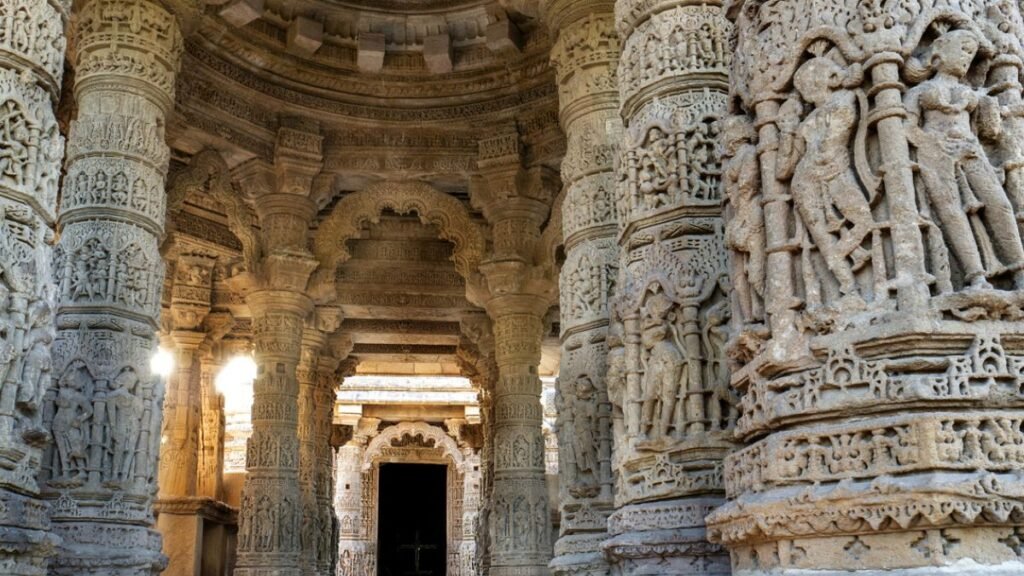
Beyond the Surya Kund, approached through a torana (decorative arched gateway) of remarkable intricacy, stands the Sabha Mandapa the assembly hall, the middle element of the three-part complex. This open, pillared structure served as the gathering place for worshippers, the antechamber to the inner sanctum, and the largest enclosed performance space within the complex.
The Sabha Mandapa is supported by 52 pillars each one carved with extraordinary detail covering its full height. The range of subjects carved into these pillars includes celestial beings (apsaras, yakshis, vidyadharas), scenes from Hindu mythology, geometric patterns and floral ornament, and — most distinctively from a devotional standpoint the twelve Adityas. The Adityas are the twelve aspects or manifestations of the Sun God, one for each month of the Hindu calendar year. Carved on the Sabha Mandapa pillars as a complete set, they present the solar deity in all twelve of his monthly forms simultaneously a visual representation of the complete solar year expressed in carved stone.
The ceiling of the Sabha Mandapa carries some of the most sophisticated carved work in the entire complex intricate mandala patterns, celestial beings, and the kind of three-dimensional pierced-stone carving that demonstrates the heights the Solanki artisan tradition reached in this period. Stand in the centre of the Sabha Mandapa and look upward at the ceiling; the light that falls through the various openings creates an ever-shifting pattern of shadow and illumination that makes the ceiling appear to move.
Part Three: The Garbhagriha — The Inner Sanctum and the Equinox Alignment
At the innermost point of the three-part complex is the Garbhagriha the inner sanctum, the womb-house, the sacred core where the deity resided. The outer walls of the Garbhagriha are covered in some of the temple’s most detailed and most densely layered carved panels: erotic sculptures (similar in character to the famous Khajuraho temple carvings, which are understood in this context to represent fertility, prosperity, and the full range of human experience offered to the divine), forms of Surya in his multiple manifestations, and an extraordinary variety of other divine and semi-divine figures.
The most remarkable architectural fact about the Garbhagriha is also the most quietly awe-inspiring one: it is aligned with perfect astronomical precision on the east-west axis, such that on the equinoxes the two dates each year when day and night are of exactly equal length, approximately March 21 and September 21 the rising sun’s first rays travel the entire length of the complex and fall directly onto the spot in the inner sanctum where the idol of Surya stood. No guesswork. No approximation. Perfect alignment, achieved a thousand years ago, maintained in stone.
The original Surya idol that occupied this spot is gone removed or lost during the invasions that the temple endured in the medieval period. The pedestal remains. The architectural chamber remains. The alignment remains. And on each equinox, the sun still does what the Solanki architects intended: it enters, illuminates the empty pedestal, and departs.
Also Read: Bohra Vad Sidhpur
The Carvings — A Stone Library of an Entire Civilisation
The exterior and interior surfaces of the Modhera Sun Temple are covered with carved stone panels in a density and variety that has few parallels in Indian temple architecture. Every wall, every column, every lintel, every torana gateway carries carved imagery — and the imagery is not decorative repetition but a systematic visual encyclopedia of the Hindu devotional, mythological, and social world of 11th-century Gujarat.
- The Twelve Adityas: The twelve forms of Surya for the twelve months, depicted on the Sabha Mandapa pillars each with its own distinct iconographic character and its own set of associated deities, vehicles, and hand positions
- Scenes from the Ramayana and Mahabharata: Narrative carved panels depicting episodes from India’s two great epics, making the temple’s walls a visual storytelling medium as well as a devotional one
- Apsaras and Celestial Beings: Graceful celestial women in varied poses applying cosmetics, playing instruments, dancing, carrying offerings carved with a sensuous naturalism that is one of the most distinctive qualities of Solanki temple sculpture
- Erotic Sculptures: Like the Khajuraho temples and several other medieval Hindu temple complexes, Modhera includes explicitly erotic carvings on its outer walls typically understood as representing the full range of human experience brought into the sacred space, fertility offered as a form of devotion, or the threshold between worldly and divine that erotic imagery symbolised in this tradition
- The Toranas (Arched Gateways): The ornate entrance arches of both the Sabha Mandapa and the Garbhagriha are covered with some of the most intricate carving in the complex multiple tiers of divine and semi-divine figures, floral ornament, and geometric patterns integrated into a single arch that frames the approach to each successive sacred space
Art historians and architectural scholars have documented hundreds of distinct carved motifs across the Modhera complex. Visitors who approach the carvings systematically moving clockwise around the outer walls, examining each panel in sequence typically spend far more time at the temple than they initially planned. Allow at least two to three hours for a thorough examination of the site.
Modhera — India’s First Solar Village
In October 2022, Prime Minister Narendra Modi dedicated the village of Modhera as India’s first 24-hour solar-powered village an initiative under which the entire village’s electricity requirements are met by a combination of solar panels and battery storage systems, making Modhera completely energy self-sufficient from renewable sources. The programme installed solar panels on rooftops and on community land, combined with battery systems to ensure continuous power supply even without sunlight.
The symbolic resonance of this designation is considerable: the village most famous for a millennium-old temple whose entire architecture is organised around the worship of the sun now meets all its energy needs from the sun. The Modhera Sun Temple and the Modhera Solar Village together create a continuity of solar significance across a thousand years of human habitation at this bend of the Pushpavati River ancient astronomical devotion and modern renewable energy, in the same village, sustained by the same celestial body.
The Modhera Dance Festival — Culture at the Sun Temple
Each January, during the third weekend of the month following the conclusion of the Uttarayan (Makar Sankranti kite festival) celebrations, the Modhera Sun Temple becomes the setting for one of North Gujarat’s most anticipated cultural events: the three-day Modhera Dance Festival. Organised by the Gujarat Tourism Department, the festival brings together classical and folk dancers from across India to perform against the backdrop of the illuminated temple.
The festival format creates one of the most visually distinctive performance settings in the country: classical dancers performing on an outdoor stage, the 11th-century carved stone temple lit behind them, the Surya Kund’s reflections adding an additional visual dimension. Bharatanatyam, Odissi, Kathak, Kuchipudi, and various folk dance traditions have all been represented at different editions of the festival. The Modhera Dance Festival has grown in reputation and now draws audiences from across Gujarat and from culturally interested visitors travelling specifically for the event.
If visiting Modhera in January, timing your trip for the festival weekend gives you both the architectural and historical heritage of the Sun Temple itself and a live cultural event of genuine quality and atmosphere. Confirm the exact dates each year through the Gujarat Tourism website or TravelRoach.
Best Time to Visit Modhera Sun Temple
October to March — Best Overall Season
The winter months provide the most comfortable conditions for an extended visit to Modhera. North Gujarat temperatures from October to February range from 15 to 27 degrees Celsius ideal for the outdoor exploration that the Surya Kund and the complex circuit require. The soft winter light on the golden sandstone creates the most beautiful photographic conditions. January is particularly special: the Modhera Dance Festival (third weekend) adds a cultural dimension to what is already one of North Gujarat’s most rewarding heritage visits.
The Equinoxes — For the Solar Alignment
If witnessing the equinox solar alignment is a specific purpose of your visit and for those interested in Indian astronomical heritage and temple astronomy, it should be plan your trip for the days around March 21 or September 21. Arriving before dawn to be in position inside or near the inner sanctum for the moment of equinox sunrise will show you the Modhera Sun Temple doing exactly what it was built to do: receive the sun into its innermost chamber. September 21 falls in the post-monsoon period when the North Gujarat weather can still be warm; March 21 is in the late winter and generally more comfortable.
Morning — Best Light and Best Photography
Morning is consistently the best time of day to visit Modhera, for both practical and aesthetic reasons. The golden sandstone responds to morning light with a warm, rich colouring that afternoon or evening light does not replicate. The carved details emerge most clearly when the sun is at a low angle, casting shadows into the recesses of each carved panel and revealing the three-dimensional quality of the sculpture. The Surya Kund reflects the morning sky with particular clarity. Arrive at or shortly after the 7:00 AM opening for the most beautiful and most crowd-free version of Modhera.
How to Reach Modhera Sun Temple
| From | Distance | Mode | Approx. Time |
| Mehsana | ~25–26 km | Car / Bus / Shared Jeep (~45 min) | 35–45 minutes |
| Patan (Rani Ki Vav) | ~35 km | Car / Taxi | 45–50 minutes |
| Becharaji (Bahuchar Mata) | ~25 km | Car | 30–35 minutes |
| Sidhpur (Bohra Vad) | ~45 km | Car | 50 minutes |
| Mehsana Junction Railway Station | ~26–28 km | Train to Mehsana + Car/Bus | ~40 minutes by road |
| Ahmedabad | ~98–100 km | Car / Bus (2–3 hours) | 1.5–2 hours |
| Ahmedabad Airport (SVP) | ~95 km | Flight + Car | ~2 hours |
| Gandhinagar | ~83 km | Car | 1.5 hours |
From Mehsana, take a State Transport bus or a shared jeep to Modhera (~45 minutes), or hire a private car for the flexibility to also visit Becharaji, Patan, and Sidhpur in the same day. From Ahmedabad, private taxi or car is the most practical option for a day trip, as it gives you the flexibility to combine multiple North Gujarat sites in a single efficient circuit. The road from Ahmedabad via Mehsana is well-maintained. Navigate to ‘Modhera Sun Temple’ on Google Maps.
The North Gujarat Heritage Circuit — Make the Most of Your Modhera Visit
Modhera is the natural centrepiece of what TravelRoach calls the North Gujarat Heritage Circuit — a group of extraordinary sites within 50 km of the Sun Temple that together constitute one of the richest single-day heritage routes in all of India:
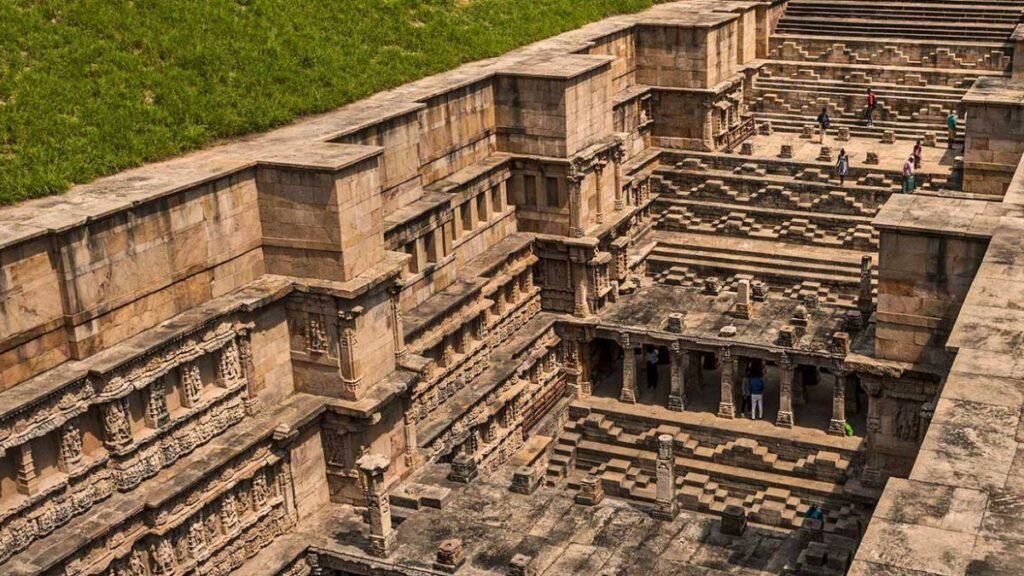
- Rani Ki Vav, Patan ~35 km | The UNESCO World Heritage stepwell — 11th-century Solanki architecture at its finest, with 863 sculptures on seven gallery levels; the image on India’s ₹100 note. Read our full TravelRoach guide.
- Bahuchar Mata Temple, Becharaji ~25 km | One of Gujarat’s three principal Shakti Peethas; the patron goddess of the Modh community and the hijra community. Read our full TravelRoach guide.
- Modheshwari Mata Temple, Modhera Same village (~500m from Sun Temple) | The clan goddess temple of the Modh community — a living, actively worshipped contrast to the heritage-monument status of the Sun Temple. Read our full TravelRoach guide.
- Bohra Vad, Sidhpur ~45 km | The extraordinary Victorian-Art Deco haveli neighbourhood of the Dawoodi Bohra community ‘Paris Galli’ of North Gujarat. Read our full TravelRoach guide.
Also Read: Shree Modheshwari Mata Temple, Modhera, Mehsana
Practical Tips for Visiting Modhera Sun Temple
- Arrive at 7:00 AM – the morning light on the golden sandstone is the most beautiful version of Modhera. The temple at opening time before the main crowd of day-trippers arrives from Ahmedabad and Mehsana has a quality of quiet that midday visits cannot replicate.
- Allow 2 to 3 hours – a thorough visit to all three parts (Surya Kund, Sabha Mandapa, Garbhagriha), with careful attention to the carved panels, takes significantly longer than a quick walk-through. This is a site that rewards close attention.
- Photography is allowed – the golden sandstone in morning light is superbly photographic. The Surya Kund with its stepped geometry and 108 shrines is particularly good for wide-angle and architectural photography.
- Hire a local guide at the entrance – the depth of astronomical, mythological, and architectural knowledge embedded in the Modhera complex is not self-evident. A guide who can explain the equinox alignment, identify the twelve Adityas, explain the erotic sculpture tradition, and contextualise the three-part architecture within the Solanki tradition transforms the visit.
- Wear comfortable footwear – the site involves significant walking across stone surfaces of varying levels, including the steps down to the Surya Kund. Flat, comfortable shoes are essential.
- Respectful dress – covered shoulders and knees; while Modhera is not an active worship site, respectful attire appropriate to a sacred heritage site is expected.
- Combine with the Modheshwari Mata Temple (500 metres away) -the contrast between the ASI-protected heritage monument and the living, actively worshipped clan goddess temple is one of Modhera’s most interesting experiential juxtapositions. Both together take approximately 3 to 3.5 hours.
- For the Modhera Dance Festival -confirm exact dates each year through Gujarat Tourism before planning a January visit; festival-weekend accommodation in Mehsana fills quickly, so book in advance.
Frequently Asked Questions (FAQs)
The Modhera Sun Temple in Mehsana district, Gujarat, is famous for three primary qualities: its extraordinary solar alignment (at the equinoxes March 21 and September 21 the rising sun’s first rays fall directly onto the inner sanctum’s deity pedestal through the perfectly east-west oriented complex); its status as one of India’s finest surviving examples of 11th-century Solanki (Maru-Gurjara) architecture, with every surface covered in intricate carved stone panels; and the unique three-part complex design combining the 108-shrine Surya Kund, the 52-pillared Sabha Mandapa with twelve Aditya carvings, and the Garbhagriha inner sanctum. It is frequently compared to the Konark Sun Temple in Odisha and is Gujarat’s pre-eminent medieval temple complex.
The Modhera Sun Temple was built in 1026-27 CE under King Bhima I of the Chaulukya (Solanki) dynasty of Gujarat. The Solankis identified as Suryavanshi descendants of the Sun God Surya making temples dedicated to Surya simultaneously acts of religious devotion and expressions of royal legitimacy. The temple was built in the immediate aftermath of Mahmud of Ghazni’s raids on western India, and many scholars understand its construction as both a pious act and a political statement of cultural resilience. The original Surya idol in the inner sanctum was later removed or lost during the invasions of Alauddin Khilji’s Delhi Sultanate in the 13th century.
The Modhera Sun Temple is built on a precise east-west axis. On the equinoxes the two days each year when day and night are of exactly equal duration, approximately March 21 and September 21 the rising sun aligns perfectly with the temple’s main entrance. The first rays of the equinox sunrise travel from the entrance through the Sabha Mandapa assembly hall and into the Garbhagriha inner sanctum, falling directly on the spot where the Surya idol originally stood. This astronomical precision was deliberately engineered by the Solanki architects, reflecting their deep knowledge of solar movement, Vastu Shastra, and the cosmic symbolism of light illuminating the deity.
The Modhera Sun Temple is managed by the Archaeological Survey of India (ASI) and charges an entry fee of ₹20 for Indian nationals and ₹250 for foreign nationals. Children below 15 years enter free. The temple complex is open from 7:00 AM to 6:00 PM every day of the week without a weekly closure. Photography is permitted throughout the complex. The best time to arrive is at opening (7:00 AM) for morning light on the golden sandstone and for the most peaceful, crowd-free exploration of the three-part complex.
The Surya Kund is the first of the three main elements of the Modhera Sun Temple complex a large, rectangular sacred reservoir (tank/stepwell) with geometrically stepped ghats descending on all four sides to the water surface. The kund is surrounded by 108 miniature temple shrines arranged in tiers along the stepped levels each shrine dedicated to a different deity, with three larger shrines dedicated to Ganesh, Vishnu, and a dancing Shiva form. The number 108, sacred in Hinduism, represents the complete sacred totality of divine forms. The Surya Kund was used for ritual purification by pilgrims before approaching the inner sanctum, and remains one of the most visually striking stepped-reservoir structures in Gujarat.
The Modhera Dance Festival is a three-day classical and folk dance festival held annually during the third weekend of January, organised by the Gujarat Tourism Department against the illuminated backdrop of the Modhera Sun Temple. Classical dance forms including Bharatanatyam, Odissi, Kathak, and Kuchipudi, as well as folk dance traditions, are performed by artists from across India on an outdoor stage with the 11th-century temple lit behind them. The festival has grown in reputation and now draws audiences from across Gujarat and culturally interested visitors from farther afield. Confirm exact dates each year through Gujarat Tourism before planning a visit.
Yes – combining the Modhera Sun Temple and Rani Ki Vav in a single day trip from Ahmedabad is one of the most popular and most rewarding North Gujarat heritage itineraries. The two sites are approximately 35 km from each other. A suggested sequence: leave Ahmedabad early, arrive at Modhera at 7:00 AM opening (approximately 1.5 to 2 hours from Ahmedabad), spend 2 to 3 hours at the Sun Temple and the Modheshwari Mata Temple next door, then drive to Patan for Rani Ki Vav in the late morning/early afternoon. Both sites together can be comfortably covered in a full day with a private car or hired taxi. Consider adding Becharaji (Bahuchar Mata Temple, 25 km from Modhera) for a complete North Gujarat circuit.
Final Thoughts
Once a year in March, and once a year in September, the sun does what it was designed to do a thousand years ago. It rises in the east. It enters the Modhera Sun Temple through the main torana. It travels the length of the Sabha Mandapa. It enters the Garbhagriha. It falls on the empty pedestal where Surya’s idol once stood.
The idol is gone. The dynasty that built the temple is gone. The priests who conducted the ceremonies here are gone. Even the God for whom all of this was built the specific relationship between the Solanki dynasty and their patron Surya has been absorbed into the larger flow of Indian religious history, unnamed and unindividuated.
But the alignment remains. The stone remains. The 108 shrines around the kund remain, most of them. The twelve Adityas on the Sabha Mandapa pillars remain, representing the twelve months of the solar year that have continued to pass, without interruption, since this building was completed in 1026 CE.
The sun enters the temple twice a year. The village outside is now powered entirely by the sun. The carvings on the stone, which have been catching and releasing light for a thousand years, will catch the same light tomorrow morning as they did the morning after the Solanki builders finished their work. Come early. Bring enough time to look at them properly.
