The building is exactly 79 feet high. Mahatma Gandhi lived 79 years.
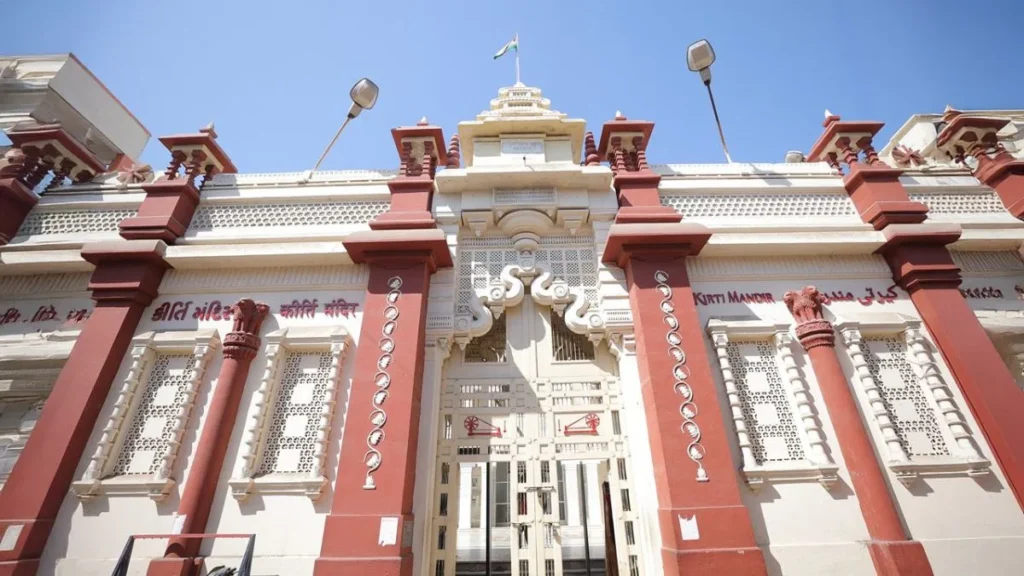
That’s the kind of memorial Kirti Mandir is deliberate, symbolic, and built by people who had thought carefully about what they were commemorating. Its architecture borrows from Hindu, Buddhist, Jain and Parsi temples, from churches and from mosques, all in one structure. A building that argues Gandhi’s pluralism in stone.
And next door, at the far end of a quiet courtyard, stands the three-storey haveli where Mohandas Karamchand Gandhi was born on 2 October 1869.
This guide covers the Mahatma Gandhi Memorial, the ancestral home, timings and entry, the symbolism most visitors miss, how to reach, and how to build a proper Porbandar day around it.
Quick Facts: Kirti Mandir at a Glance
| Detail | Information |
| Location | Kasturba Road, Porbandar, Gujarat |
| Commemorates | Mahatma Gandhi and Kasturba Gandhi |
| Meaning of name | Kirti Mandir “Temple of Fame” |
| Foundation laid | 1947, during Gandhi’s lifetime |
| Completed | 1950 |
| Inaugurated | 27 May 1950, by Sardar Vallabhbhai Patel |
| Height | 79 feet one for each year of Gandhi’s life |
| Funded by | Nanjibhai Kalidas Mehta and Santokben Mehta |
| Architect | Prushottambhai Mistry, a Porbandar resident |
| Gandhi’s birth | 2 October 1869, in the adjoining ancestral haveli |
| Entry fee | Free or nominal (~₹3) reports differ, carry change |
| Timings | Commonly 9:00 AM–12:00 PM and 3:00 PM–6:00 PM (verify) |
| Time needed | 1–2 hours |
The Ancestral Home: Where Gandhi Was Born
Walk to the far end of the courtyard and you reach the part that matters most.
The three-storey haveli was built by Gandhi’s grandfather, Uttamchand Gandhi, and it housed three generations of the family. What’s less well known is what those generations did: Uttamchand, his son Karamchand (Gandhi’s father), and Gandhi’s uncle Tulsidas all served as Diwans effectively prime ministers to the Jethwa Rajput rulers of Porbandar.
Gandhi wasn’t born into poverty. He was born into the administrative elite of a princely state, in a substantial family house, and chose the loincloth later. Standing in these rooms makes that trajectory feel much more real than any textbook does.
The exact spot of his birth on 2 October 1869 is marked within the house. It’s small, unglamorous and often the quietest corner of the complex which is somehow appropriate.
The Memorial: What the Building Is Saying
Kirti Mandir isn’t decorative architecture. Nearly every element carries an argument.
The 79 Feet
The structure stands 79 feet tall one foot for every year of Gandhi’s life. Once you know it, you can’t unsee it.
The Six Traditions
The building deliberately incorporates architectural elements from Hindu, Buddhist, Jain and Parsi temples, as well as from churches and mosques. For a man who insisted that all faiths deserved equal respect, this is the memorial arguing his case in stone rather than in words.
It’s the single most interesting thing about the building, and most visitors walk past it without being told.
The Cenotaphs
Two rooms are dedicated as cenotaphs to Mahadev Desai, Gandhi’s long-serving personal secretary, and Maganlal Gandhi, his nephew and a key figure at the ashrams. A quiet acknowledgement that the movement wasn’t one man.
The Photo Exhibition
A gallery around the courtyard traces Gandhi’s life from birth through the independence movement. Give it proper time it’s genuinely well assembled and it’s how most visitors get their context.
The Story Behind Its Construction
The details here are better than most memorial origin stories.
The foundation was laid in 1947 while Gandhi was still alive. The impetus is variously traced to his release from British imprisonment in 1944 and to a broader public wish in Porbandar to honour him at his birthplace.
The funding came from Nanjibhai Kalidas Mehta, an industrialist and philanthropist born in 1887 in Gorana village near Porbandar. He left for East Africa at thirteen, built the Mehta Group there, and returned to buy the Gandhi family house and fund a memorial complex around it. He and his wife Santokben Mehta undertook the project, with the involvement of the Maharana of Porbandar, Natavarsinhji.
Gandhi himself gave written consent for the purchase of his family home, and those transaction documents are reportedly preserved in the museum.
The memorial was completed in 1950, by which time Gandhi had been assassinated. Sardar Vallabhbhai Patel inaugurated it on 27 May 1950, and it was handed to the Indian government.
A boy who left Porbandar at thirteen, made a fortune abroad, and came home to build a memorial for another Porbandar boy who left and changed the world. That’s the story.
What to See: The Complete Circuit
1. The Ancestral Haveli
Why visit: The actual birthplace, built by Gandhi’s grandfather. Three storeys, period rooms, and the marked birth spot.
Best for: Everyone
Time: 20–30 minutes
Etiquette: Remove footwear where indicated; photography rules vary, so ask.
2. The Main Memorial Building
Why visit: The 79-foot structure with its six-faith architecture. Look for the different temple, church and mosque elements deliberately combined.
Best for: Architecture enthusiasts, history readers
Tip: Walk the exterior fully before going in.
3. The Photo Gallery
Why visit: A chronological visual account of Gandhi’s life around the courtyard.
Best for: Families, students, first-time visitors
Time: 30–40 minutes if you read properly
4. The Library and Prayer Hall
Why visit: The complex includes a library and a space for prayer, in keeping with the memorial’s function as more than a museum.
Best for: Quiet reflection
5. Kasturba’s Connection
Why visit: The memorial honours Kasturba Gandhi alongside her husband she was also from Porbandar, and her presence here is a corrective to how often she’s treated as a footnote.
Best for: Everyone
Timings, Entry and Practical Notes
Entry fee: Reports conflict. Some sources say free entry; others list a nominal charge of around ₹3 per person. Either way it’s negligible carry small change.
Time needed: 1–2 hours for a proper visit.
Guided tours: Available through local agencies or on site. Worth it the symbolism isn’t explained well by signage alone.
Best time of day: Morning, right after opening. Cooler, quieter, and you avoid the midday closure entirely.
Etiquette: This is a memorial, not just a museum. Dress modestly, keep voices low, and follow photography rules they can differ between the haveli and the main building.
How to Reach Kirti Mandir
Kirti Mandir sits on Kasturba Road in central Porbandar, making it one of the easiest heritage sites in Gujarat to reach.
Within the City
Any auto driver in Porbandar knows it it’s the city’s defining landmark. From the railway station or bus stand it’s a short ride.
By Air
Porbandar Airport is roughly 5–6 km away, with connections to Mumbai and Ahmedabad. Jamnagar and Rajkot (Hirasar) are alternatives.
By Train
Porbandar Railway Station is a few kilometres away, connected to Rajkot, Ahmedabad and beyond.
By Road
- From Dwarka: approx. 100–110 km, around 2 hours
- From Somnath: approx. 120–130 km
- From Junagadh: approx. 110–120 km
- From Rajkot: approx. 180–190 km, 3.5–4 hours
- From Ahmedabad: approx. 390–410 km, 7–8 hours
By Bus
GSRTC and private buses connect Porbandar with Rajkot, Ahmedabad, Dwarka and Junagadh.
Best Time to Visit
October to March is the season, as across coastal Saurashtra.
- October–March (Winter) – Best overall. Pleasant weather for walking the complex and the rest of the city.
- July–September (Monsoon) – Humid but green, with fewer visitors.
- April–June (Summer) – Hot and humid on the coast. Stick to the morning slot.
Where to Eat Near Kirti Mandir
Porbandar is a mid-sized coastal city, so you’ll eat well without much effort.
Around the city centre – Gujarati thali restaurants within a short drive. Unlimited veg thali runs roughly ₹250–450 for two.
Kathiawadi staples – Bajra rotla with garlic chutney, sev tameta, kadhi and chhaas. Porbandar is squarely in Kathiawad, and this is the region’s home cooking at its best.
A note on the setting – Given the city’s Gandhian and temple associations, the food culture leans strongly vegetarian. Seafood exists, as you’d expect in a fishing port, but it isn’t the default.
Chowpatty / Porbandar Beach – Evening snack stalls for chaat, bhajiya and roasted corn, a few kilometres away.
Planning a wider Saurashtra route? Our best restaurants in Rajkot guide covers the region’s biggest food city.
Places to Visit Near Kirti Mandir
| Place | Why Visit | Best For | Distance |
| Sudama Mandir | Reportedly the world’s only temple dedicated to Sudama, Krishna’s friend | Pilgrims | ~1–2 km |
| Porbandar Bird Sanctuary | India’s smallest bird sanctuary, ~150 species, winter flamingos | Birdwatchers, families | ~1–2 km |
| Porbandar / Chowpatty Beach | Arabian Sea coastline and evening food stalls | Families, couples | ~2–3 km |
| Nehru Planetarium | Small city planetarium, good with children | Families | ~2 km |
| Barda Hills Wildlife Sanctuary | Forested hills with leopards, nilgai and raptors | Wildlife lovers | ~15 km |
| Madhavpur Beach | Where Krishna is said to have married Rukmini | Couples, pilgrims | ~58–60 km |
Build the full day with our Porbandar Bird Sanctuary guide for the morning, the Barda Hills Wildlife Sanctuary guide for an afternoon drive, and the Madhavpur Beach guide if you’re continuing towards Somnath Temple.
Suggested 1-Day Porbandar Itinerary
6:30 AM – Porbandar Bird Sanctuary, before the heat.
8:30 AM – Breakfast in the city.
9:15 AM – Kirti Mandir and the Gandhi ancestral home, right at opening.
11:00 AM – Sudama Mandir.
12:30 PM – Kathiawadi thali lunch.
2:30 PM – Rest through the afternoon, or drive out to Barda Hills.
5:30 PM – Sunset at Chowpatty Beach with snacks from the stalls.
Frequently Asked Questions (FAQs)
Kirti Mandir is a memorial dedicated to Mahatma Gandhi and Kasturba Gandhi, built beside Gandhi’s ancestral home, where he was born on 2 October 1869.
The 79-foot height represents Gandhi’s 79 years of life. Its architecture blends elements from several religions, reflecting Gandhi’s message of religious harmony.
It is commonly open from 9:00 AM–12:00 PM and 3:00 PM–6:00 PM. Entry is generally free or nominal, but timings and fees may change.
No. Gandhi was born in the three-storey ancestral haveli next to Kirti Mandir. The exact birth spot is marked inside the house.
Industrialist Nanjibhai Kalidas Mehta and his wife Santokben supported the memorial. Architect Prushottambhai Mistry designed the structure to honour Gandhi’s life and ideals.
Plan around 1–2 hours to explore the memorial, ancestral haveli, photo gallery and library. Morning is a good time to visit before the midday closure.
Final Thoughts
Kirti Mandir in Porbandar is a memorial where every detail carries meaning 79 feet representing Gandhi’s 79 years, and architectural elements from six religious traditions reflecting his message of harmony.
Next door stands the ancestral haveli where Mahatma Gandhi was born in 1869. Visit in the morning, take a guide if available, and spend some extra time exploring the historic haveli.
Planning a Gujarat heritage trip? Travel Roach brings you practical travel guides to help discover meaningful places like Kirti Mandir and other Gandhi-associated sites across Gujarat.
