There are temples dedicated to gods, goddesses, and saints across every corner of India. But there is only one temple in the entire country dedicated primarily to a friend. Sudama Mandir in Porbandar, Gujarat, stands in quiet tribute to Sudama the poor Brahmin who studied with Lord Krishna at Guru Sandipani’s ashram, who grew up to lead a life of dignified poverty, and who, when he finally went to see his royal childhood friend carrying nothing but a handful of beaten rice, was treated with the love and warmth of a king. He came as a pauper. He returned to find his humble dwelling transformed beyond recognition. He never asked for a single thing. He simply went to see his friend.
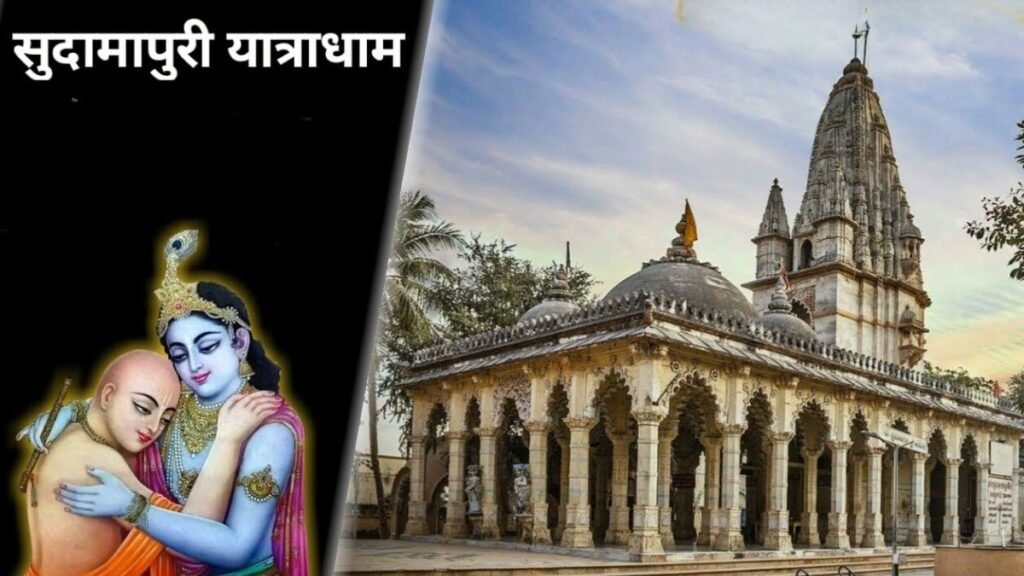
Porbandar was called Sudamapuri in the ancient tradition the city of Sudama believed to be the birthplace of this extraordinary ordinary man. The temple built here between 1902 and 1907 is not grand in the way that Gujarat’s great Solanki temples are grand. It is human-scaled, pink-hued, quiet, shaded by trees, and carried along by the warmth of a story that has nothing to do with power and everything to do with love. It is possibly the most emotionally accessible temple in Gujarat because the story it tells is not about divine might but about friendship, humility, and what happens when you give everything you have.
This TravelRoach guide covers everything: the full legend of Sudama, the temple’s architecture and deities, the historical context of Porbandar as Sudamapuri, the festivals, darshan timings, how to reach, the nearby attractions of Porbandar, and travel tips for a meaningful visit.
Sudama Mandir — Quick Information
| Detail | Information |
| Temple Name | Sudama Mandir (Sudama Temple) |
| Location | Sudamapuri, Bhatia Bazar Old, Porbandar, Gujarat 360575 |
| Position in City | Heart of Porbandar, near the main market area; close to Kirti Mandir |
| Historical Name of Porbandar | Sudamapuri – believed to be the birthplace of Sudama |
| Dedicated To | Sudama – childhood friend and devotee of Lord Krishna |
| Significance | One of the only temples in India dedicated primarily to Sudama |
| Main Deities | Sudama and his wife Susheela; Lord Krishna and Rukmini |
| Built | 1902 to 1907 – constructed under the patronage of the Jethwa dynasty |
| Architectural Style | Traditional Hindu style – marble pillars, sculpted shikhara, carved decorations |
| Temple Colour | Light pink exterior with white marble elements |
| Entry Fee | Free – no entry fee or ticket required |
| Darshan Timings | 6:00 AM – 8:30 PM (daily; may vary on festival days) |
| Photography | Generally permitted in the outer areas; respectful photography inside |
| Best Time to Visit | October to March; early morning or evening for calm darshan |
| Main Festivals | Janmashtami, Sudama Jayanti, Navratri |
| Special Feature | Small stepwell within the temple complex; monument to Ram Devji Jethwa |
| Distance from Porbandar Airport | ~5 km (~10–12 minutes) |
| Distance from Porbandar Station | ~2–3 km (short auto ride) |
| Distance from Rajkot | ~123 km (~2.5 hours) |
| Distance from Junagadh | ~107 km (~2 hours) |
| Distance from Dwarka | ~95–100 km (~2 hours) |
| Distance from Ahmedabad | ~390–400 km (~6.5 hours) |
The Legend of Sudama – The Story This Temple Tells
The Gurukul -Where the Friendship Began
The friendship between Sudama and Krishna did not begin in a palace or a court. It began in a forest specifically in the ashram of Guru Sandipani in Ujjain, where both boys were sent to receive their education in the traditional gurukul system. In the gurukul, students from all backgrounds lived together, served their teacher, studied the Vedas and shastras, and performed daily chores. The king’s son and the Brahmin’s son lived as equals. They ate the same food, slept in the same dormitory, fetched wood from the same forest.
Krishna was the son of the Yadava king destined to be the ruler of Dwarka, one of the great powers of the subcontinent. Sudama was the son of a poor Brahmin family destined for a life of scriptural study, simple living, and spiritual practice. In the world outside the gurukul, these two boys occupied completely different social positions. Inside the gurukul, they were simply friends. They shared food, covered each other’s mistakes, and built the kind of bond that forms only in childhood before the world has had a chance to explain why certain friendships are not supposed to last.
An incident from this period is remembered particularly vividly. On a cold, rainy day, Guru Sandipani sent Sudama and Krishna into the forest to gather firewood. They lost their way in the darkness and storm and spent the night huddled together in the rain under a tree. When the teacher found them the next morning, he was moved by their devotion and their care for each other. He blessed them: that whatever one needed, the other would provide.
The Years Apart – Wealth and Poverty
After completing their studies, the boys went their separate ways. Krishna’s destiny took him to Mathura, to war, to the founding of Dwarka, to the role of king, counsellor, and eventually of the divine figure who would stand at the centre of the Mahabharata war and deliver the Bhagavad Gita. He married Rukmini and other queens. He governed a prosperous kingdom. He became the most celebrated figure of his age.
Sudama’s life took a different path. He returned to his Brahmin household, married Susheela, and lived a life of dignified poverty deeply learned in scripture, devoted in practice, and completely without material ambition. The two friends did not meet for many years. The world kept them apart with the simple logic that it always applies: the powerful and the poor rarely end up in the same room.
Also Read: Bet Dwarka: Complete Travel Guide to Lord Krishna’s Sacred Island in Gujarat
The Journey to Dwarka – Beaten Rice in a Torn Cloth
Sudama’s wife Susheela finally persuaded her husband to visit Krishna in Dwarka. She was practical in her reasoning: you have a childhood friend who happens to be one of the most powerful kings alive. You have a family living in poverty. Perhaps he could help. Sudama was reluctant not because he doubted Krishna’s friendship, but because he felt uncomfortable asking for anything. He did not want the warmth of the friendship to be tainted by need.
He set out for Dwarka carrying the only thing he could afford to bring: a small amount of poha beaten rice, the humblest possible grain wrapped in a torn piece of cloth. It was not a gift worthy of a king. He knew this. But it was all he had. As he walked toward Dwarka, he rolled the little parcel in his hands with shame, wondering whether he should even present it.
When he arrived at Krishna’s palace, he was shown in immediately not kept waiting, not turned away at the gate, not made to explain himself to officials. Krishna came down himself to receive him. He embraced Sudama. He seated him in his own chair. He washed his feet the mark of the highest honour a host can show a guest. Rukmini herself attended to him. The palace was filled with warmth. Sudama, used to poverty, was overwhelmed.
The Beaten Rice – Krishna’s Secret
At some point during the visit, Krishna noticed the small parcel tied in the corner of Sudama’s cloth. He took it from him gently, before Sudama could stop him, before Sudama could decide not to give it. He opened it and found the poha the tiny handful of humble beaten rice and ate it with the delight of someone receiving the greatest delicacy in the world.
According to the tradition, Krishna ate one handful. Before he could reach for a second, Rukmini stopped his hand signalling, the texts say, that one handful was enough for all the material blessings Sudama’s family would ever need. The second handful would have given liberation itself.
Sudama stayed with Krishna for a short time. They talked, laughed, reminisced. When he left, Krishna did not give him any money, any land, any formal blessing. He said nothing about gifts. Sudama walked back toward his village feeling embarrassed that he had come with nothing and left with nothing, certain that he had been too proud to ask openly for help but too ashamed to receive it indirectly.
The Return – The Miracle of the Unchanged Gift
When Sudama reached the place where his humble hut had stood, it was gone. In its place was a mansion. His wife dressed in fine clothes, attended by servants came to receive him at the door. The poverty was gone. Everything had changed. And he had not asked for any of it. He had simply gone to see his friend.
The legend teaches that Sudama received not what he asked for because he asked for nothing but what his sincerity and love deserved. The poha he brought was not a humble gift. It was everything he had. And in the divine accounting of the Bhagavata Purana, everything you have given with a full and uncalculating heart is worth everything.
Porbandar as Sudamapuri – The City of Sudama
The city of Porbandar has been known in ancient tradition as Sudamapuri the city or settlement of Sudama. This designation places Porbandar squarely within the sacred geography of the Krishna narrative. Dwarka 95 to 100 km to the north is where Krishna ruled. Sudamapuri – Porbandar – is where his most beloved mortal friend was born and lived.
The Jethwa dynasty, which ruled Porbandar from approximately the 8th century to the 20th century, was deeply associated with this identity. The Jethwa rulers patronised the Sudama Mandir and the city’s religious and cultural life. Ram Devji Jethwa one of the prominent rulers of the dynasty is commemorated in a monument within the Sudama Mandir complex itself, recognising the royal family’s connection to this particular temple.
Today, Porbandar is most famous internationally as the birthplace of Mahatma Gandhi Kirti Mandir, the house where Gandhi was born, is the city’s most-visited heritage site. But for Vaishnava pilgrims, Porbandar is first and foremost Sudamapuri and Sudama Mandir is the spiritual centrepiece of that ancient identity.
The Temple – Architecture, Deities, and Atmosphere
The Exterior – Light Pink and Shaded by Trees
Sudama Mandir stands in the middle of Porbandar’s bustling market area but step through its entrance and the street noise recedes immediately. The temple’s exterior is light pink a colour that gives it a gentle, approachable visual identity distinct from the white marble of more formal temples and the dark stone of ancient ones. The complex is shaded by a copse of mature trees, creating a pleasant, cool environment even on warm days.
The entrance gateway leads into a square-shaped main hall. The path to the inner sanctum is flanked by marble pillars with carved decorations and floral patterns. The shikhara (temple spire/tower) above the sanctum is intricately sculpted carved with the density and care typical of the late 19th and early 20th century Hindu temple building tradition of Saurashtra. The overall character of the building is modest but dignified reflecting, many devotees feel, the character of Sudama himself.
The Main Shrine – Sudama, Susheela, Krishna, and Rukmini
The inner sanctum of Sudama Mandir houses four principal deities not just Sudama alone, but the complete friendship in its divine and human dimensions. Sudama and his wife Susheela are the primary deities, positioned centrally as the figures in whose honour the temple is built. Alongside them stand Lord Krishna and his queen Rukmini so that even in stone, the two families are reunited as they were in Dwarka when Sudama arrived with his beaten rice.
The combination of these four deities in one sanctum is theologically meaningful: it holds together Sudama’s humanity (the poor, devoted, married Brahmin) and Krishna’s divinity (the royal, all-powerful Vishnu avatar), and in doing so, it refuses to let either exist without the other. The divine needs the human witness. The human needs the divine friend. The four figures together make that statement in every darshan.
Interior Paintings and the Story in Images
The interior walls of Sudama Mandir display paintings and illustrations depicting the story of Krishna and Sudama the gurukul years, the long separation, Sudama’s journey to Dwarka with his beaten rice, the moment of reunion when Krishna washes Sudama’s feet, and the final transformation of Sudama’s village. These narrative paintings give first-time visitors a complete visual account of the story that the temple commemorates and allow the experience of darshan to be enriched with the context of the full legend.
Also Read: Gujarat Coastal Road Trip
The Stepwell and the Green Complex
Within the temple complex is a small stepwell an ancient water structure that predates the 1902 temple construction and connects Sudama Mandir to the Gujarat stepwell tradition that produced monuments like Adalaj ni Vav and Dada Harir ni Vav. The stepwell is modest in scale but architecturally interesting and adds historical depth to the complex. The wider temple complex is set in a green garden with trees and maintained paths creating a pleasant environment for walking, sitting, and reflection before or after the main darshan.
Festivals at Sudama Mandir
Janmashtami – The Birth of Krishna
Janmashtami — the birth anniversary of Lord Krishna, observed on the eighth day of the dark fortnight of the Hindu month of Bhadrapada (typically August or September) is the most celebrated festival at Sudama Mandir. The temple is decorated with flowers, lights, and garlands. Special bhajans and kirtans continue through the day and into the midnight hour when the moment of Krishna’s birth is commemorated with aarti, celebration, and devotional singing. The atmosphere at Sudama Mandir on Janmashtami is particularly moving here, the birth of Krishna is celebrated in the city that was home to his most beloved friend.
Sudama Jayanti – Celebrating the Friend
Sudama Jayanti is the annual celebration of Sudama himself one of the very few religious observances in the Hindu calendar that specifically honours a mortal devotee rather than a deity. At Sudama Mandir in Porbandar, this festival draws pilgrims from across Gujarat and Rajasthan who come to pay tribute to the man the temple commemorates. Special pujas, devotional programmes, and community meals are organised. The Jayanti reminds devotees that the tradition does not only venerate the divine it also honours those ordinary, sincere human beings whose love for the divine was so pure that they became part of the story forever.
Navratri and Other Vaishnava Festivals
Navratri the nine nights of devotion is celebrated at the temple with bhajans, Garba, and special decorations. The temple’s Vaishnava character means it follows the devotional calendar of the Pushtimarg and other Vaishnava traditions: Annakut, Govardhan Puja, and other festivals associated with Krishna’s life are also observed here with appropriate ceremonies.
Darshan Experience – What to Expect
Sudama Mandir is one of the most intimate and accessible temples in Gujarat. Unlike the larger pilgrimage temples of the state where long queues, crowd management systems, and elaborate puja protocols can sometimes make the darshan feel rushed or impersonal Sudama Mandir offers something genuinely quieter and more human-scaled.
When you enter through the gateway, the street noise genuinely does fade. The shaded compound, the marble floors, the low sound of bhajans or bells, and the relatively small size of the main hall create an atmosphere of concentrated devotion without overwhelming scale. Devotees sit, offer flowers, and spend unhurried time before the four figures in the sanctum. There is seating available. The overall pace is gentle.
Many visitors describe leaving Sudama Mandir feeling lighter as though the story of the beaten rice and the transformed village has quietly done its work. The temple’s emotional power is not architectural or ceremonial. It is narrative. Every detail inside points back to the same truth: that sincere, humble, uncalculating love is the most powerful thing in the world.
Best Time to Visit Sudama Mandir
October to March – Best Season
The winter months offer the most comfortable visiting conditions. Porbandar’s coastal climate is pleasant from October to February 18 to 28 degrees Celsius with sea breezes keeping the city cooler than the interior of Gujarat. A morning visit to Sudama Mandir in November or December, followed by a walk to Kirti Mandir and a sunset at Porbandar Beach, is one of the most pleasant heritage days available in Saurashtra.
Janmashtami (August / September) – For the Festival
If experiencing the temple at its most celebratory and devotionally charged, plan for Janmashtami. The festival transforms the temple complex with lights and garlands and draws the most dedicated pilgrims of the year. The midnight aarti commemorating Krishna’s birth is particularly atmospheric. Advance planning for accommodation is essential as Porbandar fills up during Janmashtami.
Early Morning or Evening – Always Best for Darshan
Regardless of season, the most peaceful darshan experience at Sudama Mandir is in the early morning (6 to 8 AM) or the evening (5 to 7 PM). At these hours, the market area around the temple is quieter, the interior is cool, and the devotional atmosphere is most concentrated. Midday visits are perfectly possible but the market heat in summer can make the approach uncomfortable.
Weekdays – Best for Unhurried Darshan
Sudama Mandir receives more visitors on weekends and festival days. For a slow, contemplative visit where you can sit quietly and absorb the space at your own pace, a Tuesday to Thursday morning is ideal.
How to Reach Sudama Mandir, Porbandar
| From | Distance | Mode | Approx. Time |
| Porbandar Airport | ~5 km | Taxi / Auto-rickshaw | 10–12 minutes |
| Porbandar Railway Station | ~2–3 km | Auto-rickshaw (~₹50–80) | 8–10 minutes |
| Kirti Mandir (Gandhi’s Birthplace) | ~0.5–1 km | Walking / Auto | 5–10 minutes walk |
| Rajkot | ~123 km | Car / Bus / Train | 2.5 hours |
| Junagadh | ~107 km | Car / Bus | 2 hours |
| Dwarka | ~95–100 km | Car / Bus | 2 hours |
| Somnath | ~185 km | Car / Bus | 3.5 hours |
| Ahmedabad | ~390–400 km | Car / Bus / Train to Rajkot + transfer | 6.5–7 hours |
Within Porbandar City
Sudama Mandir is in the heart of Porbandar’s main market area a central, easily accessible location. From Porbandar Railway Station (2 to 3 km), take a local auto-rickshaw and ask for ‘Sudama Mandir’ or ‘Sudama Chowk’ every driver knows it immediately. From Porbandar Airport (5 km), taxis are available directly to the temple. If you are staying anywhere in central Porbandar, the temple is within walking distance in the cooler morning and evening hours.
By Road from Other Cities
Porbandar is well-connected to Rajkot (123 km), Junagadh (107 km), and Dwarka (95 to 100 km) by road. GSRTC state buses run frequently on all these routes. If planning a Saurashtra pilgrimage circuit combining Dwarka, Somnath, Porbandar, and Junagadh, Porbandar fits naturally as a central stop and Sudama Mandir combined with Kirti Mandir makes Porbandar a rewarding 4 to 6 hour stop in any Saurashtra itinerary.
By Train
Porbandar has its own railway station with connections to Ahmedabad, Rajkot, Mumbai, and other cities. The station is 2 to 3 km from the temple easily covered by auto-rickshaw. Check current train schedules on Indian Railways before planning a rail visit.
Also Read: Junagadh Travel Guide
Nearby Attractions in Porbandar
- Kirti Mandir – Gandhi’s Birthplace ~0.5–1 km | The house where Mahatma Gandhi was born on October 2, 1869. Now a heritage museum and memorial displaying Gandhi’s personal belongings, photographs, and the story of his early life in Porbandar. One of India’s most-visited heritage sites. Combining Sudama Mandir and Kirti Mandir in a single morning is the natural Porbandar heritage experience.
- Porbandar Beach ~2–3 km | A calm, relatively clean Arabian Sea beach ideal for evening walks and sunset watching. The sea faces west the Porbandar sunset is one of the finest on the Saurashtra coast. A pleasant counterpoint to the heritage and pilgrimage intensity of the temple and Gandhi site.
- Huzoor Palace ~2 km | The former residence of the Jethwa rulers of Porbandar a European-influenced palace with a sea-facing location. The same Jethwa dynasty that patronised Sudama Mandir built this palace. The exterior and setting are worth seeing even if interior access is limited.
- Tara Mandir Planetarium ~1–2 km | A good indoor attraction particularly useful for families visiting with children. Provides respite from afternoon heat while offering an educational experience.
- Barda Hills Wildlife Sanctuary ~15–20 km | A forested hill range near Porbandar with wildlife including leopards, hyenas, wolves, sloth bears, and a rich bird population. Good for nature lovers who want to add an outdoor experience to a Porbandar visit.
- Shree Hari Mandir Porbandar city | Another important Hindu temple within Porbandar city. Worth visiting if you have additional time after Sudama Mandir and Kirti Mandir.
Practical Tips for Visiting Sudama Mandir
- Remove footwear before entering the temple – footwear storage is available near the entrance. The temple floor is clean marble.
- Dress modestly – light cotton clothing, covered shoulders and legs. The temple is in a busy market area and maintains a decorous atmosphere.
- Carry flowers and coconut for the offering – puja items are available from stalls immediately outside and near the temple entrance. The offering of poha (beaten rice) is especially appropriate here given the temple’s legend you can bring a small portion as a personal devotional gesture.
- Arrive early morning for the best experience – 6 to 7:30 AM on a weekday is the quietest, most atmospheric time at Sudama Mandir.
- Allow 45 to 60 minutes – enough for unhurried darshan of all four deities, a reading of the interior paintings, a walk around the stepwell and garden complex, and some quiet sitting in the shaded courtyard.
- Combine Sudama Mandir with Kirti Mandir on the same morning both are within 1 km of each other. The two together tell the complete story of Porbandar: one celebrates a legendary friendship from Hindu mythology, the other celebrates a real friendship between a man and a principle.
- No entry fee – darshan is completely free. Donations can be made at the donation box inside the temple if you wish to contribute to the temple’s maintenance.
- Visit Porbandar Beach in the evening after the temples the combination of a morning of pilgrimage and heritage followed by an evening beach sunset completes the Porbandar day beautifully.
Frequently Asked Questions (FAQs)
Sudama Mandir in Porbandar is one of the only temples in India and possibly the only one dedicated primarily to Sudama, the childhood friend and devoted companion of Lord Krishna. The temple commemorates the famous story from the Bhagavata Purana in which the poor Brahmin Sudama visits his royal friend Krishna in Dwarka carrying a humble gift of beaten rice (poha), is welcomed with extraordinary warmth, and returns home to find his poverty miraculously transformed. Porbandar was historically known as Sudamapuri believed to be Sudama’s birthplace and the temple, built between 1902 and 1907, honours this ancient connection.
Sudama Mandir is open for darshan from 6:00 AM to 8:30 PM daily. There is no entry fee darshan is completely free. The temple may have slightly adjusted timings on major festival days such as Janmashtami and Sudama Jayanti, when special programmes extend into the late evening. The most peaceful and atmospheric time for darshan is early morning between 6 and 7:30 AM, when the market area around the temple is quiet and the devotional atmosphere is at its most concentrated.
Sudama was a poor Brahmin who studied alongside Lord Krishna at the gurukul of Guru Sandipani in their youth. The two became close friends despite their different social positions. Years later, Sudama living in poverty was persuaded by his wife Susheela to visit Krishna in Dwarka. He brought the only gift he could afford: a small handful of beaten rice wrapped in a torn cloth. Krishna welcomed him with royal warmth, washed his feet in honour, and secretly ate the humble rice. When Sudama returned home, his poverty had been transformed into abundance. He received this blessing without having asked for anything. The story teaches that sincere devotion, true friendship, and uncalculating love are rewarded beyond all calculation. The temple in Porbandar believed to be Sudama’s birthplace (Sudamapuri) commemorates this extraordinary friendship and its lesson.
From Porbandar Railway Station, Sudama Mandir is approximately 2 to 3 km away a short auto-rickshaw ride of 8 to 10 minutes for approximately ₹50 to ₹80. All local auto drivers know the temple immediately by the name ‘Sudama Mandir’ or ‘Sudama Chowk.’ The temple is in the central market area of Porbandar and is within easy walking distance from most central Porbandar hotels and guesthouses. From Porbandar Airport (5 km), taxis are available directly to the temple.
Yes and this combination is strongly recommended. Kirti Mandir the birthplace of Mahatma Gandhi is located just 0.5 to 1 km from Sudama Mandir, making a combined visit entirely practical in a single morning. The two sites together present Porbandar’s complete identity: as Sudamapuri (the birthplace of Sudama, friend of Krishna) and as the birthplace of Gandhi. One commemorates a legendary friendship from Hindu mythology; the other commemorates a real life devoted to truth, simplicity, and moral courage. The thematic resonances between the two sites humility, the dignity of simple gifts, the power of sincere friendship are genuinely illuminating when visited together.
Sudama Mandir is unique for several reasons. It is one of the only temples in India dedicated primarily to a devotee rather than to a deity specifically to a mortal man remembered for his humility, poverty, and friendship. This makes its theological focus distinctly human rather than divine: the temple celebrates what a human being can be rather than what a god can do. The four deities in the sanctum Sudama and Susheela, Krishna and Rukmini reflect the completeness of this human-divine relationship. The narrative paintings inside give first-time visitors a complete visual account of the legend. And the temple’s location in Porbandar historically Sudamapuri gives it a geographical authenticity that most temples commemorating mythological events lack.
Yes – Sudama Mandir is one of the most family-friendly temples in Gujarat. The story of Sudama and Krishna is one of the most beloved and easily understood narratives in Hindu mythology the friendship, the humble gift of beaten rice, the miraculous transformation and children who know the story find the temple deeply engaging. The interior paintings tell the story in a visual format that children can follow. The shaded garden and stepwell compound give younger children space to explore. The temple’s modest scale and unhurried atmosphere make it comfortable for elderly family members as well. Allow one hour and plan a Porbandar Beach sunset afterward for a complete family day.
Final Thoughts
India has tens of thousands of temples. They are dedicated to forms of Shiva, Vishnu, Devi, and Ganesh. They celebrate divine power, cosmic creation, and the great mythological events of the Ramayana and Mahabharata. A very small number are dedicated to saints. Almost none are dedicated to friends.
Sudama Mandir is built for a friend. Not for a warrior, not for a sage, not for a king for the poor Brahmin who went to Dwarka with a handful of beaten rice and came back to find his house changed. Who gave everything he had, which was almost nothing. Who asked for nothing, which is the only way to receive everything.
The city of Porbandar holds two extraordinary legacies: the home of the man who used friendship, humility, and truth to change a nation; and the home of the man who used friendship, humility, and a handful of rice to learn something about grace. It is possible that Porbandar knows something the rest of us are still working out.
Visit Sudama Mandir in the morning. Walk to Kirti Mandir afterward. Go to the beach in the evening. Let the Arabian Sea tell you the rest.
