Four times the size of Buckingham Palace. Built in 12 years. Completed in 1890 at a cost that was extraordinary for its time. Home to paintings commissioned from the greatest Indian artist of the 19th century. And still to this day occupied by the royal family that built it, who also open it to the public for Navratri Garba celebrations that have become one of Gujarat’s most celebrated annual events.
Laxmi Vilas Palace in Vadodara is not just the largest private residence in Gujarat. It is one of the most significant buildings in India an architectural masterpiece, a museum of royal heritage, a living home, and a monument to a ruler whose progressive vision shaped modern Gujarat as profoundly as any politician or industrialist. Maharaja Sayajirao Gaekwad III of Baroda the man who commissioned the palace also introduced free and compulsory education, built libraries, patronised Raja Ravi Varma, gave Dr. B.R. Ambedkar a scholarship, and ran one of the most enlightened princely states in colonial India.
This TravelRoach guide covers the palace’s full story the Gaekwad dynasty, the architecture, the Darbar Hall, the Fateh Singh Museum, the Raja Ravi Varma connection, the Navratri celebrations, entry fees, timings, how to reach, and all of Vadodara’s remarkable nearby heritage.
Laxmi Vilas Palace – Quick Information
| Detail | Information |
| Full Name | Laxmi Vilas Palace (also Lakshmi Vilas Palace) |
| Named After | Maharani Laxmibai consort of Maharaja Sayajirao Gaekwad III |
| Location | J.N. Marg, Vadodara (Baroda), Gujarat ~3 km from city centre |
| Commissioned By | Maharaja Sayajirao Gaekwad III, ruler of Baroda State |
| Construction | 1878 to 1890 (12 years) |
| Primary Architect | Major Charles Mant (British architect); completed by Robert Fellowes Chisholm after Mant’s death |
| Construction Cost | ~£180,000 (at time of completion in 1890) |
| Estate Area | ~700 acres |
| Scale Comparison | Four times the size of Buckingham Palace one of the world’s largest private residences |
| Architectural Style | Indo-Saracenic fusion of Mughal, Venetian Gothic, Rajput, Hindu, and European Renaissance elements |
| Special Features | Among first Indian palaces with electricity, elevators, telephone, and modern plumbing |
| Current Status | Gaekwad royal family still resides here; selected areas open to public |
| Key Museum | Maharaja Fateh Singh Museum European art, Raja Ravi Varma works, sculptures, royal artifacts |
| Famous For | Darbar Hall, Navratri Garba celebrations, Raja Ravi Varma paintings, Indo-Saracenic grandeur |
| Entry Fee (Indian) | ₹200 per adult (approximate – confirm at gate) |
| Entry Fee (Foreign) | ₹400 per person (approximate – confirm at gate) |
| Visiting Hours | 9:30 AM – 5:00 PM (Tuesday to Sunday; closed Mondays) |
| Audio Guide | Available at the entrance |
| Distance from Vadodara Station | ~4–5 km (~15 minutes) |
| Distance from Ahmedabad | ~110 km (~2 hours) |
| Distance from Mumbai | ~400 km (~7 hours) |
| Distance from Surat | ~155 km (~2.5 hours) |
Laxmi Vilas Palace – The Greatest Private Home in India
The Scale – Four Times Buckingham Palace
The comparison to Buckingham Palace is not a marketing exaggeration it is a genuine architectural fact. Buckingham Palace, the official residence of the British monarch in London, covers approximately 77,000 square metres including its wings. Laxmi Vilas Palace covers significantly more, spread across a 700-acre estate in the heart of Vadodara. In terms of floor area, it is consistently cited as four times the size of Buckingham Palace making it one of the largest private residences ever constructed anywhere in the world.
This scale, when you experience it in person, is genuinely overwhelming. The palace is not simply large in the way that many royal buildings are large. It has a completeness multiple wings, gardens, a museum, a golf course, fountains, a pond, stables, and outbuildings that makes the estate feel like a small city rather than a house. And yet it was built as a private home. A home for a royal family that still lives here.
The Maharaja Who Built It Sayajirao Gaekwad III
No understanding of Laxmi Vilas Palace is complete without understanding the man who commissioned it. Maharaja Sayajirao Gaekwad III (ruled 1875 to 1939) was not simply a wealthy royal who wanted a grand house. He was one of the most extraordinary rulers in the history of princely India a progressive, cosmopolitan, reforming maharaja whose achievements in education, social reform, and cultural patronage were decades ahead of his time.
- 1893 – Introduced free and compulsory primary education in Baroda State, making it one of the first regions in India to do so decades before the Government of India would follow
- Founded the Baroda Central Library and a network of public libraries across the state firmly believing that education was the foundation of social progress
- 1908 – Established the Bank of Baroda (Baroda State Bank) now one of India’s largest nationalised banks
- Founded what would become the Maharaja Sayajirao University of Baroda (MSU) now one of India’s finest educational institutions
- Personally gave a scholarship to Dr. B.R. Ambedkar the future author of the Indian Constitution to study in the United States and United Kingdom, an act of remarkable vision given the prevalent caste prejudices of the time
- Patronised Raja Ravi Varma commissioning paintings and supporting the press that democratised Indian art
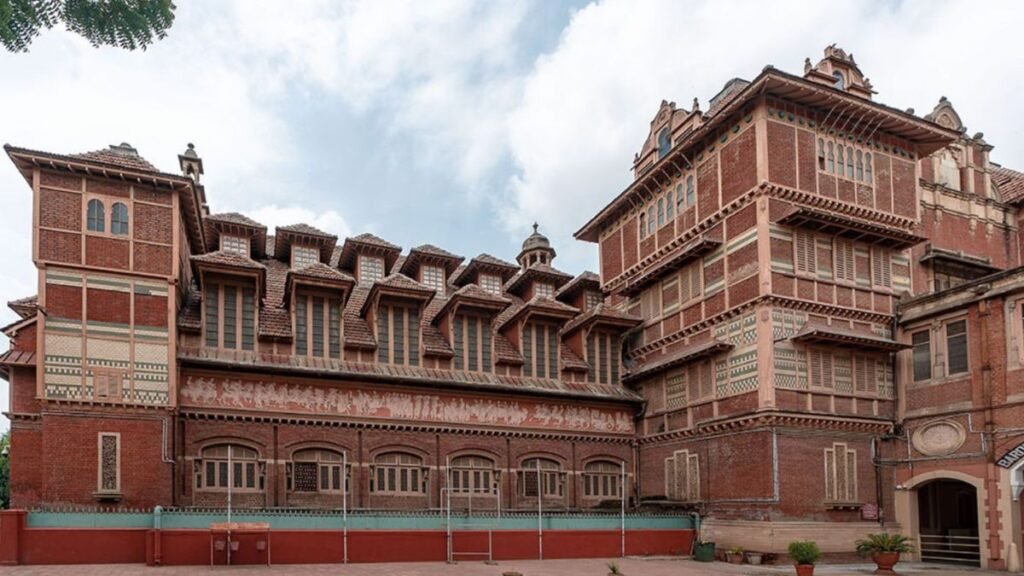
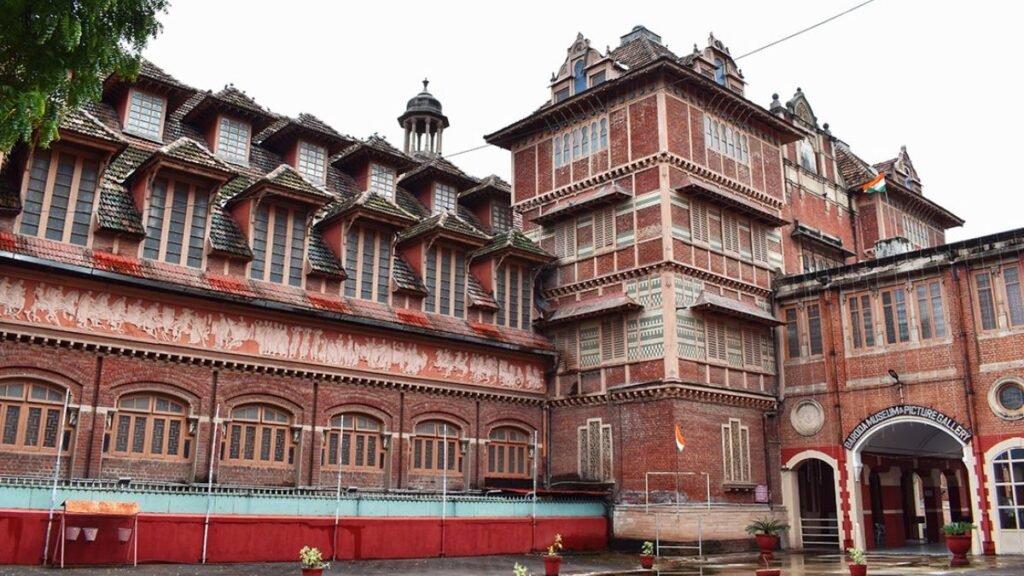
- Built Baroda Museum and Picture Gallery one of the finest regional museums in India
The palace was his most visible monument a statement that Baroda was a modern, sophisticated, globally engaged state, not a provincial backwater. Every architectural decision reflected this ambition: the first elevators, the first electricity, the fusion of world architectural styles into a specifically Indian setting. Laxmi Vilas Palace is as much a manifesto as it is a home.
Also Read: Weekend Getaways from Ahmedabad, Surat & Vadodara
The Gaekwad Family Today
One of the most remarkable aspects of Laxmi Vilas Palace is that it is not a museum. It is not a heritage hotel. It is not a government property. It is still, today, the home of the Gaekwad royal family specifically Maharaja Samarjitsinh Gaekwad, the current head of the family, and his household. The family lives in a private portion of the palace that is not accessible to visitors, while the museum and selected public areas of the estate are open for tourism.
This makes Laxmi Vilas Palace one of the world’s very few examples of a living royal palace a building that simultaneously serves as a world-class heritage attraction and a family home. The Navratri celebrations held in the palace’s Darbar Hall, to which the public is invited, are the most vivid expression of this living royal relationship between the Gaekwad family and the city of Vadodara.
The Architecture – An Indo-Saracenic Masterpiece
The Architects – Mant and Chisholm
The palace was designed primarily by Major Charles Mant, a British architect who had worked extensively in India on various colonial commissions. Mant developed the Indo-Saracenic design concept for Laxmi Vilas Palace a vocabulary that fused Islamic geometric principles, Mughal spatial traditions, Venetian Gothic ornament, Rajput craftsmanship, and European Renaissance detailing into a single coherent style. Construction began in 1878 under his direction.
Mant died before the project was complete. The work was taken over and completed by Robert Fellowes Chisholm another British architect who had worked in India and was sympathetic to the Indo-Saracenic vision. The palace was completed in 1890, twelve years after the first stone was laid. The stone carvings used throughout the palace were sourced from Agra, Ajmer, and Pune the finest stone-carving traditions in northern and western India.
The Visual Character -Domes, Minarets, and Stained Glass
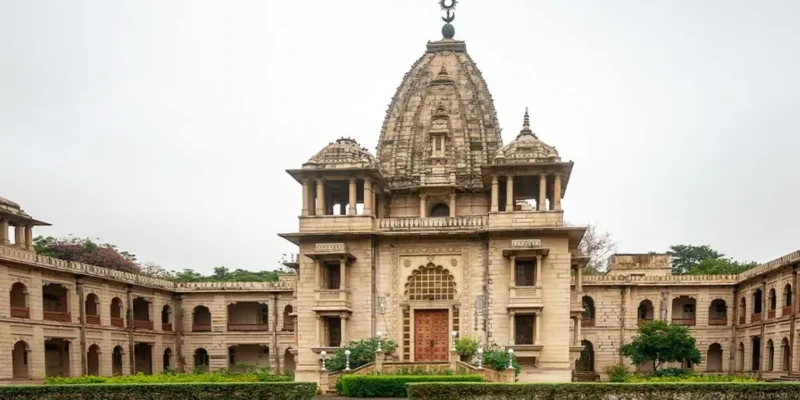
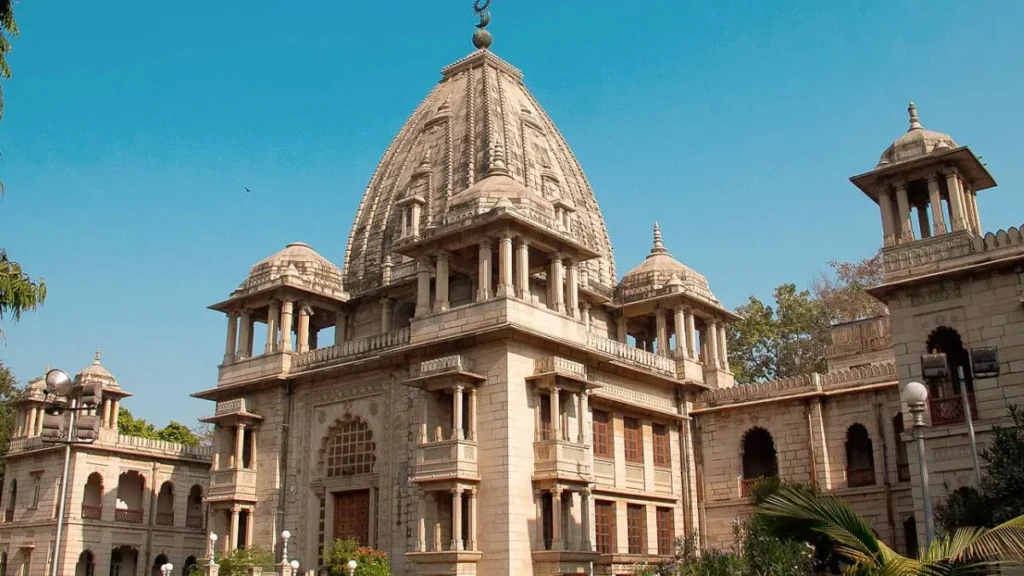
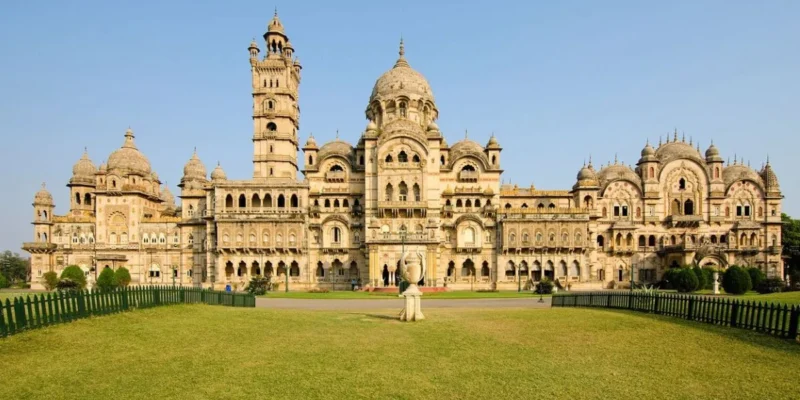
The silhouette of Laxmi Vilas Palace is immediately distinctive and immediately memorable. The building’s skyline is defined by a complex arrangement of domes large and small, at different heights and in different positions interspersed with towers, minarets, and arched loggias that recall both Mughal palace architecture and the Gothic Revival buildings of Victorian England. The central dome of the main building is particularly magnificent its scale and ornament visible from a considerable distance.
At close range, the palace reveals its extraordinary surface detail. Arched windows with stone tracery and stained glass; ornate balconies with carved stone railings; decorative brackets combining Hindu and Islamic motifs; and the consistent use of high-quality stone throughout. The interiors continue this standard of finish: mosaic floors of exceptional quality, Venetian chandeliers of the kind used in the grandest European royal palaces, walls panelled with European and Indian materials, and painted ceilings.
An Engineering Marvel of Its Time
Beyond its visual splendour, Laxmi Vilas Palace was a technological marvel by the standards of 1890. It was among the first palaces in India to incorporate:
- Electricity – at a time when most Indian cities had no electrical infrastructure
- Elevators (lifts) – vertical mechanical conveyance was an extraordinary luxury in 1890 India
- Telephone – a communication technology that had only been patented in 1876
- Modern indoor plumbing – an amenity that most Indian buildings, even grand ones, lacked
These innovations reflected Maharaja Sayajirao Gaekwad III’s characteristic approach: the best of the world, applied in India, without apology. The palace was not an imitation of European luxury it was the equal of it, achieved through the fusion of Indian craftsmanship and European engineering.
Also Read: Best Fast Food in Vadodara
What to See at Laxmi Vilas Palace
1. The Darbar Hall – The Crown Jewel

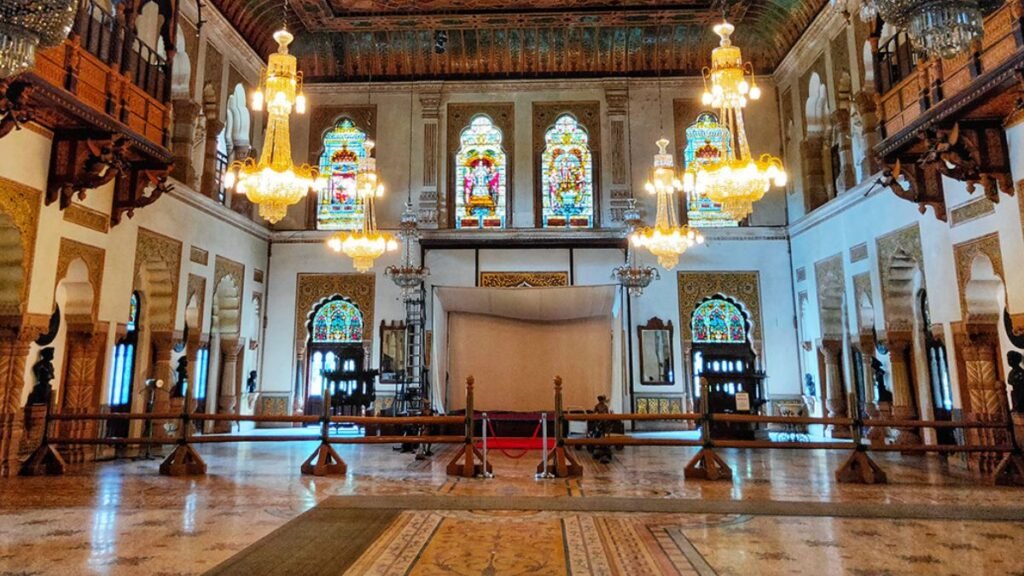
The Darbar Hall is the most celebrated and most photographed space in Laxmi Vilas Palace the room that defines the entire building in the public imagination. Built for the Maharaja’s royal court, the Darbar Hall is a space of extraordinary opulence and beauty.
The hall features Venetian chandeliers of exceptional quality massive, elaborate light fittings imported from Venice, each one representing a significant investment of craftsmanship and cost. The mosaic floor is composed of thousands of individually placed tiles in geometric patterns that rival the finest European examples. The walls are decorated with carved panels and painted details. The ceiling is articulated with intricate geometric and floral ornament.
The Darbar Hall is where the Maharaja held official court, received visiting dignitaries, and conducted the formal ceremonial life of the Baroda state. Today, it is also the venue for the most famous aspect of the palace’s contemporary life: the Navratri Garba celebrations, when the public is invited into the hall to celebrate the nine nights of the festival in one of India’s most extraordinary historic settings.
2. The Maharaja Fateh Singh Museum
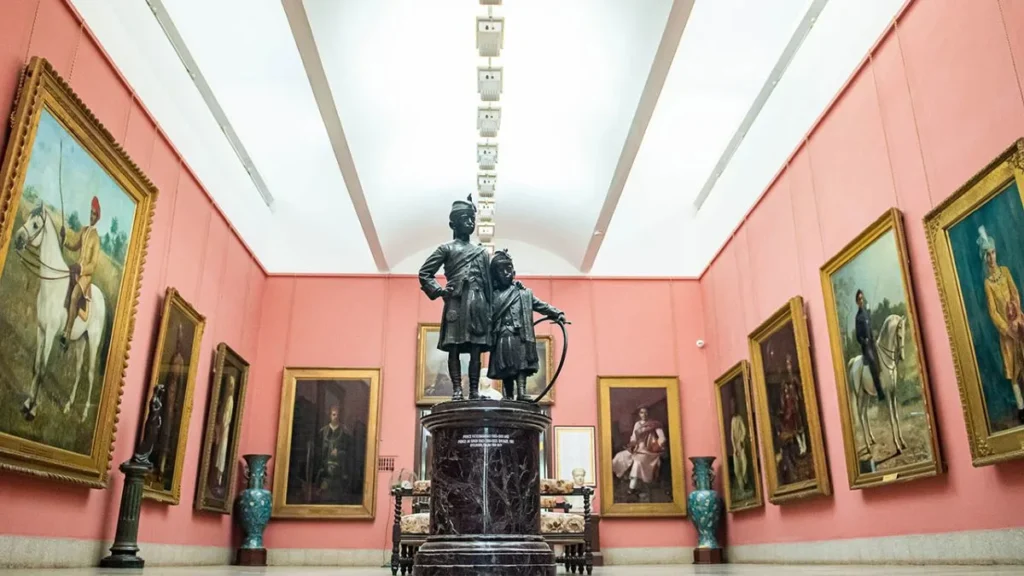
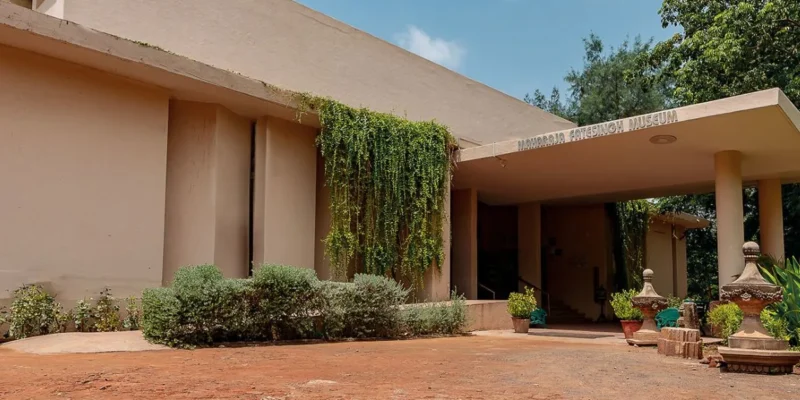
A separate building within the palace estate originally the palace school for the Maharaja’s children now houses the Maharaja Fateh Singh Museum, one of the finest small royal museums in India. The museum’s collections include:
- European paintings – including originals and significant works acquired by the Gaekwad family during their extensive travels in Europe
- Works associated with Raja Ravi Varma – the celebrated Indian painter who was personally patronised by Sayajirao Gaekwad III. Ravi Varma’s mythological paintings, which depicted Indian classical subjects in a realistic European academic style, are considered among the most significant works in 19th-century Indian art.
- Sculptures – including Greek, Roman, and Indian sculptures from the royal collection
- Royal artifacts and memorabilia – weapons, personal items, ceremonial objects, and gifts received from visiting dignitaries
- Portraits and photographs – documenting the history of the Gaekwad family from the 18th century onward
3. The Palace Gardens and Grounds
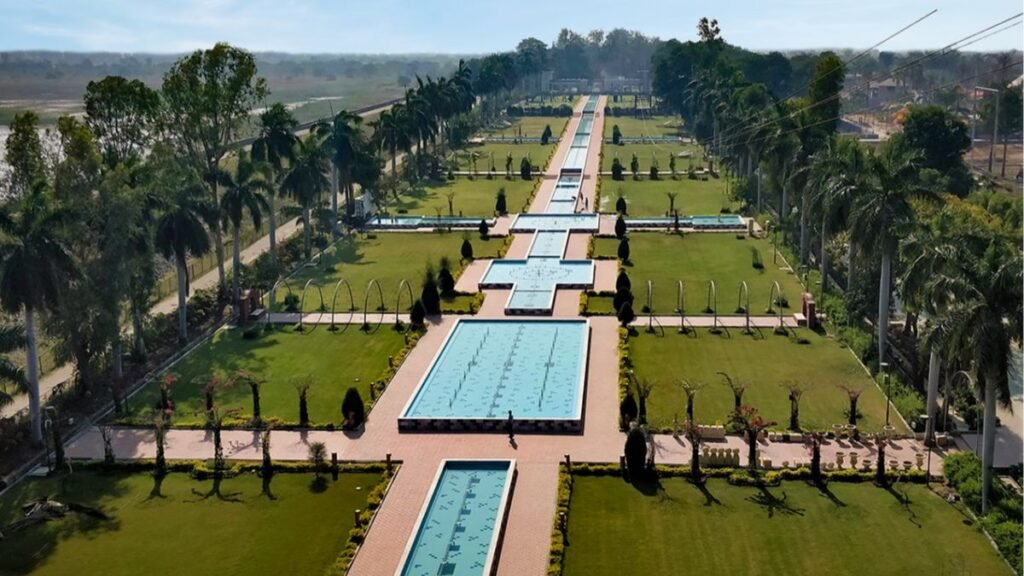
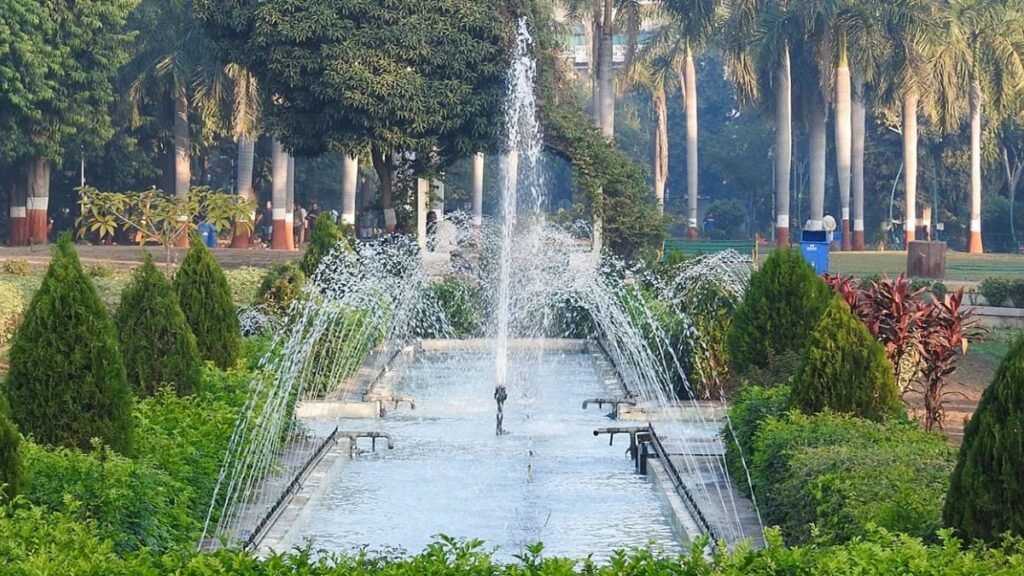
The 700-acre estate of Laxmi Vilas Palace encompasses beautifully maintained gardens, fountains, a central pond, open lawns, and an abundance of mature trees. The gardens are laid out in a combination of formal European garden design (geometric paths, fountain axials) and the more naturalistic English landscape tradition. Walking through the gardens gives you a sense of the estate’s extraordinary scale the palace is visible from different angles as you move through the grounds, revealing new compositions and viewpoints.
The estate also includes a golf course one of India’s oldest golf grounds which adds to the sense of Laxmi Vilas Palace as a complete self-contained world rather than simply a building.
4. The Navlakhi Stepwell
Within the palace estate, there is an ancient stepwell the Navlakhi Vav that predates the palace by several centuries. The stepwell is an example of the Gujarat stepwell tradition that produced Adalaj ni Vav and other masterpieces of the form. Its presence within the palace grounds creates a fascinating visual juxtaposition the ancient water architecture of Gujarat alongside the Victorian Indo-Saracenic palace.
5. The Main Entrance and Facade
Even before you enter the palace, the main entrance and facade deserve extensive time. The entrance gateway, the approach driveway, and the first full view of the palace facade as you approach are among the most dramatic architectural experiences in Gujarat. The relationship between the scale of the building and the scale of a human being is immediately and viscerally communicated by the entrance sequence. Take your time here. Look up. Let the scale register.
Raja Ravi Varma and the Baroda Connection
One of the most significant cultural dimensions of Laxmi Vilas Palace’s history is its deep connection to Raja Ravi Varma the Kerala-born painter who is widely considered the father of modern Indian art. This connection is worth understanding in some depth, because it explains much about the cultural ambition of Maharaja Sayajirao Gaekwad III and the significance of the palace’s art collections.
Raja Ravi Varma (1848 to 1906) developed a painting style that combined European academic realism the kind of technique taught at the great European art academies with Indian classical and mythological subject matter. His paintings depicted scenes from the Ramayana, the Mahabharata, and Indian classical poetry in a visual language that Indian audiences had never seen before: realistic, three-dimensional, emotionally expressive, and using light and shadow in a way derived from European oil painting.
Maharaja Sayajirao Gaekwad III of Baroda was one of Ravi Varma’s most important patrons. The Maharaja invited the painter to come to Baroda, commissioned multiple significant works, and supported Ravi Varma’s establishment of an oleograph printing press the Ravi Varma Press that mass-produced affordable prints of his paintings for ordinary Indian households. This press, founded in 1894, fundamentally democratised Indian art: for the first time, beautiful coloured images of the gods and goddesses of Indian mythology could be purchased by any household for a few annas. The calendar art, the prayer images, and the poster art that became ubiquitous in Indian homes through the 20th century all trace their visual ancestry to this press and its output.
The Maharaja Fateh Singh Museum at Laxmi Vilas Palace preserves this connection displaying works associated with Ravi Varma and commemorating the creative partnership between one of India’s greatest artists and one of its most visionary rulers.
Navratri at Laxmi Vilas Palace – The Most Famous Garba in India
In recent years particularly with the explosion of social media and the growing national prominence of Navratri as a cultural event the Laxmi Vilas Palace Navratri celebrations have become one of the most widely shared and recognised events in Gujarat’s festival calendar.
The Gaekwad family opens the palace’s Darbar Hall for public Garba celebrations during Navratri the nine nights of devotion to Goddess Durga that are celebrated with particular intensity and passion in Gujarat. Dancing Garba in the Darbar Hall of Laxmi Vilas Palace a space of Venetian chandeliers, mosaic floors, and carved walls, built in the 19th century by one of India’s most enlightened rulers is an experience that no ordinary Navratri venue can replicate.
The images and videos from the palace Garba have become iconic in Gujarat and across India: women in embroidered chaniya choli, men in traditional Navratri attire, spinning and clapping in the vast, ornate hall, with the lights of the Venetian chandeliers casting moving shadows on the carved walls. It is both a deeply traditional Gujarati celebration and a visual spectacle of extraordinary quality.
If you are visiting Gujarat during Navratri and the palace celebrations are scheduled, attending the Laxmi Vilas Palace Garba should be at the top of your Vadodara itinerary. Check the palace’s official communications each year for dates and public access information.
Best Time to Visit Laxmi Vilas Palace
October to March – Best Overall
The winter months offer the most comfortable visiting conditions. Vadodara temperatures from October to February range from 15 to 28 degrees Celsius pleasant for extended outdoor exploration of the palace gardens and grounds. The morning light on the palace facade in October to January is particularly beautiful the golden ochre sandstone catches the winter sun and the building’s dome silhouette is at its most dramatic against a clear blue sky.
Navratri (September / October) – For the Festival
If experiencing the palace at its most alive and celebratory is your goal, plan for Navratri. The public Garba at the Darbar Hall is the most extraordinary version of this festival experience in all of Gujarat. Book travel and accommodation in Vadodara well in advance the city fills up during Navratri and the palace draws visitors from across the state and country.
Morning Visits (9:30 to 11:30 AM) – Best for Photography
Regardless of season, visiting early arriving at the 9:30 AM opening gives you the best light, the fewest crowds, and the most peaceful experience of the interiors. The Darbar Hall in the morning, when the light enters at a low angle through the stained glass windows, is at its most photographically magnificent. By midday, the light is flat and the visitor numbers have built significantly.
April to June – Hot (Not Recommended for Extended Visits)
Vadodara summers can reach 42 to 45 degrees Celsius. Extended walking in the palace grounds in the afternoon heat is uncomfortable. If visiting in summer, focus on the interior spaces (the museum and Darbar Hall are air-conditioned or shade-protected) and arrive at opening time.
How to Reach Laxmi Vilas Palace, Vadodara
| From | Distance | Mode | Approx. Time |
| Vadodara city centre | ~3 km | Auto-rickshaw / Taxi / Walking (30 min) | 10–15 minutes |
| Vadodara Railway Station (BRC) | ~4–5 km | Auto-rickshaw / Taxi | 15–20 minutes |
| Vadodara Airport | ~8–10 km | Taxi | 20–25 minutes |
| Ahmedabad | ~110 km | Car / Train (2 hours) + local transfer | 2.5 hours total |
| Surat | ~155 km | Car / Train + local transfer | 2.5–3 hours |
| Mumbai | ~400 km | Train (Shatabdi/Rajdhani) + local transfer | ~3.5–4 hours (train) |
| Champaner-Pavagadh (UNESCO) | ~47 km | Car | 1 hour |
Within Vadodara
Laxmi Vilas Palace is located on J.N. Marg (Jawaharlal Nehru Marg), approximately 3 km from Vadodara’s central area. All local auto-rickshaws and taxis know it simply say ‘Laxmi Vilas Palace’ or ‘Lukshmi Vilas.’ Ola and Uber are widely available in Vadodara. From the railway station (Vadodara Junction / BRC), the palace is approximately 15 to 20 minutes by auto or cab. Paid parking is available at the palace entrance for private vehicles.
By Train – Recommended from Ahmedabad, Surat, and Mumbai
Vadodara Junction (BRC) is one of the busiest and best-connected railway stations in Gujarat — on the main Western Railway line between Mumbai and Delhi. Multiple express trains (including the Shatabdi Express and Rajdhani Express) stop at Vadodara. From Ahmedabad (110 km), the fastest trains take approximately 1 to 1.5 hours. From Mumbai (400 km), the Shatabdi Express takes approximately 3.5 to 4 hours. From Surat (155 km), approximately 1.5 to 2 hours.
Beyond the Palace – Vadodara’s Other Attractions
Vadodara is one of Gujarat’s most culturally rich cities the palace is its centrepiece, but the city repays a full day or two of exploration. Here are the key attractions to combine with your Laxmi Vilas Palace visit:
- Baroda Museum and Picture Gallery ~3 km from palace | One of India’s finest regional museums, also founded by Maharaja Sayajirao Gaekwad III. The Picture Gallery contains an extraordinary collection of European and Indian paintings — including works by Constable, Reynolds, Raphael (copies), and significant Indian masters. The natural history, archaeology, and Kutch craft collections are also excellent.

- Sayaji Baug (Kamatibaug) ~3 km | A large, beautifully maintained public garden commissioned by Sayajirao Gaekwad III, containing the Baroda Museum, a planetarium, a zoo, and a miniature train. One of the finest urban gardens in Gujarat.
- EME Temple (Dakshinamurti Temple) ~3 km | A remarkable modern temple built by the Indian Army’s Corps of Engineers with a unique aluminium shikara (spire). One of Vadodara’s most unusual and visually distinctive monuments.
- Champaner-Pavagadh Archaeological Park ~47 km | UNESCO World Heritage Site with 15th-century Islamic architecture, the Kalika Mata Temple atop Pavagadh Hill, helical stepwells, and ancient fortifications. Read our full TravelRoach guide.
- Makarpura Palace ~7 km | Another Gaekwad palace in Vadodara now a National Cadet Corps wing; the grounds and exterior are worth seeing.
- Old City Baroda Walk City centre | The older lanes of Vadodara around Mandvi area, with traditional haveli architecture, textile shops, and the Maharaja Sayajirao University campus.
Also Read: Best Restaurants in Vadodara: Top 10 Must-Try Places
Practical Tips for Visiting Laxmi Vilas Palace
- Arrive at 9:30 AM when the palace opens -morning light on the palace facade and through the stained glass is the best photographic window of the day.
- Collect the audio guide at the entrance – it is available in multiple languages and significantly enriches the visit by providing historical context for each major space.
- Allow at least 2 to 3 hours – the palace and the Fateh Singh Museum together deserve unhurried attention. Rushing through means missing the detail that makes the visit extraordinary.
- The palace is closed on Mondays – plan your visit for Tuesday to Sunday.
- Wear comfortable, flat shoes – the palace grounds are extensive and involve significant walking on both interior stone floors and exterior grounds.
- Dress modestly – the palace is a royal home and a heritage attraction; avoid beachwear, shorts, or inappropriate clothing.
- Confirm entry fees at the gate before visiting – as a private royal property, the fee structure may be updated. Budget approximately ₹200 to ₹400 per adult depending on Indian/foreign national status.
- Photography is generally allowed in the gardens and exterior – check with staff for specific rules inside the Darbar Hall and museum.
- For Navratri Garba – check the palace’s official social media pages for the current year’s public Garba schedule, entry process, and dress code. Demand is high and advance planning is essential.
- Combine with Baroda Museum on the same day – both were created by the same Maharaja and together tell the complete story of Sayajirao Gaekwad III’s remarkable vision for Baroda.
Frequently Asked Questions (FAQs)
Laxmi Vilas Palace is spread across a 700-acre estate in Vadodara and is consistently cited as approximately four times the size of Buckingham Palace, London. This makes it one of the largest private residences ever built in the world. It was constructed over 12 years from 1878 to 1890 at a cost of approximately £180,000 a remarkable sum for a private residence at the time. The palace itself contains multiple wings, the Darbar Hall, gardens, a museum, a golf course, a pond, and numerous outbuildings within its vast estate.
Laxmi Vilas Palace was commissioned by Maharaja Sayajirao Gaekwad III one of the most progressive and enlightened rulers of any Indian princely state and completed in 1890. It was designed by British architect Major Charles Mant and completed by Robert Fellowes Chisholm after Mant’s death. Today, the palace is still the home of the Gaekwad royal family specifically Maharaja Samarjitsinh Gaekwad and his household, who occupy the private portion of the palace. Selected areas including the Maharaja Fateh Singh Museum, Darbar Hall, and gardens are open to the public.
Laxmi Vilas Palace is open Tuesday to Sunday from 9:30 AM to 5:00 PM; it is closed on Mondays. The entry fee is approximately ₹200 per adult for Indian visitors and ₹400 for foreign nationals (fees are subject to change as the palace is a private royal property). An audio guide is available at the entrance for an additional fee. Always confirm current fees and timings directly at the palace gate or through their official communications before visiting, as rates may be updated.
The Maharaja Fateh Singh Museum is a museum housed in a building within the Laxmi Vilas Palace estate originally the palace school for the Maharaja’s children. It contains one of the finest royal art collections in India, including European paintings, works by and associated with Raja Ravi Varma (the celebrated 19th-century Indian painter patronised by the Baroda royal family), Greek and Roman sculptures, royal artifacts, weapons, ceremonial objects, and portraits of the Gaekwad rulers. The museum provides essential context for understanding the cultural ambition and global engagement of Maharaja Sayajirao Gaekwad III.
The Navratri Garba at Laxmi Vilas Palace has become one of the most celebrated Navratri events in Gujarat. The Gaekwad royal family opens the palace’s Darbar Hall with its Venetian chandeliers, mosaic floors, and carved walls to the public for Garba celebrations during the nine nights of Navratri (typically September or October). Dancers in traditional chaniya choli and Navratri attire perform Garba in one of India’s most magnificent historic interiors. The events have been widely shared on social media and have significantly elevated the palace’s national profile. Check the palace’s official communications each year for current dates, access procedures, and dress code.
Maharaja Sayajirao Gaekwad III (ruled 1875–1939) was one of the most extraordinary rulers in the history of princely India. Beyond building Laxmi Vilas Palace, his achievements include: introducing free and compulsory primary education in Baroda State in 1893 (decades before independent India); establishing the Bank of Baroda in 1908; founding what would become the Maharaja Sayajirao University of Baroda; creating an extensive public library network; personally patronising Raja Ravi Varma and supporting his democratising printing press; giving a scholarship to the young B.R. Ambedkar (future author of India’s Constitution) to study in the US and UK; and building one of the finest regional museums in India. He was, in short, as significant a figure for modern Gujarat as the palace he built is for Gujarat’s architectural heritage.
Vadodara is a rewarding city for heritage tourism and Laxmi Vilas Palace combines well with several other attractions. The Baroda Museum and Picture Gallery (3 km, also founded by Sayajirao Gaekwad III) is the natural companion to the palace and should ideally be visited on the same day. Sayaji Baug garden (3 km) and the EME Temple are good afternoon additions. For a longer trip, Champaner-Pavagadh Archaeological Park (47 km) is the UNESCO site that makes Vadodara a 2-day destination, and the Jambughoda Wildlife Sanctuary (70 km) adds a nature dimension. Vadodara is also an excellent base for day trips to Ahmedabad (110 km) and its heritage monuments.
Final Thoughts
There are palaces in India that are larger. There are palaces that are older. There are palaces whose art collections are deeper or whose gardens are more elaborate. But very few palaces in India are simultaneously all of the following: among the largest private residences in the world, still inhabited by the family that built them, still celebrating the traditions that gave them meaning, and built by a ruler whose progressive vision was as extraordinary as his architectural ambition.
Laxmi Vilas Palace is all of these things. It is Vadodara’s greatest monument and one of Gujarat’s most magnificent buildings. The Darbar Hall alone with its Venetian chandeliers catching the light of another Gujarat morning is worth the drive from Ahmedabad.