In 1819, roughly 10,000 people lived inside these walls. Millionaire merchants. Ships from Sindh. A port that reportedly earned one lakh koris a day the coin that gave the town its name.
Then, on the evening of 16 June, the earth moved.
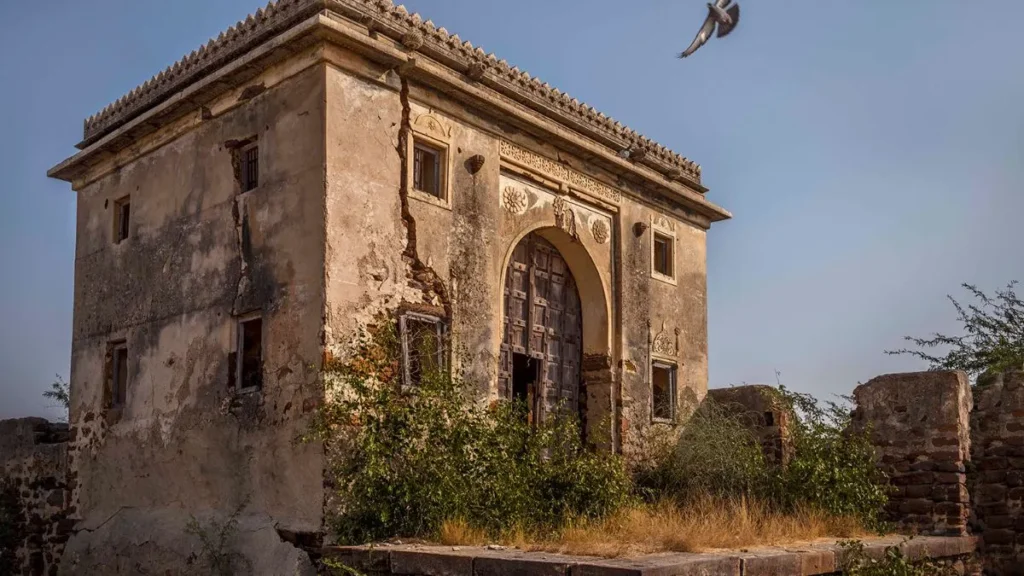
Today, a few hundred people live inside seven kilometres of fortification, and Lakhpat Fort in Kutch is the most atmospheric ruin in Gujarat: crumbling havelis, a Sufi tomb, a Gurudwara where Guru Nanak is said to have stayed, and ramparts looking out over Kori Creek towards Pakistan.
This guide covers the fort’s history, what’s inside the walls, how to reach, best time to visit, border-area practicalities, and nearby stops written for heritage travellers, photographers, road-trippers and anyone building an offbeat Kutch itinerary.
Quick Facts: Lakhpat Fort at a Glance
| Detail | Information |
| Location | Lakhpat, Lakhpat taluka, Kutch district, near the India–Pakistan border |
| Setting | Mouth of Kori Creek, overlooking the Great Rann of Kutch |
| Fort walls | Approx. 7 km long, with around 24 watchtowers |
| Fortified | 1801, by Jamadar Fateh Muhammad, a Kutch general |
| Named after | Rao Lakhpatji (ruled c. 1752–61) — also linked to lakh koris of daily revenue |
| What ended it | The 16 June 1819 earthquake, which diverted the Indus |
| Population then / now | Over 10,000 → a few hundred residents |
| Entry fee | Free |
| Distance from Bhuj | Approx. 135 km |
| Best time to visit | November to February; sunset for the ramparts |
The Story: How a Millionaires’ Port Became a Ghost Town
Lakhpat sat at the mouth of Kori Creek, exactly where the Indus once met the sea. That geography made it everything.
The town takes its name from Rao Lakhpatji, the Kutch ruler under whom it flourished around the mid-1700s. The other explanation locals offer is more evocative: lakhpat means millionaire, and the port was said to earn one lakh koris a day koris being the currency of Kutch at the time.
In 1801, Jamadar Fateh Muhammad enlarged the fortifications into the roughly 7 km circuit you see today, built to hold off the Sindhis across the water. Contemporary accounts describe a garrison of around 50 Arabs and 150 Kutch soldiers guarding a town of merchants trading opium, rice, ghee, silk and perfumes with Sindh.
Then came 16 June 1819. The Rann of Kutch earthquake, estimated at magnitude 7.7 to 8.2, tore through the region and threw up a natural dam that came to be called the Allah Bund the “dam of God.”
The consequence was catastrophic in slow motion. The Indus changed course, shifting away from the town. A port without a river is not a port. Trade collapsed, families left, and a settlement of over ten thousand emptied out across the following decades.
What survives is the strangest kind of monument: not a ruin built as a palace, but an entire town that simply stopped.
What to See Inside Lakhpat Fort
1. Walk the Ramparts at Sunset
Why visit: This is the reason to come. Climb the fort walls and the landscape opens out across Kori Creek and the Rann, with Pakistan on the horizon. The light in the last hour is extraordinary, and you will very likely have the wall to yourself.
Best for: Photographers, couples, solo travellers
Cost: Free
Safety note: The ramparts are old and unrailed in stretches. Watch your footing and don’t climb after dark.
2. Gurudwara Lakhpat Sahib
Why visit: Guru Nanak is believed to have stayed here during his udasis his great missionary journeys on the route towards Mecca. The Gurudwara preserves relics associated with him, including wooden footwear (khadaun), a palkhi and old manuscripts. It’s calm, beautifully kept, and the hospitality extended to visitors is genuine.
Best for: Pilgrims Sites, everyone
Note: The structure was restored after the 2001 Bhuj earthquake and the conservation work received a UNESCO Asia-Pacific heritage award.
Etiquette: Cover your head, remove footwear, dress modestly.
3. The Tomb of Pir Ghaus Muhammad
Why visit: A stone tomb close to the Gurudwara, dedicated to a Sufi saint remembered locally as having drawn from both Hindu and Islamic practice. In a town where a Sikh shrine, a Sufi tomb and Hindu temples sit within one wall, it captures Lakhpat’s whole character.
Best for: History readers, culture seekers
4. Sayyed Pir Shah Dargah
Why visit: A nine-domed structure noted for its intricate carving some of the finest stonework surviving inside the fort.
Best for: Architecture lovers, photographers
5. The Ruins Themselves
Why visit: Honestly, the best thing to do in Lakhpat is wander. Collapsed havelis, the old custom house, empty gateways, lanes that lead nowhere. There’s no ticketed circuit and no signage worth speaking of you simply walk into an 18th-century town and find things.
Best for: Slow travellers, photographers
Tip: Allow at least two hours. People who budget forty minutes always regret it.
6. Hatkeshwar Temple and Nani Mai Dargah
Why visit: Two more surviving religious structures inside the walls, worth seeking out as you explore further evidence of how mixed this trading town’s population once was.
Best for: Completists
The Bollywood Connection
Here’s a detail most visitors don’t know: J.P. Dutta’s Refugee (2000) Abhishek Bachchan and Kareena Kapoor’s debut film was shot in this region, with Lakhpat standing in for a fictional town across the border.
If the ramparts and the creek feel oddly familiar, that’s why.
Border Area: What You Should Know
Lakhpat sits in the far north-west of Kutch, close to the India–Pakistan border. This shapes a few practical things:
- Carry government photo ID for every person in your group. Always.
- Expect checkpoints on the approach roads. Be polite, be patient, keep documents accessible.
- Some areas nearby are restricted and may require permits. Lakhpat town itself is generally accessible to visitors, but check locally in Bhuj or Naliya before setting out if you plan to go further towards the creek or the border.
- Don’t photograph military installations, checkpoints or personnel. This should be obvious. It isn’t always.
- Foreign nationals should confirm current requirements in advance, as rules for border districts can differ.
- Mobile network is patchy. Download offline maps before you leave Bhuj.
None of this makes Lakhpat difficult to visit. It just means you should arrive prepared rather than improvising.
How to Reach Lakhpat Fort, Kutch
Lakhpat Fort is remote, and that remoteness is exactly why it’s still intact and uncrowded.
By Road (Recommended)
From Bhuj: Approximately 135 km north-west, taking around 3 hours. This is the standard approach and the one most travellers use.
From Narayan Sarovar / Koteshwar: Approximately 30–33 km, under an hour. If you’re already doing the pilgrimage circuit, Lakhpat is an easy and obvious add-on.
From Naliya: Roughly 60–70 km. Useful if you’re combining with the Abdasa coastal belt.
From Ahmedabad: Approximately 500 km. This is a two-stage journey overnight in Bhuj, then drive out.
Roads are reasonable but empty. Fill fuel in Bhuj or Naliya do not assume you’ll find a pump closer.
By Bus
State and private buses connect Bhuj towards the Lakhpat side, though services are limited and slow. For a day trip, a hired car or taxi is far more practical.
By Train / By Air
Bhuj is both the nearest railhead and the nearest airport, with connections to Ahmedabad and Mumbai. Everything onward is by road.
Best Time to Visit Lakhpat Fort
November to February is the season, and it isn’t close.
- November–February (Winter) – Best overall. Cool, dry, comfortable for walking the walls and the ruins. Overlaps with Rann Utsav, so it pairs naturally with a wider Kutch trip.
- March–June (Summer) – Severe. There is almost no shade inside the fort and very little shelter. Avoid.
- July–September (Monsoon) – The Rann fills and the landscape shifts dramatically, but roads and access get unreliable.
Best time of day: Arrive by mid-afternoon, explore the ruins, then be on the ramparts for the last hour of light. Start the drive back before it’s fully dark the roads out are unlit and unpopulated.
Where to Eat Near Lakhpat Fort
Set your expectations: there is essentially no restaurant scene in Lakhpat. A tea stall or a very basic eatery is the realistic ceiling.
The Gurudwara may serve langar the free community meal offered at Sikh shrines. If you eat there, do so respectfully, follow the customs, and consider contributing to the shrine.
What to do instead: Pack Gujarati travel food. Theplas, khakhra, athanu and dry farsan like gathiya or sev mamra hold up beautifully in the dry Kutch air and need no refrigeration.
Narayan Sarovar (30–33 km) – Basic pilgrim eateries with simple thali options.
Bhuj (135 km) – Where you’ll eat properly. Kutchi thali houses serving bajra rotla with garlic chutney, plus the local dabeli that Kutch is famous for.
Carry at least two litres of water per person. This is not a place to run short.
Places to Visit Near Lakhpat Fort
| Place | Why Visit | Best For | Distance |
| Narayan Sarovar | One of Hinduism’s five sacred lakes | Pilgrims | ~30–33 km |
| Koteshwar Temple | Shiva temple at the westernmost tip of India’s coastline | Pilgrims, photographers | ~35 km |
| Pingleshwar Beach | Quiet, undeveloped golden-sand beach near Naliya | Slow travellers | ~70–80 km |
| Mata no Madh | Ashapura Mata temple, a major Kutchi pilgrimage site | Devotees | ~70 km |
| Bhuj | Aina Mahal, Prag Mahal, Kutch Museum, Hamirsar Lake | Everyone | ~135 km |
| Great Rann / Dhordo | The white desert and Rann Utsav grounds | Everyone | ~180 km |
Suggested 2-Day Western Kutch Itinerary
Day 1: Reach Bhuj → Aina Mahal, Prag Mahal and the Kutch Museum → overnight in Bhuj.
Day 2: Early start with a full tank → drive to Mata no Madh → continue to Narayan Sarovar and Koteshwar → reach Lakhpat Fort by mid-afternoon → explore the ruins and Gurudwara → sunset on the ramparts → return to Bhuj.
It’s a long day. It’s also one of the most rewarding drives in Gujarat.
Where to Stay Near Lakhpat Fort
There are no proper tourist hotels in Lakhpat, so most visitors stay in nearby towns before exploring the fort and surrounding attractions.
Stay in Bhuj
Bhuj, around 135 km from Lakhpat, is the most convenient base for travellers. You will find a wide range of accommodation, from budget lodges and guesthouses to heritage properties and business hotels. Staying in Bhuj also makes it easier to arrange transport, fuel and supplies before your Lakhpat trip.
Stay in Narayan Sarovar
Narayan Sarovar, approximately 30–33 km from Lakhpat, offers basic accommodation such as pilgrim dharamshalas and simple guesthouses. It is a practical option if you want to stay closer to Lakhpat and visit nearby religious attractions.
Gurudwara Lakhpat Sahib
Gurudwara Lakhpat Sahib may offer basic shelter to travellers, depending on current arrangements. If you stay here, respect the gurudwara’s customs, maintain cleanliness and follow the community guidelines.
Frequently Asked Questions (FAQs)
Lakhpat is called a ghost town because the 1819 earthquake diverted the Indus River and ended its port trade, causing most residents to leave.
No, there is no entry fee for Lakhpat Fort. Visitors can freely explore the fort and surrounding town.
Lakhpat Fort is around 135 km from Bhuj and takes approximately three hours by road.
Indian visitors generally do not need a special permit for Lakhpat town, but carry valid photo ID as border-area checkpoints may apply.
Gurudwara Lakhpat Sahib is associated with Guru Nanak’s visit and preserves historic relics linked to him.
Plan around two to three hours to explore Lakhpat Fort, its historic sites, religious landmarks and ramparts.
Final Thoughts
Lakhpat Fort in Kutch is not just a restored monument with a ticket counter and gift shop. It is an 18th-century port town that fell silent after an earthquake, still standing behind nearly seven kilometres of historic walls at the edge of India.
Plan your visit in winter, carry valid ID and enough water, and fill your fuel tank in Bhuj before heading out. Take your time exploring the fort, historic sites and ramparts, and stay until sunset for beautiful views across the Kutch landscape.
Have you visited Lakhpat Fort? Tell us what the view from the walls looked like and share the offbeat Kutch places you think Travel Roach should cover next in the comments.
