On the Ahmedabad-Kalol Highway, twenty kilometres north of Ahmedabad and fifteen kilometres from Gandhinagar, there stands a temple that does something almost no other temple in India does: it gives equal, simultaneous worship space to the deities of three entirely distinct religious traditions. The Trimandir at Adalaj houses Jainism, Shaivism, and Vaishnavism under a single white marble roof Lord Simandhar Swami, Lord Shiva, and Lord Krishna receiving devotion side by side, in shrines of equal dignity, attended by seven hundred thousand visitors each year.
The Trimandir is not an ecumenical museum or a tourist exhibit. It is a fully functioning devotional space alive from 5 AM to 10 PM every day, with regular satsang programmes, school groups from across Gujarat, a health centre serving thousands, a specialist bookshop, and a mini-theatre that has screened more than nine thousand shows to over two hundred thousand viewers. The concept and the institution both originate from Gnani Purush Param Pujya Dada Bhagwan a Gujarati spiritual figure whose teaching that the Soul transcends all religious identity became the architectural principle of the Trimandir: if souls are equal, why should temples not be?
This TravelRoach guide covers everything: who Dada Bhagwan was, what Akram Vignan teaches, the architecture and what to expect inside, all the facilities on campus, timings, entry (free), how to reach from Ahmedabad, and how to combine Adalaj Trimandir with the nearby Adalaj ni Vav and Akshardham Temple in a complete Gandhinagar-area day.
Adalaj Trimandir — Quick Information
| Detail | Information |
| Full Name | Trimandir, Adalaj (also Dada Bhagwan Trimandir) |
| Address | Amarapur Village, Nr. Amarnath Dham, Gram Bharati Cross Road, Gandhinagar-Mahudi Highway, Adalaj, Gujarat 382735 |
| Also Located On | Ahmedabad-Kalol Highway |
| What is Trimandir | A non-sectarian temple honouring Jainism (Simandhar Swami), Shaivism (Shiva), and Vaishnavism (Krishna) simultaneously under one roof |
| Founded By | Gnani Purush Param Pujya Dada Bhagwan (born Ambalal Muljibhai Patel, 1908-1988) |
| Spiritual Tradition | Akram Vignan – Science of Spontaneous Self-Realization; founded by Dada Bhagwan |
| Built | 2002 |
| Material | White marble |
| Area | 40,175 sq ft (temple complex); Temple podium 20,895 sq ft; Satsang Hall 31,861 sq ft |
| Status | Largest Trimandir in India |
| Central Idol | Lord Shree Simandhar Swami – 155 inches (~13 feet) tall, made entirely of marble; currently living Tirthankara in another world-sphere per Jain belief |
| Other Deities | Lord Shiva (Shivalinga), Lord Krishna, Lord Balaji, Lord Vishnu, Goddess Lakshmi, Goddess Padmavati, Sai Baba |
| Annual Visitors | ~700,000 devotees per year |
| Entry Fee | Free -no entry fee |
| Timings | 5:00 AM – 10:00 PM (open daily) |
| Museum | About Dada Bhagwan’s life; ~300,000 visitors per year |
| Mini-Theatre | Shows in Gujarati, Hindi, English; ~9,400 shows/year; ~222,000 viewers/year |
| Vignan Bhandar (Bookshop) | Spiritual books, CDs, DVDs in Gujarati, English, Hindi, German, Portuguese, Spanish and other languages |
| Amba Health Centre | Allopathic + Ayurvedic + Homeopathic doctors; subsidized; Mon-Sat |
| School Hosting | ~1,000 schools, 7,000 teachers, 70,000+ children annually |
| Store of Happiness | Children’s shows and puppet shows on moral values; open to all |
| Distance from Ahmedabad | ~20 km (~30 minutes) |
| Distance from Gandhinagar | ~12–15 km (~20 minutes) |
| AMTS Buses | Routes 4, 4D, 4E, 4S, 89/1, 109 serve Trimandir bus stop |
| Nearest Railway Station | Gandhinagar Capital Railway Station |
| Nearest Airport | Ahmedabad SVP International Airport (~20 km) |
Gnani Purush Dada Bhagwan — The Visionary Behind the Trimandir
A Contractor Who Became a Gnani
The story of Adalaj Trimandir begins not with an architect or a religious institution but with a specific moment on a railway platform in Surat in 1958. It was there, according to the account preserved by his followers, that Ambalal Muljibhai Patel a building contractor from Tarsali, Gujarat, then working at Patel & Co. maintaining dry docks in Mumbai underwent a spontaneous and complete spiritual experience of self-realization. In less than an hour on that platform, what he described as the separation of the ‘I’ from the body and mind occurred entirely and Ambalal Muljibhai Patel became Dada Bhagwan: the Gnani Purush (embodied knowledge-person) whose teaching would subsequently attract devotees from around the world.
What made this event unusual in the context of Indian spiritual tradition was its spontaneity. Dada Bhagwan had not spent years in ashram practice or sat under the guidance of a guru. He had left school after the tenth grade, worked in business, married and raised a family the life of an ordinary, engaged householder. The realization that occurred on the Surat platform was, in the framework of the spiritual science he subsequently articulated, precisely the kind of realization that the Akram Vignan path makes available to any sincere seeker.
Akram Vignan — The Science Without Steps
The teaching tradition that emerged from Dada Bhagwan’s realization is called Akram Vignan the Science (Vignan) Without Steps (Akram, contrasted with Kram, meaning sequential or step-by-step). The conventional spiritual paths of Jainism and other Indian traditions prescribe a sequential progression of spiritual practices ethics, meditation, renunciation, austerity that, followed over many lifetimes, progressively purify the soul and move it toward liberation. Akram Vignan proposes a different path: that a direct, non-sequential, instantaneous self-realization is available through the grace of a living Gnani.
The central philosophical claim of Akram Vignan is that the pure Soul the Atma is entirely separate from the body, mind, and ego (what Dada Bhagwan called the relative self). Realizing this separation, and living thereafter from the perspective of the pure Soul rather than the relative self, is moksha liberation or at minimum the beginning of the path that leads there. The implication of this for religious identity is the one that shaped the Trimandir: if the Soul is equally pure in all human beings regardless of the religious tradition they were born into, then the distinctions between Jain, Shaivite, Vaishnava, Muslim, and Christian are distinctions at the level of the relative self, not the Soul. And temples, in Dada Bhagwan’s vision, should reflect the Soul’s perspective which sees all deities as equally valid expressions of the divine.
The Vision of the Trimandir
‘Tri’ means three; ‘Mandir’ means temple. The Trimandir concept a temple of three traditions, specifically Jainism, Shaivism, and Vaishnavism was Dada Bhagwan’s architectural expression of his philosophical conviction that religious divisions are a product of the relative self rather than an absolute truth. Building a temple in which these three traditions shared equal space, equal dignity, and equal devotion was, in his understanding, an act of service to the Soul itself demonstrating, in stone and marble, the unity that the spiritual vision reveals.
‘These invisible walls between castes and religions must be broken,’ he is quoted as saying, in the formulation preserved on the Trimandir’s own communications. The Trimandir at Adalaj the largest of the Trimandirs built across India and the world according to this vision is the most complete expression of that breaking.
Also Read: Akshardham Temple Gandhinagar
Inside Adalaj Trimandir — What You Will See
The Entrance and Garden
The approach to the Adalaj Trimandir is through an expansive, well-maintained garden campus that immediately establishes the scale of the institution. A grand fountain flanked by lion and elephant sculptures marks the entrance the lion and elephant carrying the traditional auspicious symbolism that both Jain and Hindu traditions share. The lush green garden with benches creates a transition space between the road and the temple giving visitors the opportunity to compose themselves and their intention before entering the sacred complex.
The temple building itself is two storeys of white marble clean, luminous, and imposing in scale. The ground floor houses the Satsang Hall; the main temple is on the upper floor, reached by staircases on both sides. An elevator is available at the rear for elderly visitors and those with mobility limitations an accessibility feature that reflects the institution’s practical care for the breadth of its visitor community.
The Satsang Hall — Ground Floor
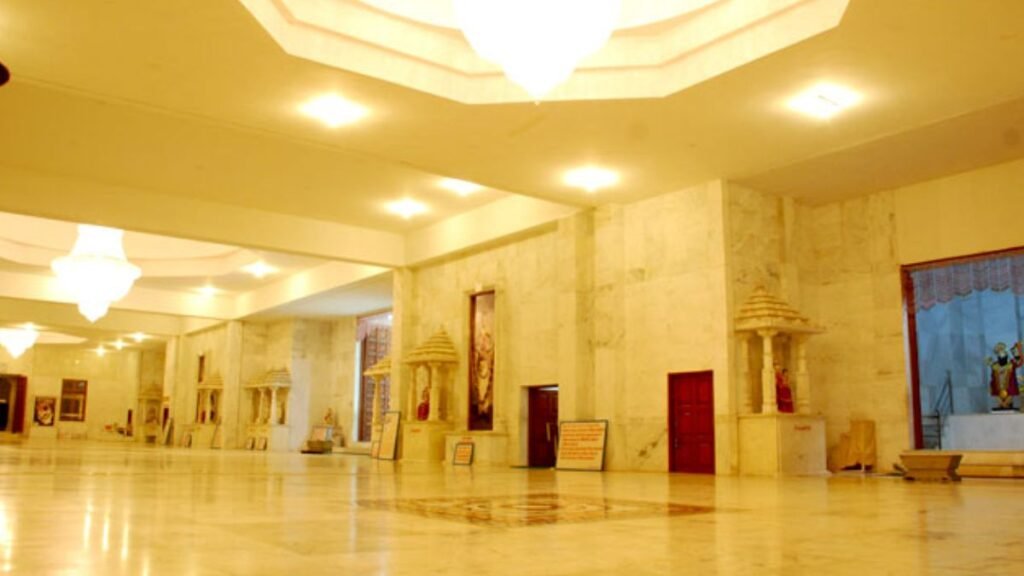
The ground floor of the Trimandir building is dominated by the Satsang Hall a vast 31,861-square-foot assembly space used for spiritual discourses, community gatherings, and the regular satsang programmes that are central to the Akram Vignan devotional tradition. The hall is designed to accommodate large numbers comfortably, and the regularity of its satsang programme means it is in active use throughout the week. Non-devotee visitors who arrive during a satsang programme will find the space alive with the chanting, the explanations of Dada Bhagwan’s teachings, and the community atmosphere of the Akram Vignan congregation.
The Main Temple — Upper Floor
Climbing either staircase from the ground floor brings visitors to the upper floor where the main temple shrines are located. The approach is marked by lion sculptures at the top of the stairs continuing the auspicious symbolism of the entrance and the intricate carvings that embellish the temple’s pillars become visible at close range, their quality evident in the detail of the stonework.
The central hall of the upper temple the Sabhamandap, spanning approximately 10,000 square feet is dominated by a giant chandelier at its centre, providing both illumination and a dramatic visual focal point. The Dwarpals (divine gatekeepers) at the massive gateway frame the devotee’s entry into the sacred space.
The Three Traditions — Deities and Their Shrines
At the heart of the upper temple are the three traditions’ presiding deities, enshrined with equal dignity within the same sacred space:
Lord Shree Simandhar Swami (Jainism): The central and most immediately imposing idol a standing marble figure of 155 inches (approximately 13 feet) in height. Simandhar Swami is, in Jain cosmology, a currently living Tirthankara existing in another world-sphere (Mahavideh Kshetra) a detail that gives this deity a quality distinct from the historical Tirthankaras like Mahavira and Rishabhadeva whose liberation is complete. For Akram Vignan followers, Simandhar Swami is the presiding Tirthankara of the current cosmic period in that other realm.
Lord Shiva (Shaivism): Represented through a Shivalinga the symbolic form of Shiva’s formless, universal aspect given equal prominence within the temple’s sacred arrangement. Shaivite devotees perform abhishek (ritual bathing of the Shivalinga) and standard Shaivite worship here.
Lord Krishna (Vaishnavism): The beloved deity of the Vaishnava tradition, worshipped alongside Lord Balaji, Lord Vishnu, Goddess Lakshmi, and Goddess Padmavati in the Vaishnava section of the Trimandir. Sadguru Sai Baba is also present extending the temple’s inclusivity beyond the formal three-tradition structure.
The atmosphere of the Trimandir’s upper temple, with its chandelier light falling across the marble, the sound of devotion from multiple traditions blending without conflict, and the sheer scale of the Simandhar Swami idol, is one of the most genuinely unusual sacred atmospheres available anywhere in Gujarat.
The Campus Facilities — More Than a Temple
Museum and Mini-Theatre — The Story of Dada Bhagwan
The Adalaj Trimandir campus includes a museum dedicated to the life and teachings of Gnani Purush Param Pujya Dada Bhagwan covering his early life in Tarsali and Mumbai, the 1958 Surat platform experience, the development of Akram Vignan, and the global spread of the teaching in the decades following. The museum draws approximately 300,000 visitors per year.
Adjacent to the museum, a mini-theatre runs shows about Dada Bhagwan’s life and the Akram Vignan teaching in Gujarati, Hindi, and English approximately 9,400 shows per year, attended by around 222,000 viewers. Both facilities are accessible to all visitors regardless of their prior knowledge of or affiliation with Akram Vignan, and function as introduction spaces for first-time visitors.
Vignan Bhandar — The Spiritual Bookshop
The Vignan Bhandar is the campus bookshop a specialist outlet for Dada Bhagwan’s spiritual literature in an extensive range of languages. Books, audio CDs, DVDs, audio books, photographs, and other material are available in Gujarati, English, Hindi, German, Portuguese, Spanish, and other Indian and international languages reflecting the global reach of the Akram Vignan following. For visitors interested in exploring Dada Bhagwan’s teachings further after their temple visit, the Vignan Bhandar provides a comprehensive starting library.
Amba Health Centre — Subsidised Healthcare
One of the most unusual and practically meaningful facilities on the Trimandir campus is the Amba Health Centre a multi-system healthcare facility where allopathic, Ayurvedic, and homeopathic doctors all practice under one roof. The centre operates on a highly subsidised basis, providing affordable medical care including to marginalised patients who might not otherwise access professional healthcare. The Health Centre is open Monday through Saturday. This integration of healthcare with the temple’s service vision reflects the broader understanding, within the Akram Vignan tradition, of seva (service) as spiritual practice.
School Hosting Programme and Store of Happiness
Each year, approximately 1,000 schools from across Gujarat and India bring students to the Trimandir as part of the School Hosting programme designed to expose children to a spiritual environment and introduce values that, in the programme’s stated aim, will benefit them throughout their lives. Approximately 7,000 teachers and 70,000 children participate annually. The children are taught specific practices from the Akram Vignan tradition and participate in the Store of Happiness a purpose-built space offering themed shows and puppet shows on moral values that are open to all visitors, not only school groups. Themes include ideal teacher-student relationships, respect for parents, conflict avoidance, and how to be happy in life.
Also Read: Adalaj ni Vav, Gandhinagar
Best Time to Visit Adalaj Trimandir
October to March — Best Overall Season
The winter months are the most comfortable for a visit to Adalaj Trimandir. The campus’s extensive garden, fountains, and outdoor spaces are most enjoyable in the cool October-to-February weather of approximately 15 to 27 degrees Celsius. The early morning opening time (5 AM) is particularly conducive to contemplative visits in the winter season arriving at dawn to the Satsang Hall or having darshan of the central Simandhar Swami idol before the main visitor flow begins for the day.
Any Morning — The Ideal Daily Visit Time
The Trimandir is open from 5:00 AM daily, and the morning hours before 9:00 AM consistently provide the most peaceful and devotionally concentrated visit experience. The chandelier-lit upper temple in the early morning, with fewer visitors and the morning quiet of the garden, has a quality of calm and beauty that the midday or afternoon visit cannot replicate. For visitors combining Trimandir with the nearby Adalaj ni Vav (stepwell), the recommended sequence is Trimandir darshan first (opening time), followed by the Vav in the morning light.
How to Reach Adalaj Trimandir
| From | Distance | Mode | Approx. Time |
| Ahmedabad city centre | ~20 km | Car / AMTS Bus (Routes 4, 4D, 89/1, 109) / Taxi | 30–40 minutes |
| Ahmedabad SVP Airport | ~20 km | Taxi | 30–35 minutes |
| Gandhinagar | ~12–15 km | Car / State Bus | 20 minutes |
| Gandhinagar Capital Railway Station | ~12–15 km | Car / Auto / Taxi | 20 minutes |
| Adalaj ni Vav (Stepwell) | ~3 km | Auto / Walking | 10 minutes |
| Akshardham Temple Gandhinagar | ~12–15 km | Car / Bus | 20 minutes |
| Science City Ahmedabad | ~10 km | Car | 20 minutes |
By AMTS city bus from Ahmedabad, routes 4, 4D, 4E, 4S, 89/1, and 109 all serve the Trimandir bus stop the closest stop is a 2-minute walk from the temple entrance. This makes Adalaj Trimandir one of the most public-transport-accessible attractions in the Gandhinagar-Ahmedabad corridor. By Ahmedabad BRTS, service also runs to the Trimandir stop. By car or taxi, navigate to ‘Trimandir Adalaj’ on Google Maps on the Ahmedabad-Kalol Highway.
Nearby Attractions to Combine with Adalaj Trimandir
- Adalaj ni Vav (Adalaj Stepwell) ~3 km | The magnificent 15th-century five-storey stepwell — one of Gujarat’s finest examples of late medieval Gujarati architecture; UNESCO World Heritage-listed as part of the Queen’s Stepwell tradition. Read our full TravelRoach guide.
- Akshardham Temple, Gandhinagar ~12–15 km | The BAPS Swaminarayan temple — 108 feet of pink sandstone, 8,000 tonnes, built without steel by 1,200 artisans and 12,000 volunteers. Free darshan, closed Mondays. Read our full TravelRoach guide.
- Indroda Nature Park (Dinosaur and Fossil Park) ~10 km | India’s largest open-air fossil park; the ‘Jurassic Park of India’. Particularly good for children.
- Science City Ahmedabad ~10 km | Gujarat’s largest science education park with 40+ attractions including IMAX theatre, Hall of Space, Aquarium, and Robo Museum. Read our full TravelRoach guide.
Also Read: Science City Ahmedabad Guide
Practical Tips for Visiting Adalaj Trimandir
- Dress modestly – covered shoulders and knees as appropriate to a multi-faith sacred space; both men and women should come in clothing that reflects the respectful atmosphere of the temple.
- Remove footwear at the designated point – footwear storage is provided.
- Visit the mini-theatre -even for visitors unfamiliar with Dada Bhagwan’s teaching, the mini-theatre show in English, Hindi, or Gujarati provides the context that makes the Trimandir concept meaningful rather than simply curious. Shows run regularly throughout the day.
- The Vignan Bhandar is worth 20 minutes – the multilingual collection of books and audio material on Akram Vignan is unusual and may include materials in languages not commonly available in Indian temple bookshops.
- The Amba Health Centre is available for genuine healthcare needs -if you are travelling in the region and require medical attention, this subsidised multi-system centre is a genuine resource.
- Combine with Adalaj ni Vav on the same morning -the stepwell is only 3 km away and a short auto-rickshaw ride; the combination of the 15th-century Gujarati architectural tradition (the Vav) and the 21st-century Gujarati spiritual architectural tradition (the Trimandir) in a single morning makes for an unusually layered heritage experience.
- Early morning is the best visit time -arrive at or shortly after the 5 AM opening for the most peaceful and devotionally concentrated experience of the campus.
Frequently Asked Questions (FAQs)
Adalaj Trimandir is a non-sectarian temple complex located near Adalaj village on the Ahmedabad-Kalol Highway, approximately 20 km from Ahmedabad and 12-15 km from Gandhinagar. Built in 2002 from white marble on 40,175 square feet, it is India’s largest Trimandir a concept originated by Gnani Purush Param Pujya Dada Bhagwan (1908-1988). What makes it unique is that it simultaneously houses deities from three distinct spiritual traditions Jainism (Lord Shree Simandhar Swami, 155 inches tall), Shaivism (Lord Shiva), and Vaishnavism (Lord Krishna, with Balaji, Vishnu, Lakshmi, Padmavati, and Sai Baba also present) giving equal worship space to all.
Gnani Purush Param Pujya Dada Bhagwan was born Ambalal Muljibhai Patel on November 7/8, 1908, in Tarsali, Gujarat, and died on January 2, 1988. He worked as a contractor in Mumbai before undergoing a spontaneous spiritual self-realization experience on a railway platform in Surat in 1958. The teaching he subsequently developed is called Akram Vignan the Science Without Steps which proposes that direct, spontaneous self-realization (separate from the body, mind, and ego) is available through the grace of a living Gnani. The core conviction is that the pure Soul transcends all religious identity which became the philosophical basis for the Trimandir concept.
Entry to Adalaj Trimandir is completely free there is no admission charge for any part of the campus, including the temple, museum, mini-theatre, and gardens. The campus is open from 5:00 AM to 10:00 PM daily. The mini-theatre shows run in Gujarati, Hindi, and English throughout the day at regular intervals. The Vignan Bhandar bookshop is open during campus hours. The Amba Health Centre is open Monday through Saturday.
Adalaj Trimandir houses deities from three principal traditions with equal devotional dignity. From Jainism: Lord Shree Simandhar Swami, a 155-inch (approximately 13-foot) marble standing idol in the centre. From Shaivism: Lord Shiva represented through a Shivalinga. From Vaishnavism: Lord Krishna, Lord Balaji, Lord Vishnu, Goddess Lakshmi, and Goddess Padmavati. Sadguru Sai Baba is also present, extending the inclusive spirit beyond the formal three-tradition structure. All deities are treated with equal reverence.
Multiple AMTS city bus routes connect central Ahmedabad to the Trimandir bus stop (a 2-minute walk from the entrance): routes 4, 4D, 4E, 4S, 89/1, and 109 all serve this stop. Ahmedabad BRTS also provides service to the Trimandir area. The Trimandir bus stop is the bus terminus for several of these routes, making it easy to confirm you have reached the right stop. By car or taxi from Ahmedabad, the journey takes approximately 30 to 40 minutes on the Ahmedabad-Kalol Highway; navigate to ‘Trimandir Adalaj’ on Google Maps.
Yes – absolutely. Adalaj Trimandir is by definition and by design open to all visitors regardless of faith, religion, or affiliation. The entire concept of the Trimandir is non-sectarian Dada Bhagwan’s teaching specifically holds that religious distinctions are relative rather than absolute, and the Trimandir is built to reflect that. Visitors of any background are welcome to have darshan of all the deities, visit the museum and mini-theatre, use the garden, and access the campus. Approximately 700,000 people visit annually, from a very wide range of religious backgrounds.
Yes -this combination is highly recommended and straightforward. Adalaj ni Vav (the Adalaj Stepwell) is approximately 3 km from Adalaj Trimandir a short auto-rickshaw ride of about 10 minutes. The recommended sequence for a morning visit: arrive at Trimandir at or shortly after opening (5 AM) for darshan and the morning atmosphere; spend 1 to 1.5 hours including the mini-theatre and Vignan Bhandar; then take an auto to Adalaj ni Vav for the stepwell visit in the morning light. The combination takes approximately 3 to 3.5 hours total and covers two of the most distinctive religious and heritage sites in the Gandhinagar-Ahmedabad corridor.
Final Thoughts
India has many thousands of temples. It has very few temples that ask, by their very design, whether the distinctions between the traditions that those thousands of temples embody are as fundamental as they appear. The Trimandir at Adalaj is one of those few a building that is the physical argument of a specific philosophical position: that the Soul is equal in all people, and that temples, if they are about the Soul, should reflect that equality.
You can agree or disagree with the philosophy. You can be a Jain for whom the Simandhar Swami idol’s scale is moving and Dada Bhagwan’s teaching is already known, or a Hindu who finds the Shaivite and Vaishnava shrines familiar and the Jain idol newly encountered, or a person of no particular religious tradition who finds the whole arrangement intellectually interesting and aesthetically striking. The temple accommodates all of these responses.
What it does not accommodate is indifference. A temple that takes a position that says something specific about what it believes the divine to be and how human beings should relate to it is more interesting than a neutral heritage site. The Adalaj Trimandir has a position. It is worth going to understand what that position is, even if you end your visit unsure whether you share it.
Have you visited Adalaj Trimandir? Share your experience what the Simandhar Swami idol looked like at close range, whether you stayed for the mini-theatre, what you found in the Vignan Bhandar in the comments. TravelRoach would love to hear from every Ahmedabad-area spiritual explorer.
