There is one place on the planet outside the high arid plateaus of Tibet and Central Asia where the wild ass still runs free, and it is a stretch of cracked salt desert in Surendranagar district, Gujarat, called the Little Rann of Kutch. The Indian Wild Ass Equus hemionus khur, known locally as the ghudkhar or khur exists nowhere else on earth in the wild. Not in a neighbouring district. Not in a different Indian state. Nowhere. If you want to see this animal running free, this 4,954 square kilometre expanse of salt flats, grassland islands, and thorny scrub in central Gujarat is the only place in the world you can do it.
The Wild Ass Sanctuary also called the Little Rann of Kutch Sanctuary is India’s largest wildlife sanctuary by area, spanning five districts of Gujarat: Surendranagar, Patan, Banaskantha, Kutch, and Rajkot. At its centre is a population that has come back from the edge of extinction: from a low of 362 individuals counted in 1963, the wild ass population has recovered to approximately 3,000 today one of Indian wildlife conservation’s genuine, if under-celebrated, success stories. This guide covers the wild ass itself, the extraordinary landscape of the Rann, the jeep safari experience, the bird life that rivals any wetland in India, the pastoral communities who share this land, entry logistics, timings, how to reach from Ahmedabad, and how to plan a complete Little Rann visit.
Wild Ass Sanctuary — Quick Information
| Detail | Information |
| Official Name | Indian Wild Ass Sanctuary (also Wild Ass Sanctuary, Little Rann of Kutch Sanctuary) |
| Location | Little Rann of Kutch, primarily Surendranagar District; spans 5 districts of Gujarat |
| The Five Districts | Surendranagar, Patan, Banaskantha, Kutch, Rajkot |
| Established | January 12, 1973 (notified 1972 under Wildlife Protection Act) |
| Area | 4,954 sq km (India’s largest wildlife sanctuary by area) |
| Biosphere Status | Part of the Kutch Biosphere Reserve (designated 2008); India’s 15th Biosphere Reserve |
| UNESCO Status | On UNESCO World Heritage Tentative List |
| The Khur / Ghudkhar | Indian Wild Ass (Equus hemionus khur) found nowhere else on earth in the wild |
| Population History | 1946: ~3,500 | 1963: low of 362 (near extinction) | Today: ~3,000 |
| Wild Ass Speed | Cruising speed ~24–50 km/h; up to 70 km/h in short bursts |
| Wild Ass Size | Over 1 metre at the shoulder; ~2 metres in length |
| The Bets | 74 small islands/plateaus within the salt desert; largest is Pung Bet (30.5 sq km); highest is Mardak Bet (55m) |
| Other Mammals | 32+ species: chinkara, Indian fox, white-footed fox, jackal, caracal, nilgai, Indian wolf, blackbuck, striped hyena |
| Birds | 350 species; 70,000–75,000 nesting birds across 250 acres |
| Migratory Birds | Cinereous Vulture (Egypt), Common & Demoiselle Cranes (Siberia), Blue-tailed Bee-eater (Europe), Houbara Bustard (Iran/Iraq) |
| Lesser Florican | Breeds in the grasslands July–September (monsoon) |
| Reptiles | 29 species (2 turtles, 14 lizards, 12 snakes, 1 crocodile) |
| Local Communities | Rabari and Bharwad pastoral tribes; Agariya salt workers |
| Salt Industry | ~25% of India’s salt comes from mining in and around the Little Rann |
| Safari Type | Jeep/4WD safari; mandatory permits and guide |
| Best Season | October to June (some sources cite this range; peak is November–February) |
| Avoid | Monsoon (July–September) -much of the area is submerged |
| Main Entry Village | Dasada (Zainabad area) -most common safari base |
| Distance from Ahmedabad | ~100–130 km (~2–2.5 hours) |
| Distance from Surendranagar | ~50 km |
| Distance from Dhrangadhra (rail) | Nearest railway junction in Surendranagar district |
| Nearest Airport | Ahmedabad SVP International Airport |
The Indian Wild Ass — A Conservation Story Worth Knowing
Khur — The Last of Its Kind in India
The Indian Wild Ass, called Khur or Ghudkhar in Gujarati, is one of only a small number of wild ass subspecies surviving anywhere on earth its closest relatives exist only in the high arid plateaus of Tibet and the steppes of Central Asia. The Little Rann of Kutch is the only place in India, and one of the very few places on the planet, where you can see a wild ass population running free in its natural habitat without the elevation and access difficulties of a Himalayan or Central Asian expedition.
Despite the donkey-like build that gives the animal its common name, the Indian Wild Ass bears almost no behavioural resemblance to its domesticated cousins. It is genuinely wild in every sense fast, alert, fiercely resistant to any human approach beyond a respectful safari distance, and capable of explosive bursts of speed when it senses any threat. Local guides describe the animal’s temperament candidly: these are not docile pack animals but genuinely wild equids that have resisted domestication for millennia and will defend themselves vigorously if cornered.
The Numbers — A Recovery from the Edge
The population history of the Indian Wild Ass is one of the most dramatic conservation arcs in Indian wildlife history, even though it receives far less attention than the more famous recovery stories of the tiger or the Asiatic lion. In 1946, the population was estimated at approximately 3,500 individuals. By 1963, intensive hunting, habitat loss, and possibly disease had reduced this to a catastrophic low of just 362 animals a population collapse that brought the species to the genuine edge of extinction within less than two decades.
The notification of the Wild Ass Sanctuary in 1972-73, under the newly enacted Wildlife Protection Act, was a direct response to this crisis. Over the subsequent five decades, sustained protection has allowed the population to recover to approximately 3,000 individuals today not yet at the historical peak, but a recovery that represents genuine, hard-won conservation success. The species remains classified as endangered, and the Little Rann remains its only wild stronghold in India, with occasional individuals recorded as far afield as Viramgam and Nal Sarovar in Ahmedabad district evidence of the population’s gradual range expansion as numbers recover.
Speed, Social Structure, and the Breeding Season
The wild ass is built for endurance running across open terrain a cruising speed of approximately 24 to 50 kilometres per hour that it can sustain for considerable distances, with the capacity to accelerate to 70 kilometres per hour in short emergency bursts when threatened. This combination of sustained speed and explosive acceleration makes the wild ass one of the most genuinely athletic large mammals on the Indian subcontinent.
The breeding season produces some of the most dramatic behavioural displays that visitors to the Little Rann can witness: stallions compete vigorously for control of harems, with confrontations involving rearing, kicking with the hind legs, and biting genuine combat rather than ritualised display. Foals are born between July and September, relatively small at birth but capable of running alongside the herd almost immediately. October and November when foals are old enough to be visible with the herds but young enough to still show their distinctive juvenile markings are widely considered the best months for observing complete wild ass family groups.
The Little Rann Landscape — A Lunar World of Salt and Islands
Understanding the Rann’s Seasonal Transformation
The Little Rann of Kutch occupies approximately 5,000 square kilometres northeast of the larger and more famous Great Rann of Kutch, spread across the five Gujarat districts of Surendranagar, Patan, Banaskantha, Kutch, and Rajkot. Within this vast area, the landscape consists of 74 small islands or raised plateaus, known locally as bets, scattered across a flat expanse of saline mudflat.
The seasonal transformation of this landscape is dramatic and total. During the monsoon, the Little Rann floods extensively seawater from the Gulf of Kutch mixes with freshwater discharged from the rivers draining into the Rann, submerging most of the flat terrain and turning the bets into genuine islands surrounded by water. As the monsoon ends and the water gradually evaporates through the following months, the landscape transforms into the cracked, barren, almost lunar terrain that most visitors associate with the Little Rann a vast expanse of dried saline mudflat, punctuated by the grassland islands where the wild ass and other wildlife concentrate during the dry season.
The Bets — Islands of Life in a Salt Desert
The 74 bets of the Little Rann are the ecological heart of the sanctuary raised areas of land, elevated just enough above the surrounding salt flat to remain above water during the monsoon flooding and to support grassland and scrub vegetation that the salt flat itself cannot sustain. The largest bet, Pung Bet, covers 30.5 square kilometres. The highest, Mardak Bet, rises to 55 metres a modest elevation that nonetheless represents significant topographic relief in this otherwise extremely flat landscape.
Vegetation on the bets is considerably richer than on the saline fringe areas 253 flowering plant species have been documented across the sanctuary, including 18 tree species, 23 shrubs, 18 climbers, 157 herbs, and 37 grasses. The bets, with this richer floral diversity, are where the wild ass, blackbuck, nilgai, and other grazing species concentrate, and where the predator species (wolves, foxes, jackals, hyenas, caracals) that hunt them are correspondingly most active.
Also Read: Rani Ki Vav Patan
A Stark and Singular Beauty
The visual experience of the Little Rann is unlike any other landscape in Gujarat or, arguably, in India. The flat salt desert extends to the horizon in every direction, broken only by the low silhouettes of the grassland islands and the occasional moving form of a wild ass herd, a flock of birds, or a Rabari shepherd with livestock. At sunrise and sunset, the white salt surface catches and reflects the colour of the sky with an intensity that few other landscapes can match the same phenomenon that makes the Great Rann’s White Rann famous, present here at smaller scale and with considerably fewer visitors.
Birdwatching in the Little Rann — 350 Species and 75,000 Nests
The Wild Ass Sanctuary’s position at the confluence of the Gulf of Kutch’s tidal influence and the freshwater discharge of the rivers draining into the Rann creates an extraordinary diversity of wetland and grassland bird habitat. Approximately 70,000 to 75,000 birds nest within a concentrated area of 250 acres in the sanctuary a density that places the Little Rann among India’s most significant bird breeding sites.
- Migratory raptors: the Cinereous Vulture arrives from Egypt; multiple falcon species (6 races recorded), buzzards, and 3 species of harrier hunt across the open terrain
- Cranes: Common Cranes and Demoiselle Cranes arrive from Siberia in enormous winter numbers among the most spectacular winter bird sights in the sanctuary
- Houbara Bustard: a winter visitor from Iran and Iraq; one of the most sought-after sightings for dedicated birders
- Lesser Florican: the critically endangered grassland bustard breeds in the Little Rann’s grasslands during the monsoon (July-September), its distinctive jumping display visible above the grass
- Flamingos: lesser flamingo and greater flamingo using the saline flats and wetland margins
- Other migratory birds: Blue-tailed Bee-eater (Europe), pelicans, storks, ibises, spoonbills, and a wide diversity of ducks and waterfowl
- Dryland specialists: large flocks of larks, sandgrouse, coursers, plovers, chats, warblers, babblers, and shrikes characteristic of the open grassland and scrub habitat
Nearby birding sites that complement the core sanctuary include Nawa Talao near Dasada village, the Dasada wetlands, Patdi Fort’s adjacent wetlands, and Viramgam Lake all of which produce excellent winter birding and are typically combined with the core Little Rann safari circuit by serious birders.
Beyond the Wild Ass — The Full Mammal Community
While the Indian Wild Ass is the sanctuary’s signature species and the reason for its existence, the Little Rann supports a genuinely diverse mammal community of 32 additional species:
- Chinkara (Indian Gazelle) -the small, elegant antelope of India’s arid zones
- Nilgai (Blue Bull) -Asia’s largest antelope, present in good numbers
- Blackbuck – present in the Little Rann’s grassland margins, alongside the wild ass
- Indian Wolf – a healthy population hunting across the open terrain, similarly to the population at Velavadar further south
- Striped Hyena – a significant scavenger and opportunistic predator species
- Indian Fox and White-footed (Desert) Fox – two distinct fox species adapted to the arid Rann environment
- Golden Jackal – common and frequently sighted
- Caracal (African Lynx) – one of the rarest and most elusive cats in India; the Little Rann is among the few locations where this species is regularly recorded
- Jungle Cat and Desert Cat – smaller wild cat species present in the scrub habitat
- Hedgehog – present in the drier scrub margins
The presence of the caracal in particular gives the Little Rann a significance for serious wildlife enthusiasts that goes beyond the wild ass alone this is one of India’s most reliable, if still difficult, locations for sighting this rare and beautiful cat.
Also Read: Modhera Sun Temple, Mehsana
The Rabari and Bharwad — Life on the Edge of the Rann
The Little Rann is not an uninhabited wilderness in the conventional national park sense it is shared landscape, home to significant populations of the Rabari and Bharwad pastoral communities, who have grazed livestock across this terrain for generations, alongside the wildlife the sanctuary protects. Encountering Rabari shepherds and their herds during a Little Rann safari is a routine and culturally significant part of the experience a reminder that this landscape has supported human pastoral life for centuries in parallel with its wild ass population.
The Agariya salt workers represent another significant human presence in the broader Rann landscape communities whose livelihood depends on traditional salt extraction from the saline flats. Approximately a quarter of India’s total salt production comes from mining in and around the Little Rann, and the visible salt pans, with their geometric patterns and white crystalline surfaces, are a distinctive feature of the wider landscape beyond the core protected sanctuary area. This salt industry also represents one of the sanctuary’s significant conservation challenges the noise, vehicle traffic, and habitat disturbance associated with large-scale salt extraction places ongoing pressure on the wildlife habitat that borders the mining areas.
The Safari Experience
Jeep Safari — The Standard Format
The standard way to experience the Little Rann’s wildlife is by 4WD jeep safari, typically arranged through resorts or tour operators based in Dasada (the most common entry village) or through registered safari operators. Safaris run in morning and afternoon sessions, taking visitors across the open salt flat terrain and onto the bets where wildlife concentration is highest. The completely open, treeless terrain of the Little Rann means that wildlife sightings wild ass herds, blackbuck, nilgai, and the various bird species are visible at considerable distance, giving a different visual and photographic experience from forest-based safaris elsewhere in India.
Camel and Horse Safari Options
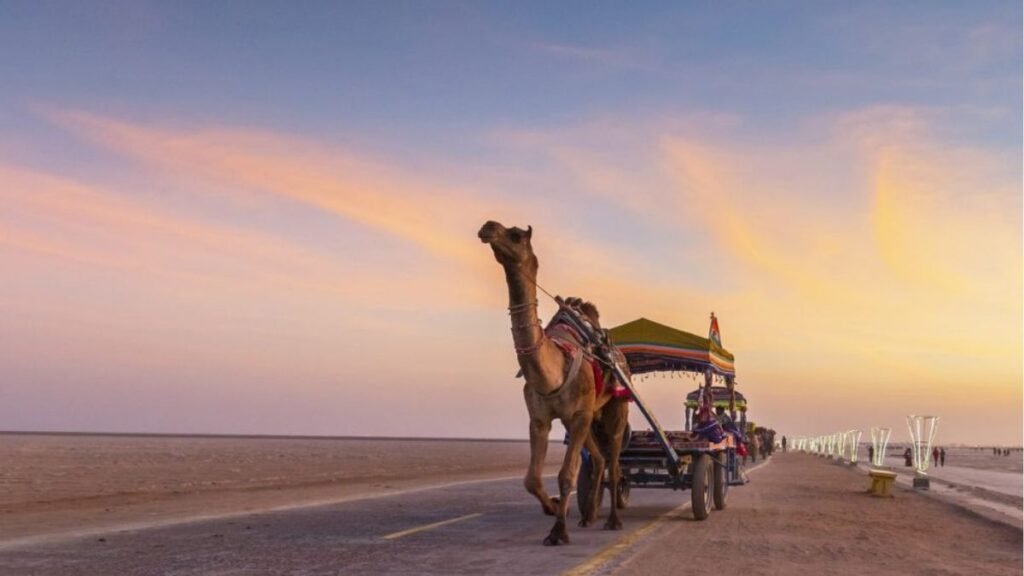
Beyond the standard jeep safari, camel and horse safari options are available in and around the Little Rann, particularly through resorts catering to visitors interested in a slower, more contemplative experience of the landscape and a closer connection to the pastoral tradition that has shaped this terrain. These options are typically arranged through Dasada-based accommodation providers.
Best Time of Day
Dawn and dusk are consistently the best times for wildlife viewing at the Little Rann both for the practical reason that animals are most active at watering holes and in the open during these cooler hours, and for the simple aesthetic reason that the low-angle light on the white salt flat at sunrise and sunset produces some of the most striking landscape photography conditions available anywhere in Gujarat.
Best Time to Visit Wild Ass Sanctuary
October to February — Peak Season
The peak season for visiting the Little Rann runs from October through February, when the post-monsoon landscape has dried sufficiently for full safari access, temperatures are comfortable, and the wild ass foals from the July-September breeding season are visible alongside the adult herds making October and November specifically excellent for observing complete family groups. This period also coincides with the peak migratory bird season, bringing cranes, the Houbara Bustard, and the full range of winter migratory species to the sanctuary’s wetland margins.
Summer (March to June) — Challenging but Possible
The Little Rann’s summer can produce extreme temperatures, and most wildlife retreats from open areas during the hottest parts of the day, making summer safaris less productive than winter ones. However, the sanctuary remains technically accessible through this period for visitors with flexible schedules who can plan around the cooler dawn and dusk hours.
Monsoon (July to September) — Avoid the Core Safari, But Note the Lesser Florican
During the monsoon, much of the Little Rann floods and becomes inaccessible for the standard wild ass safari most tour operators and safari providers do not operate during this period. However, the Lesser Florican’s breeding display occurs specifically during these monsoon months in the surrounding grasslands, making this a niche but specific reason some specialist birders visit the broader Surendranagar region (rather than the flooded core sanctuary) during the rains.
Combine with Tarnetar Fair — Early September
Nearby Surendranagar hosts the Tarnetar Fair in early September a famous traditional rural matrimonial fair drawing tribal communities from across the region in colourful traditional dress for matchmaking, folk performances, and cultural exchange. Combining a Tarnetar Fair visit with a side trip to the Wild Ass Sanctuary (acknowledging the limited monsoon safari access) is a distinctive cultural-and-nature itinerary for visitors with September travel dates.
How to Reach Wild Ass Sanctuary
| From | Distance | Mode | Approx. Time |
| Ahmedabad | ~100–130 km | Car / Bus to Dasada/Zainabad | 2–2.5 hours |
| Ahmedabad Airport (SVP) | ~110–135 km | Taxi to Dasada | 2.5 hours |
| Surendranagar city | ~50 km | Car / State Transport Bus | 1 hour |
| Dhrangadhra (railway junction) | Within Surendranagar district | Train to Dhrangadhra + local jeep/taxi | Varies |
| Viramgam | ~45 km from sanctuary edge | Car | 1 hour |
| Bhuj | ~238 km | Car | 4.5 hours |
| Nal Sarovar Bird Sanctuary | Adjacent wildlife corridor | Car | Varies |
From Ahmedabad, the most common approach is by private car or hired taxi to Dasada or Zainabad village the primary entry points and safari base for the Little Rann, approximately 100 to 130 km and 2 to 2.5 hours away. By train, Dhrangadhra in Surendranagar district is the nearest major railway junction; from there, local jeeps or hired taxis cover the final distance to the sanctuary entry points. State Transport buses also run from Ahmedabad toward Surendranagar district, with local transport covering the final leg to Dasada.
Accommodation Near the Little Rann
Accommodation options in the Dasada/Zainabad area range from simple guest houses to dedicated wildlife resorts and tented camps offering full safari packages, meals, and guided experiences. Several established resorts in this area have decades of experience specifically organising Little Rann safaris and can arrange jeep safaris, camel and horse safari options, and birding guides for the surrounding wetlands. Booking accommodation that includes safari arrangements is the most practical approach for first-time visitors, as it removes the logistical complexity of arranging permits, guides, and vehicles independently.
Carry warm clothing for early morning and evening safaris desert nights and dawns can be genuinely cold even when daytime temperatures are warm, particularly from November through January. Sunscreen, sunglasses, and a hat are essential for daytime protection from the intense reflected light off the white salt surface.
Also Read: Famous Food In Ahmedabad
Nearby Attractions to Combine with Wild Ass Sanctuary
- Nal Sarovar Bird Sanctuary Gujarat’s famous Ramsar wetland with flamingos and 200+ bird species; a natural birding companion to the Little Rann’s wetland margins, located in the same broader region between Ahmedabad and Surendranagar. Read our full TravelRoach guide.
- Tarnetar Fair (Trineshwar Mahadev) Held annually in early September in Surendranagar district; one of Gujarat’s most distinctive and visually rich traditional fairs, with tribal matchmaking customs, folk dance, and colourful traditional dress.
- Patan (Rani Ki Vav) The UNESCO World Heritage stepwell, reachable from the northern approach to the Little Rann via Patan district. Read our full TravelRoach guide.
- Modhera Sun Temple The 11th-century Solanki Sun Temple, combinable with a broader North Gujarat-Little Rann circuit. Read our full TravelRoach guide.
Practical Tips for Visiting Wild Ass Sanctuary
- Book through a registered resort or operator – permits, guides, and safari vehicle access are most reliably arranged through established Dasada/Zainabad-based accommodation and safari providers rather than attempting independent access.
- Plan for October-November for foals – if seeing complete wild ass family groups with young foals is a priority, these two months offer the best probability.
- Dawn and dusk safaris are most productive – both for wildlife activity and for the best photographic light on the salt flat landscape.
- Carry warm clothing – desert nights and early mornings get genuinely cold, even when daytime temperatures are pleasant; thick layers and ankle-high boots are recommended.
- Sun protection is essential – the reflected light off the white salt surface is intense; sunscreen, sunglasses, and a hat are non-negotiable for daytime safaris.
- Avoid monsoon season for the core safari – most of the sanctuary floods and safari operations largely cease from approximately July to September; plan visits for October through June instead.
- Combine with Nal Sarovar for a complete Gujarat wetland birding circuit – both sanctuaries lie in the same general region between Ahmedabad and Surendranagar and can be combined in a multi-day itinerary.
- Respect the pastoral communities and their livestock – the Little Rann is shared grazing land for Rabari and Bharwad communities; maintain respectful distance and behaviour around both wildlife and local herders.
Frequently Asked Questions (FAQs)
The Wild Ass Sanctuary in the Little Rann of Kutch, Surendranagar district, Gujarat, is famous as the only place in India and one of the very few places on earth where the endangered Indian Wild Ass (Equus hemionus khur, locally called Khur or Ghudkhar) survives in the wild. It is India’s largest wildlife sanctuary by area at 4,954 square kilometres, spanning five Gujarat districts. The sanctuary’s population of approximately 3,000 wild asses represents a major conservation recovery from a low of just 362 individuals counted in 1963. Beyond the wild ass, the sanctuary hosts 32 other mammal species (including caracal, Indian wolf, striped hyena, and blackbuck) and 350 bird species, with up to 75,000 birds nesting annually within the protected area.
The Little Rann of Kutch Wild Ass Sanctuary is the only place in India, and one of the very few locations on earth, where the Indian Wild Ass can be observed running free in its natural habitat its only other surviving close relatives live in the high arid plateaus of Tibet and the steppes of Central Asia. Within the sanctuary’s 4,954 square kilometres across the Surendranagar, Patan, Banaskantha, Kutch, and Rajkot districts of Gujarat, approximately 3,000 wild asses live, concentrated particularly on the grassland islands (bets) that rise above the surrounding salt flat. Occasional individuals have also been recorded outside the core sanctuary, as far as Viramgam and Nal Sarovar in Ahmedabad district, reflecting the population’s gradual range recovery.
The best overall period is October to February, when the post-monsoon landscape has dried sufficiently for full safari access, temperatures are comfortable, and wild ass foals born during the July-September breeding season are visible with the herds making October and November specifically excellent for observing complete family groups. This period also coincides with peak migratory bird season, bringing Common and Demoiselle Cranes, the Houbara Bustard, and numerous other winter migrants. The monsoon months (July-September) should be avoided for the core jeep safari, as much of the Little Rann floods and most safari operations cease during this period.
From Ahmedabad, the Wild Ass Sanctuary is approximately 100 to 130 km about 2 to 2.5 hours by private car or taxi to Dasada or Zainabad village, the primary safari base and entry point. By train, Dhrangadhra in Surendranagar district is the nearest major railway junction; from there, local jeeps or taxis cover the remaining distance. State Transport buses also connect Ahmedabad to Surendranagar district, with local transport covering the final stretch to Dasada. Most visitors book accommodation in Dasada/Zainabad that includes safari arrangements rather than attempting to organise permits and safari vehicles independently.
Beyond the Indian Wild Ass, the Little Rann supports 32 additional mammal species including chinkara, nilgai, blackbuck, Indian wolf, striped hyena, Indian and white-footed desert foxes, golden jackal, jungle cat, desert cat, and the rare and elusive caracal (African lynx) one of India’s few reliable locations for this species. The sanctuary also hosts 350 bird species with up to 75,000 nesting birds annually, including migratory Common and Demoiselle Cranes from Siberia, the Houbara Bustard from Iran and Iraq, the Cinereous Vulture from Egypt, and the critically endangered Lesser Florican, which breeds in the grasslands during the monsoon.
No -the Little Rann of Kutch (where the Wild Ass Sanctuary is located) and the Great Rann of Kutch are two distinct, though related, salt desert landscapes in Gujarat. The Little Rann covers approximately 5,000 square kilometres across the Surendranagar, Patan, Banaskantha, Kutch, and Rajkot districts, located northeast of the larger Great Rann. The Great Rann of Kutch, spanning approximately 7,850 square kilometres primarily in Kutch district, is the more famous White Rann associated with the annual Rann Utsav festival and the spectacular white salt desert visible under the full moon. The two are often confused but are separate landscapes with different wildlife focuses — the Little Rann for the wild ass, the Great Rann for its vast white salt expanse and cultural festival.
A jeep safari into the Wild Ass Sanctuary requires permits and a registered guide these are most reliably arranged through established resorts or tour operators based in Dasada or Zainabad village, the primary entry points to the sanctuary. Booking accommodation that includes safari packages is the standard and most practical approach for visitors, as the resort handles permit arrangements, guide booking, and vehicle logistics as part of the safari package. Independent visitors without pre-arranged safari bookings should contact the Gujarat Forest Department or a registered Dasada-based operator well in advance of their visit to confirm current permit requirements and procedures.
Final Thoughts
In 1963, there were 362 Indian Wild Asses left on earth. Today, there are approximately 3,000 all of them in this one stretch of cracked salt desert in Surendranagar district, Gujarat. Nowhere else in India. Almost nowhere else on the planet. This is what successful conservation looks like when it works: not loud, not internationally famous like the tiger or the Asiatic lion, but quietly, persistently effective over five decades of protection.
The Little Rann gives you something that very few landscapes in India can: a sense of total, stark openness, white salt to the horizon, the silhouette of a wild ass herd moving across terrain that looks, in the right light, like the surface of another world entirely. The Rabari shepherds with their livestock. The salt workers’ geometric pans catching the morning sun. The cranes arriving from Siberia, the bustard from Iran, the vulture from Egypt all converging, for a few months each winter, on this single unlikely stretch of Gujarat.
Most travellers to Gujarat never make it here. Most have never heard of it. The wild ass deserves better than that and so does the landscape that, against considerable odds, has kept it alive.
