In the foothills of the Aravalli range, on a three-peaked hill near Kheralu in Mehsana district, there is a temple complex that two traditions of Jainism built together, on ground that Buddhism had already consecrated centuries before either of them arrived. Taranga is a Siddha Kshetra a place where, in Jain belief, 35 million monastics have attained moksha (liberation), making the hill itself one of the most spiritually charged points in Jain sacred geography.
The centrepiece of Taranga’s temple landscape is the magnificent Ajitnath Temple built in 1161 CE by King Kumarapala of the Solanki dynasty, under the direct spiritual guidance of Acharya Hemachandra, one of medieval India’s greatest polymaths. A 9-foot-2-inch white marble idol of the second Tirthankara presides over a complex of fourteen Svetambara temples and five Digambara shrines, in a forested hill setting that combines natural beauty, architectural grandeur, multi-religious historical depth, and active Jain pilgrimage in a way that few sites in Gujarat can match.
This TravelRoach guide covers the layered history of the site from Buddhist origins through Jain transformation, the architecture of the Ajitnath Temple and the broader complex, the significance of Acharya Hemachandra, the Digambara temples on the three peaks, the Buddhist caves, entry fees, timings, accommodation, how to reach, and how to combine Taranga with the extraordinary North Gujarat heritage circuit it belongs to.
Taranga Hill Jain Temple — Quick Information
| Detail | Information |
| Location | Taranga Hill, near Kheralu, Mehsana District, Gujarat (in the Aravalli hill foothills) |
| Ancient Names | Tarapur, Tarvur, Taravar Nagar, Tarangiri, Tarangarh |
| Sacred Status | Siddha Kshetra – one of the 108 names of Siddhachal; 35 million monastics believed to have attained moksha here |
| Main Temple | Ajitnath Temple (Shvetambara) dedicated to the 2nd Tirthankara Shri Ajitnatha |
| Main Idol | 9 feet 2 inches (~2.75m) tall white marble idol of Ajitnatha |
| Built | 1161 CE (Vikram Samvat 1200) |
| Commissioned By | King Kumarapala of the Solanki (Chaulukya) dynasty – himself a Shvetambara Jain |
| Spiritual Guide | Acharya Hemachandra (Kalikalasarvajna ‘Omniscient of the Dark Age’) the great Jain philosopher-polymath |
| Architectural Style | Maru-Gurjara (Solanki) architecture same tradition as Modhera Sun Temple and Rani Ki Vav |
| Temple Dimensions | 45m length × 30.4m width × 30.6m height; 639-foot perimeter; 7 domes |
| Material | Light sandstone; magnificently carved wooden summit |
| Svetambara Complex | 14 temples total in the walled compound; managed by Shri Anandji Kalyanji Murtipujak Jain Pedhi |
| Digambara Presence | 5+ Digambara shrines at Taranga Hill; additional Digambara temples at the foothills; Manastambha |
| The Three Peaks | Kotishila and Siddhashila hillocks with Neminath and Mallinath idols; highest peak has Tonk with Mallinath marble idol |
| Buddhist History | 4th-5th century Buddhist caves at Taranga; Jogida ni Gafa with 4 Dhyani Buddha statues; Buddhist stupa remnants |
| Hemachandra Connection | Hemachandra persuaded Kumarapala to embrace Jainism; his influence made Gujarat predominantly Jain in the Solanki period |
| Entry Fee | Generally free for pilgrims; confirm any nominal temple trust charges at the entrance |
| Timings | Generally 5:00 AM – 9:00 PM (temples are active pilgrimage sites – confirm current hours) |
| Accommodation | Dharamshala facilities with Jain vegetarian food available for both Svetambara and Digambara pilgrims |
| Distance from Ahmedabad | ~130 km (~2–2.5 hours by road) |
| Distance from Mehsana | ~56 km (~1.5 hours) |
| Distance from Ambaji Temple | ~50 km (~1 hour) |
| Distance from Patan (Rani Ki Vav) | ~48 km (~1 hour) |
| Nearest Railway Station | Taranga Hill Railway Station (~5–6 km from temple); also Visnagar (38 km), Mehsana (52 km) |
| By Local Train | Slow local train from Mehsana to Taranga Hill Station (~2 hours); from station, jeep or auto to temple |
| Nearest Airport | Ahmedabad SVP International (~130 km) |
The Layered History of Taranga — Before the Jain Temples
Buddhist Beginnings — The 4th-5th Century Foundation
The hill that carries the Taranga Jain temples today has a history that pre-dates Jainism’s presence at the site by many centuries. Archaeological evidence established in 1938 and subsequent studies have documented clear Buddhist occupation of the Taranga hills from the 4th to 5th centuries CE. The most tangible surviving evidence is the cave complex locally known as Jogida ni Gafa a cave shelter that houses four Buddhist statues of Dhyani Buddhas (the meditating celestial Buddhas of Vajrayana Buddhism), confirming the presence of a Buddhist monastic community at this site more than fifteen centuries ago.
Near the Taran Mata and Dharan Mata shrines, approximately 2.5 km north of the main hill, Buddhist images including one of Avalokiteshwara Padmapani (the Bodhisattva of Compassion) have been found. What is now understood to be an altered Buddhist stupa also exists in this area. The accumulation of Buddhist material evidence across the Taranga hill complex suggests that this was a significant Buddhist monastic site before the Jain tradition established itself here.
The Name — Goddess Tara and the Town of Tarapur
The Kumarapala Pratibodha, a text by Acharya Somaprabhacharya composed in Vikram Samvat 1241, provides the earliest written account of the site’s naming. According to this text, the local Buddhist king Veni Vatsaraja and a Jain monk named Khaputacharya jointly built a temple for the Goddess Tara at this location and from this temple, the town took the name Tarapur, which eventually evolved through Tarangiri and Tarangarh to the current Taranga. This joint Buddhist-Jain temple foundation is historically remarkable: it speaks to a period of religious pluralism in which the boundaries between traditions were more permeable than later sectarian identities might suggest.
The presence of the Taran Mata and Dharan Mata shrines, still active and still receiving both Hindu and Jain pilgrims 2.5 km from the main temple complex, is the living continuation of this ancient goddess worship tradition that gave the hill its name before the Jain temples were built.
Also Read: Rani Ki Vav Patan
The 6th-Century Jain Presence
The Kumarpal Pratibodh also records that King Vatsrai, ruling in the 6th century, established a temple of Shashanadhishthatri Shri Siddhadayika Devi at this location. This places the beginnings of formal Jain religious activity at Taranga considerably before the 12th-century temple building that is most commonly cited as the site’s founding date. The Jain tradition was gradually consolidating its presence at a location that already had multiple layers of sacred significance Buddhist, goddess-worship, and nascent Jain when Kumarapala and Hemachandra made it the site of one of medieval Gujarat’s most magnificent architectural achievements.
Acharya Hemachandra — The Sage Who Shaped a King and a Kingdom
No account of Taranga Hill’s Jain temples is complete without a full understanding of Acharya Hemachandra the philosopher, scholar, and spiritual master who guided King Kumarapala to Jainism and who directed the construction of the Ajitnath Temple. Hemachandra (1089-1172 CE) is one of the most extraordinary individuals in the intellectual history of medieval India: a man who excelled simultaneously in philosophy, poetry, grammar, logic, lexicography, biography, and theology, who wrote comprehensively in Sanskrit and Apabhramsha (the vernacular predecessor of Gujarati), and who shaped the religious and cultural life of the entire Solanki kingdom.
He is known by the title Kalikalasarvajna the Omniscient of the Kali Yuga, or the All-Knowing of the Present Age. This is not a modest title, but the body of work it describes is genuinely exceptional: his Trishashthisalakpurusha-charitra (Lives of the 63 Great Men) is the most comprehensive Jain biographical text in the tradition; his Yoga Shastra is a foundational Jain text on ethics and spiritual practice; his Hemachandra Grammar is a systematic description of both Sanskrit and Apabhramsha that remains a primary scholarly resource.
Hemachandra’s relationship with King Kumarapala was the defining political fact of the Solanki period’s later decades. He converted the king to Jainism, making him one of the most committed Jain royal patrons in history. Under Kumarapala’s patronage, influenced by Hemachandra’s teaching, animal sacrifice was banned across the kingdom, numerous temples were built, and the Jain tradition received royal support at a scale that transformed the religious landscape of medieval Gujarat. The Taranga Ajitnath Temple, built under Hemachandra’s guidance, is the most tangible surviving evidence of what this spiritual and political partnership produced.
The Temple Complex — Architecture and Sacred Sites
The Ajitnath Temple — Maru-Gurjara Architecture at Its Height
The Ajitnath Temple, built in 1161 CE, is the centrepiece of the Taranga complex and one of the finest surviving examples of Maru-Gurjara (Solanki) architecture the same tradition that produced the Modhera Sun Temple and the carving tradition that fed into the Rani Ki Vav stepwell at Patan. The temple is built of light sandstone and demonstrates the full vocabulary of the Solanki architectural achievement: its carved shikhara tower, its richly sculptured outer walls, its beautifully proportioned plan, and the extraordinary wooden summit magnificently carved to a height of 275 metres give the building a visual presence that is immediately commanding in the forest-hill setting.
The temple’s dimensions 45 metres long, 30.4 metres wide, reaching a height of 30.6 metres — give it a scale appropriate to its significance. Its perimeter of 639 feet (195 metres) encloses a complex with seven domes. The plan and design are deliberately similar to two other Kumarapala-commissioned temples: the Neminath Temple on Mount Girnar in Junagadh and the Adinath Temple on Shatrunjaya near Palitana — the three together representing Kumarapala’s Jain architectural legacy in Gujarat.
The Main Idol — Shri Ajitnatha at 9 Feet 2 Inches
At the heart of the Ajitnath Temple is its principal idol: a 9-foot-2-inch (approximately 2.75-metre) white marble image of Shri Ajitnatha, the second Tirthankara of Jainism. Ajitnatha whose name means ‘the one who has conquered all enemies’ represents the second of the 24 great teachers who, in Jain belief, have achieved complete liberation and shown the path to moksha for others. His representation in white marble, at this scale, in an inner sanctum that has been the object of continuous Jain devotion for over 800 years, carries the accumulated spiritual charge of eight centuries of pilgrimage.
Within and around the main temple, a range of additional sacred images and spaces enrich the devotional landscape: on the right side of the temple, foot-idols of Bhagwan Adinath and the 20 wandering Tirthankaras (the Viharamana Jinas) are venerated; on the left side, a temple of Gaumukhji, a Samavasaran (the open circular hall where the Tirthankaras delivered their discourses), and a painting of Jambudvipa (the sacred cosmological map of the central continent of Jain universe) are all present. On the outer platform stand idols of Padmavati Devi (the protector goddess of Jains) and of Maharaja Kumarapala himself the king’s presence in stone before the temple he built.
The Svetambara Complex — Fourteen Temples in the Walled Compound
The fourteen temples of the Svetambara complex at Taranga are enclosed within a walled compound the traditional format of major Jain tirth (pilgrimage) complexes, which organises multiple temples within a shared sacred enclosure. The complex is managed by the Shri Anandji Kalyanji Svetambara Murtipujak Jain Pedhi the Ahmedabad-based trust that manages many of Gujarat’s most significant Jain tirthas including the Palitana temples on Shatrunjaya Hill. Each of the fourteen temples within the compound has its own presiding deity and its own ritual tradition, creating a complete pilgrimage circuit within the enclosure.
The Digambara Presence — The Three Peaks and the Foothills
The two main sects of Jainism Shvetambara (white-clad) and Digambara (sky-clad) are both represented at Taranga, a fact that is theologically and practically significant. The Digambara community established themselves specifically on the three-peaked hill, separate from the Shvetambara complex, creating a physical separation that reflects the two traditions’ distinct doctrinal identities while sharing the same hilltop sacred site.
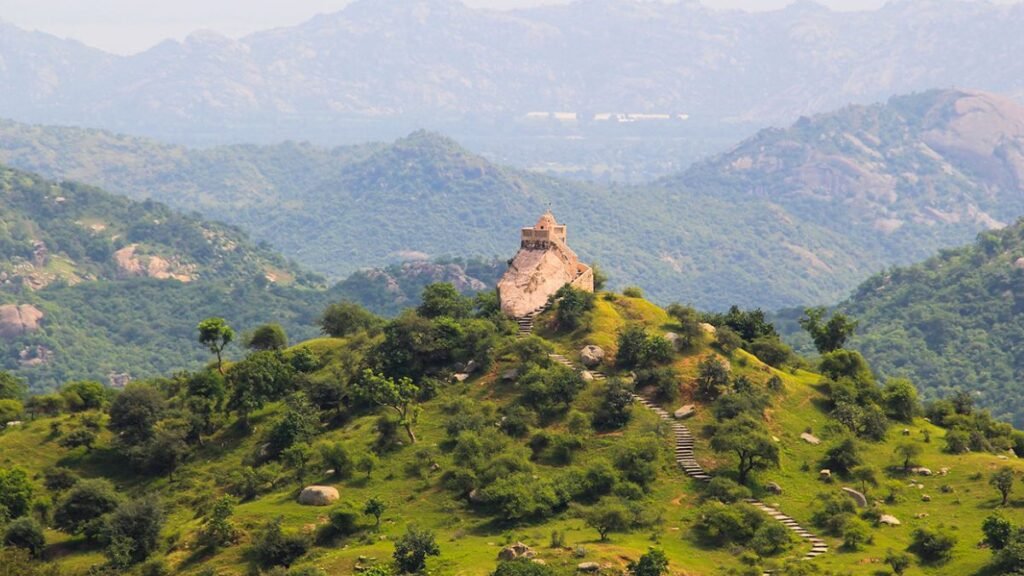
The two hillocks named Kotishila and Siddhashila carry idols of Tirthankaras Neminath (22nd Tirthankara) and Mallinath (19th Tirthankara), installed in Vikram Samvat 1292 (1235 CE). At the highest elevation of the three-peaked hill stands what is described as a Tonk a small domed structure in a form reminiscent of a Muslim dargah, built by the Digambara community as the shrine housing a marble idol of Mallinatha. The view from this summit encompasses the entire temple complex below and the surrounding Aravalli foothills one of the finest natural viewpoints associated with any temple site in North Gujarat. At the foothills, additional Digambara temples and a Digambara Dharamshala serve the pilgrims of this tradition, along with a Manastambha — the tall pillar that is a characteristic feature of Digambara Jain temple complexes.
The Buddhist Caves — Taranga’s Pre-Jain Sacred Layer
The Buddhist cave shelters at Taranga hills particularly the Jogida ni Gafa are among the most interesting archaeological features of the site for visitors interested in the pre-Jain history of this sacred landscape. The cave houses four statues of Dhyani Buddhas (the meditating celestial Buddhas of the Vajrayana Buddhist tradition) beneath a representation of the Bodhi Tree confirming that a Buddhist monastic community used this cave as a place of meditation and worship in the 4th to 5th centuries CE.
The combination of the Buddhist caves and the Jain temples nearly a thousand years separating their respective moments of creation, on the same hill gives Taranga a historical depth that most pilgrimage sites simply do not have. You are not visiting a site with a single tradition’s relationship to a single hill. You are visiting a hill that has been understood as sacred by Buddhist monks of the 4th century, by Jain and Buddhist founders of a joint goddess temple in an early medieval period, and by Shvetambara and Digambara Jain communities from the 12th century onward. Each tradition chose this hill. Each found here what they were looking for.
Also Read: Modhera Sun Temple, Mehsana
Festivals at Taranga Jain Temple
Mahavir Jayanti
Mahavir Jayanti the birthday of Bhagwan Mahavir, the 24th and final Tirthankara of the present cosmic cycle is the most widely observed Jain festival and is celebrated at Taranga with appropriate ceremonies and significantly larger pilgrim numbers. The date falls in March or April according to the Jain calendar. At a Siddha Kshetra of Taranga’s significance, Mahavir Jayanti draws pilgrims from across Gujarat and beyond.
Paryushana Parva
The Paryushana Parva (also Paryushan) the eight or ten-day period of intense spiritual retreat and purification observed annually in August or September is the most spiritually significant period of the Jain calendar year. During Paryushana, Jain pilgrims intensify their devotional practice, many undertaking fasts and extended prayer and the confession and forgiveness rituals (Samvatsari Pratikraman) that are central to this period. Taranga receives increased pilgrim numbers during Paryushana, and the atmosphere at the temple complex during this period is one of concentrated devotional intensity.
Akshaya Tritiya — The Festival of Sugarcane
Akshaya Tritiya (Akhaj in Gujarati) has a specific Jain significance: it is the day when Tirthankara Rishabhadeva (Adinath) ended his year-long fast by accepting sugarcane juice from the king Shreyanshanatha the first symbolic offering that ended the first Tirthankara’s period of penance. On this day, Jain pilgrims make sugarcane juice offerings at Jain temples across Gujarat. The festival typically falls in April or May and is observed with particular reverence at significant Jain tirthas like Taranga.
Best Time to Visit Taranga Hill Jain Temple
October to March — Best Overall Season
The winter months provide the most comfortable conditions for the Taranga visit. The forested hill setting and the elevated position of the temples make Taranga pleasantly cool from October to February temperatures range from 12 to 25 degrees Celsius. The forest on the hillside is green and attractive, the light on the Ajitnath Temple’s sandstone carvings is warm and revealing, and the walk between the various temples and up the hill paths to the Digambara shrines and the Buddhist caves is genuinely enjoyable in the cool air.
Monsoon — Lush Hills, Possible Road Challenges
The monsoon transforms the Taranga hills dramatically the Aravalli foothills go intensely green, the brushwood and forest that covers most of the hill becomes a proper lush canopy, and the temple complex in the monsoon atmosphere has a visual quality completely different from the dry season. Nature lovers specifically appreciate the monsoon Taranga experience. However, the roads to Taranga and the paths on the hill can become slippery and difficult in heavy rain, and the 5-6 km from the railway station to the temple requires local transport that may be less readily available in monsoon conditions.
Avoid Summer Afternoons
North Gujarat summers can be harsh temperatures exceeding 40 degrees Celsius. The hill and forest setting of Taranga provides some natural shade, but the climbs to the hilltop Digambara shrines and the Buddhist caves are physically demanding in afternoon summer heat. If visiting in summer (April to June), plan to arrive at the temple complex by 7 to 8 AM and complete the hill climbs before 10 AM.
How to Reach Taranga Hill Jain Temple
| From | Distance | Mode | Approx. Time |
| Ahmedabad | ~130 km | Car / Bus (via Mehsana-Visnagar route) | 2–2.5 hours |
| Mehsana | ~56 km | Car / Bus / Shared Jeep | 1.5 hours |
| Patan (Rani Ki Vav) | ~48 km | Car | 1 hour |
| Ambaji Temple | ~50 km | Car | 1 hour |
| Sidhpur (Bohra Vad) | ~70 km | Car | 1.5 hours |
| Visnagar (nearest major railway) | ~38 km | Train to Visnagar + Car | 1 hour from Visnagar |
| Taranga Hill Railway Station | ~5–6 km | Local Jeep / Auto | 10–15 minutes |
| Unjha | ~54 km | Car | 1.5 hours |
| Gandhinagar | ~130 km | Car | 2.5 hours |
By road from Ahmedabad, take the Ahmedabad-Mehsana road and continue toward Kheralu and Taranga. Bus services run from Ahmedabad and Mehsana to Timba village (near Danta on the Ahmedabad-Abu Road), from where shared jeeps (approximately ₹5-10) or private autos cover the 8 km to Taranga. By train, a slow local train runs from Mehsana to Taranga Hill Station (approximately 2 hours); from the station, shared or private jeeps cover the 5-6 km to the temple complex.
Accommodation at Taranga — Dharamshala Facilities
Taranga’s status as a significant Jain tirth means accommodation is readily available for pilgrims. Both the Shvetambara and Digambara communities maintain Dharamshala facilities at Taranga lodging with clean, basic rooms and Jain vegetarian food provided for pilgrims. The Shri Anandji Kalyanji Murtipujak Jain Pedhi manages Shvetambara accommodation; the Digambara Jain Dharamshala is situated at the foothills. Rates are typically very modest these are pilgrimage facilities rather than commercial hotels. Advance booking for festival periods (Mahavir Jayanti, Paryushana) is advisable.
For visitors who prefer commercial hotel accommodation, Mehsana city (56 km) and Visnagar (38 km) have several hotel options, from where day trips to Taranga are practical.
Nearby Attractions to Combine with Taranga
- Ambaji Temple, Banaskantha ~50 km | One of Gujarat’s most revered Shakti temples the goddess’s heart is said to have fallen here, making it one of the 51 Shakti Peethas. A natural companion pilgrimage to Taranga for those travelling from North Gujarat. Read our full TravelRoach guide.
- Rani Ki Vav, Patan ~48 km | The UNESCO World Heritage stepwell 11th-century Solanki architecture built in the same tradition and the same period as Taranga. Read our full TravelRoach guide.
- Modhera Sun Temple ~70 km | The Solanki Sun Temple built 65 years before Taranga a direct architectural predecessor in the Maru-Gurjara tradition. Read our full TravelRoach guide.
- Polo Forest ~40 km | A beautiful eco-tourism forest area with Shiva temples and ancient ruins set in the Harnav River valley an excellent nature and heritage combination with Taranga.
- Vadnagar ~50–60 km | The ancient town that is PM Modi’s birthplace, with the historic Sharmishtha Lake and the Tana-Riri memorial. A heritage addition to the North Gujarat circuit.
Also Read: Palitana and Shatrunjaya Hill, Bhavnagar
Practical Tips for Visiting Taranga Hill Jain Temple
- Plan for a full morning -a complete visit to Taranga covering the Ajitnath Temple and the Shvetambara complex, the hill climb to the Digambara Tonk and the views, and the Buddhist caves requires 3 to 4 hours minimum. Do not rush.
- Wear comfortable walking shoes -the paths between temples and up the three-peaked hill are uneven. Flat, sturdy footwear is essential.
- Remove footwear at all temple entrances -both the Shvetambara compound and the individual Digambara shrines require footwear to be removed at the entrance; footwear storage is available.
- Jain code of conduct applies -Taranga is an active Jain pilgrimage site; appropriate respectful attire (no leather items; covered clothing) is expected and in some temple areas required. Non-Jain visitors are welcome as respectful guests.
- The Buddhist caves (Jogida ni Gafa) require a local guide to locate -ask at the dharamshala or from local residents for directions to the Buddhist cave shelters; they are not immediately obvious or well-signposted.
- Arrive by shared jeep from Timba if using public transport -the bus route from Ahmedabad/Mehsana will drop you at Timba village; from there, shared jeeps run regularly to Taranga for a nominal fare of ₹5-10 per person.
- Accommodation availability peaks during Mahavir Jayanti and Paryushana -book the dharamshala in advance for these periods.
Frequently Asked Questions (FAQs)
Taranga Hill Jain Temple in Mehsana district, Gujarat, is famous as a Jain Siddha Kshetra a place where, in Jain belief, 35 million monastics have attained moksha (liberation). The main Ajitnath Temple, built in 1161 CE by King Kumarapala of the Solanki dynasty under the guidance of Acharya Hemachandra, is one of the finest surviving examples of Maru-Gurjara (Solanki) architecture in Gujarat. The 9-foot-2-inch white marble idol of the second Tirthankara Ajitnatha is the principal deity. The complex includes 14 Shvetambara temples and Digambara shrines on the three peaks, and the hill also contains 4th-5th century Buddhist caves, giving the site a multi-religious historical depth unique in North Gujarat.
Taranga’s Ajitnath Temple was built in 1161 CE by King Kumarapala of the Solanki dynasty a king who had embraced Jainism under the influence of Acharya Hemachandra. Hemachandra (1089-1172 CE), titled Kalikalasarvajna (Omniscient of the Dark Age), was one of medieval India’s most extraordinary polymaths: a Jain philosopher, poet, grammarian, logician, lexicographer, and biographer who wrote comprehensively in Sanskrit and Apabhramsha. He converted Kumarapala to Jainism, directed the construction of the Ajitnath Temple, and shaped the religious culture of the entire Solanki kingdom, making medieval Gujarat one of the most significant centres of Jain learning and patronage.
Yes -Taranga Hill has documented Buddhist cave shelters dated to the 4th-5th century CE, predating the Jain temples by approximately 700 years. The most significant is the Jogida ni Gafa (Jogida’s Cave), which contains four statues of Dhyani Buddhas (meditating celestial Buddhas of the Vajrayana tradition) beneath a representation of the Bodhi Tree. Buddhist images have also been found at the Taran Mata and Dharan Mata shrines approximately 2.5 km from the main hill. The hill’s name itself derives from a joint Buddhist-Jain temple built for the Goddess Tara, according to the 13th-century text Kumarapala Pratibodha.
In Jain belief, a Siddha Kshetra is a place where enlightened souls (siddhas) have attained moksha final liberation from the cycle of birth and death. Taranga is considered one of the most significant Siddha Kshetras in Jain geography: it is said that 35 million monastics, including the Ganadharas Vardatta and Sagardatta, attained moksha here. The name Tarangir is also one of the 108 names of Siddhachal (the supreme sacred hill of Jainism), placing Taranga in the same sacred category as Shatrunjaya (Palitana) and Girnar. For Jain pilgrims, visiting a Siddha Kshetra is a particularly meritorious act.
Taranga Hill is approximately 130 km from Ahmedabad about 2 to 2.5 hours by road. From Ahmedabad, take the Ahmedabad-Mehsana road and continue toward Kheralu and Taranga. Bus services run from Ahmedabad and Mehsana toward Timba village (near Danta on the Ahmedabad-Abu Road), from where shared jeeps (approximately ₹5-10) cover the 8 km to Taranga. By train, a slow local train runs from Mehsana to Taranga Hill Station (approximately 2 hours); from the station, shared or private jeeps cover the 5-6 km to the temple complex.
Yes -Taranga, Ambaji Temple (50 km), and Rani Ki Vav/Patan (48 km) form a natural North Gujarat three-site heritage circuit that can be covered in 1 to 2 days with private transport. A suggested two-day itinerary: Day 1 -morning at Taranga (Ajitnath Temple + hill climb + Buddhist caves), afternoon drive to Ambaji for evening darshan. Day 2 – morning at Rani Ki Vav in Patan, afternoon at Modhera Sun Temple (70 km from Taranga), return to Ahmedabad. This covers a 12th-century Jain temple, a major Shakti Peetha, a UNESCO Heritage stepwell, and a solar-aligned Sun Temple in a single North Gujarat loop.
Yes – non-Jain visitors are welcome at the Taranga temple complex and many heritage and nature tourists visit specifically for the architectural beauty of the Ajitnath Temple and the historical interest of the Buddhist caves. The Maru-Gurjara architecture of the main temple is of interest to any heritage traveller familiar with Modhera Sun Temple or Rani Ki Vav. The multi-religious history of the site Buddhist foundations, a joint Buddhist-Jain goddess temple at the naming of the town, and the subsequent Jain transformation makes it one of North Gujarat’s most intellectually interesting heritage destinations. Appropriate dress and footwear-removal protocols are observed as respectful visitors; leather items should not be brought into the temple precincts.
Final Thoughts
The hill at Taranga has been understood as sacred for at least seventeen centuries. Buddhist monks came here first they found caves, carved their Dhyani Buddhas into the rock, meditated under the Bodhi Tree in stone. A Buddhist king and a Jain monk built a temple together for a goddess, and the town took her name. Then came Kumarapala, the Solanki king, brought to Jainism by the greatest intellect of his age, and he built the Ajitnath Temple white marble, sandstone carved across every surface, seven domes, 45 metres of length, a structure that resembles the temples he built at Shatrunjaya and Girnar and that has stood, essentially intact, for 863 years.
Two sects of Jainism share this hill Shvetambara in their walled compound below, Digambara on the three peaks above, looking out over the Aravalli foothills. Both had their reasons for wanting this particular hill. So did the Buddhists who came centuries earlier. So did the builders of the Tara temple whose name the town still carries.
When a hill collects that many reasons to be sacred across that many centuries, it accumulates a quality that is genuinely difficult to put into words but immediately felt upon arrival. Taranga has this quality. Come for the Solanki architecture, for Acharya Hemachandra’s legacy, for the Buddhist caves, for the forest setting, for the view from the Digambara peaks. You will find more than you came for.
