Most people who visit Somnath come for the temple. They arrive, walk through the magnificent reconstructed Jyotirlinga shrine on the Arabian Sea cliff, take photographs, attend the Sound and Light Show, and leave without knowing that 300 metres away in a busy market alley just north of the temple there is a small museum that holds the actual physical bones of every Somnath that came before.
Prabhas Patan Museum is the storehouse of destroyed Somnath Mandirs. In its courtyard and galleries lie the carved stones, sculpted idols, architectural fragments, and inscriptions from the multiple incarnations of the Somnath Temple across more than a thousand years of devotion, invasion, destruction, and rebuilding. The stones in this museum have witnessed things raids, fires, reconstructions, celebrations, more raids that no living thing has seen. They are, in the most literal sense, the memory of one of India’s most significant sacred sites.
This TravelRoach guide covers the full story: what Prabhas Patan means, the remarkable history of Somnath’s repeated destruction and rebuilding, the museum’s most important exhibits (including the extraordinary sacred waters collection from rivers across the world), entry fees, timings, how to reach, and how to combine the museum with a complete Somnath pilgrimage and heritage experience.
Prabhas Patan Museum – Quick Information
| Detail | Information |
| Full Name | Prabhas Patan Museum (Government Archaeological Museum, Somnath) |
| Location | 300 metres north of Somnath Temple, along the market street, Prabhas Patan, Somnath |
| District | Gir Somnath District, Saurashtra, Gujarat |
| Established | 1951 |
| Managed By | Government of Gujarat |
| Collection Size | ~3,500 objects in 3 major categories: art, archaeology, natural history |
| What It Holds | Physical remains from multiple incarnations of Somnath Temple across 1,000+ years |
| Key Exhibits | Stone sculptures, inscriptions (Brahmi, Sanskrit, Pali, Persian), 12th-century reconstructed shrine, Jain idols, toranas, sacred waters |
| Most Unusual Exhibit | Sacred Waters Collection water from rivers worldwide (Nile, Tigris, Danube, Murray, St. Lawrence, Plata) and seas of Tasmania and New Zealand |
| Entry Fee — Indian | ₹5 per person |
| Entry Fee — Foreign | ₹50 per person |
| Photography | Additional charges apply confirm at entry |
| Timings | 10:30 AM – 5:30 PM (Thursday to Tuesday; closed Wednesdays and public holidays) |
| Distance from Somnath Temple | ~300 metres north (5 minutes walk) |
| Distance from Veraval | ~7 km (~10–12 minutes) |
| Distance from Somnath Railway Station | ~2 km |
| Distance from Junagadh | ~82 km (~1.5–2 hours) |
| Distance from Porbandar | ~120 km (~2.5 hours) |
| Distance from Ahmedabad | ~400 km (~7 hours) |
| Best Time | October to February; any morning on a non-Wednesday non-holiday |
| Note | Closed on Wednesdays verify before visiting; closed on select public holidays |
What is Prabhas Patan? Understanding the Sacred Geography
The Meaning of the Name
‘Prabhas’ is a Sanskrit word meaning divine lustre, sacred radiance, or holy light. ‘Patan’ means town or city. Prabhas Patan is therefore the ‘City of Sacred Light’ — a name that carries the full weight of the site’s mythological and spiritual significance.
The area known as Prabhas Patan has been sacred in the Hindu tradition for thousands of years long before the first Somnath Temple was built here. The site is understood as the confluence of three sacred rivers: Saraswati, Hiranya, and Kapila. In the Hindu tradition, confluences (called Sangams or Triveni) are among the holiest of sacred sites places where rivers merge and their combined spiritual power is believed to be amplified. Prabhas Patan’s Triveni Sangam is a site of active pilgrimage to this day.
The Krishna Connection – Where the Lord Left the World
Prabhas Patan holds one of the most poignant episodes of the entire Mahabharata narrative. After the conclusion of the Mahabharata war, the Yadava tribe the kinsmen of Lord Krishna turned on each other in a catastrophic internal conflict. Krishna, aware that the end of his mortal sojourn was approaching, retired to Prabhas Patan. At the site now known as Bhalka Teerth (approximately 3 km from the Somnath Temple), Lord Krishna sat beneath a tree in meditation. A hunter named Jara, mistaking his foot for a deer, struck him with an arrow. Krishna blessed the hunter and peacefully left the mortal world. The spot where this occurred Bhalka Teerth is one of the most visited sacred sites associated with the Krishna narrative in all of Gujarat.
This combination of factors the Triveni Sangam, the Krishna departure, and the presence of the first Jyotirlinga makes Prabhas Patan arguably the most mythologically dense single location on the entire Gujarat coastline. The museum at the centre of this landscape holds the archaeological record of what human beings have built, destroyed, and rebuilt here across 1,500 years of recorded history.
The Story the Museum Tells – Somnath’s History of Destruction and Rebirth
The First Jyotirlinga
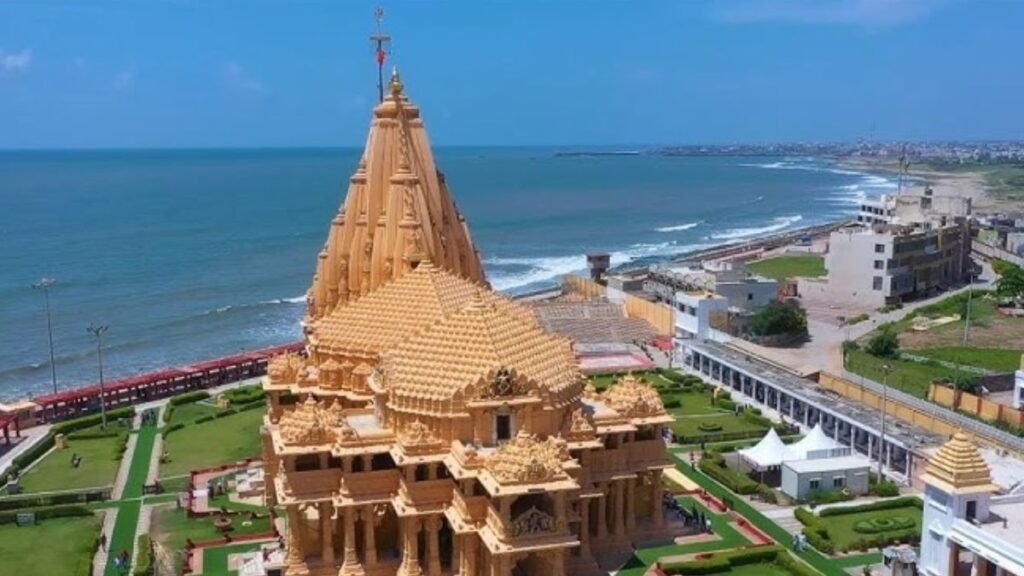
The Somnath Temple is the first and most important of the 12 Jyotirlingas the most sacred Shiva shrines in India. The Jyotirlinga is the form of Lord Shiva as a column of divine light (Jyoti = light, Linga = form), and the 12 Jyotirlingas are distributed across the subcontinent as the 12 points of Shiva’s self-revelation.
The name Somnath combines ‘Soma’ (the moon Lord Shiva’s name as the one who bears the moon) and ‘Nath’ (master, lord). Somnath is the Lord of the Moon. According to the Shiva Purana, the moon god Chandra (Soma) built the original Somnath Temple in gold after Lord Shiva lifted the curse that had been making the moon wane. This mythological origin places the temple in the cosmic time frame of the Puranas, far before any historical period.
Also Read: 7-Day Gujarat Itinerary: White Desert to Dwarka & Somnath
Multiple Destructions – The 1,000-Year Story in Stone
The historical record of Somnath is one of India’s most dramatic stories of destruction and resilience. The temple has been destroyed, damaged, plundered, or razed multiple times over a period of approximately 1,000 years. The most famous destruction was carried out by Mahmud of Ghazni in 1025 CE an event that has been retold, debated, and mourned in Indian historical and cultural consciousness ever since. Mahmud’s forces broke open the lingam, killed thousands of temple guardians, and carried away the temple’s legendary treasures.
After each destruction, the temple was rebuilt by successive rulers, dynasties, and communities who considered its restoration a matter of dharmic obligation. The Chalukya king Bhimdev I (the same king in whose memory Queen Udayamati built Rani Ki Vav) rebuilt it in stone. The Paramara king Bhoj rebuilt it. The Chudasama Rajputs maintained it. The modern temple was consecrated in 1951, just after Indian Independence, in a ceremony that Sardar Vallabhbhai Patel himself organised as a symbol of national self-determination — the reclamation of India’s most repeatedly desecrated sacred site.
Each destruction left stone. Each rebuilding created new stones. The Prabhas Patan Museum holds the archaeological record of this 1,000-year cycle the actual carved fragments, inscriptions, and sculpted figures from the various Somnath temples that existed and were destroyed. These are not reproductions. These are the stones themselves.
Inside the Museum – The Exhibits in Detail
The Courtyard – Carved Stones Open to the Elements
The first thing you see when you enter the Prabhas Patan Museum is its courtyard a large open space filled with carved architectural fragments from previous Somnath temples, left out under the open sky. Pillars, doorway sections, carved panels, and decorative elements from temples that no longer exist in their original form are arranged throughout the courtyard. The exposure to the elements the same elements that damaged the temples these stones came from is historically appropriate, if architecturally unfortunate.
Walking through the courtyard before entering the gallery buildings is a profound experience for anyone who knows the history of Somnath. These stones were carved in the 11th or 12th century, stood in the temple, survived (partially) a destruction, and ended up here. They carry the marks of history on their surfaces the places where figures were defaced, the sections that were broken away, the weathering of centuries.
The 12th-Century Reconstructed Shrine – The Centrepiece
The most celebrated exhibit inside the museum building is the reconstructed 12th-century shrine from the main Somnath Temple. This reconstruction using original stones and architectural elements from the 12th-century temple that was destroyed allows visitors to experience, in three dimensions, what the interior of a medieval Solanki-era Somnath Temple actually looked and felt like. The carved ceilings are intricate and beautiful preserved in this reconstruction from their original context. Spiritual paintings within the shrine add to the devotional atmosphere.
This reconstruction is one of the most interesting and honest pieces of architectural heritage display in Gujarat it uses the actual historical material to show what was lost, rather than substituting a modern reproduction. Standing inside it, you are simultaneously inside a museum exhibit and inside a 12th-century sacred space.
Stone Sculptures – Vishnu, Shiva, and the Hindu Pantheon
The museum holds a significant collection of stone sculptures from the various Somnath temples, including 11th-century representations of several major deities:
- Lord Agni – the fire god, depicted with his distinctive attributes; the 11th-century carving is of high quality
- Uma Maheshwara – Shiva and Parvati in their conjugal form; one of the most commonly depicted subjects in Shaiva temple sculpture
- Lord Vishnu – multiple representations from different periods of the temple’s history
- Parvati – the goddess as Shiva’s consort; beautifully carved
- Natya Bhairava – the dancing form of Bhairava (a fierce manifestation of Shiva); energetic and powerful
The Jain Collection – Evidence of Prabhas Patan’s Pluralism
One of the most historically revealing sections of the museum is its collection of Jain idols some intact, some visibly desecrated. The presence of a Jain collection in a museum otherwise dominated by Shaiva and Vaishnava material reflects the historical reality that Prabhas Patan was a pluralistic religious centre. Jainism was deeply influential in Gujarat from the early medieval period, and the Jain community had a significant presence at Prabhas Patan. The desecrated idols where figures have been broken or defaced record the violence that religious sites repeatedly faced during the medieval invasions of Gujarat. They are among the most historically sobering objects in the museum.
Inscriptions – History Written in Stone
The museum holds stone inscriptions in four scripts: Brahmi, Sanskrit, Pali, and Persian/Arabic. This multi-script collection is a complete map of the cultural history of Prabhas Patan across time. Brahmi the oldest Indian script, dating from approximately the 3rd century BCE represents the ancient layer. Sanskrit inscriptions represent the Hindu and Jain historical record. Pali inscriptions suggest Buddhist connections. And Persian/Arabic inscriptions represent the period of Muslim rule rulers who both destroyed and, in some cases, also commissioned work at the site.
Together, these inscriptions constitute a multi-lingual, multi-script record of the same place across nearly 2,000 years of history. They are, in their quiet way, one of the most extraordinary collections of primary historical documentation in Gujarat.
Architectural Elements – Domes, Toranas, and Pillars
The museum preserves several large-scale architectural elements from the destroyed temples:
- Five domes from earlier temple structures carved stone dome sections that once formed the ceilings of the medieval Somnath complex
- 12th-century toranas the ornate gateway arches that framed the entrances of Solanki-era temples; the torana at this period reached its height of decorative complexity
- Massive pillars from various temple incarnations
- Carved ceiling panels and wall sections
Seashells, Pottery, and Natural History
A smaller section of the museum holds specimens from natural history seashells from the Arabian Sea coast that speak to Prabhas Patan’s coastal geography, and pottery shards from different archaeological periods. These humbler objects — the everyday residue of human habitation over millennia provide context for the more dramatic sculptural and architectural exhibits, reminding visitors that behind the temples and the inscriptions, people lived ordinary lives at this site across an extraordinary span of time.
Coins from Different Periods
A collection of coins from various historical periods spanning several dynasties and centuries is included in the museum. Coins are among the most reliably dateable archaeological objects in the Indian historical record, and the Prabhas Patan coin collection provides a numismatic timeline of the political history of the region from ancient through medieval times.
Also Read: Junagadh Travel Guide
The Sacred Waters Collection – The Museum’s Most Unusual Exhibit
Prabhas Patan Museum contains one of the most intellectually striking and conceptually unusual exhibits in any museum in Gujarat: a collection of water samples from rivers and seas across the world. In a glass case, bottles of water from the following sources are preserved and labelled:
| Water Source | Location | Significance |
| Tigris River | Iraq / Turkey | One of the two rivers of ancient Mesopotamia the cradle of one of the world’s oldest civilisations |
| Nile River | Egypt / North Africa | The lifeblood of ancient Egyptian civilisation; one of the world’s most sacred rivers |
| Danube River | Central Europe (10 countries) | The great river of Central Europe; flows through or past 10 European countries |
| St. Lawrence River | Canada | One of the great rivers of North America |
| Río de la Plata (Plata) | Argentina / Uruguay | The estuary of the Paraná and Uruguay rivers in South America |
| Murray River | Australia | Australia’s longest river system |
| Seas of Tasmania | Australia (Southern Ocean) | Waters from the island of Tasmania and the Southern Ocean |
| Seas of New Zealand | New Zealand (Pacific Ocean) | Waters from the Pacific shores of Aotearoa New Zealand |
The symbolic logic of this exhibit is fascinating and worth dwelling on. Prabhas Patan is the Triveni Sangam the confluence of the Saraswati, Hiranya, and Kapila rivers. It is a place defined by the coming together of waters. The museum brings waters from the world’s great rivers and seas to this confluence as if completing a global Triveni, a sacred gathering of the world’s waters at one of India’s holiest sites.
The exhibit is also a reminder of the global reach of Hindu civilisational thought: the idea that all water is sacred that the Tigris and the Nile and the Murray carry the same sacred quality as the Saraswati is a profoundly cosmopolitan theological statement. This small exhibit in a small museum in a small market alley in Somnath carries more philosophical weight than its modest presentation suggests.
Why Visit Prabhas Patan Museum – The Case for the Undervisited
Most visitors to Somnath walk past the museum without going in. This is understandable the Somnath Temple is one of India’s most powerful and famous shrines, and after the temple experience, the appetite for more sightseeing can be limited. But the museum offers something the temple cannot: the past.
The current Somnath Temple consecrated in 1951, renovated and expanded multiple times since is a magnificent, living religious monument. It is the present of Somnath. The Prabhas Patan Museum is the entire past of Somnath all 1,000-plus years of construction, destruction, reconstruction, and the human stories behind each cycle. Every carved stone in the museum was once part of a temple that people prayed in, that invaders destroyed, that a subsequent generation rebuilt. The museum does not tell this story with labels and explanatory text (the labelling and documentation are, in the honest assessment of many visitors, inadequate). The stones tell it themselves.
For anyone with an interest in Indian history in the specific, grounded, stone-and-mortar reality of how India’s most enduring sacred site has been built, broken, and rebuilt the Prabhas Patan Museum is essential. And at ₹5 for Indian visitors, the price of this essential experience is approximately the cost of a cup of tea.
Best Time to Visit Prabhas Patan Museum
October to February – Best Season
The winter months are the most comfortable for Somnath visits generally. The weather in Gir Somnath district during October to February is pleasant 20 to 28 degrees Celsius and the sea breeze keeps the coastal city cooler than the interior of Gujarat. The museum’s courtyard exhibits, which are outside, are best visited in this weather. The morning light on the outdoor stone sculptures is particularly good for observation and photography.
Any Morning, on a Non-Wednesday Non-Holiday
The museum is open Thursday to Tuesday from 10:30 AM to 5:30 PM. It is closed on Wednesdays and on some public holidays. Check before going. Within its open hours, morning visits (10:30 AM to 12:30 PM) are when the light in the courtyard is best and the visitor numbers are lowest. Afternoons can be warmer and slightly busier, particularly on weekends when Somnath Temple draws large pilgrim numbers.
Plan for 1 to 2 Hours
The museum is modest in physical scale but rich in content. A thorough visit courtyard, main gallery, reconstructed shrine, inscriptions, sacred waters takes approximately 1 to 1.5 hours. Those who read every label and spend time with individual sculptures may need 2 hours. Do not rush the reconstructed 12th-century shrine; it deserves extended attention.
How to Reach Prabhas Patan Museum
| From | Distance | Mode | Approx. Time |
| Somnath Temple | ~300 m north | Walking (5 minutes along market street) | 5 minutes |
| Somnath Railway Station | ~2 km | Auto-rickshaw / Walking | 10 minutes |
| Veraval | ~7 km | Auto / Bus / Taxi | 10–15 minutes |
| Junagadh | ~82 km | Car / Bus | 1.5–2 hours |
| Porbandar | ~120 km | Car / Bus | 2.5 hours |
| Bhavnagar | ~270 km | Car | 5 hours |
| Rajkot | ~200 km | Car / Bus | 4 hours |
| Ahmedabad | ~400 km | Car / Bus / Train to Veraval + local | 7+ hours |
The museum is in the market street that runs northward from the Somnath Temple main entrance. It is easy to miss look for it in the bustling commercial alley approximately 300 metres from the temple gate. If you ask any local in Somnath for directions to ‘Prabhas Patan Museum’ or ‘Somnath Museum,’ they will know it.
Things to Do in Somnath and Prabhas Patan
- Somnath Temple ~300 m south of museum | The first Jyotirlinga one of the 12 most sacred Shiva shrines in India. The current temple, consecrated in 1951, stands dramatically on the Arabian Sea cliff. The Sound and Light Show in the evenings is a major attraction.
- Triveni Sangam (Triveni Teerth) Near the temple complex | The confluence of the Saraswati, Hiranya, and Kapila rivers one of Gujarat’s most sacred confluences. Devotees take a ritual bath here before visiting the Somnath Temple.
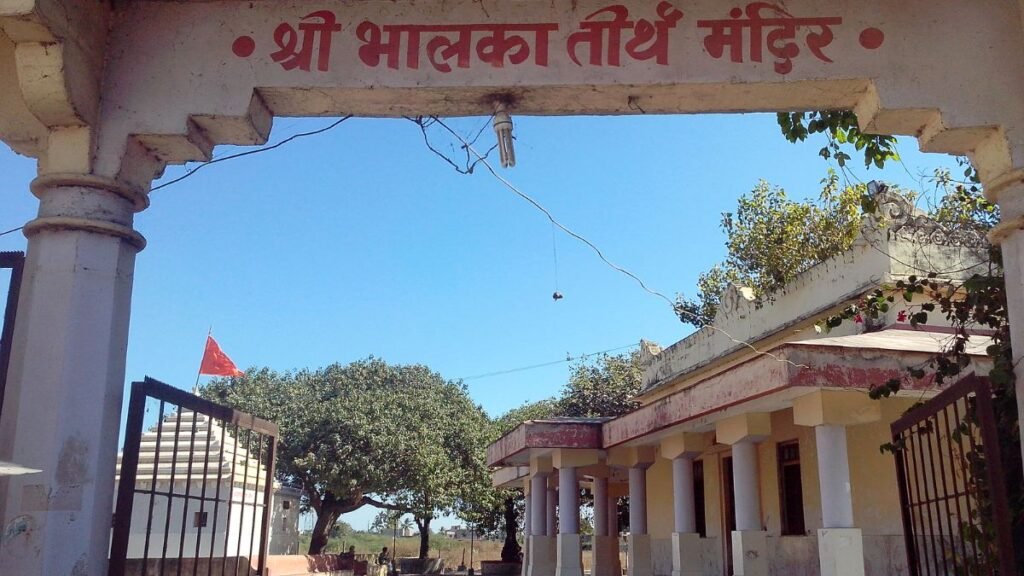
- Bhalka Teerth ~3 km from Somnath Temple | The sacred site where Lord Krishna is believed to have left the mortal world after being struck by the hunter Jara’s arrow. A small but deeply significant pilgrimage site that completes the Prabhas Patan narrative.
- Somnath Beach Adjacent to the temple | The Arabian Sea beach below the Somnath Temple cliff. Excellent for evening walks after the temple visit. Sunset over the Arabian Sea from this location is exceptional.
- Gita Mandir Near Somnath | A temple with all 18 chapters of the Bhagavad Gita inscribed on its walls one of Somnath’s most meditative spaces.
- Suraj Mandir (Sun Temple) Near Somnath | A small but architecturally interesting Sun Temple near the Somnath complex.
- Veraval ~7 km | One of India’s most important fishing ports. The fishing harbour at dawn or dusk — with hundreds of boats, the smell of the sea, and the sound of working vessels — is one of Gujarat’s most vivid urban scenes.
- Junagadh ~82 km | Girnar Hill (10,000 steps), Uparkot Fort (319 BCE), Mahabat Maqbara (Indo-Gothic), Ashoka Rock Edicts, Bhavnath Mela. Read our full TravelRoach guide.
Also Read: Rani Ki Vav Patan
Practical Tips for Visiting Prabhas Patan Museum
- Confirm it is not Wednesday before you go the museum is closed on Wednesdays and on public holidays. A wasted trip from a distant city on a closed day is avoidable with a quick check.
- Carry a small torch or phone flashlight some sections of the gallery buildings have inadequate artificial lighting; supplementary light helps you see the carved detail on sculptures and inscriptions.
- Spend more time in the courtyard than you think you need the outdoor carved stone fragments repay slow examination. Each stone has a different history, different condition, and different story.
- Do not rush the reconstructed 12th-century shrine this is the museum’s centrepiece and deserves at least 15 to 20 minutes of unhurried attention.
- The entry fee is ₹5 – the lowest of any major heritage attraction in Gujarat. Pay without hesitation. Consider a donation to the museum’s upkeep if you feel that the collection deserves better maintenance.
- Combine with a full Somnath day – temple in the morning, museum mid-morning, Triveni Sangam and Bhalka Teerth in the afternoon, Somnath Beach and Sound and Light Show in the evening.
- Photography charges apply inside – bring cash for the photography fee; digital payment options at the counter may be limited.
Frequently Asked Questions (FAQs)
Prabhas Patan Museum is an archaeological museum located 300 metres north of the Somnath Temple in Prabhas Patan, Gir Somnath District. Established in 1951 and managed by the Government of Gujarat, it holds approximately 3,500 objects including stone sculptures, inscriptions, architectural fragments, Jain idols, and a remarkable sacred waters collection all related to the history of Prabhas Patan and the multiple incarnations of the Somnath Temple. For history lovers, it is essential: the museum’s stones are the actual physical remains of the various Somnath Temples that were built, destroyed, and rebuilt over 1,000 years. Entry for Indian visitors is just ₹5.
Prabhas Patan Museum is open Thursday to Tuesday from 10:30 AM to 5:30 PM. It is closed on Wednesdays and on select public holidays always confirm before visiting to avoid a wasted trip. Entry for Indian visitors (adults and students) is ₹5 per person. For foreign nationals, the entry fee is ₹50 per person. Photography inside the museum requires an additional payment confirm the current rate at the entry counter. No advance booking is required.
The most unusual exhibit at Prabhas Patan Museum is the Sacred Waters Collection a collection of water samples from rivers and seas across the world, preserved in glass bottles and labelled. The collection includes water from the Tigris (Iraq), Nile (Egypt), Danube (Europe), St. Lawrence (Canada), Río de la Plata (South America), Murray (Australia), and the seas of Tasmania and New Zealand. The symbolic significance is profound: Prabhas Patan is a sacred confluence (Triveni Sangam) of three rivers. The museum brings waters from the world’s great rivers to this confluence as if completing a global sacred gathering of waters at one of India’s holiest sites.
Prabhas Patan Museum holds the archaeological remains from the multiple historical versions of the Somnath Temple the physical stones, sculptures, inscriptions, and architectural elements from the temples that existed at this site before the current structure (consecrated in 1951). The Somnath Temple has been destroyed and rebuilt multiple times over 1,000 years; the museum holds what was left behind by those cycles of destruction and construction. The most significant single exhibit is the reconstructed 12th-century shrine from the main temple assembled from original stones to show what a medieval Somnath interior looked like.
Prabhas Patan meaning ‘City of Sacred Light’ is one of Gujarat’s most mythologically dense sacred sites. It is: the site of the first and most important Jyotirlinga (Somnath); the Triveni Sangam where the rivers Saraswati, Hiranya, and Kapila are said to converge; and the site of Bhalka Teerth, where Lord Krishna is believed to have left the mortal world after being struck by a hunter’s arrow. This combination of the supreme Shiva pilgrimage, a sacred river confluence, and the departure of Lord Krishna from the world makes Prabhas Patan one of the most sacred and historically significant sites on the entire Indian coastline.
The museum is only 300 metres north of the Somnath Temple entrance, making a combined visit entirely natural. The recommended sequence for a full Somnath day: start with Somnath Temple darshan in the morning (arrive by 7 to 8 AM for morning aarti); walk north to Prabhas Patan Museum after the temple (10:30 AM opening); spend 1 to 1.5 hours in the museum; visit Triveni Sangam and Bhalka Teerth in the afternoon; walk to Somnath Beach for the sunset; and end with the Sound and Light Show at the temple in the evening. This itinerary gives you the complete religious, historical, and natural experience of Prabhas Patan in a single day.
For casual tourists, the museum may feel underwhelming due to limited interpretation the labelling and explanatory information inside could be significantly improved. One reviewer honestly noted it is ‘poorly promoted with very few writeups and badly maintained.’ However, for anyone with even a basic interest in Indian history, the experience of standing among the actual stones of destroyed Somnath Temples carvings from the 11th and 12th centuries, inscriptions in Brahmi and Persian side by side, Jain idols showing the marks of medieval violence is irreplaceable. The reconstructed 12th-century shrine alone justifies the visit. At ₹5 entry, the barrier to trying it is negligible.
Final Thoughts
The Somnath Temple gets the pilgrims, the sound and light show, the crowds, and the Instagram photographs. Three hundred metres away, in a busy market alley, the Prabhas Patan Museum gets the serious visitors the historians, the heritage lovers, the people who want to understand not just what Somnath is now but what it has been.
The stones in this museum have been carved, worshipped, broken, buried, found, labelled, and placed in a courtyard to weather in the Arabian Sea air for a few more decades. They have seen everything this site has seen. They carry on their surfaces the cuts of Mahmud’s soldiers and the chisels of Solanki craftsmen, sometimes on the same stone. They are the complete, honest, physical record of one of India’s most enduring acts of devotion and one of its most repeated experiences of loss.
Spend ₹5. Spend 90 minutes. Walk into the courtyard before you enter the gallery. Let the stones tell you what the temple cannot.
Have you visited Prabhas Patan Museum? Share what surprised you, what moved you, or which stone you spent the most time with in the comments TravelRoach would love to hear from every visitor who looked past the temple entrance and found the museum on the other side.
