Note to Readers: Smritivan is a memorial dedicated to the approximately 13,805 people who lost their lives in the 2001 Gujarat earthquake. This guide approaches it with the depth, care, and reverence that such a place deserves. It is one of the most moving destinations in all of India.
On the morning of January 26, 2001 Republic Day the ground beneath Kutch moved with a violence that lasted two minutes and changed everything. The earthquake that struck at 8:46 AM with a magnitude of 7.7 killed approximately 13,805 people, left 600,000 homeless, damaged or destroyed 1,800 villages, and shattered the city of Bhuj. It was one of the deadliest natural disasters in independent India’s history.
Twenty-one years later, on August 28, 2022, Prime Minister Narendra Modi stood atop Bhujiyo Dungar the hill overlooking Bhuj and inaugurated Smritivan. The name means Forest of Memories in Sanskrit. Spread across 170 acres of the same hilltop where the ancient Bhujia Fort has stood for 300 years, this is now India’s largest memorial museum a place that holds a tree for every victim, a nameplate for every life lost, and seven galleries that trace the story of a disaster, a recovery, and the extraordinary character of the people of Kutch.
Smritivan is not a conventional tourist attraction. It is a pilgrimage. It is an education. It is, above all, a deeply human place. This TravelRoach guide covers everything you need to plan a meaningful visit the 2001 earthquake story, the seven galleries, the Miyawaki forest, the check-dam memorials, entry fees, timings, how to reach, and how to combine it with the best of Bhuj’s other extraordinary heritage.
Smritivan – Quick Information
| Detail | Information |
| Full Name | Smritivan Earthquake Memorial Museum |
| Name Meaning | ‘Smriti’ = Memory / Remembrance | ‘Van’ = Forest | ‘Forest of Memories’ |
| Location | Atop Bhujiyo Dungar (Bhujia Hill), Bhuj, Kutch District, Gujarat |
| Inaugurated | August 28, 2022 by Prime Minister Narendra Modi |
| Built to Honour | 13,805 victims of the 2001 Gujarat Earthquake (January 26, 2001) |
| Area | 170 acres atop Bhujiyo Dungar |
| Significance | India’s largest memorial museum ever built in modern times |
| Architecture | Designed by Vastu Shilpa Consultants (heritage of legendary architect B.V. Doshi) |
| Museum Galleries | 7 themed galleries: Rebirth, Remember, Rebuild, Rethink, and more |
| Miyawaki Forest | World’s largest Miyawaki forest 3+ lakh (300,000) plants |
| Check-Dam Memorials | 50 check-dam reservoirs bearing the nameplates of all 13,805 victims |
| Memorial Trees | One tree planted for each of the ~13,000 victims |
| Bhujia Fort | The 300-year-old fort shares the Bhujiyo Dungar hilltop with Smritivan |
| Sun Point | Scenic overlook offering panoramic sunrise and sunset views of Bhuj city |
| Phase 2 | Announced January 2026 disaster management training, sustainability, learning centre |
| Entry Fee | Confirm at site gate (approximately ₹100–₹150 per adult; subject to change) |
| Timings | Approximately 10:00 AM – 7:00 PM (confirm locally before visiting) |
| Photography | Permitted in open areas; drone photography requires prior permission |
| Distance from Bhuj Station | ~5–6 km (10–15 minutes by auto/taxi) |
| Distance from Rajkot | ~229 km |
| Distance from Ahmedabad | ~329 km |
The 2001 Bhuj Earthquake – Understanding What Smritivan Commemorates
January 26, 2001 – Republic Day Morning
It was India’s Republic Day a national holiday, a morning of celebration. Families were gathered together. Children were home from school. The parades were beginning. At exactly 8:46 AM, a fault line beneath Kutch district ruptured with a magnitude of 7.7. The shaking lasted approximately two minutes.
In those two minutes, everything changed. Bhuj the historic capital of Kutch lost most of its older architecture. Entire neighbourhoods collapsed in seconds. The towns of Bhachau (near the epicentre), Anjar, Rapar, and dozens of villages in the surrounding plains were devastated. Gujarat’s most culturally distinctive district with its embroidered textiles, ancient traditions, and semi-arid beauty became, overnight, a landscape of rubble and grief.
The Scale of the Loss
- 13,805 people officially confirmed killed (many estimates suggest the true toll was higher)
- 166,000 people injured
- 600,000 people left homeless
- Approximately 450 villages in Kutch completely destroyed
- 1,800 villages across the district damaged to varying degrees
- Total economic losses estimated at US$5.5 billion
- 350,000 houses destroyed or made uninhabitable
The earthquake was felt across most of India and Pakistan. Tremors were recorded in Nepal. It remains one of the deadliest earthquakes in India’s post-independence history, and the scale of destruction in Kutch a district already characterised by sparse population, significant tribal communities, and ancient architectural heritage was enormous in proportion to the region’s size.
Also Read: Rann Utsav 2026 Full Guide
The Recovery – Kachchhiyat
What happened after the earthquake is as important to understand as the disaster itself. The Gujarat government with international assistance, civil society organisations, and above all the extraordinary resilience of the people of Kutch undertook one of the most ambitious disaster recovery projects in Indian history. Within ten years, most of the destroyed villages had been rebuilt. Within fifteen years, Kutch had become one of the fastest-growing districts in Gujarat by several economic metrics. New roads, new industries, new infrastructure.
The people of Kutch have a word for the quality that made this possible: Kachchhiyat. It does not translate easily, but it roughly means the essential character of Kutch an identity forged by centuries of living on the edge of a great desert, surviving droughts and floods and invasions, and returning. Kachchhiyat is resilience as cultural identity. Smritivan was built to honour the memory of the dead and to celebrate without diminishing the grief the resilience that brought the living back.
Smritivan What the Memorial Contains
The Seven Thematic Galleries
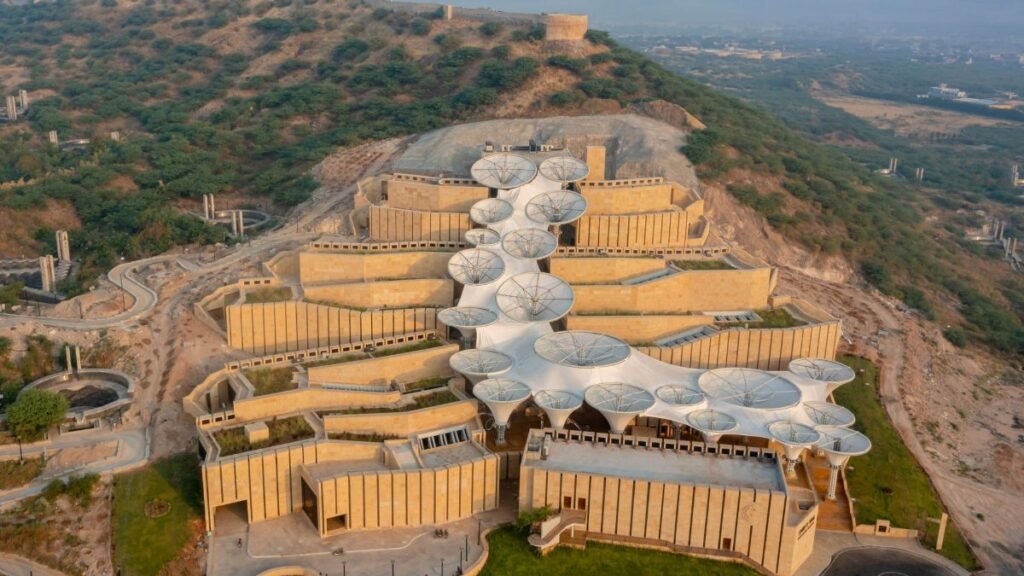
The heart of Smritivan is its museum a sequence of seven themed galleries that together tell the full story: from Kutch’s ancient roots, through the earthquake’s devastating impact, to the recovery and the lessons drawn from both. The galleries are designed to be experienced in sequence, each building on the emotional and intellectual foundation of the previous one.
Gallery 1 – Rebirth
The journey begins with Kutch before the earthquake its ancient civilisation, its Harappan connections, its position as a major centre of maritime trade and cultural exchange. The Indus Valley Civilisation had settlements in Kutch thousands of years before the earthquake. The district’s embroidery traditions, its nomadic communities, its salt flats and the seasonal miracles of the Rann all of this is presented as the foundation of a place that has repeatedly faced destruction and repeatedly come back. The gallery frames Kutch’s resilience not as something that began in 2001 but as something that has defined the region for millennia.
Gallery 2 – Remember
This is the most emotionally intense gallery the one that confronts visitors directly with the earthquake itself. The timeline of January 26, 2001 is reconstructed in detail: the precise moment of the rupture, the propagation of the shaking, the immediate collapse of structures, the hours of silence and the hours of rescue. Personal testimonies from survivors. Photographs. The human stories individual people, individual families, individual villages behind the abstract statistics of thousands of deaths.
The Remember gallery is where many visitors particularly those who lived through the earthquake or lost someone find themselves most deeply affected. It is designed with care: powerful enough to make the loss real without being exploitative. Take your time here. Speak quietly. This gallery is the moral centre of the entire Smritivan experience.
Gallery 3 – Rebuild
The Rebuild gallery documents the recovery how Kutch was reconstructed after 2001. The formation and work of GSDMA (Gujarat State Disaster Management Authority) is presented through a table projection multimedia show that recreates the sequence of emergency response, relief operations, and the long-term rebuilding process. The gallery documents the extraordinary scale of community participation in reconstruction how individual villages were rebuilt with their own design inputs, how traditional craft practices were integrated into new construction, how international expertise was combined with local knowledge.
The GSDMA Multimedia Show: A table projection show recreates the disaster scenario and the subsequent actions from the first 72 hours of rescue to the decade of reconstruction. This is one of the most technically impressive exhibits in the museum and gives visitors a concrete understanding of what disaster response actually looks like at scale.
Gallery 4 – Rethink
The Rethink gallery shifts from specific history to universal lessons. Interactive exhibits and games teach earthquake science how faults work, why certain buildings collapse while others survive, what early warning systems look like, and how community preparedness saves lives. The gallery also documents the emotional and psychological dimensions of disaster recovery post-traumatic experiences, community mental health, the process of rebuilding social fabric alongside physical infrastructure. Survivor testimonies and first-person accounts are presented alongside scientific information.
This gallery is particularly designed for students and educational groups it is the most interactive section of the museum and offers genuine learning about disaster preparedness that is directly applicable to visitors’ own communities.
Also Read: Sarkhej Roza, Ahmedabad
Additional Galleries
Beyond the four primary galleries described above, Smritivan’s museum complex includes additional exhibition spaces covering Gujarat’s reconstruction model as a global case study in post-disaster recovery; the role of technology and innovation in earthquake-resistant construction; and the cultural heritage of Kutch its crafts, communities, and traditions that survived and were preserved through the recovery period. The full museum experience requires approximately 2 to 3 hours for a thorough visit.
The Living Memorial – Forest, Check-Dams, and Sun Point
13,805 Memorial Trees – The Forest of Memories
The most profound element of Smritivan’s concept is the simplest: one tree planted for each person who died in the 2001 earthquake. Approximately 13,805 trees each one a life, each one a name, each one a memory grow across the 170-acre hilltop, creating an actual living forest on what was once barren, scrub-covered hill terrain.
Walking through this memorial forest knowing what each tree represents is one of the most quietly overwhelming experiences the site offers. There is no dramatic architecture here, no large display. Just trees, growing, in memory of the dead. The forest is also functional: its roots bind the hillside soil, its canopy creates habitat for birds and insects, and its presence transforms the ecology of the Bhujiyo Dungar. The memorial lives, because the trees live.
The World’s Largest Miyawaki Forest
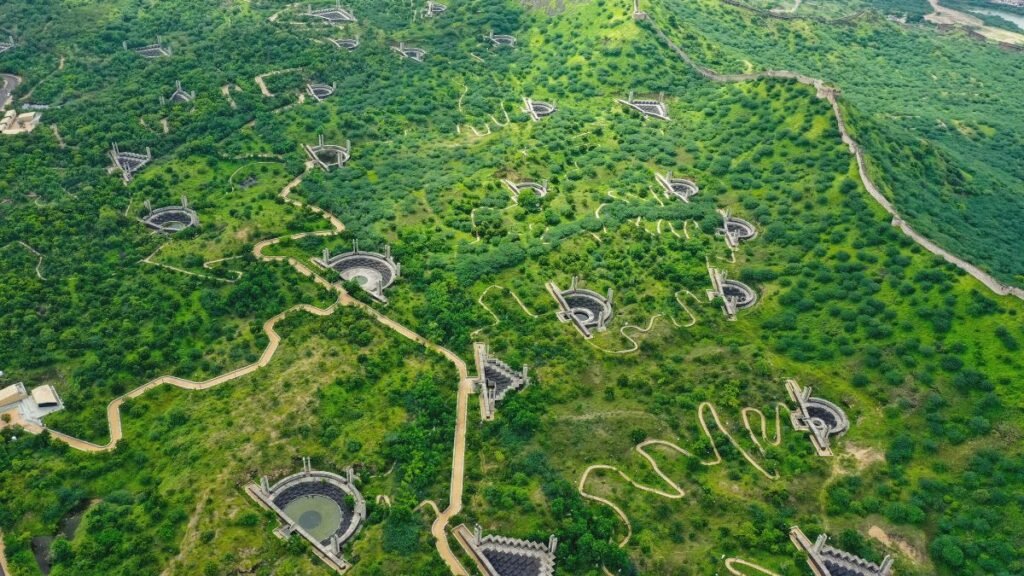
The afforestation at Smritivan uses the Miyawaki method a technique developed by Japanese botanist Akira Miyawaki that creates dense, multi-layered, native forests that grow 10 times faster than conventionally planted forests and become fully self-sustaining within three years. The Smritivan Miyawaki Forest with over 3 lakh (300,000) plants using native species is the largest Miyawaki forest in the world. This achievement transformed a rocky, arid hillside into a biodiversity-rich forest ecosystem in a remarkably short time, demonstrating principles of ecological restoration that are significant far beyond the memorial’s immediate purpose.
50 Check-Dam Reservoirs — Nameplates of the Lost
Distributed across the Smritivan site are 50 check-dams small reservoir structures that collect rainwater and support the sustainability of the memorial forest and the larger ecological site. Each check-dam bears the nameplates of the earthquake victims ensuring that every single person who died on January 26, 2001 is individually named and remembered. The combination of the functional water conservation purpose and the memorial purpose of the check-dams is a powerful design decision: the structures that sustain the living memorial forest are literally built of the names of the dead.
Sun Point — Overlook of Bhuj
At the highest accessible point of Bhujiyo Dungar, Smritivan has created the Sun Point a viewing area that offers a complete panoramic view of Bhuj city below and the Kutch landscape stretching in every direction. The Sun Point is particularly spectacular at sunrise, when the Rann of Kutch district comes alive with light, and at sunset, when the sky over the Great Rann turns the colours of amber, orange, and red. For photographers, the Sun Point at golden hour is one of the finest viewpoints in all of Kutch.
Bhujia Fort – The 300-Year-Old Fort on the Same Hill
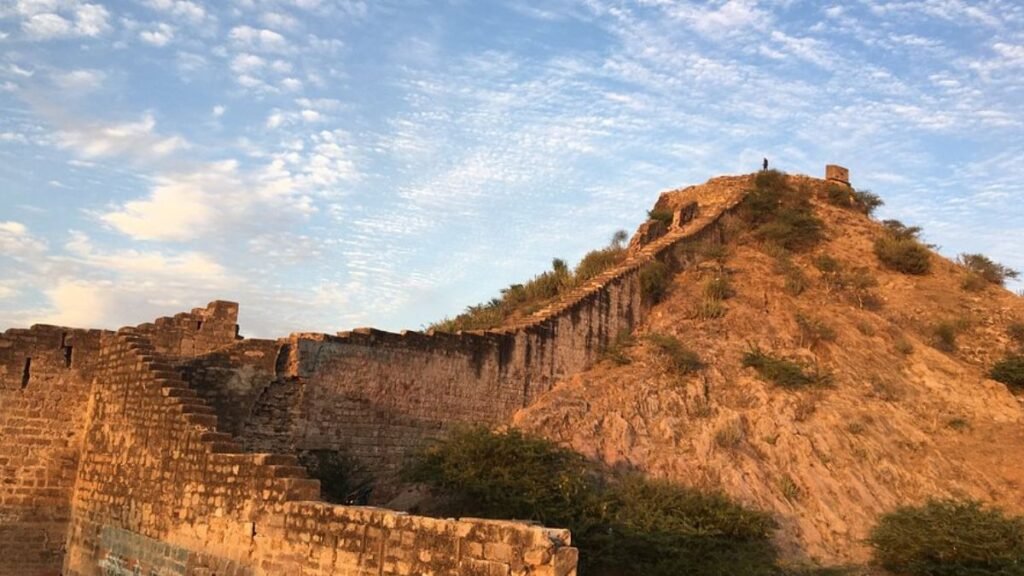
Sharing the Bhujiyo Dungar with Smritivan is the Bhujia Fort a 300-year-old fortification built in the 18th century during the reign of the rulers of Kutch. The fort was originally constructed to defend Bhuj from invasion and was the site of a famous battle in 1741 in which the Kutch forces resisted the Maratha army under Senapati Trimbak Rao Dabhade.
The fort is built from the same dark stone as the hill itself, making it appear almost organic from a distance. Its ramparts and bastions wrap around the hilltop, and within the fort complex there is a temple to Bhujang Dev (the naga deity after whom the hill Bhujiyo Dungar is named). The fort’s walls offer additional viewpoints of the surrounding landscape, and its historical character contrasts beautifully with the contemporary memorial architecture of Smritivan that surrounds it.
Visiting both Smritivan and Bhujia Fort on the same hilltop gives you a remarkable span of time: from the 18th century fort to the 21st century memorial, with the ancient hill at the foundation of both.
Smritivan Phase 2 – Announced January 2026
On January 26, 2026 the 25th anniversary of the earthquake Gujarat Chief Minister Bhupendrabhai Patel announced the launch of Smritivan Phase 2. While Phase 1 focused on remembrance, history, and education, Phase 2 is designed as a ‘living space’ for the future, expanding the 170-acre site’s role into:
- Capacity Building – International training programmes for disaster management and resilience, positioning Smritivan as a global centre for learning from catastrophe
- Sustainability – Expanded renewable energy installations and water conservation models that demonstrate sustainable living in an arid environment
- Holistic Learning – New institutional spaces where students and professionals from India and internationally can study ‘Kachchhiyat’ the science, culture, and philosophy of Kutch’s unique resilience
Phase 2 transforms Smritivan from a memorial of the past into a living institution of the future ensuring that the lessons of January 26, 2001 continue to benefit communities facing disaster risk worldwide.
The Visitor Experience – How to Approach Smritivan
How Long to Spend
Allow a minimum of 2.5 to 3 hours for a thorough visit to Smritivan 1.5 to 2 hours for the museum galleries and 30 to 60 minutes for the outdoor memorial areas, forest walk, check-dam memorials, and Sun Point. Those who want to read all the exhibits carefully or who are visiting as part of a research or educational purpose should plan up to 4 hours. The site is large comfortable footwear is essential.
Emotional Preparation
Smritivan will affect you. The Remember gallery, in particular, is designed to make the earthquake’s human impact fully real through personal testimonies, photographs, and the confrontation with individual stories behind the aggregate numbers. Many visitors particularly those from Kutch or Gujarat who have personal connections to the earthquake find parts of the visit deeply affecting. This is appropriate. The memorial works because it makes the loss real, not abstract.
Come with openness. Speak softly throughout the museum complex. Give other visitors space for their own experience. The Smritivan experience is best approached as a pilgrimage rather than a sightseeing visit.
For Children and School Groups
Smritivan is exceptionally well-suited for school educational visits. The Rethink gallery is specifically designed with interactive games and activities for younger learners. The science of earthquakes, the principles of disaster preparedness, and the story of community recovery are all presented in age-appropriate, engaging formats. Gujarat state schools regularly bring students to Smritivan as part of their social studies and disaster preparedness curriculum.
Also Read: Idar Fort, Sabarkantha
Best Time to Visit Smritivan
October to March – Best Season Overall
The winter months offer the most comfortable visiting conditions for Kutch and Bhuj. Temperatures in Kutch during October to February range from 12 to 25 degrees Celsius cool and pleasant for outdoor exploration of the memorial forest, the check-dam memorials, and the Sun Point. This season also coincides with the Rann Utsav festival (typically November to February) the famous festival celebrating the cultural heritage of Kutch at the White Rann making a Smritivan visit a natural complement to a wider Kutch cultural trip.
January 26 – The Most Significant Date
The anniversary of the earthquake January 26 is the most significant day to visit Smritivan. Memorial services, official events, and personal pilgrimages by survivors and bereaved families mark the day. The atmosphere on January 26 is uniquely solemn and powerful. For those who want to understand Smritivan at its most moving and to participate in an act of collective remembrance visiting on this date is the most meaningful choice.
Sunrise and Sunset at Sun Point
Regardless of season, the sunrise from the Sun Point at Bhujiyo Dungar is extraordinary the light breaking over Bhuj city and the Kutch landscape simultaneously. Sunset is equally spectacular. If your schedule allows, time one of your Smritivan visits to coincide with either the combination of the memorial’s meaning and the raw beauty of the Kutch landscape at golden hour creates an experience of rare depth.
April to June – Hot (Not Recommended)
Kutch summers are extreme temperatures can exceed 45 degrees Celsius. The outdoor memorial areas and forest walks become difficult in this heat. If visiting in summer, limit your time to the air-conditioned museum galleries and plan exclusively for early morning (opening time to 11 AM).
How to Reach Smritivan, Bhuj
| From | Distance | Mode | Approx. Time |
| Bhuj city centre | ~5–6 km | Auto-rickshaw / Taxi / Own vehicle | 10–15 minutes |
| Bhuj Railway Station | ~5–6 km | Auto-rickshaw / Taxi | 10–15 minutes |
| Rajkot | ~229 km | Car / Bus | 3.5–4 hours |
| Ahmedabad | ~329 km | Car / Bus | 5–5.5 hours |
| Gandhinagar | ~350 km | Car / Bus | 5.5–6 hours |
| Bhuj Airport (Bhuj, BHJ) | ~5 km | Flight + Taxi | 10 minutes |
From Bhuj City (The Starting Point for All Visitors)
Smritivan is located on Bhujiyo Dungar a hill that rises above Bhuj city approximately 5 to 6 km from the city centre and the railway station. From anywhere in Bhuj, hire an auto-rickshaw or local taxi to ‘Smritivan’ or ‘Bhujiyo Dungar’. Every driver in Bhuj knows the memorial. The road up the hill is motorable vehicles can reach the memorial complex directly.
By Air
Bhuj Airport (BHJ) is just 5 km from Smritivan. Regular flights connect Bhuj to Mumbai, Delhi, Ahmedabad, and other major cities. For visitors combining Smritivan with the Rann Utsav or a wider Kutch trip, flying into Bhuj is the most convenient option.
By Train
Bhuj Railway Junction is well-connected to Ahmedabad, Rajkot, Mumbai, and other cities. From Bhuj station, take an auto-rickshaw or local taxi to Smritivan (10 to 15 minutes, approximately ₹80 to ₹150). The Bhuj-Ahmedabad train journey takes approximately 7 to 8 hours; several services run daily.
By Road
From Ahmedabad (329 km) or Rajkot (229 km), the drive to Bhuj is on well-maintained highways through the Kutch landscape. If coming from Ahmedabad, the Ahmedabad-Bhuj highway passes through Surendranagar and Halvad a scenic route through the transitional landscape between Gujarat’s plains and the Rann of Kutch. Google Maps navigation to ‘Smritivan Earthquake Memorial Museum, Bhuj’ is accurate.
Nearby Attractions to Combine with Smritivan in Bhuj
- Aina Mahal (Hall of Mirrors) In Bhuj city | An 18th-century palace of the Kutch rulers, built by Ram Singh Malam — a craftsman who travelled to Europe and returned to Kutch with Dutch techniques of glass and mirror work. The result is one of India’s most distinctive small palaces — every surface covered in hand-blown glass, mirrors, Meissen-style tiles, and intricate metalwork. A must-visit before or after Smritivan.
- Prag Mahal Adjacent to Aina Mahal | A grand 19th-century palace built in Italian Gothic style with a soaring clock tower. The contrast between the intimate Aina Mahal and the theatrical scale of Prag Mahal both in the same palace complex is one of Bhuj’s finest heritage experiences.
- Kutch Museum Bhuj city | The oldest museum in Gujarat, housing collections of Kutch arts, crafts, archaeology, and natural history. Particularly strong on the embroidery traditions of Kutch’s various communities Ahirs, Rabaris, Meghwals — that are among the finest in the world.
- Bhujia Fort (on the same hill) Bhujiyo Dungar | The 300-year-old fort sharing the Smritivan hilltop. Walk through the fort walls and the Bhujang Dev temple as part of your Smritivan visit.
- Rann of Kutch and Rann Utsav ~80 km from Bhuj | The extraordinary white salt desert one of the world’s largest is the defining natural landscape of Kutch. The Rann Utsav festival (November to February) transforms the Rann into a cultural festival of music, crafts, and celebration. Essential for any Kutch trip.
- Hamirsar Lake Bhuj city centre | The central lake of Bhuj, ringed by heritage structures and gardens. A pleasant early morning walk after the intensity of Smritivan.
Practical Visitor Information
- Confirm entry fee and timings before visiting – as a relatively recently inaugurated site (2022), fees and timings at Smritivan may be subject to revision. Call ahead or check the official website (smritivanearthquakemuseum.com) before your visit.
- Allow at least 2.5 to 3 hours – rushing through Smritivan misses the point of the place. The galleries are rich in content and the outdoor memorial areas deserve unhurried attention.
- Comfortable walking shoes are essential – the site is large and outdoor areas involve walking on uneven terrain including the hillside memorial forest.
- Photography is permitted in most areas – drones and commercial filming require prior permission from Smritivan authorities. Respect photography restrictions near exhibits where flash or video may be prohibited.
- The museum is air-conditioned – the gallery spaces provide relief from Kutch’s heat. Outdoor areas require sun protection – carry a hat, sunscreen, and water.
- Visit early in the day – the morning light at the Sun Point overlook is exceptional and the museum is quietest in the first hour after opening.
- Silence and respect – the Remember gallery especially. Mobile phones on silent. Low voices. Give space to visitors who may be personally bereaved.
- Combine with Rann Utsav (November to February) – a Smritivan visit combined with the Rann Utsav festival gives you the full emotional and cultural range of Kutch — from grief and recovery to celebration and pride.
Frequently Asked Questions (FAQs)
Smritivan meaning Forest of Memories is India’s largest memorial museum, built atop Bhujiyo Dungar (Bhujia Hill) in Bhuj, Kutch, Gujarat. It was inaugurated by Prime Minister Narendra Modi on August 28, 2022, to commemorate the approximately 13,805 people who lost their lives in the devastating 2001 Gujarat earthquake (magnitude 7.7, January 26, 2001). The memorial honours the dead through individual trees, named check-dams, and seven museum galleries that trace the earthquake’s impact and Kutch’s extraordinary recovery. It also celebrates the resilience and spirit of the people of Kutch a quality the local culture calls ‘Kachchhiyat’.
Smritivan Earthquake Memorial Museum charges an entry fee of approximately ₹100 to ₹150 per adult (subject to revision). The museum is generally open from approximately 10:00 AM to 7:00 PM. As the site was inaugurated in 2022 and may have updated its ticketing and scheduling, it is strongly recommended to confirm current timings and fees by visiting the official website (smritivanearthquakemuseum.com) or calling ahead before making the trip.
Smritivan is located approximately 5 to 6 km from Bhuj city centre and Bhuj Railway Station about 10 to 15 minutes by road. Take a local auto-rickshaw or taxi from anywhere in Bhuj and ask for ‘Smritivan’ or ‘Bhujiyo Dungar’. All local drivers know the memorial. The road up the hill is motorable and vehicles can reach the site directly. Bhuj Airport is also approximately 5 km from Smritivan.
Smritivan’s museum features seven thematic galleries that together tell the complete story of the 2001 earthquake and its aftermath. Key galleries include Rebirth (Kutch’s ancient civilisation and historic resilience), Remember (the earthquake timeline, personal testimonies, and human impact the most emotionally intense section), Rebuild (the recovery process and GSDMA’s role, including a multimedia table projection show), and Rethink (interactive earthquake science, disaster preparedness education, and the psychological dimensions of recovery). Additional galleries cover Gujarat’s reconstruction as a global case study, technology and construction innovation, and the cultural heritage of Kutch.
The Miyawaki Forest at Smritivan is the world’s largest forest created using the Miyawaki method a Japanese afforestation technique developed by botanist Akira Miyawaki that creates dense, multi-layered, native forests growing 10 times faster than conventionally planted trees and becoming self-sustaining within three years. At Smritivan, over 3 lakh (300,000) native plants were planted across the hillside using this method, transforming barren terrain into a rich forest ecosystem. This is both an ecological restoration achievement and a deeply meaningful part of the memorial the one tree for each earthquake victim concept is woven into this living forest.
A thorough visit to Smritivan takes approximately 2.5 to 3 hours. This allows 1.5 to 2 hours for the seven museum galleries which are rich in content and deserve unhurried attention and 30 to 60 minutes for the outdoor areas including the memorial forest walk, the check-dam nameplates, the Sun Point overlook, and the Bhujia Fort. Visitors specifically focused on the interactive Rethink gallery (particularly school groups) may spend longer. Those who want to read every exhibit comprehensively should plan up to 4 hours.
Yes – Smritivan is exceptionally well-suited for school educational visits and is one of the finest educational heritage experiences in Gujarat. The Rethink gallery is specifically designed with interactive games, earthquake science exhibits, and disaster preparedness activities for younger learners. The Remember gallery should be approached with sensitivity for very young children, but for children aged 10 and above, it provides a powerful and age-appropriate encounter with India’s modern history and the principles of community resilience. Gujarat state schools regularly bring students to Smritivan as a core part of their curriculum.
Final Thoughts
There are places that give you information. There are places that give you beauty. And there are places that give you something rarer a genuine encounter with what it means to be human: to grieve, to endure, to rebuild, to carry forward the names of the dead while planting trees in their memory and teaching children how to be safer than their grandparents were.
Smritivan is all of these things. India’s largest memorial museum is not large in the way that things are large when they are trying to impress you. It is large in the way that genuine grief is large it takes up real space, it cannot be walked through quickly, and it stays with you after you leave.
If you visit Kutch and you should visit Smritivan. Not as a tourist. As a witness. Walk through the forest of 13,805 trees. Read the names on the check-dams. Stand at Sun Point and look out over the city that came back. That is what Kutch did. And Smritivan is where you go to understand how.
Have you visited Smritivan? Share your experience what the Remember gallery made you feel, what the Miyawaki forest looked like in winter light, or the view from Sun Point in the comments. TravelRoach would love to hear from every visitor to this extraordinary place.
