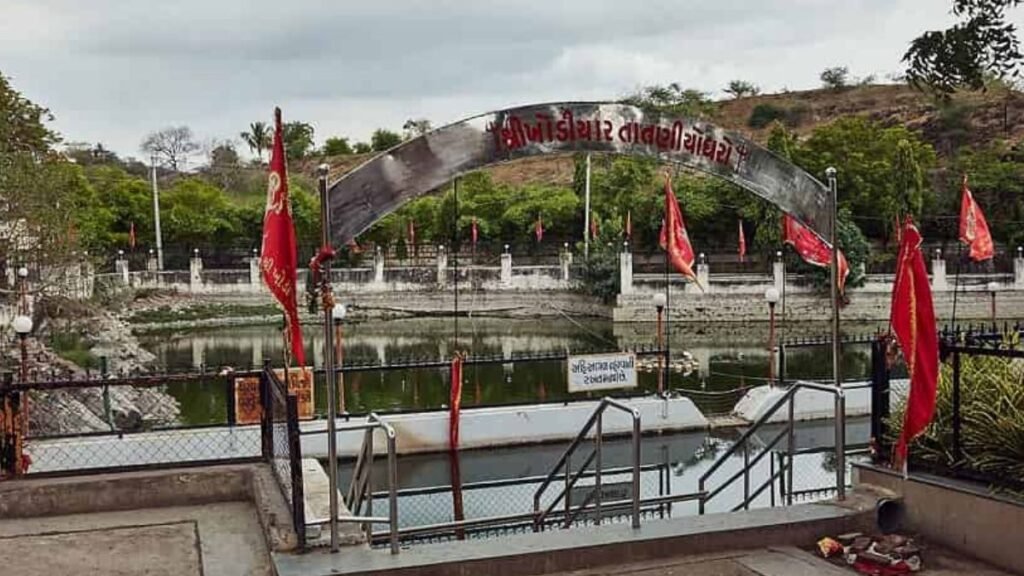
Fifteen kilometres from Bhavnagar on the Bhavnagar-Rajkot Highway, where the road runs alongside the Tataniya Dharo a wide, glittering freshwater lake there is a temple where a goddess stopped walking and decided to stay.
The story is one of the most beloved in Saurashtra’s oral tradition. A Maharaja of Bhavnagar, devoted beyond measure to Khodiyar Maa, insisted the goddess leave her distant shrine and come closer to his capital. The goddess agreed on one condition. He must walk ahead and never turn around to look. They walked together through the night, the king ahead, the goddess behind him, the sound of her anklets marking each step. A few kilometres from Sihor, the footstep sounds ceased. The Maharaja, overcome by doubt, turned. The goddess, true to her word, stopped exactly where she was. She and her seven sisters built their home at that spot. At that spot the village of Rajpara the temple was built.
Shree Khodiyar Mata Mandir at Rajpara is one of the five most important Khodiyar Maa temples in Gujarat, the ancestral deity (Kuldevi) of the Bhavnagar royal family and the Gohil Rajputs, and a place of deep active faith for millions of devotees across Gujarat, Rajasthan, and beyond. This TravelRoach guide covers everything: the legend of Khodiyar Maa’s birth, the founding story of the Rajpara temple, the architecture, the festivals, the extraordinary facilities, darshan timings, how to reach, and all the practical information for a complete pilgrimage visit.
Khodiyar Mandir Rajpara – Quick Information
| Detail | Information |
| Full Name | Shree Khodiyar Mata Mandir (Aai Shri Khodiyar Mata Mandir) |
| Also Known As | Rajpara Khodiyar Mandir |
| Location | Rajpara village, Sihor Taluka, Bhavnagar District, Gujarat |
| Highway | On the Bhavnagar-Rajkot Highway, just before Rajpara village |
| Scenic Setting | On the banks of Tataniya Dharo (Tataniya Wali Lake) a large freshwater lake |
| Deity | Khodiyar Maa (Khodiyar Mata) warrior goddess; Lokdevi and Kuldevi |
| Kuldevi of | Gohil Rajputs (Bhavnagar royal family), Charan community, and many Saurastrian communities |
| One of Five Key Temples | The five most important Khodiyar Maa temples: Matel, Khodaldham (Kagvad), Galdhara, Rajpara (Bhavnagar), and one other near Bhavnagar |
| Temple Built | 1911 CE formally commissioned by Maharaja Krishnakumarsinhji of Bhavnagar |
| Originally Founded | Maharaja Wakhatsinhji Akherajji Gohil (late 1700s / early 1800s) established the original humble shrine |
| Managed By | Shree Rajpara Khodiyar Mandir Trust |
| Entry Fee | Free no entry fee for darshan |
| Darshan Timings | 6:00 AM – 8:00 PM (daily; extended during festivals) |
| Free Meals | Bhojnalaya serves free meals for up to 3,000 people at a time daily |
| Accommodation | Dharamshalas: 4 large halls (~100 beds) + ~50 AC and Non-AC rooms |
| Medical Facility | Hospital with doctors and ambulance available within the complex |
| Live Darshan | Available online check official website for live stream links |
| Distance from Bhavnagar | ~15–16 km (~25–30 minutes) |
| Distance from Sihor | ~6 km |
| Distance from Sihor Railway Station | ~6 km (~15 minutes by auto) |
| Distance from Bhavnagar Airport | ~22 km (~35 minutes) |
| Distance from Ahmedabad | ~170 km (~3.5 hours) |
| Distance from Palitana (Shatrunjaya) | ~60 km (~1.5 hours) |
| Most Auspicious Days | Saturdays; Navratri; Chaitra Navratri |
Who is Khodiyar Maa? – The Warrior Goddess of Saurashtra
The Birth Legend – Seven Sisters and a Blessing
Khodiyar Maa is a warrior goddess who is believed to have taken human birth around 700 CE in the Saurashtra region of Gujarat. According to the devotional tradition, her story begins with a devout man named Mamiya Gadhvi (Mamad Ji Charan) a member of the Charan caste, one of Gujarat’s ancient communities known for their oral tradition of praise poetry and their devotional connection to the divine.
Mamiya Gadhvi was a man of deep faith facing profound hardships. In response to his devotion, Lord Shiva intervened he took Mamiya to the realm of Nagdev (the divine serpent deity). Nagdev, moved by the man’s faith and suffering, blessed Mamiya’s wife with seven daughters and a son. These daughters, born of divine blessing, each possessed extraordinary spiritual power. Khodiyar Maa was among these seven sisters. Her birth story traces specifically to the village of Roishala, near Bhavnagar in Saurashtra connecting her birth to the very soil of the Bhavnagar region where her most important temples stand.
The Name Khodiyar – The Lame Goddess
The name Khodiyar is particularly significant and theologically distinctive. In Gujarati, ‘Khodi’ means lame one who walks with a limp or physical disability. Khodiyar Maa is worshipped as a goddess who is herself physically impaired. This is one of the most remarkable aspects of her divine form: she is not the conventionally perfect goddess figure but one whose power and authority exist alongside and indeed through a physical limitation.
For millions of devotees across Gujarat, Khodiyar Maa’s disability is not a weakness but a theological statement: that divine power is not contingent on physical perfection. That the goddess who destroys obstacles, protects communities, and fulfils the deepest wishes of her devotees does so despite or perhaps because of her own experience of physical limitation. This aspect of Khodiyar Maa’s character gives her a particularly intimate quality in the devotional relationship. She is the protector who has known vulnerability.
Also Read: Nishkalank Mahadev Temple
Lokdevi and Kuldevi – Community and Royal Goddess
Khodiyar Maa holds two overlapping sacred roles in Gujarati and Rajasthani religious life:
Lokdevi – the goddess of the people. A Lokdevi is not merely a deity for a specific caste or community but for the entire region and its population. Khodiyar Maa is worshipped across caste boundaries by Gujaratis who see her as the protector and blessing-giver of the broader community.
Kuldevi – the ancestral deity of specific lineages. For the Gohil Rajputs the ruling family of Bhavnagar state Khodiyar Maa is the Kuldevi: the goddess whose blessing was sought at the founding of the lineage and whose presence has been maintained through all subsequent generations. She is also the Kuldevi of the Charan community (Mamiya Gadhvi’s own community) and of numerous other Saurastrian families across Gujarat.
This combination — universal enough to be everyone’s goddess, specific enough to be the ancestral deity of specific royal and community lineages — is what gives the Khodiyar Maa tradition its extraordinary reach and depth across western India.
The Legend of the Rajpara Temple – The Promise and the Pause
The King’s Devotion
Thakur Sahib Wakhatsinhji Akherajji Gohil was the ruler of Bhavnagar state in the late 18th and early 19th century one of the Gohil Rajput rulers in the line that had governed this region for centuries. He was a devotee of Khodiyar Maa of a particularly intense kind: he paid regular visits to her distant shrine at Galdhara (some accounts say Matel), travelling the considerable distance each time out of personal devotion.
In the theological imagination of Saurashtra, a king’s devotion to a goddess creates a reciprocal relationship the king’s territory is under the goddess’s protection, and the goddess’s presence in or near the capital intensifies that protection. Wakhatsinghji, deeply aware of this, began asking Khodiyar Maa to come closer to Sihor the then capital of Bhavnagar state so that the goddess would be at the heart of his kingdom rather than a long journey away.
The Agreement and the Walk
Khodiyar Maa agreed to come to Sihor but on a condition that tested the Maharaja’s faith in a very specific way. He must walk ahead, she would follow behind, and he must not turn around during the entire journey, no matter what he heard, felt, or feared. The agreement was made. The journey began.
They walked through the night. The Maharaja walked ahead. Behind him, he could hear the sound of the goddess’s footsteps and the light jingling of her anklets the reassurance that she was there, following, present. For many kilometres, the sounds continued. The faith held.
A few kilometres from Sihor at a spot that is today the village of Rajpara the footstep sounds and the anklet sounds suddenly ceased. Silence. The Maharaja walked on for some distance but the sounds did not resume. In the dark, his doubt and his love for the goddess became indistinguishable from each other. He turned.
Khodiyar Maa was there. She had been there. But by turning, Wakhatsinhji had broken the condition of the agreement. The goddess, who is always as good as her word, stopped exactly where she was and declared that she would go no further. She and her seven sisters settled at Rajpara not in the capital as the king had hoped, but in the village where his faith had faltered. A shrine was built at the spot where she stopped. That shrine became the Khodiyar Mandir at Rajpara.
Also Read: Hastagiri Jain Tirth, Bhavnagar
The Golden Egg on the Temple Spire
An additional legend associated with the Rajpara temple concerns a golden egg the spherical golden ornament that crowns the temple’s shikhara (spire). According to local tradition, the golden egg represents a discovery made by fishermen or shepherds who saw Khodiyar Maa beneath the waters of the Tataniya Dharo lake. When a miraculous flood occurred and then receded, the site was recognised as divinely charged. The golden egg placed at the temple’s summit commemorates this connection between the goddess and the lake that stretches alongside her temple the vast Tataniya Dharo whose waters define the approach to the shrine.
The Temple – Architecture, Setting, and What to See
The 1911 Temple and the Maharaja’s Patronage
The original humble shrine established by Maharaja Wakhatsinhji was a simple structure in keeping with the founding legend’s spirit of devotion over grandeur. It was Maharaja Krishnakumarsinhji of Bhavnagar the later ruler who formally commissioned and built the present magnificent temple structure who transformed the site into the significant religious complex it is today. The formal construction of the current temple is dated to 1911 CE, placing it in the final period of the Bhavnagar princely state’s history under British paramountcy.
The temple that visitors see today managed by the Shree Rajpara Khodiyar Mandir Trust is the product of this 1911 foundation and the subsequent additions and improvements made by the Trust over the more than a century since. The Gohil royal family’s connection to the temple as its Kuldevi temple means that the royal patronage and devotional relationship have continued even after independence and the merger of the princely states.
The Lake Setting – Tataniya Dharo
The most immediately striking aspect of the Khodiyar Mandir at Rajpara is its setting. The temple stands on the banks of the Tataniya Dharo a wide, expansive freshwater lake whose still waters reflect the sky and the surrounding hills. The combination of the temple and the lake creates one of Bhavnagar district’s most visually beautiful sacred landscapes: the white-and-orange temple against the blue-grey water, the hills in the background, and the flat agricultural landscape of Saurashtra extending in every direction.
The lake itself which extends considerably in both directions from the temple creates a natural spiritual resonance: water is sacred in the Hindu tradition, and the goddess who stopped at Rajpara is specifically associated with the Tataniya Dharo. Devotees often pause at the lakeside before entering the temple, the view of the water creating a natural transition from the worldly road and the sacred space ahead.
The Main Sanctum and the Idol
At the centre of the temple complex is the main sanctum housing the principal idol of Aai Shri Khodiyar Mata. The idol is richly adorned in the traditional manner jewellery, garments, and the regalia of the warrior goddess. Khodiyar Maa is typically depicted with multiple arms, weapons, and the fierce-compassionate expression of the Shakti warrior form. The idol is dressed and adorned differently for different festivals and days of the week.
The approach to the sanctum through the temple’s courtyard and inner halls follows the standard pilgrimage sequence: the gradual deepening of concentration as you move from the outer world toward the innermost sacred space. Many devotees perform a pradakshina (circumambulation) of the main shrine as part of their darshan protocol.
The Small Ropeway and the Kund
Two features within or adjacent to the temple complex are mentioned by regular visitors as distinctive: a small ropeway that connects the main temple area to a higher vantage point or a secondary shrine, and a Kund (sacred stepped tank) for ritual purification. The ropeway adds an unusual element to the pilgrimage experience and is popular with families and children. The Kund provides the traditional facility for ritual bathing before the main temple darshan.
The Temple Trust’s Extraordinary Facilities
The Shree Rajpara Khodiyar Mandir Trust has developed the temple complex into one of the most comprehensively facilitated pilgrimage sites in Bhavnagar district. The facilities available reflect both the scale of the daily pilgrim numbers and the Trust’s commitment to seva (service) as a religious principle:
Bhojnalaya – Free Meals for 3,000
The Bhojnalaya at Khodiyar Mandir serves free vegetarian meals for up to 3,000 people at a time every day. This is one of the most significant expressions of the temple’s commitment to the principle of Anna Daan (donation of food) as a sacred act. Every pilgrim who visits Rajpara Khodiyar Mandir, regardless of their economic means or social background, can eat. The meals are simple, wholesome, and prepared in accordance with the satvik principles appropriate to a temple complex.
Also Read: Top Cafes in Bhavnagar
Dharamshalas – Accommodation for Pilgrims
The Khodiyar Mandir Trust provides two types of accommodation for pilgrims travelling long distances:
- 4 large halls accommodating approximately 100 beds dormitory-style accommodation for pilgrims who need simple overnight facilities
- Approximately 50 AC and Non-AC rooms private or semi-private accommodation for families and those requiring more comfortable facilities
Advance booking is essential for the rooms, particularly during Navratri and major festival periods when the temple draws pilgrims from across Gujarat and beyond. Contact the Trust directly for current accommodation rates and booking procedures.
Medical Facility – Hospital and Ambulance
One of the most practically significant features of the Rajpara Khodiyar Mandir complex is the on-site medical facility a hospital with resident doctors and an ambulance available for emergencies. For a pilgrimage site that draws large crowds particularly during summer Navratri, this medical provision is a genuine and meaningful safety infrastructure. The presence of the hospital reflects the Trust’s understanding that seva (service) extends to the physical well-being of the pilgrims it hosts.
Live Darshan – Online Streaming
The Rajpara Khodiyar Mandir Trust provides live darshan streaming allowing devotees who cannot physically visit the temple to have darshan of Khodiyar Maa online. This facility is particularly valued by the Gujarati diaspora in other parts of India and internationally, and by elderly or unwell devotees who cannot make the journey. Check the official temple website and social media channels for current live stream links.
Festivals at Khodiyar Mandir Rajpara
Navratri – Nine Nights of the Goddess
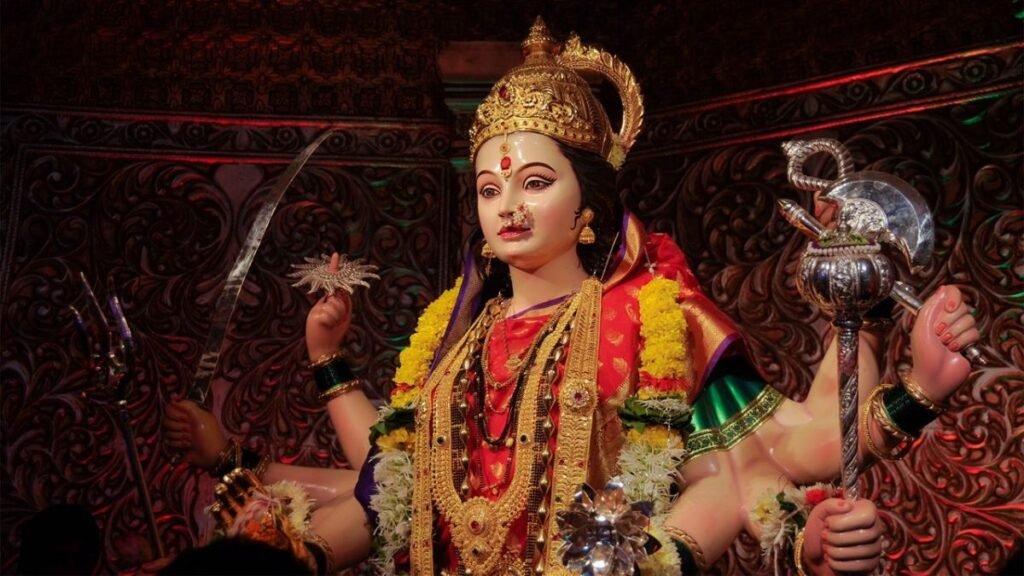
Navratri the nine-night festival dedicated to the Divine Mother is the most important and most attended annual event at the Rajpara Khodiyar Mandir. In Gujarat, Navratri is the most celebrated festival of the year, and for a Shakti temple dedicated to a warrior goddess who is the Kuldevi of so many communities, the devotional intensity of Navratri is particularly concentrated. The temple is decorated with flowers and lights. Garba and Dandiya are performed in the temple grounds. The queue for darshan extends for many hours on the nine nights of Navratri.
Chaitra Navratri – The Spring Festival
Chaitra Navratri the Navratri of the Chaitra month (March-April), as opposed to the more widely celebrated Ashvin Navratri of autumn is also a significant festival at Rajpara Khodiyar Mandir. For many devotees, Chaitra Navratri has a particular connection to specific Kuldevi worship traditions. The spring Navratri at Khodiyar Mandir is one of the major events of the pilgrimage calendar for the Gohil Rajput community and others for whom the goddess is their ancestral deity.
Khodiyar Maa Festival
The specific festival dedicated to Khodiyar Maa observed on a date in the Hindu calendar associated with her birth or her primary manifestation is the most concentrated celebration of the goddess’s specific identity. The precise date varies each year according to the Hindu calendar. During this festival, the temple is at its most devotionally intense and the crowds are among the largest of the year.
Saturdays – Weekly Pilgrimage Days
Saturday is traditionally the most auspicious day for Shakti goddess worship in the Hindu calendar associated with the powerful Devi tradition and with the principle of overcoming obstacles. Khodiyar Mandir is significantly more crowded on Saturdays throughout the year, with pilgrims from Bhavnagar, surrounding districts, and even from Ahmedabad making the weekly journey. If you want a quieter, more contemplative darshan, a weekday morning is preferable to Saturday.
Best Time to Visit Khodiyar Mandir Rajpara
October to February – Best Season
The winter months offer the most comfortable pilgrimage conditions. Bhavnagar district temperatures from October to February are pleasant 18 to 27 degrees Celsius and the Tataniya Dharo lake is at a beautiful level after the monsoon rains. The morning light on the lake and the temple complex in November and December is particularly beautiful. Weekday morning visits in this period give the most peaceful darshan experience.
Navratri – For the Festival Experience
Ashvin Navratri (September-October) is the peak pilgrimage season at Khodiyar Mandir. If experiencing the temple at its most festively alive with the full community of Bhavnagar’s Khodiyar devotees gathered, Garba in the temple grounds, the nine nights of continuous celebration this is the season to visit. Plan all logistics: accommodation in Bhavnagar city (16 km away) if the dharamshala is full, early arrival for shorter queues on the Navratri nights, and an awareness that the road between Bhavnagar and Rajpara will be busier than usual.
Early Morning – Always Best
Regardless of season, the early morning darshan session arriving by 6:00 to 6:30 AM is the most peaceful and spiritually concentrated time at Rajpara Khodiyar Mandir. The dawn atmosphere at the lake, the morning prayers, and the first darshan of the day have a quality that the busier midday and afternoon visits cannot replicate.
How to Reach Khodiyar Mandir, Rajpara
| From | Distance | Mode | Approx. Time |
| Bhavnagar city | ~15–16 km | Car / Auto / Bus (Bhavnagar-Rajkot Highway) | 25–30 minutes |
| Sihor town | ~6 km | Car / Auto / Bus | 10–15 minutes |
| Sihor Railway Station | ~6 km | Train + Auto | 15 minutes from station |
| Bhavnagar Airport | ~22 km | Taxi | 35 minutes |
| Palitana (Shatrunjaya) | ~60 km | Car | 1.5 hours |
| Ahmedabad | ~170 km | Car / Bus | 3.5 hours |
| Rajkot | ~155 km | Car / Bus | 3 hours |
| Vadodara | ~215 km | Car | 4 hours |
The temple is located on the Bhavnagar-Rajkot Highway just before Rajpara village. Navigate to ‘Khodiyar Mata Mandir, Rajpara, Bhavnagar’ on Google Maps. From Bhavnagar city, the drive takes approximately 25 to 30 minutes. Regular ST buses from Bhavnagar city and Sihor run to Rajpara. From Sihor Railway Station (~6 km), auto-rickshaws are available to the temple.
Nearby Attractions to Combine with Khodiyar Mandir
- Palitana and Shatrunjaya Hill ~60 km | The most sacred Jain pilgrimage in the world — 863 temples on two summits of Shatrunjaya Hill. Combining Khodiyar Mandir (Bhavnagar Hindu pilgrimage) with Palitana (Jain pilgrimage) in a single Bhavnagar district day covers the full range of the region’s sacred landscape. Read our full TravelRoach guide.
- Nishkalank Mahadev Temple, Koliyak ~40 km via Bhavnagar | The extraordinary sea temple accessible only at low tide. One of Bhavnagar district’s most remarkable spiritual destinations. Read our full TravelRoach guide.
- Hastagiri Jain Tirth ~60 km | The tallest Jain temple in Gujarat, connected to the story of Bharat Chakravartin and located in the Bhavnagar district hills. Read our full TravelRoach guide.
- Bhavnagar city ~15–16 km | Nilambag Palace (heritage hotel), Takhteshwar Temple (hilltop Shiva temple with views of the Gulf of Khambhat), Gaurishankar Lake. Good for accommodation and dining before or after the temple visit.
- Sihor ~6 km | The ancient town that was once the capital of Bhavnagar state — the same Sihor that the Maharaja was trying to reach when Khodiyar Maa stopped at Rajpara. Worth a brief visit to understand the historical geography of the founding legend.
Practical Tips for Visiting Khodiyar Mandir
- Remove footwear at the temple entrance – footwear storage is available; carry a cloth bag for your shoes if doing a long visit.
- Dress modestly – covered shoulders and knees; women should carry a dupatta for covering the head inside the main sanctum.
- Early morning visit (6:00 AM) – for the most peaceful darshan, free of the weekend and festival crowds.
- The Bhojnalaya is open daily – take the free meal, which is both practically useful (Rajpara village has limited dining options) and spiritually meaningful as an act of community eating at a sacred site.
- Book dharamshala accommodation in advance – especially for Navratri and the spring Navratri periods. Contact the Trust directly for current availability and booking.
- Online live darshan is available – useful for verifying current festival darshan timings and special programmes before your visit.
- Saturdays are the busiest non-festival day – if you want a quiet visit, Tuesday to Thursday mornings are ideal.
- Combine with Palitana for a complete Bhavnagar pilgrimage day – Khodiyar Mandir in the early morning, drive to Palitana for the Shatrunjaya Hill climb in the late morning, and return to Bhavnagar in the evening.
Frequently Asked Questions (FAQs)
Khodiyar Mata Mandir at Rajpara, approximately 15 to 16 km from Bhavnagar on the Bhavnagar-Rajkot Highway, is one of the five most important temples dedicated to Goddess Khodiyar Maa in Gujarat. It is famous as the Kuldevi (ancestral deity) temple of the Gohil Rajput community (Bhavnagar’s royal family) and is widely revered as a Lokdevi (goddess of the people) across Gujarat. The temple stands on the scenic banks of the Tataniya Dharo freshwater lake and was formally established in 1911 CE. The founding legend in which Maharaja Wakhatsinhji broke his promise not to look back while Khodiyar Maa was following him, and the goddess stopped at this exact spot is one of Saurashtra’s most beloved devotional stories.
Khodiyar Maa is a warrior goddess worshipped widely across Gujarat, Rajasthan, and parts of Maharashtra. She is believed to have taken human birth around 700 CE in the Saurashtra region, as one of the seven daughters of Mamiya Gadhvi (Mamad Ji Charan) blessed by Lord Shiva and Nagdev. Her name Khodiyar means ‘lame’ in Gujarati, and she is worshipped as a goddess who possesses extraordinary power and compassion despite or through her own physical limitation. She is the Kuldevi (ancestral goddess) of the Gohil Rajput community, the Charan community, and many other Saurastrian lineages. Devotees worship her for protection, fulfilment of vows (Manat), prosperity, and the removal of obstacles.
The founding legend of the Rajpara Khodiyar Mandir centres on Maharaja Wakhatsinhji Gohil of Bhavnagar state (late 1700s/early 1800s). As a devoted follower of Khodiyar Maa, he asked the goddess to follow him from her distant shrine to the capital Sihor, so she would be closer to his kingdom. The goddess agreed on one condition: he must not turn back to check if she was following. They walked through the night, the Maharaja ahead, the goddess behind her footsteps and anklets audible throughout. A few kilometres from Sihor (at Rajpara), the sounds suddenly ceased. The Maharaja, overcome by doubt, turned around. The goddess stopped exactly where she was and declared she would go no further. The temple was built at the spot where she stopped.
Khodiyar Mandir at Rajpara is open for darshan from 6:00 AM to 8:00 PM daily. Entry for darshan is completely free. The earliest morning session arriving by 6:00 to 6:30 AM is the most peaceful and is recommended for devotees seeking a quiet, contemplative darshan. During Navratri and major festivals, the temple operates with extended darshan hours. Saturdays are the busiest non-festival day; weekday morning visits are significantly quieter. Online live darshan is available for those who cannot visit in person.
From Bhavnagar city, Khodiyar Mandir at Rajpara is approximately 15 to 16 km about 25 to 30 minutes by car or bus on the Bhavnagar-Rajkot Highway. Regular ST buses and shared vehicles run from Bhavnagar to Rajpara. From Sihor Railway Station (~6 km from the temple), auto-rickshaws are available to the temple. From Bhavnagar Airport (~22 km), taxis can take you directly to the temple. Navigate to ‘Khodiyar Mata Mandir, Rajpara, Bhavnagar’ on Google Maps for accurate directions.
Yes – the Shree Rajpara Khodiyar Mandir Trust provides both free meals and accommodation. The Bhojnalaya serves free vegetarian meals for up to 3,000 people at a time, every day. The Trust’s Dharamshalas offer two options: 4 large halls with approximately 100 beds, and approximately 50 AC and Non-AC private or semi-private rooms. Advance booking is recommended for rooms, particularly during Navratri and festival periods. The Trust also maintains an on-site medical facility with a hospital, doctors, and an ambulance.
Yes – this is one of the most rewarding pilgrimage combinations in Bhavnagar district. Khodiyar Mandir (15 km from Bhavnagar) and Palitana (60 km from Khodiyar Mandir) can be combined in a single full day. The suggested sequence: arrive at Khodiyar Mandir by 6:30 AM for the morning darshan and free breakfast at the Bhojnalaya; drive to Palitana by 9 AM and begin the Shatrunjaya Hill climb; complete the temple circuit and descend by 1 to 2 PM; return to Bhavnagar or drive back toward Ahmedabad in the afternoon. This gives you both the Shakti pilgrimage of Khodiyar Maa and the Jain pilgrimage of Shatrunjaya in the same extraordinary day.
Final Thoughts
The legend of Khodiyar Maa and the Maharaja is, at its heart, a story about the limits of human faith. A king who loved the goddess enough to invite her into his kingdom, who walked through the night with her following behind, who was tested by silence and who, in the last few kilometres, looked back. The goddess stopped. The temple was built not in the capital but in the village where faith faltered.
There is a theological wisdom in this outcome. The most sacred places are sometimes not the most grand locations, not the capital cities, not the centres of power. They are the places where something happened where a promise was almost kept, where a divine being chose to stay because the moment made it right.
Khodiyar Maa chose Rajpara. The lake is beautiful. The temple is magnificent. The free meals feed three thousand people every day. An ambulance waits for whoever needs it. The goddess who is lame, who chose limitation, who stopped at a specific spot on a highway in Saurashtra she has been there since that night, 200-plus years ago, and she is not going anywhere.
Come for the darshan. Stay for the lake view. Eat at the Bhojnalaya. And as you drive back toward Bhavnagar on the highway, look once at the temple through your rear window. You have permission.
Have you visited Khodiyar Mandir at Rajpara? Share your darshan experience, your Navratri memory, or the moment the lake view stopped you in the comments TravelRoach would love to hear from every Bhavnagar pilgrim.
