In the sacred geography of Jainism, few landscapes carry more spiritual weight than the hills of Bhavnagar district. Palitana and its Shatrunjaya Mahatirth is the most famous 863 temples on a single hill, one of the holiest places on earth for the Jain faith. But nearby, less visited and less known, there is another sacred hill that the Jain tradition connects directly to the very beginnings of the faith itself: Hastagiri.
Shri Hastagiri Jain Tirth also known as Hastisengiri sits in the hills of Bhavnagar district, approximately 25 km from Palitana and 51 km from Bhavnagar city. This is the hill where Bharat Chakravartin, the eldest son of Bhagwan Rishabhdev (the first Jain Tirthankara) and India’s first emperor, is believed to have attained salvation. This is the hill that is named after his elephant, who also attained moksha here alongside its master. And this is the hill where, in 1979, an extraordinary octagonal Jain temple was consecrated a temple taller than the tallest Jain temple of Taranga, with carvings that rival the celebrated Dilwara temples of Mount Abu.
This TravelRoach guide covers the tirth’s mythology and history, the architectural marvels of the main temple, the ancient footprint shrine, the panoramic views of Shatrunjaya and Kadamgiri, pilgrimage rules and darshan information, how to reach, facilities for pilgrims, and all nearby Jain tirths in Bhavnagar district.
Hastagiri Jain Tirth – Quick Information
| Detail | Information |
| Full Name | Shri Hastagiri Jain Tirth (also Hastisengiri Tirth) |
| Also Known As | Hastisengiri ‘Hasti’ = Elephant, ‘Giri’ = Mountain (Elephant Mountain) |
| Location | Near Jalia (Amaraji) Village, Bhavnagar District, Gujarat PIN 364270 |
| Deity | Bhagwan Rishabhdeva (Adishvar) First Jain Tirthankara |
| Significance | Kalyanak Bhumi (Salvation Ground) of Bharat Chakravartin son of Bhagwan Rishabhdev |
| Main Temple Built | 1979 (consecrated on Shukla Shashti of the Vikram Samvat era) |
| Temple Area | 9 acres |
| Temple Structure | Four-mouthed (Chaturmukha) octagonal Jain temple the tallest in Gujarat, taller than Taranga |
| 72 Devkulikas | 72 smaller shrines around the main temple one for each Tirthankara tradition |
| Main Idol | Four-faced white marble idol of Bhagwan Adishvar facing four cardinal directions |
| Ancient Shrine | Small ancient temple on the original hill with foot-idols (Charan Paduka) of Bhagwan Adishvar |
| Part of | 38 km circumambulatory Parikrama of Mt. Shatrunjaya |
| Entry Fee | No entry fee Jain tirth is free to visit |
| Darshan Timings | Approximately 6:00 AM – 12:00 PM and 3:00 PM – 7:00 PM (confirm locally) |
| Distance from Palitana | ~16 km from Palitana Railway Station; ~25 km from Palitana town |
| Distance from Bhavnagar | ~51 km (~1.5 hours by road) |
| Distance from Ahmedabad | ~215 km (~3.5–4 hours via Bhavnagar) |
| Nearest Railway Station | Palitana (~16 km); Bhavnagar (~51 km) |
| Nearest Airport | Bhavnagar Airport (~51 km) |
| Contact (Pedhi) | 02848-284101 |
| Facilities at Jalia Village (Base) | Dharmashalas, Bhojanalayas, Upashray (monk accommodation) |
The Sacred Story – Why Hastagiri is Called Elephant Mountain
Bhagwan Rishabhdev and the Shatrunjaya Sacred Geography
In Jain cosmology, Bhagwan Rishabhdev also called Adishvar holds a position of extraordinary significance. He is the first Tirthankara of the present cosmic cycle the founder and teacher of the Jain path of liberation in this era. He is also, according to Jain tradition, the figure who taught humanity the arts of civilisation: farming, weaving, writing, mathematics, and governance. The Jain texts refer to him as both the first spiritual teacher and the founding father of human civilisation.
The sacred hills of Bhavnagar district Shatrunjaya above Palitana, and Hastagiri are deeply connected to Bhagwan Rishabhdev’s spiritual biography. According to Jain tradition, Shatrunjaya Hill is the most sacred mountain in the world for Jains, and Hastagiri is part of this sacred geography a peak of the same holy complex where events of cosmic spiritual importance took place.
Bharat Chakravartin – Emperor, Son, Pilgrim
Bharat Chakravartin was the eldest son of Bhagwan Rishabhdev and, according to Jain and Hindu scriptural traditions, the first Chakravarti (universal emperor) of India the king from whom the name Bharat (one of India’s names for itself) is derived. He ruled an empire of extraordinary extent and power, possessing the fourteen ratnas (divine treasures) of a Chakravarti.
Despite his worldly glory, Bharat Chakravartin was a deeply spiritual being. After learning from his father Bhagwan Rishabhdev, he too sought liberation from the cycle of birth and death. According to Jain tradition, he came to this sacred hill then known as Hastisengiri to perform Santhara, the Jain practice of fasting unto death as a path to moksha, having renounced all worldly attachments.
The Elephant That Attained Salvation
The story that gives the hill its name is deeply moving. When Bharat Chakravartin arrived at this hill and began his Santhara, his royal elephant his devoted companion through the years of his reign refused to leave his side. The elephant too remained, fasted, and when Bharat Chakravartin attained moksha (final liberation), the faithful elephant also attained salvation alongside him.
This story of an animal’s devotion so deep it transcended species and cosmic cycle became the defining narrative of the hill. The hill was named Hastagiri: Hasta (elephant) + Giri (mountain). The elephant’s moksha from this hill is considered one of the most profound examples in Jain tradition of the universality of liberation that moksha is not exclusively human, but available to any soul that has sufficiently purified its karma.
The Ancient Footprint Shrine
After Bharat Chakravartin attained salvation here, his footprints (Charan Paduka) and by extension the presence of his soul on this hill became objects of deep veneration. A small ancient temple on the original hill enshrines these foot-idols of Bhagwan Adishvar (Rishabhdev), preserving the connection to the first Tirthankara. These footprint-idols are among the oldest sacred objects at the tirth and are venerated with particular reverence by pilgrims who make the effort to climb to this ancient hilltop shrine. When you stand before them, you are standing in the presence of an object that Jain tradition connects to the very first moments of the faith in this cosmic cycle.
Also Read: Mahuva Beach Bhavnagar
The Temple Complex – Architecture and What to See
The Main Temple – Four-Mouthed, Octagonal, the Tallest in Gujarat
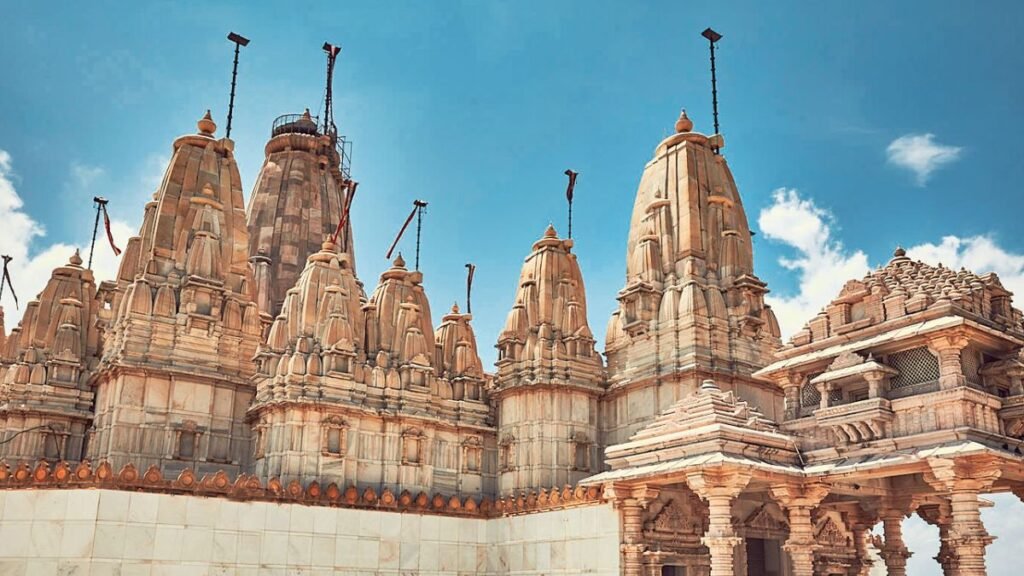
The crowning jewel of Hastagiri Jain Tirth is the magnificent main temple consecrated in 1979 a structure of extraordinary ambition and achievement that represents the devotion of Shri Kantibhai Manibhai of Mumbai (originally from Patan), who dedicated himself to bringing this tirth to its current glory under the spiritual guidance of Acharya Vijayramachandrasurisavarji Maharaj Saheb and Mahatungasurisvarji Maharaj Saheb.
The temple is octagonal in plan and four-mouthed (Chaturmukha) in design meaning it has four entrances facing the four cardinal directions, and the principal idol inside faces all four directions simultaneously. It spreads across 9 acres of hill land, with three separate hill-forts (kotas) forming the fortified sections of the complex, and a magnificent lecture hall that adds a teaching dimension to the place of worship.
Most significantly for the Jain world: this temple is taller than the tallest Jain temple of Taranga making it the tallest Jain temple in Gujarat. This is not just an architectural claim; it reflects the extraordinary scale of devotion that went into its construction.
The Four-Faced Principal Idol – Bhagwan Adishvar
At the centre of the main sanctum stands the Chaturmukha (four-faced) white marble idol of Bhagwan Adishvar the first Jain Tirthankara, carved in pure white and oriented to face north, south, east, and west simultaneously. The four-faced idol represents the omniscient vision of the Tirthankara a being who sees all directions, all times, and all souls with equal compassion and clarity. The idol is described by visitors as simultaneously imposing and serene a quality that characterises the finest Jain marble sculpture.
The Dome – Dilwara-Quality Carvings
The dome above the inner sanctum is the architectural showpiece of Hastagiri’s main temple. The carving density and quality of the stone lattice on this dome has been compared by multiple visitors and temple scholars to the celebrated carved domes of the Dilwara Temples of Mount Abu in Rajasthan widely regarded as some of the finest examples of marble temple sculpture anywhere in the world. This is a significant comparison: the Dilwara domes are among the most intricately worked stone surfaces in human history. That Hastagiri’s craftsmen achieved a comparable level of detail is a testament to the extraordinarily high standards maintained in this construction.
72 Devkulikas – A Shrine for Every Tradition
Surrounding the main temple are 72 devkulikas smaller shrine chambers, one for each of the 72 traditions within the Jain Tirthankar legacy. Each devkulika is a self-contained shrine with its own idol and consecration. Together, they create a complete representation of the Jain devotional universe surrounding the central temple. Walking through the devkulikas before or after the main darshan deepens the spiritual experience considerably.
Three Hill Forts – The Spiritual Architecture of the Hill
The Hastagiri complex includes three hill-forts stone walls and enclosures built at different elevations on the hill, giving the entire tirth a stratified, layered character that reflects the hill’s spiritual topography. Each kot (fort) represents a different level of the pilgrimage the transition from the world below to the sacred space above and devotees pass through each fortified gateway as they ascend.
The Lecture Hall – A Space for Learning
Accompanying the main temple is a large, magnificently designed lecture hall a pratishtha mandap where Jain scholars, monks, nuns, and lay devotees gather for pravachan (spiritual discourse), Agama study (Jain scripture), and community learning. This educational dimension the temple not only as a place of devotional ritual but as a centre of learning reflects the Jain tradition’s deep commitment to knowledge as a path to liberation.
The Ancient Hill Temple – Bhagwan’s Footprints
Separate from the 1979 temple complex is the ancient hilltop shrine that predates the modern construction by centuries a small, quiet temple that enshrines the Charan Paduka (foot-idols) of Bhagwan Adishvar. This shrine is on the very top of the original Hastagiri hill and requires a shorter climb from the main temple complex. For many devoted pilgrims, this ancient shrine where the first Tirthankara’s presence is directly felt is the true heart of the tirth.
The View from Hastagiri – A Spiritual Panorama
One of the exceptional aspects of a Hastagiri visit is what you see from the hilltop. The view from the summit of Hastagiri is one of the most spiritually charged panoramas in all of Gujarat:
- To one side: The temples of Shatrunjaya Mahatirth at Palitana the silhouette of 863 temples on the distant sacred hill, the most holy Jain pilgrimage site in the world. Seeing Shatrunjaya from Hastagiri is to see the sacred geography of Jainism laid out before you in a single frame.
- To the other side: Mt. Kadamgiri another significant Jain tirth in Bhavnagar district (~42 km from Hastagiri), visible on the horizon.
- Below: The Shatrunjaya River (Shetrunjaya) and the Shatrunjaya Dam/Reservoir the sacred river that flows through Jainism’s holiest landscape, reflecting the sky between the hills.
- The Saurashtra plains spread out in every direction farmland, small villages, and the distant blue of the Arabian Sea on clear winter mornings.
This panoramic view two sacred Jain hills, a sacred river, and the vast Saurashtra landscape is unique in all of Gujarat. No other single viewpoint in the state allows you to simultaneously see Shatrunjaya and Kadamgiri while standing on a third sacred hill. It is the visual equivalent of standing at the centre of Jainism’s greatest sacred geography.
The Pilgrimage Experience – Darshan, Devotion, and the Parikrama
Darshan at Hastagiri
Darshan (sacred viewing) at Hastagiri follows the standard Jain temple protocol. Upon arriving at the tirth complex, remove your footwear and store them in the facilities provided. Wash your hands and feet before entering the main temple. Approach the principal Chaturmukha idol of Bhagwan Adishvar with reverence.
The four-faced nature of the idol means that every direction of approach gives you the direct gaze of the Tirthankara. This is intentional the Chaturmukha form symbolises the omniscient awareness of the liberated soul that sees all equally. Spend time in silence before the idol. The atmosphere inside the octagonal sanctum, particularly in the early morning, has a quality of stillness that is difficult to describe except by experience.
Puja and Offerings
Jain puja at Hastagiri follows the Shwetambar Jain tradition. Devotees perform the eight-fold puja (Ashtaprakari Puja) offering water, sandalwood paste, flowers, incense, lamp, rice, fruits, and sweets in a prescribed sequence. Puja materials are available from authorised vendors near the temple premises.
The ancient footprint shrine on the hilltop typically receives simpler offerings sandalwood paste, flowers, and devotional prayers (stavan). Many pilgrims consider the footprint darshan the culmination of their Hastagiri visit.
The Shatrunjaya Parikrama – 38 km Circumambulation
Hastagiri is one of the sacred sites included in the 38-kilometre circumambulatory pilgrimage (Parikrama) of Mt. Shatrunjaya. This parikrama a long walk encircling the entire sacred geography of the Shatrunjaya hills and the associated tirths is one of the most spiritually significant acts a Jain pilgrim can perform in the Bhavnagar district. The route links Palitana’s Shatrunjaya Mahatirth with Hastagiri and other sacred sites into a single continuous act of devotion.
Paryushana and Major Festivals
- Paryushana Parva – The most sacred Jain festival, occurring in August-September (dates vary by year in the Jain calendar). Hastagiri is particularly active during Paryushana, with extended darshan hours, special pujas, and large gatherings of monks, nuns, and lay devotees.
- Mahavir Jayanti – The birth anniversary of Bhagwan Mahavir (24th Jain Tirthankara), typically in March or April. Celebrated at the tirth with processions, special worship, and community gatherings.
- Kartik Purnima – The full moon of the Kartik month (October-November) is an auspicious time for Jain pilgrimage throughout Gujarat. Special activities at Hastagiri during this period.
- Posh Dashami (Magh Dashami) – Auspicious Jain days for visiting temples and performing special pujas.
Visitor Rules and Etiquette at Hastagiri Jain Tirth
Hastagiri Jain Tirth is a place of serious religious observance. The following rules and etiquette are important to respect:
- Remove footwear completely before entering the temple complex. Footwear storage is available at the base.
- Dress modestly wear full-length clothing. Shorts, sleeveless tops, and revealing clothing are not permitted inside the temple area.
- Women should carry a dupatta or headscarf to cover the head when inside the main sanctum.
- Do not bring leather items into the temple premises leather (from animal hides) is not permitted in Jain temples.
- Maintain silence or speak only in a low voice within the temple complex. The sanctum is a place of meditation and worship.
- Do not take photographs inside the main sanctum or while devotees are performing puja. Photography of the exterior and architectural details may be permitted check with temple authorities.
- Non-Jains are respectfully welcome but are expected to observe all the rules above with care and sincerity.
- Do not bring food (including chewing gum) or tobacco inside the temple premises.
- The tirth follows Jain principles only vegetarian, satvik food is available at or near the complex. Non-vegetarian food must not be brought.
Also Read: Nishkalank Mahadev Temple, Bhavnagar
Best Time to Visit Hastagiri Jain Tirth
October to March – Best Season
The winter months provide the most comfortable pilgrimage conditions. The weather in Bhavnagar district is cool and pleasant, the hilltop view is clear, and the ascent is manageable in the morning air. November to January mornings at Hastagiri when the air is cool, the light is golden, and the tirth is quiet are genuinely extraordinary. The panoramic view of Shatrunjaya is clearest in winter when the atmosphere is free of haze.
Paryushana (August to September) – Festival Season
If your purpose is to experience the full devotional atmosphere of Hastagiri, visit during Paryushana the holiest period of the Jain year. The tirth will be busy with pilgrims and monks, special pujas will be performed, and the spiritual energy is at its most intense. The monsoon weather is warm and humid, but the tirth is beautiful in its greenery.
Early Morning Visits – Always Best
Regardless of season, the best time of day at Hastagiri is early morning arriving at the complex gate by 6:30 to 7 AM. The morning aarti-equivalent (mangal darshan) at the main temple is the most spiritually elevated moment of the day. The hilltop at dawn before any significant number of visitors arrives has a stillness and clarity that is deeply conducive to meditation and contemplation.
April to June – Hot, Less Comfortable
Bhavnagar district summers can be intense. The climb to the hilltop and back in afternoon heat is exhausting. If visiting in summer, plan exclusively for early morning arrive by 6 AM and complete your visit before 9:30 AM.
How to Reach Hastagiri Jain Tirth
| From | Distance | Mode | Approx. Time |
| Palitana town | ~25 km | Car / Taxi / Auto | 35–45 minutes |
| Palitana Railway Station | ~16 km | Train + Taxi/Bus | 25 minutes |
| Bhavnagar city | ~51 km | Car / Bus to Palitana + local transfer | 1.5 hours |
| Bhavnagar Airport | ~51 km | Flight + Taxi | 1.5 hours |
| Mahuva | ~60 km | Car | 1.5 hours |
| Talaja | ~50 km | Car | 1 hour |
| Ahmedabad | ~215 km | Car / Bus via Bhavnagar + transfer | 3.5–4 hours |
| Rajkot | ~210 km | Car / Bus | 3.5–4 hours |
| Junagadh | ~175 km | Car | 3 hours |
Step 1 – Reach Palitana or Bhavnagar
By Train: Palitana Railway Station is the nearest station (~16 km from Hastagiri). From Palitana station, hire a taxi or bus to Jalia village at the foot of the Hastagiri hill. Palitana is connected to Bhavnagar, Surat, Vadodara, and Ahmedabad by rail.
By Bus: GSRTC buses run from Bhavnagar, Palitana, and other nearby towns. From the Palitana bus stand, hire local transport to Jalia village.
By Air: Bhavnagar Airport has flights from Mumbai, Ahmedabad, and Surat. From the airport, hire a taxi directly to Hastagiri (~51 km, 1.5 hours).
By Road: Private car or hired taxi from Ahmedabad (~215 km via Bhavnagar), Rajkot (~210 km), or Junagadh (~175 km) is the most convenient option for families and groups.
Step 2 – Jalia Village to the Temple
In Jalia village (Amaraji), at the foot of the Hastagiri hill, you will find dharmashalas, bhojanalayas, and the start of the ascent route. The ascending road on the hill is approximately 3.5 km long and is motorable buses and taxis can drive up to the temple complex directly. There is also a footpath for those who wish to climb on foot as an act of devotion.
Facilities for Pilgrims at Hastagiri Jain Tirth
Accommodation – Dharmashalas
Dharmashalas (pilgrim lodges) are available in Jalia village at the foot of the hill and within the tirth complex itself. These provide clean, basic accommodation primarily for Jain pilgrims making the traditional pilgrimage. Facilities are functional and appropriate for a pilgrimage stay the focus is on comfort for devotion rather than tourist amenities.
Food – Bhojanalayas
Bhojanalayas (dining halls) near the tirth serve pure vegetarian, satvik Jain food prepared without root vegetables (garlic, onion, potatoes, carrots, etc.) in accordance with Jain dietary principles. This is an important distinction for pilgrims: the food follows strict Jain Paryaya (dietary rules) and is prepared with great care. Meals are simple, wholesome, and deeply satisfying after the spiritual exertion of the pilgrimage.
Also Read: Best Cafés in Bhavnagar
Upashray – For Monks and Nuns
Jain monastics sadhus (monks) and sadhvis (nuns) who travel the pilgrimage circuit have dedicated upashray (monk accommodation) in Jalia village and at the tirth. This reflects the significant role of Jain ascetics in the life of a tirth. Lay pilgrims may attend the monks’ pravachan (discourses) and receive spiritual guidance during their stay.
Nearby Jain Tirths to Combine with Hastagiri
Bhavnagar district is the spiritual heartland of Jainism’s most sacred geography in Gujarat. Hastagiri fits naturally into a multi-tirth Bhavnagar pilgrimage that can include:
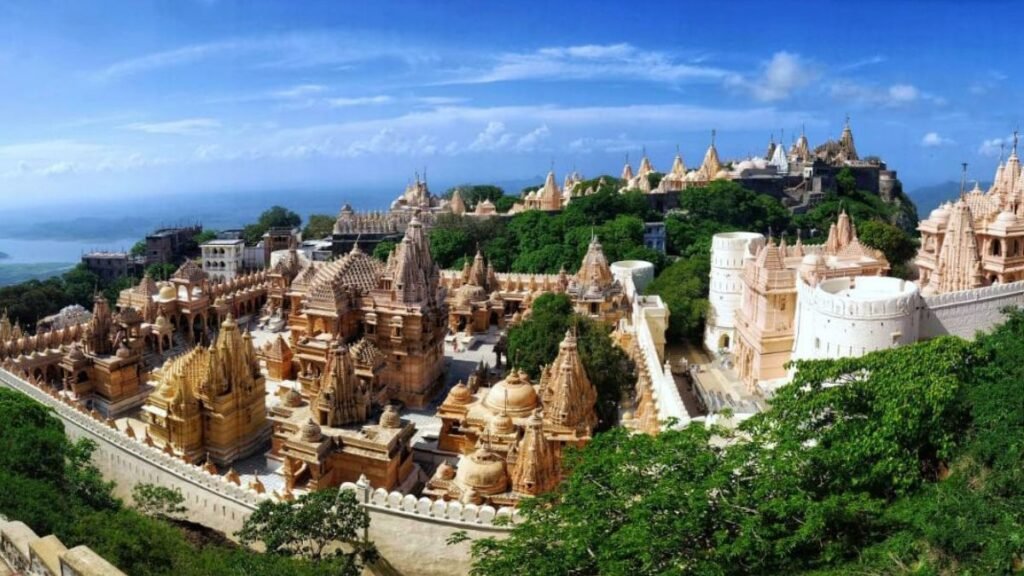
- Shatrunjaya Mahatirth, Palitana ~25 km | The most sacred Jain pilgrimage in the world. 863 temples on two summits of Shatrunjaya Hill. The Adi-Tirth (eternal pilgrimage site) of Jainism, visited by hundreds of thousands of pilgrims annually. Combine Hastagiri and Palitana into a 2-day Bhavnagar Jain circuit.
- Kadamgiri Tirth ~42 km | Another sacred Jain hill in Bhavnagar district. Kadamgiri is included in the Shatrunjaya sacred geography and is visible from Hastagiri’s hilltop.
- Datha Tirth Bhavnagar district | A Jain pilgrimage site in Bhavnagar district worth visiting if doing a comprehensive Bhavnagar Jain circuit.
- Navkhanda Parshwanath Tirth, Ghogha Near Bhavnagar | A Jain temple dedicated to Bhagwan Parshwanath. Located in Ghogha, the ancient port town near Bhavnagar.
- Talaja Tirth ~50 km | Another significant Jain tirth in Bhavnagar district.
- Nishkalank Mahadev Temple, Koliyak ~51 km via Bhavnagar | For those who also wish to visit non-Jain sacred sites, the extraordinary sea temple of Nishkalank Mahadev accessible only at low tide is one of Bhavnagar district’s most remarkable spiritual destinations. Read our full guide on TravelRoach.
Combining Hastagiri and Palitana – The Ideal 2-Day Bhavnagar Jain Itinerary
Most serious Jain pilgrims who visit Bhavnagar district combine Hastagiri and Palitana into a single trip — and this is undoubtedly the most complete and meaningful way to experience the sacred geography of this region.
| Day | Morning | Afternoon / Evening |
| Day 1 — Hastagiri | Arrive at Jalia village. Early morning darshan at the main temple Chaturmukha idol of Bhagwan Adishvar. Descend to the ancient hilltop shrine for Charan Paduka darshan. Absorb the panoramic view of Shatrunjaya. | Return to Jalia village. Visit the 72 devkulikas at leisure. Evening prayers. Overnight stay at dharamshala. |
| Day 2 — Palitana | Pre-dawn wake. Begin the Palitana climb by 5:30 AM. Complete the circuit of the Palitana temples. Descend by midday. | Rest at Palitana dharamshala or hotel. Optional: brief visit to Shatrunjaya Dam viewpoint. Return to Bhavnagar or depart. |
Travel Tips for Visiting Hastagiri Jain Tirth
- Arrive early morning – the first darshan of the day (by 7 AM) is the most spiritually powerful and most peaceful time to visit. The Chaturmukha idol in morning light is breathtaking.
- Combine with Palitana – Hastagiri and Palitana’s Shatrunjaya Mahatirth are ~25 km apart. Both in a 2-day Bhavnagar circuit is the definitive Jain pilgrimage experience in Gujarat.
- No leather – remove all leather items (shoes, bags, belts) before entering the temple premises. Cloth or jute bags are acceptable.
- Dress fully – no shorts, no sleeveless, no revealing clothing. Women should carry a scarf for covering the head inside the sanctum.
- Carry water and light snacks from Jalia village – while the bhojanalayas serve meals, carrying your own water for the hill walk is advisable.
- Comfortable walking shoes are essential – even though the road is motorable, parts of the complex require walking on uneven stone surfaces.
- Pre-book dharamshala accommodation for peak pilgrimage periods – Paryushana, Mahavir Jayanti, and the October-March winter season are busy. Contact the tirth Pedhi at 02848-284101 well in advance.
- If climbing on foot choose early morning for the foot ascent. The path is devotionally rewarding. Carry water. Flat sandals or light trekking shoes work well on the stone path.
- Respect the monks and nuns if you encounter Jain ascetics at the tirth, maintain respectful distance, do not photograph them without permission, and feel free to attend their pravachan (discourses) if invited.
Frequently Asked Questions (FAQs)
Hastagiri Jain Tirth also called Hastisengiri is a sacred Jain pilgrimage site located near Jalia village in Bhavnagar district, approximately 25 km from Palitana. It is significant for three reasons: it is believed to be the hill where Bharat Chakravartin (eldest son of Bhagwan Rishabhdev, the first Jain Tirthankara, and India’s first emperor) attained moksha through Santhara; his royal elephant also attained salvation here, giving the hill its name (Hasti = elephant, Giri = mountain); and the ancient footprints (Charan Paduka) of Bhagwan Adishvar are enshrined in a small hilltop temple. The main temple complex, built in 1979, is the tallest Jain temple in Gujarat, taller than the Taranga temple.
Chaturmukha means ‘four-faced’ in Sanskrit — Chatur (four) + Mukha (face). The main temple at Hastagiri is a Chaturmukha temple because it has four entrances facing the four cardinal directions (north, south, east, west), and the principal white marble idol of Bhagwan Adishvar inside the sanctum is also four-faced — looking simultaneously in all four directions. In Jain theology, the four-faced form of a Tirthankara represents omniscience — the liberated soul’s ability to perceive all directions, all times, and all beings with equal awareness and compassion.
From Ahmedabad, Hastagiri Jain Tirth is approximately 215 km away about 3.5 to 4 hours by road via Bhavnagar. Drive to Bhavnagar (~195 km from Ahmedabad) and then continue towards Palitana, diverting to Jalia village at the Hastagiri turn (~25 km from Palitana). By train, take any service from Ahmedabad to Palitana (via Bhavnagar) and from Palitana station (~16 km from the tirth) hire a local taxi or auto. Palitana town can also be reached by direct GSRTC buses from Ahmedabad.
Bharat Chakravartin was the eldest son of Bhagwan Rishabhdev (first Jain Tirthankara) and, according to Jain and Hindu traditions, India’s first universal emperor (Chakravarti) the king from whom the name Bharat (India’s name in Sanskrit) is derived. At this hill then called Hastisengiri Bharat Chakravartin performed Santhara (fasting unto death) after renouncing all worldly attachments, and attained moksha (final liberation). His royal elephant, refusing to leave his side, remained with him and also attained salvation. The hill was named Hastagiri Elephant Mountain in honour of this extraordinary event.
Yes – non-Jains are respectfully welcome to visit Hastagiri Jain Tirth as long as they observe the temple’s rules with sincerity. This means removing leather items and footwear before entering, wearing modest full-length clothing, covering the head inside the sanctum, refraining from photography inside the main sanctum during worship, maintaining silence or speaking softly, and not bringing non-vegetarian food or tobacco onto the premises. The tirth’s management generally welcomes all visitors who come with genuine respect and curiosity.
The Shatrunjaya Parikrama is a 38-kilometre circumambulatory pilgrimage encircling the sacred geography of the Shatrunjaya hills and the associated Jain tirths in Bhavnagar district. Hastagiri is one of the sacred sites included on this pilgrimage route. The parikrama connects multiple Jain tirths including the Shatrunjaya Mahatirth at Palitana, Hastagiri, Kadamgiri, and other sacred sites — into a single, continuous act of devotion and circumambulation. Completing the full 38-km parikrama is considered a highly meritorious act in Jain tradition.
Hastagiri Jain Tirth generally opens for darshan in the early morning (approximately 6:00 AM) and has a midday break before reopening in the afternoon (approximately 3:00 PM to 7:00 PM). During Paryushana and major festivals, darshan hours may be extended. Since timings can change seasonally and for special events, it is advisable to confirm current darshan times by calling the Pedhi office at 02848-284101 before your visit, especially if traveling from a distance.
Final Thoughts
There are temples you visit because they are famous. And then there are temples you visit because they are true true to the deepest traditions of a faith, true to the landscape that shaped them, true to the stories that give them meaning. Hastagiri is the second kind.
The hill where Bharat Chakravartin the first emperor of India gave up his empire to attain liberation. The elephant who followed him and also found freedom. The ancient footprints of the first Tirthankara enshrined in a small stone temple at the summit. The tallest Jain temple in Gujarat, its dome carved with a delicacy that echoes Dilwara, its four-faced idol looking in all four directions at once. The view across to Shatrunjaya the world’s holiest Jain hill from this quieter, less crowded sacred place.
Hastagiri is not Palitana. It is something different: more intimate, less known, and, in its own way, just as profound. Visit both if you can. If you can visit only one in Bhavnagar district visit Palitana. But do not leave the district without knowing that Hastagiri exists.
