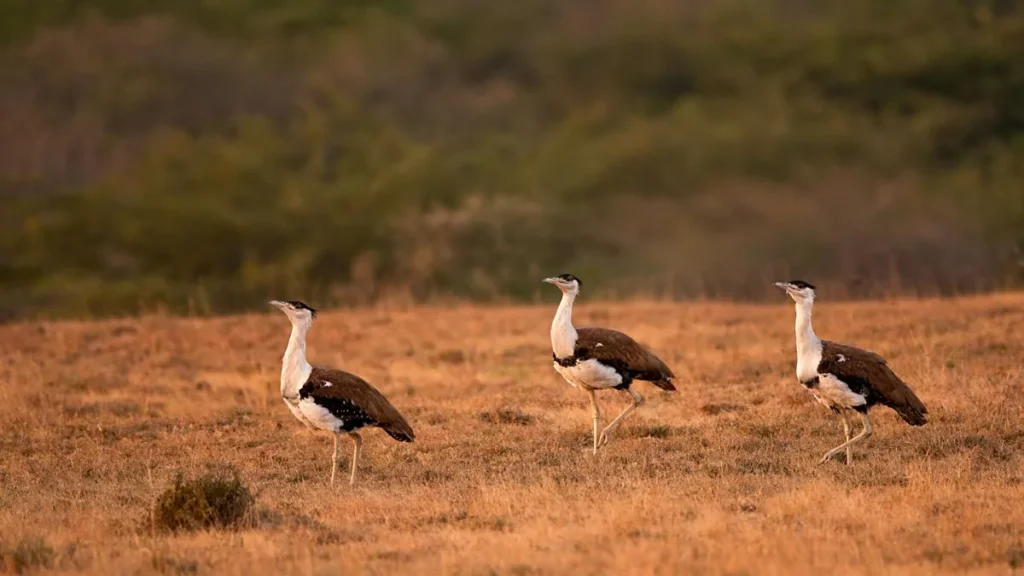
Most travel pages will tell you the Great Indian Bustard Sanctuary in Kutch is a birdwatcher’s paradise where you can watch India’s heaviest flying bird stride across the grassland. Here is the more accurate version:
In 1999 there were around 30 great Indian bustards here. By 2007, protection had pushed that to 45. Then from 2008, windmills and powerlines went up along the sanctuary boundary, and numbers fell. The government has since stated that there are no great Indian bustards left in the Kutch Bustard Sanctuary a claim that has drawn serious pushback from conservationists.
So this guide isn’t a promise of a sighting. It’s an honest account of what the Bird Sanctuary is, why it matters, what you might realistically see in the wider Naliya grasslands, and why the story is worth knowing even if the bird isn’t there.
Quick Facts at a Glance
| Detail | Information |
| Official names | Kutch Bustard Sanctuary; Kachchh Great Indian Bustard Sanctuary; Lala–Parjan Sanctuary |
| Location | Near Jakhau village, Abdasa (Naliya) taluka, Kutch district |
| Established | July 1992 |
| Protected area | ~2.03 sq km (202.86 hectares) of fenced land |
| Distinction | The smallest wildlife sanctuary in India |
| Flagship species | Great Indian bustard (Ardeotis nigriceps), locally “ghorad” |
| Legal status of GIB | Schedule I, Wildlife Protection Act 1972; IUCN Critically Endangered |
| Sister sanctuary | One of two GIB sanctuaries in Gujarat; the other is near Jamnagar |
| Habitat | Semi-desert grassland; average annual rainfall ~384 mm |
| Distance from Naliya | Approx. 20 km |
| Distance from Bhuj | Approx. 110 km |
| Best time to visit | November to March |
| Realistic GIB sighting odds | Extremely low to nil |
Set Your Expectations Honestly
Before you plan a trip, understand what you are and aren’t likely to see.
The population timeline:
- 1999 – around 30 great Indian bustards recorded
- 2007 – up to around 45, following protection measures
- 2008 onward – windmills and powerlines built along the sanctuary borders; numbers begin falling
- Recently – the government has stated there are no GIB in the sanctuary, a claim conservationists dispute
What you can realistically see: The wider Naliya grasslands remain an important habitat, and the area supports raptors including harriers and eagles, vultures, and desert mammals such as wolves, foxes, hyenas and chinkara. Serious birders come here for the grassland assemblage, not for one bird.
Why go anyway: Because standing in India’s smallest sanctuary 2 square kilometres of fenced land created for a bird that may already have gone from it tells you more about Indian conservation than any museum will.
Why the Great Indian Bustard Matters
The ghorad, as it’s known locally, is one of the world’s heaviest flying birds, and among the most endangered.
Four bustard species occur in India: the great Indian bustard, MacQueen’s bustard, the lesser florican and the Bengal florican. The GIB is the largest of them.
Its historic range once covered much of the Indian subcontinent. That range has shrunk to roughly 10 per cent of what it was.
They’re terrestrial birds, spending most of their time walking through grassland, flying only to move between habitat patches. That habit is precisely what makes powerlines lethal a heavy, poorly manoeuvrable bird flying low across open country collides with cables it cannot see in time.
Conservationists describe the GIB as the flagship species of Indian grasslands a barometer for ecosystems that get treated as wasteland and handed over to development because they aren’t forests.
The Kutch story is that argument in miniature A sanctuary of two square kilometres, surrounded by wind farms, protecting a bird whose habitat needs are measured in hundreds.
The Sanctuary Itself: Two Square Kilometres
Here’s the structural problem, stated plainly.
The sanctuary legally protects about 2.03 sq km roughly 203 hectares of fenced land That makes it the smallest wildlife sanctuary in India.
The bustard’s actual ecological requirement is vastly larger. The birds range across the surrounding Naliya grasslands, which are subject to grazing pressure, cattle populations and human use pressures conservationists classify as biotic threats.
Repeated proposals have been made to substantially enlarge the sanctuary. They have not materially changed the picture, and the windmill and powerline development along the boundary since 2008 has compounded it.
Two square kilometres of fence around a bird that needs a landscape. That is the whole problem in one sentence.
What You Might Actually See
Come for the grassland ecosystem rather than the headline species.
Birds of Prey
The Naliya belt is a genuinely notable raptor area harriers, eagles and vultures are the draw, with winter bringing the best numbers. Harrier roosts in Gujarat’s grasslands are a serious birding attraction in their own right.
Grassland and Desert Birds
Larks, coursers, sandgrouse and other dry-country specialists. MacQueen’s bustard and lesser florican are also associated with this broader landscape, though both are scarce.
Mammals
Wolves, desert foxes, striped hyenas and chinkara move through the surrounding scrub and grassland. Sightings are chance-based, but the wolf records make this a notable site.
The Landscape
Semi-desert grassland with an arid climate and meagre, erratic rainfall around 384 mm annually. It looks empty at first glance. Spend a morning and it isn’t.
How to Reach the Sanctuary
The sanctuary sits near Jakhau village in Abdasa taluka, in the far west of Kutch.
By Road
- From Naliya: approx. 20 km Naliya is the nodal town and your practical base
- From Bhuj: approx. 110 km, roughly 2.5 hours
- From Ahmedabad: approx. 450–470 km
Fill fuel in Bhuj or Naliya There’s nothing closer.
By Bus
Naliya is the nearest bus station and runs frequent services. Arrange local transport onward.
By Train
Bhuj Railway Station is the nearest railhead, roughly 110 km away.
By Air
Bhuj Airport is closest, with connections to Mumbai and Ahmedabad.
Practical Note
Take a local guide As with Chhari Dhand, this is open country with limited signage, and a guide from the Naliya area will know where birds are actually being seen this season which matters far more than the sanctuary’s formal boundary. Contact the Kutch forest department before travelling to confirm access arrangements and current conditions.
Best Time to Visit
November to March is the window.
- November–March (Winter) – Best overall. Cool weather, peak raptor and migratory activity, comfortable for long hours in open grassland.
- July–September (Monsoon) – The grassland greens up, but access is unreliable and this is a breeding-sensitive period. Check whether restrictions apply.
- April–June (Summer) – Arid, exposed and severe. Avoid.
Best time of day: Dawn and the last two hours before dusk. Grassland birds and mammals are most active then, and the light is far better for photography.
What to Carry
- A local guide – arranged in advance
- Binoculars – non-negotiable in open grassland
- Spotting scope – if you’re serious about raptors
- Long lens – 400mm minimum
- Food and water – at least two litres per person
- Full fuel tank – from Bhuj or Naliya
- Sun protection – no shade whatsoever
- Warm layers – for pre-dawn starts in winter
- Offline maps and a power bank – signal is unreliable
- A field guide – to Indian birds
- A rubbish bag – carry everything out
Responsible Visiting
For a critically endangered species, ethics aren’t optional.
- Never approach or pursue a bustard if you are extraordinarily lucky enough to see one. Watch from distance, and leave first.
- No playback calls. Ever.
- Don’t publicise precise locations of any sighting on social media. Location data on rare species invites disturbance.
- Stay on tracks. Driving into grassland destroys nesting habitat you can’t see.
- Keep groups small and quiet.
- Respect grazing communities the pastoralists here have used this land for generations, and conservation that ignores them fails.
- Report sightings to the forest department or a recognised body like BNHS rather than to a WhatsApp group.
Where to Eat and Stay
Nothing at the sanctuary. Carry everything.
Naliya (approx. 20 km) – Basic dhabas and Gujarati thali joints, plus simple lodges. This is your closest practical base. Roughly ₹150–300 for two.
Bhuj (approx. 110 km) – The realistic base for most visitors. Kutchi thali houses serving bajra rotla with garlic chutney, plus the local dabeli. Accommodation from budget lodges around ₹1,000 to heritage hotels above ₹5,000.
What to pack: Theplas, khakhra, athanu and dry farsan like gathiya or sev mamra Gujarati travel food is built for exactly this.
Places to Visit Near the Sanctuary
| Place | Why Visit | Best For | Distance |
| Pingleshwar Beach | Quiet golden-sand beach with birdlife and wind farms | Slow travellers | ~20–30 km |
| Jakhau Port | Working fishing harbour, rows of wooden boats | Photographers | ~15–25 km |
| Lakhpat Fort | The 1819 ghost town behind 7 km of walls | Heritage travellers | ~60–70 km |
| Narayan Sarovar & Koteshwar | Sacred lake and India’s westernmost coastal temple | Pilgrims | ~70–90 km |
| Chhari Dhand | Seasonal desert wetland, ~200 bird species | Birdwatchers | ~90–110 km |
| Bhuj | Aina Mahal, Prag Mahal, Kutch Museum | Everyone | ~110 km |
This sanctuary pairs naturally with our Pingleshwar Beach guide the same Naliya grasslands belt appears in both and with the Lakhpat Fort guide for western Kutch heritage. Serious birders should read the Chhari Dhand guide alongside this one; between them they cover Kutch’s two most significant birding landscapes.
Suggested 2-Day Western Kutch Wildlife Itinerary
Day 1: Reach Bhuj → arrange guide and confirm access with the forest department → drive to Naliya, overnight there or continue to Bhuj.
Day 2: Pre-dawn start → Naliya grasslands and the Bustard Sanctuary area for the morning → raptors and grassland birds → Jakhau Port → Pingleshwar Beach for sunset → return to Bhuj.
Frequently Asked Questions (FAQs)
Great Indian Bustard sightings are now extremely rare in Kutch. Visit for the wider grassland ecosystem and other wildlife rather than expecting to see one.
The legally protected sanctuary covers only about 2.03 sq km. The bustard’s wider habitat extends across the surrounding Naliya grasslands.
It is also known as the Kachchh Great Indian Bustard Sanctuary and Lala–Parjan Sanctuary. It is located near Jakhau village, close to Naliya.
Powerline collisions, habitat loss, wind energy infrastructure, and grazing pressure are among the major threats to the species.
Yes, especially for serious birders. The wider Naliya grasslands support raptors, harriers, vultures, wolves, chinkara, and other wildlife.
The sanctuary is around 20 km from Naliya and about 110 km from Bhuj. A local guide is recommended, and access should be confirmed with the forest department before visiting.
Final Thoughts
The Great Indian Bustard Sanctuary in Kutch is two square kilometres of fenced grassland created for a bird that has been pushed to the edge of extinction and possibly out of this sanctuary altogether. Go with a guide, go in winter, and go for the harriers, wolves, and the enormous quiet of the Naliya grasslands. Travel Roach recommends visiting with an understanding of the conservation story, because it is one of India’s clearest illustrations of what happens when grassland is treated as empty land.
If you birded the Naliya grasslands, tell Travel Roach what you recorded and when. And if you saw a ghorad, please report it to the forest department or BNHS rather than posting the location that matters more than the photograph.
