If you’ve been reading about Vadodara, you’ve probably seen Raja Ravi Varma’s name attached to several buildings. This is where his paintings actually are.
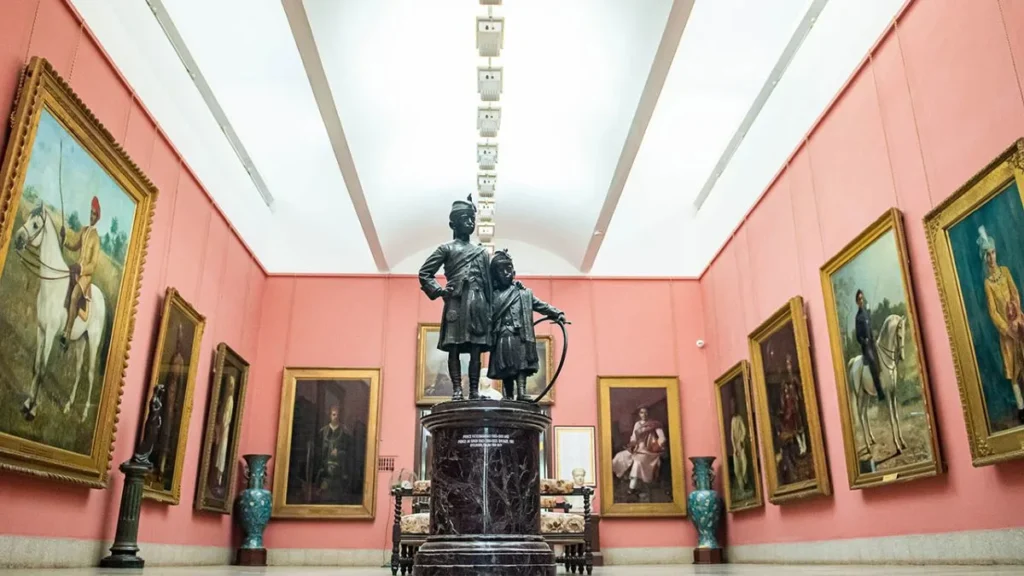
The Maharaja Fateh Singh Museum sits inside the Lakshmi Vilas Palace Estate, in a building that was once the Motibaug School where the Gaekwad princes did their lessons. In 1961 it was converted into a museum, and it now holds what Maharaja Sayajirao Gaekwad III spent decades collecting on his travels: Ravi Varma canvases commissioned directly by the family, European oils, Chinese and Japanese porcelain, Greco-Roman marble, and a royal toy train.
This guide covers what’s inside, timings and tickets (both genuinely inconsistent across sources), the attribution question worth knowing about, and how to pair it with the palace next door.
Quick Facts at a Glance
| Detail | Information |
| Location | Lakshmi Vilas Palace Estate, Jawaharlal Nehru Marg, Vadodara – 390001 |
| Originally | Motibaug School – the school for Gaekwad royal children |
| Converted by | Art historian Dr Hermann Goetz |
| Inaugurated | April 1961, by Gujarat Governor Nawab Mehdi Nawaz Jung |
| Named after | Maharaja Fatehsinghrao Gaekwad |
| Collection assembled by | Maharaja Sayajirao Gaekwad III (1875–1939), on his travels abroad |
| Star attraction | Raja Ravi Varma paintings, commissioned by the Gaekwads |
| Also holds | European oils, marble and bronze sculpture, Chinese and Japanese porcelain, royal artefacts |
| Timings | Roughly 10:00/10:30 AM – 5:00 PM; closed Mondays – see note |
| Entry fee | Reported around ₹150–250 for adults verify |
| Photography | Generally restricted in gallery sections |
| Time needed | 1.5–2.5 hours |
| Distance from Vadodara Junction | Approx. 4–5 km, about 15 minutes |
Timings and Tickets: Verify Before You Go
Sources disagree on both, so treat published figures as indicative.
Timings reported across sources:
- 10:00 AM – 5:00 PM, Tuesday to Sunday, closed Mondays
- Around 10:30 AM – 5:00 PM
- 9:30/10:30 AM – 5:00/5:30 PM, described as a continuous daytime session rather than a long midday closure
The useful takeaways: it’s a daytime museum with no long afternoon break, and Monday closure is reported worth confirming, because a Monday trip is the easiest way to waste a morning.
Entry fee: One source puts adult tickets in the ₹150–250 range, and even that is hedged. Others don’t state a figure at all.
What to do: arrive mid-morning on a Tuesday-to-Sunday, budget for separate tickets, and confirm at the gate.
The Building: A School Before It Was a Museum
The museum’s origin story is better than most.
The structure was the Motibaug School, built for the education of the Gaekwad royal children. When the family later decided to open the collection to the public, they converted the schoolhouse rather than building new.
The conversion was guided by Dr Hermann Goetz, a serious art historian rather than a decorator, and the museum was inaugurated in April 1961 by the Governor of Gujarat, Nawab Mehdi Nawaz Jung.
Why this matters to a visitor: the galleries are high-ceilinged classrooms and halls, not purpose-built exhibition boxes. Cool, echoing, a little faded. It gives the place a very different feel from a modern museum, and most people find it better for it.
The Collection: What’s Actually Inside
1. The Raja Ravi Varma Paintings
Why it matters: This is the reason to come. Ravi Varma was invited to Baroda and commissioned directly by the Maharaja, producing both mythological compositions and portraits of the royal family. His mythological work the paintings that shaped how modern India pictures its own gods is his most famous output, and seeing canvases the Gaekwads commissioned, hanging in the Gaekwads’ own building, is a genuinely different experience from seeing them in a national collection.
Best for: Art lovers, students, anyone interested in modern Indian art
Tip: Slow down here. Most visitors give the Ravi Varma room ten minutes. Give it thirty.
2. The European Paintings
Why it matters: Sayajirao III collected extensively on his travels through Europe, and the museum holds oils spanning Renaissance and Rococo styles.
Best for: Art enthusiasts
Worth knowing: Some listings name Raphael, Titian and Murillo. Treat those attributions with car see the note below.
3. Marble and Bronze Sculpture
Why it matters: A substantial collection, including originals by renowned artists and bronze copies of great masters commissioned by the Maharaja. The distinction is stated openly in the museum’s own descriptions, which is refreshing.
Best for: Sculpture enthusiasts
4. The Fellicci Works
Why it matters: The Italian artist Fellicci was commissioned by the Maharaja, and his work appears both here and across Lakshmi Vilas Palace itself. Spotting the same hand in both buildings is a nice thread to follow if you’re doing them on the same day.
Best for: Detail-spotters
5. Chinese and Japanese Porcelain, Greco-Roman Marble
Why it matters: The collection’s international reach is the point. A Gujarati prince in the late nineteenth century assembling East Asian ceramics and classical European statuary tells you something about how Baroda saw itself.
Best for: Everyone
6. Royal Artefacts – and the Toy Train
Why it matters: Royal furnishings, weapons, armoury and personal effects give the human dimension. And there’s a royal toy train, which is exactly the kind of detail that makes children remember a museum visit.
Best for: Families
A Note on Attributions
Worth reading if you’re coming specifically for the European collection.
Some travel listings state that the museum holds works by Raphael, Titian and Murillo. These are extraordinary names, and extraordinary claims deserve scrutiny.
What the more careful sources say: the collection includes “copies of great masters in bronze commissioned by the Maharaja and also originals by renowned artists.” That phrasing explicitly distinguishes commissioned copies from originals.
The sensible position: the museum genuinely holds significant European art assembled by a serious collector. Whether specific canvases are originals, workshop pieces, period copies or later reproductions is a question for the museum’s own labelling, not a travel blog.
Who Was Sayajirao Gaekwad III?
The collection only makes sense with the collector.
Maharaja Sayajirao Gaekwad III ruled from 1875 to 1939, and he’s remembered as one of India’s most progressive princely rulers a reformer whose investment in art and education turned Baroda into one of the most enlightened states of its era.
The museum’s holdings came largely from his own travels abroad, acquired with expert advice rather than assembled at random. That shows: the collection is global in taste but rooted in Indian imagery, and it was always intended for public access rather than private display.
The Gaekwad trail in Vadodara runs through three buildings Lakshmi Vilas Palace (where they lived), this museum (what they collected), and Kirti Mandir (where they memorialised their dead). Do all three and you have the whole story.
Practical Visitor Notes
- Photography is generally restricted in the gallery sections. Follow on-site rules and ask before shooting anything.
- Facilities include ticket counters, restrooms and parking within the Lakshmi Vilas Palace complex.
- Allow 1.5 to 2.5 hours. Visitors who budget 45 minutes rush the Ravi Varma rooms, which is the one thing not to rush.
- Combine with Lakshmi Vilas Palace. They’re in the same estate, and the palace tour and museum work as a single half-day block.
- Go on a weekday morning for the quietest galleries.
- Carry cash for tickets don’t assume card facilities.
How to Reach the Museum
The museum sits on Jawaharlal Nehru Marg, inside the Lakshmi Vilas Palace Estate a reportedly enormous compound, often described as around four times the size of Buckingham Palace.
Within the City
Auto-rickshaws, taxis and app cabs all serve it. Ask for Lakshmi Vilas Palace rather than the museum by name.
By Train
Vadodara Junction is roughly 4–5 km away about 15 minutes by auto depending on traffic. It’s one of India’s major railway junctions, with direct connections to Mumbai, Delhi and Ahmedabad.
By Air
Vadodara Airport connects to Ahmedabad, Delhi, Mumbai, Daman and Pune. Ahmedabad is the alternative for wider connections.
By Road
- From Ahmedabad: approx. 110–120 km, about 1.5–2 hours on the expressway
- From Surat: approx. 150–160 km
- From Mumbai: approx. 400–420 km
- From Rajkot: approx. 300–320 km
Parking is available within the palace complex.
Best Time to Visit
October to March is the season for Vadodara generally.
- October–March (Winter) – Best overall, especially if you’re combining with the palace grounds and other outdoor sights.
- April–June (Summer) – Vadodara gets very hot, but this is an indoor museum with high-ceilinged halls. It’s a sensible midday refuge when the city is at its worst.
- July–September (Monsoon) – Fine. Rain doesn’t affect an indoor visit.
Best day and time: Weekday mornings, Tuesday to Friday. Avoid Mondays entirely if the reported closure holds, and expect more visitors at weekends.
Where to Eat Nearby
Vadodara’s food culture is genuinely distinctive and worth planning around.
The city’s signature dishes:
- Sev usal – Vadodara’s defining street dish, spicy and deeply local
- Lilva kachori – seasonal, with fresh green pigeon peas in winter
- Bhakarwadi – the Vadodara version has its own following
- Gujarati thali – several long-established thali houses across the city
Near the palace estate – Cafés and restaurants within a short drive in the surrounding central areas. Roughly ₹400–900 for two.
Alkapuri and Race Course – Vadodara’s modern restaurant and café belt, a few kilometres away.
Mandvi and the old city – The traditional street-food area, and where to go hunting for sev usal properly.
If you’re driving in from elsewhere, our famous foods in Ahmedabad guide is a useful regional primer, and the Surat food joints guide covers the other direction on the Mumbai corridor.
Places to Visit Near the Museum
| Place | Why Visit | Best For | Distance |
| Lakshmi Vilas Palace | The Gaekwad palace, in the same estate do both together | Everyone | Same complex |
| Kirti Mandir | The Gaekwad cenotaph with Nandalal Bose murals | Heritage lovers | ~3–4 km |
| Sayaji Baug (Kamati Baug) | Large public garden with zoo, museum and toy train | Families | ~2–3 km |
| Baroda Museum & Picture Gallery | Inside Sayaji Baug; archaeology and art collections | History readers | ~2–3 km |
| Nyay Mandir | Sayajirao-era courthouse, Indo-Saracenic architecture | Heritage lovers | ~2–3 km |
| Champaner-Pavagadh | UNESCO World Heritage Site | Everyone | ~45–50 km |
Complete the Gaekwad trail with our Kirti Mandir Vadodara guide the dynasty’s memorial, and the third piece of the story alongside the palace and this museum.
Suggested 1-Day Vadodara Art & Heritage Itinerary
9:00 AM – Kirti Mandir (confirm access in advance).
10:30 AM – Maharaja Fateh Singh Museum, right after opening.
12:30 PM – Lakshmi Vilas Palace, same estate.
2:30 PM – Gujarati thali lunch.
4:00 PM – Sayaji Baug and the Baroda Museum.
7:00 PM – Sev usal in the old city.
Frequently Asked Questions (FAQs)
The museum is generally open during daytime hours, with reported timings around 9:30–10:30 AM to 5:00–5:30 PM. Monday closure is commonly reported. Confirm timings before visiting.
Entry fees vary across sources, with adult tickets reported around ₹150–₹250. Check the counter for the latest museum or combined ticket price.
Yes. The museum houses several works by Raja Ravi Varma, including mythological paintings and portraits connected with the Gaekwad royal family.
No. The building originally served as Motibaug School, where the Gaekwad royal children studied. It was later converted into a museum and inaugurated in 1961.
Photography is generally restricted inside the gallery areas. Always check the current rules and follow the signs and instructions given by museum staff.
Plan around 1.5–2.5 hours to explore the collection comfortably. If you also visit Lakshmi Vilas Palace, allow around half a day for both attractions.
Final Thoughts
The Maharaja Fateh Singh Museum in Vadodara is a princely schoolhouse filled with the things a well-travelled Maharaja considered worth bringing home with the Raja Ravi Varma canvases commissioned by the Gaekwads forming the heart of the collection. Visit mid-morning on a weekday, check ticket details separately from Lakshmi Vilas Palace, and give the Ravi Varma galleries enough time to appreciate their details.
Planning a Vadodara heritage trip? Travel Roach helps you discover Gujarat’s historic landmarks, cultural attractions and memorable places to explore.
Which painting stayed with you? Tell us in the comments. If you have visited recently, share the latest timings and ticket price, as published information can vary.
