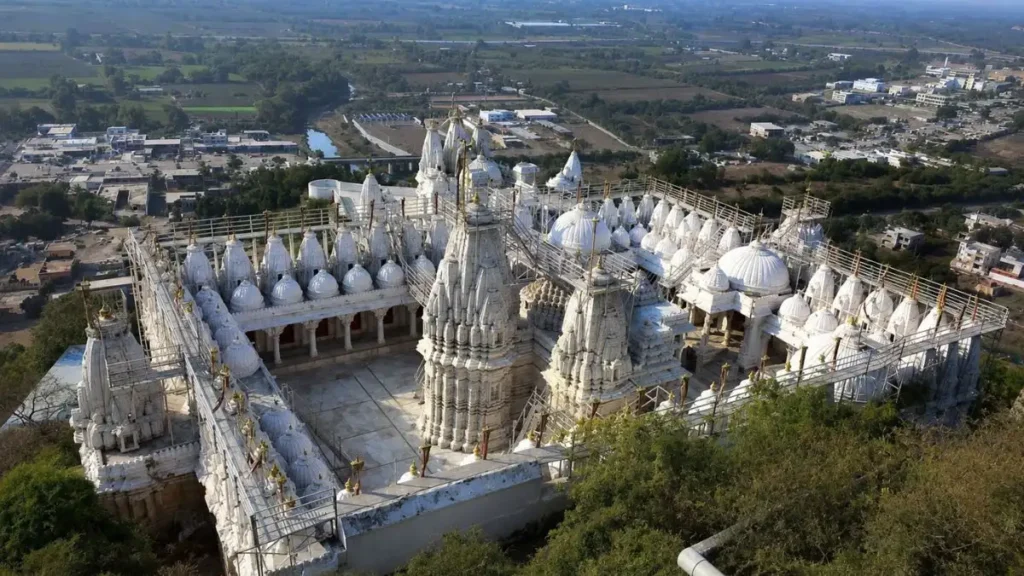
There aren’t many places in India where you can climb a single hill and find a 2,000-year-old Buddhist meditation cave, a 12th-century Jain temple and a Hindu shrine to Khodiyar Mata all on the same rock.
Talaja Hills in Bhavnagar district is one of them.
Around 30 caves were cut into this isolated conical hill, some of them older than the famous rock-cut caves of Maharashtra. Then Jain emblems were carved over the Buddhist cells centuries later. Then temples came. And in the town below, Narsinh Mehta the poet who gave Gujarat Vaishnav Jan To was born.
This guide covers the caves and Ebhal Mandap, the temples, the climb, timings, how to reach, and nearby stops written for heritage travellers, Pilgrims Sites, photographers and anyone exploring Saurashtra beyond the obvious.
Quick Facts: Talaja Hills at a Glance
| Detail | Information |
| Location | Talaja town, Talaja taluka, Bhavnagar district, Gujarat |
| Total caves | Approx. 30 rock-cut caves; around 15–20 are water cisterns |
| Buddhist caves | Around 13, with chaitya windows and Bodhisattva carvings |
| Star attraction | Ebhal Mandap a hall with four octagonal pillars |
| Earliest phase | Commonly dated to the 2nd century BCE (dating is disputed) |
| Jain temple | Shwetambar; attributed to Kumarpala, 12th century |
| Hindu shrine | Khodiyar Mata temple, on the same hill |
| The climb | Roughly 15–20 minutes on foot |
| Entry fee | Free |
| Timings | Approx. 6:00 AM – 6:00 PM (verify locally) |
| Distance from Bhavnagar | Approx. 54 km |
Why Talaja Hills Matters
Most people in Gujarat have never heard of Talaja, and that’s a genuine loss.
These caves were cut into an isolated conical rock during a period of Buddhist influence, with the earliest phase commonly placed around the 2nd century BCE. That makes them older than the celebrated rock-cut caves of Maharashtra the tradition that eventually produced Ajanta, Ellora and Karla. Gujarat’s contribution to that story tends to get skipped entirely.
Then the site changed hands, religiously speaking. Under the Kshatrapas around the 2nd–3rd century CE, Jain emblems were carved onto cells and halls that Buddhist monks had cut centuries earlier. Later came the Jain temple. Later still, the Khodiyar Mata shrine.
That layering is the point. Talaja isn’t a monument to one faith it’s a hill that three traditions used in turn, and the physical evidence of all three is still there to walk through.
What to See at Talaja Hills
1. Ebhal Mandap
Why visit: The single most impressive structure on the hill, and the only cave here with real ornamentation. It’s a large hall carried on four octagonal pillars striking precisely because the rest of the caves are so deliberately plain.
Best for: Heritage travellers, architecture lovers, photographers
Cost: Free
Tip: Give it time. Look at the pillar sections and the way the hall is squared out of solid rock.
2. The Buddhist Caves and Chaitya Windows
Why visit: Around 13 Buddhist caves survive, cut as meditation halls and monastic cells. The facades carry chaitya windows the arched horseshoe openings that define early Buddhist rock architecture and there are carvings of Bodhisattva figures within.
Best for: History readers, students
Note: The interiors are austere by design. These were working monastic spaces, not display halls.
3. The Water Cisterns
Why visit: Of roughly 30 rock cuts, around 15 to 20 were carved as water tanks. That’s not incidental it’s the engineering that made monastic life possible on a dry Saurashtra hill, and it’s the detail most visitors walk straight past.
Best for: Anyone who likes knowing how things actually worked
4. The Jain Temple
Why visit: A Shwetambar temple on the hill, attributed to Kumarpala in the 12th century and renovated in the early 19th. The principal idol is a black stone image of Sacha Sumatinath Bhagwan, roughly 79 cm tall. The site is associated with the Shatrunjay Panchtirthi circuit.
Best for: Jain pilgrims, families
Etiquette: Remove leather items before entering; dress modestly.
5. Khodiyar Mata Temple
Why visit: A Hindu shrine to Khodiyar Mata goddess deeply woven into Saurashtra’s devotional life sitting on the same hill as the caves and the Jain temple. Its presence completes the three-faith picture that makes Talaja unusual.
Best for: Devotees, everyone
Tip: Weekends and festival days bring local crowds; weekday mornings are quiet.
6. Narsinh Mehta’s Birthplace (in the town below)
Why visit: Talaja town is the birthplace of Narsinh Mehta, the 15th-century bhakti poet who composed Vaishnav Jan To Tene Kahiye later Gandhi’s favourite bhajan and, arguably, the most recognised devotional song in Gujarat.
Best for: Literature lovers, Gujarati readers
Manage expectations: There is little to see beyond a marker identifying the site. Come for what it means, not for a museum.
The Climb: What to Expect
The caves sit up the hill, and you’ll walk about 15 to 20 minutes to reach them.
Difficulty: Moderate. Manageable for most reasonably fit visitors, including older children.
Surface: Rock and steps, uneven in stretches.
Shade: Limited. This matters more than people expect.
Practical advice:
- Wear proper shoes. Sandals and slippers are a bad idea on worn rock.
- Go early morning or late afternoon. Midday on an exposed Saurashtra hill is punishing.
- Carry water at least a litre per person. Facilities on the hill are minimal.
- Take your time on the descent. Most slips happen coming down, not going up.
- Elderly visitors and small children may find the temple sections easier to manage than the cave approach.
History: Who Carved What, and When
The Buddhist phase. Monks carved meditation halls, monastic cells, and water cisterns into the conical rock, most commonly dating the work to around the 2nd century BCE. This period features plain halls, chaitya windows, and Bodhisattva carvings. The site also represents a distinct stage in the development of Buddhist cave architecture.
The Kshatrapa reuse. Around the 2nd to 3rd century CE, during Kshatrapa rule, people added Jain emblems to the existing cells and halls. They did not rebuild the site; instead, they reused and re-inscribed the spaces. This later use explains why Buddhist and Jain elements appear together on the same walls.
The temple era. The Jain temple is attributed to Kumarpala in the 12th century, with a documented renovation in the early 1800s. The Khodiyar Mata shrine adds the Hindu layer.
The Bhavnagar chapter. Control of Talaja shifted between rulers through the 18th century before the town was absorbed into Bhavnagar State under Maharaja Vakhatsinhji.
How to Reach Talaja Hills, Bhavnagar
Talaja Hills sits beside Talaja town, roughly midway along the Bhavnagar–Mahuva coastal belt.
By Road (Recommended)
- From Bhavnagar: approx. 54 km, about 1 to 1.5 hours
- From Palitana: approx. 40 km, under an hour the natural pairing for a Jain heritage circuit
- From Mahuva: approx. 43 km
- From Ahmedabad: approx. 250–275 km, roughly 5 hours
- From Surat: approx. 300–330 km via the coastal route
Roads are decent throughout. Talaja works best as a half-day trip from Bhavnagar or a stop on the way to Mahuva.
By Bus
This is the practical public option. Talaja has its own bus depot, and both GSRTC and private buses connect it regularly with Bhavnagar and Palitana. Local transport within town is easy to find.
By Train
Talaja has no working railway station. The old Bhavnagar–Mahuva narrow-gauge line was removed in the early 1990s. Your nearest railheads are Palitana (approx. 40 km), Bhavnagar (approx. 54 km) or Mahuva (approx. 43 km).
By Air
Bhavnagar Airport is the closest, roughly 55–60 km away. Ahmedabad is the alternative for wider connections.
Best Time to Visit Talaja Hills
October to February is comfortably the best window. Saurashtra winters are dry and mild, which matters a great deal on an exposed hill with a climb attached.
- October–February (Winter) – Best overall. Cool mornings, clear light, easy climbing conditions.
- July–September (Monsoon) – The landscape greens up beautifully, but rock surfaces get slippery and the climb needs more care.
- March–June (Summer) – Very hot with minimal shade. Only viable at 6 AM or in the last hour before closing.
Best time of day: Early morning, soon after opening. Cooler air, softer light on the rock faces, and far fewer people on the path.
Where to Eat Near Talaja Hills
Talaja is a small town, so keep expectations local and simple.
Talaja town – Basic Gujarati thali joints and small eateries near the bus depot. Expect roughly ₹150–300 for two. Honest, hot, unfussy food.
What to carry – There’s little on the hill itself. Pack theplas, khakhra and dry farsan like gathiya or sev mamra, plus water. Standard Gujarati travel kit, and exactly right here.
Bhavnagar (approx. 54 km) – Where you’ll eat properly. Kathiawadi thali with bajra rotla, garlic chutney, sev tameta and chhaas, plus a growing café scene.
Palitana (approx. 40 km) – Strictly vegetarian, no onion or garlic in many establishments given the Jain pilgrimage context. Simple satvik thalis.
Planning the Bhavnagar leg? Our top 10 restaurants in Bhavnagar guide covers where to eat after the drive back, and the best cafés in Bhavnagar list is the natural follow-up for an evening coffee.
Places to Visit Near Talaja Hills
| Place | Why Visit | Best For | Distance |
| Palitana (Shatrunjaya Hills) | One of Jainism’s holiest sites – hundreds of temples up 3,500+ steps | Pilgrims, trekkers | ~40 km |
| Gopnath Beach | Quiet clifftop coastline, historically linked to Narsinh Mehta | Couples, slow travellers | ~35–40 km |
| Mahuva | Coastal town known for its beaches and coconut groves | Families | ~43 km |
| Bhavnagar | Takhteshwar Temple, Gandhi Smriti, Victoria Park, Nilambag Palace | Everyone | ~54 km |
| Velavadar Blackbuck National Park | Grassland park famous for blackbuck and harrier roosts | Wildlife lovers | ~90–100 km |
| Alang | The world’s largest ship-breaking yard (viewing restrictions apply) | Curious travellers | ~50 km |
Suggested 1-Day Saurashtra Heritage Circuit
7:00 AM – Leave Bhavnagar.
8:30 AM – Reach Talaja Hills, climb before the heat builds.
10:30 AM – Caves, Ebhal Mandap, Jain temple, Khodiyar Mata shrine.
11:30 AM – Narsinh Mehta’s birthplace marker in town, then thali lunch.
1:30 PM – Drive to Palitana.
3:00 PM – Shatrunjaya temple complex.
7:00 PM – Return to Bhavnagar for dinner.
Frequently Asked Questions (FAQs)
They are famous for ancient rock-cut caves, Buddhist carvings, chaitya windows, and the distinctive Ebhal Mandap.
They are generally dated to around the 2nd century BCE, although scholars debate the exact date.
No, entry is generally free. Local timings should be confirmed before visiting.
The climb takes about 15–20 minutes and is moderately easy for reasonably fit visitors.
The hill was used by different religious traditions over several periods, creating a unique three-faith heritage site.
Yes. It is a good half-day trip for visitors interested in archaeology, history, and religious heritage.
Final Thoughts
Talaja Hills in Bhavnagar district is the kind of site that deserves far more attention than it gets. The hill features caves possibly older than Ajanta, a hall supported by octagonal pillars, and Buddhist, Jain, and Hindu sacred spaces built across the same landscape over two millennia. Visit early, wear sturdy shoes, carry enough water, and take your time exploring the climb.
Have you climbed Talaja Hill? Tell us what struck you most in the comments and share the Saurashtra heritage sites you think deserve more attention. Follow Travel Roach for more inspiring travel guides, hidden gems, and heritage destinations across Gujarat.
