Somewhere along the Jamnagar coast, between two high tides, the Gulf of Kutch exhales. The water pulls back. The seafloor appears not a featureless mudflat but a landscape of extraordinary biological complexity: coral heads in branching and brain and staghorn forms, sea anemones waving their tentacles in the remaining pools, starfish moving on tube feet across the rock, octopus retreating under coral ledges as your shadow falls. You are standing on a coral reef. Without a wetsuit. Without fins. Without an oxygen tank. The sea will return in three and a half hours. Until then, this world that is normally underwater is yours to walk through.
The Marine National Park and Wildlife Sanctuary in the Gulf of Kutch is India’s first marine national park, established in 1982 after the Marine Wildlife Sanctuary was created in 1980. It protects an archipelago of 42 tropical islands along the Jamnagar coastline, 33 of which are surrounded by fringing coral reefs. The park is one of the rare places in the world where the intertidal position of its coral reefs makes them fully visible and walkable at low tide without any diving equipment a phenomenon that occurs because the Gulf of Kutch has some of the largest tidal ranges on India’s coast, exposing the reef at low water to an extent that the rest of India’s coral habitats the Andamans, Lakshadweep, the Palk Bay do not.
This TravelRoach guide covers everything: the park’s history, the unique intertidal ecology, the key islands (Narara, Pirotan, Poshitara, Ajad), the marine life and birdlife, the tidal timing requirement, entry fees, Forest Department permission, how to reach from Jamnagar, and all practical advice for visiting what remains despite being a state secret to most Gujaratis one of the most unusual and most rewarding natural experiences on the Indian coast.
Marine National Park Jamnagar — Quick Information
| Detail | Information |
| Full Name | Marine National Park and Wildlife Sanctuary, Gulf of Kutch |
| Location | Southern shore of the Gulf of Kutch, Jamnagar District, Gujarat |
| India First | India’s first Marine Wildlife Sanctuary (1980) and India’s first Marine National Park (1982) |
| Sanctuary Area | 458 sq km (from Okha to Jodiya) |
| National Park Area | 163 sq km (core area) |
| Established | Sanctuary: 1980 | National Park: 1982 |
| Islands | 42 tropical islands in the archipelago; 33 have coral reefs |
| Key Islands | Pirotan (most famous), Narara (coral walk), Karubhar, Ajad, Poshitara (Positara) |
| What Makes It Unique | Intertidal coral reefs — visible and walkable at low tide WITHOUT diving equipment |
| Coral Species | 52 species (42 hard, 10 soft); finest reefs at Pirotan, Narara, Ajad, Poshitara |
| Marine Mammals | Dugong, Dolphins (Common, Bottlenose, Indo-Pacific Humpback), Finless Porpoise, Whale Shark |
| Sea Turtles | Green Sea Turtle, Olive Ridley, Leatherback |
| Other Marine Life | 70+ sponge species, 27+ prawn species, octopus, starfish, sea cucumber, sea horse, stingray, 3 sea snake species, pearl oysters, jellyfish |
| Birds | 200+ species; Greater Flamingo colony of up to 20,000 nests; Crab Plover, Oystercatcher, Pelicans, Storks |
| Mangroves | 7 species; protect the coast; home to diverse fauna |
| CRITICAL: Tidal Timing | The coral walk at Narara/Poshitara is ONLY possible at low tide check tidal schedule before visiting |
| Tide Information | 4 tides per day; 3.5 hours to reach high tide; coral walk between 2 high tides |
| Entry Fee — Indians | ~₹40 per person (confirm; +25% on weekends/holidays) |
| Entry Fee — Foreigners | ~₹650 per person (+25% on weekends/holidays) |
| Guide Charge | ~₹300 (guide is recommended and may be mandatory) |
| Permission Required | Forest Department permission required; foreign tourists also need Police permission |
| Forest Department Contact | 0288-2679355 | Nagnath Gate, Van Sankul, Ganjiwada, Jamnagar |
| Access Timings | From 5:00 AM (tide-dependent; varies daily) |
| Pirotan Access | Boat from Bedi Port, Jamnagar; check availability and tides |
| Narara Access | By road from Jamnagar (~56 km); on foot at low tide |
| Best Season | October to March |
| Distance from Jamnagar city | ~56 km (to Narara); ~7 km (Jamnagar Airport to city) |
| Distance from Rajkot | ~90 km (~1.5 hours) |
| Distance from Ahmedabad | ~320 km (~5 hours) |
| Nearest Airport | Jamnagar Airport (within the city) |
India’s First Marine National Park — A Conservation Milestone
In 1980, the Government of India and the Gujarat State Government took a step that was genuinely unprecedented in Indian environmental policy: they created India’s first Marine Wildlife Sanctuary, protecting 458 square kilometres of the Gulf of Kutch coastline from Okha to Jodiya. Two years later, in 1982, a core area of 163 square kilometres was specifically designated as a Marine National Park India’s first under the provisions of the Wildlife Protection Act, 1972.
The context for this decision was significant. Coral reefs and mangrove systems worldwide were under increasing pressure from industrial development, fishing, and coastal modification. The 2004 Indian Ocean Tsunami, which struck two decades after Velavadar’s establishment, would dramatically demonstrate the protective role of intact mangrove forests the areas where mangroves had been preserved suffered dramatically less damage than those where they had been cleared. The Gulf of Kutch Marine National Park’s establishment was, in retrospect, prescient conservation policy.
The park protects what the Gujarat Tourism website accurately describes as the richest diversity of marine habitats in the country: saline grasslands, marshy areas, rocky shores, mudflats, creeks, estuaries, sandy strands, coral reefs, and seven species of mangrove all within a single protected area of 458 square kilometres. The archipelago’s 42 islands, the vast majority surrounded by fringing coral reefs, are the park’s architectural backbone.
The Intertidal Zone — Why You Can Walk on the Coral
The Gulf of Kutch’s Exceptional Tides
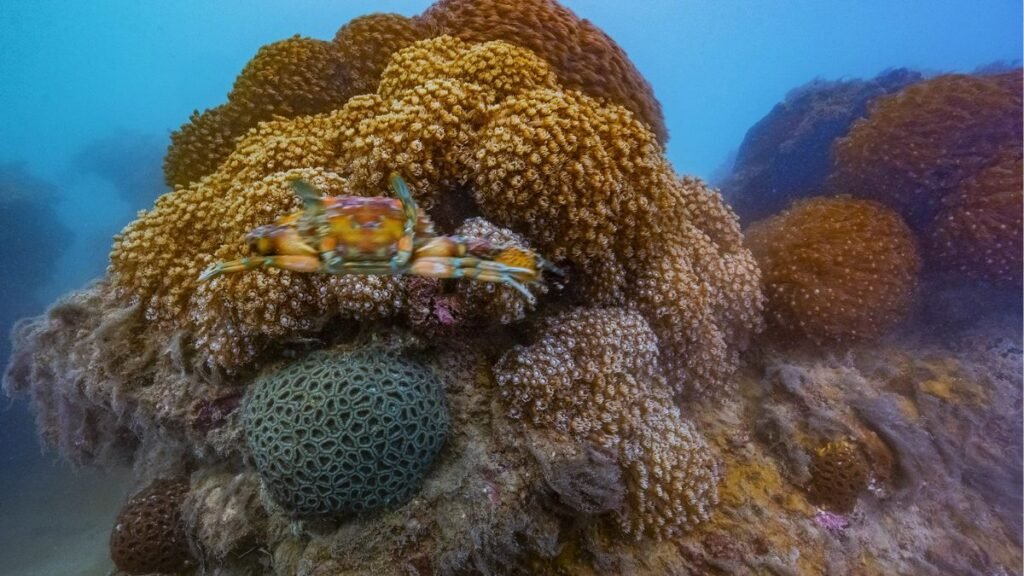
The most singular feature of the Marine National Park in the Gulf of Kutch the one that makes it unlike any other coral reef destination in India is a consequence of geography and tidal physics. The Gulf of Kutch is a funnel-shaped inlet of the Arabian Sea, narrowing from west to east as it extends inland along the Gujarat coast. This funnel shape amplifies the tidal range: as the tide moves from the open ocean into the narrowing gulf, the same volume of water is forced into an increasingly narrow space, producing exceptionally large tidal fluctuations.
The result is that the coral reefs of the Gulf of Kutch are located in the intertidal zone the area of the seafloor that lies below the water surface at high tide and is exposed above the water surface at low tide. This exposure occurs twice daily, for a window of several hours each time, and it is during this window that the coral reefs at Narara, Poshitara, and other intertidal islands can be walked upon and explored without any diving equipment whatsoever.
Walking on Coral — What the Experience Is Like
The coral walk at Narara island, which is the most accessible point for this experience from Jamnagar city, is one of India’s most unusual and most memorable nature encounters. As the tide retreats, the reef emerges from the water gradually first the highest coral heads appearing above the surface, then the broader reef platform becoming walkable as the water level drops further, with residual pools remaining in the depressions of the reef surface.
Walking on an exposed coral reef at low tide is not the same as snorkelling above one. You are moving through the reef at the level of the organisms themselves rather than above them. You can crouch to examine a sea anemone at close range, watch an octopus backing away under a coral ledge, pick your way between brain corals the size of footballs and branching staghorn formations, and observe the starfish and sea cucumbers that inhabit the reef platform in tidal pools left by the retreating sea. The reef is alive in every sense: the colours, the movement, the noise of the water in the pools, the smell of the sea in the exposed air.
This experience is tidal and therefore time-limited. The window between the two high tides the period during which the reef is adequately exposed for walking is finite. The tide will return. The reef will be submerged. This creates a quality of urgency and presence that most nature experiences do not have: you know, while you are there, that the sea is coming back, and that this particular version of the reef walkable, approachable, intimate exists only for these hours.
Also Read: Khijadia Bird Sanctuary, Jamnagar
The Critical Tidal Timing Requirement
The most important practical point for any Marine National Park visit is this: the coral walk is ONLY possible during low tide. The park at Narara and Poshitara is literally inaccessible during high tide the reef is submerged and there is nothing to walk on. The tidal schedule changes daily, and the time of low tide shifts by approximately an hour each day as the lunar cycle progresses.
This means that planning a Marine National Park visit is not like planning a temple visit. You cannot simply decide to arrive on a specific morning. You must first determine when low tide falls on your intended visit date, and then plan your arrival to coincide with the low tide window. Call the Forest Department at 0288-2679355 for current tidal schedules, or check with your accommodation in Jamnagar or with local tour operators. Arriving during high tide, after a 56-km drive, to find the reef submerged and inaccessible is the most avoidable disappointment in Gujarat wildlife tourism.
The Key Islands — 42 Tropical Islands in the Gulf of Kutch
Narara — The Most Accessible Coral Walk
Narara island is the most commonly visited site for the coral walk experience, largely because of its road accessibility from Jamnagar city the 56 km drive is straightforward, and from the Narara coastline, the low-tide coral walk begins directly from the shore without a boat journey. The Narara reef offers excellent examples of the range of coral types found in the Marine National Park, the tidal pool communities that the low-tide conditions support, and the intertidal marine life that makes the Gulf of Kutch reef system so distinctive.
Foreign tourists visiting Narara require both Forest Department permission and Police Department permission begin the permission process well in advance of your intended visit. Indian tourists require Forest Department permission. Contact the Forest Department at 0288-2679355 for current procedures.
Pirotan — The Park’s Most Famous Island
Pirotan Island is the Marine National Park’s most celebrated and most photographed destination accessible by boat from Bedi Port, Jamnagar (confirm current boat availability and schedule with the Forest Department). The island combines the coral reef experience with mangrove forests, sandy beaches, flamingos in shallow coastal waters, hermit crabs moving across the beach sand, and a general visual character that makes it the most complete single-island expression of the Marine National Park’s ecological variety. The boat journey from Bedi Port to Pirotan is itself wildlife-rich dolphins are frequently seen from the boat, and the views of the other islands in the archipelago provide the best spatial sense of what 42 islands across a marine national park looks like from water level.
Ajad and Poshitara — Finest Coral
Among the 42 islands of the Marine National Park archipelago, the finest coral reef fringe formations are found at Pirotan, Narala, Ajad, and Poshitara (Positara) according to Gujarat Tourism’s official information. Poshitara and Narara are specifically noted as being open only during low tide; the entry schedule shifts daily with the tidal calendar. Visitors to these islands will encounter narrow fringing reefs visible from 150 to 300 metres from the island shore, patch reefs that rise from depths of 2 to 9 metres, and reef formations extending up to 2 kilometres in length.
Marine Life — 52 Corals and a World of Tidal Pool Creatures
The Coral
The Marine National Park protects 52 species of coral 42 hard (hermatypic, reef-building) corals and 10 soft (ahermatypic) corals. Among the hard corals, 106 species from 30 genera of hermatypes are documented, representing a diversity that surprises even marine biologists familiar primarily with the better-known coral systems of the Andamans or Lakshadweep. The coral formations include branching corals (elkhorn and staghorn types), massive brain corals, plate corals, and encrusting types the full range of morphological variety that makes a coral reef visually complex.
The polyp communities of these corals the millions of tiny animals whose limestone skeletons collectively constitute the reef structure exist in a relationship with symbiotic algae (zooxanthellae) that gives the coral its characteristic colours and provides the photosynthetic energy that supports the reef ecosystem. The nutrient turnover in a healthy coral reef is equivalent, per unit area, to a tropical rainforest.
Tidal Pool Creatures
The tidal pool communities at low tide are the most immediately accessible and most visually engaging part of the Marine National Park for general visitors. Species commonly encountered in the tidal pools and on the exposed reef surface include:
- Starfish – multiple species, moving on their tube feet across the reef surface at characteristic starfish pace
- Sea cucumber – elongated, leathery echinoderms that process sediment from the seafloor; remarkable animals despite their undramatic appearance
- Sea anemone – tentacled cnidarians attached to rocks and coral surfaces, their tentacles waving in the tidal pool water
- Octopus – highly intelligent cephalopods that use the coral reef structure as cover; often retreating under ledges as visitors approach
- Hermit crab – carrying borrowed shells across the reef platform
- Sea horse -the extraordinarily evolved fish whose upright posture and horse-shaped head make it one of the most distinctive creatures in any coral reef
- Puffer fish -the fish capable of inflating itself to several times its normal size as a defence mechanism
- Stingray – resting in sandy areas between coral formations
- Sea snakes (3 species) -highly venomous but generally non-aggressive; give them space
Also Read: Bet Dwarka
Larger Marine Animals — Beyond the Reef
In the deeper waters of the Gulf of Kutch beyond the intertidal reef, the Marine National Park harbours an impressive community of larger marine animals:
- Dolphins: Common dolphin, Indo-Pacific Humpback dolphin, Bottlenose dolphin, and the unusual Finless porpoise all present in the Gulf; frequently seen from boats to Pirotan Island
- Dugong (Sea cow): One of the most endangered marine mammals in the Indian Ocean; the dugong has been recorded in the Gulf of Kutch Marine National Park a significant record for what is an increasingly rare species on Indian coastlines
- Whale shark: The world’s largest fish, present in deeper Gulf of Kutch waters a gentle filter-feeder of enormous size
- Sea turtles: Green sea turtle, Olive Ridley, and Leatherback turtles all recorded in the sanctuary
- Larger cetaceans: Blue whale, Sei whale, and Humpback whale have been recorded in the Gulf of Kutch waters
Birdwatching at Marine National Park — 200+ Species
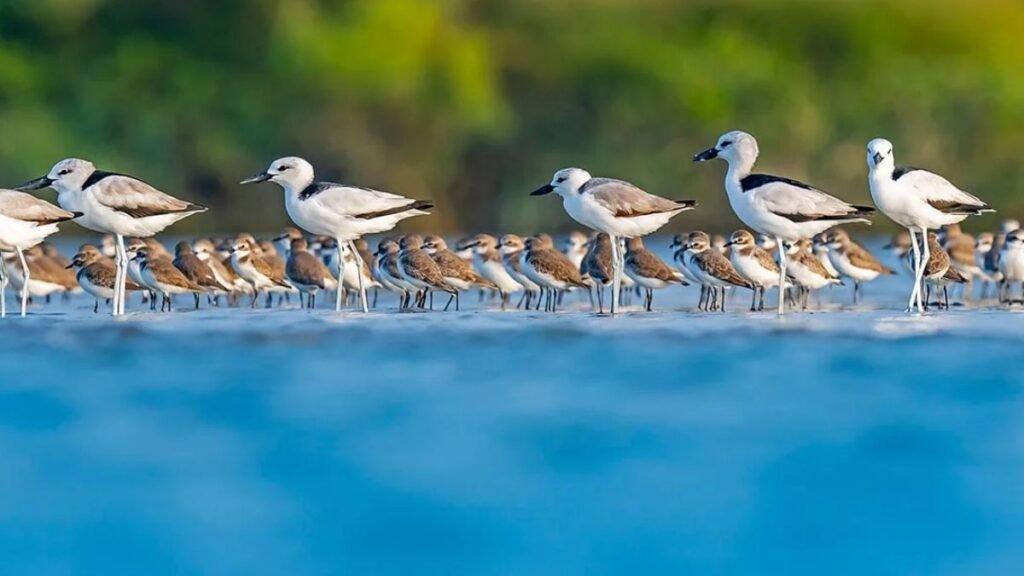
The Flamingo Colony — Up to 20,000 Nests
The Marine National Park and its surrounding Gulf of Kutch coastline support one of India’s largest Greater Flamingo concentrations with colony counts reaching up to 20,000 nesting pairs in some surveys. Flamingos use the shallow tidal flats and mudflats of the Gulf of Kutch as feeding grounds, their distinctive pink colouring visible from considerable distances across the flat coastal landscape. The combination of a flamingo colony at close range, the coral reef underfoot, and the sea birds overhead creates a bird experience that is comprehensive in its diversity and extraordinary in individual encounters.
The Crab Plover — A Regional Speciality
For dedicated birdwatchers, the Crab Plover (Dromas ardeola) is one of the Marine National Park’s most significant species. The Gulf of Kutch is one of the most important wintering grounds for the Crab Plover in India a striking black-and-white wading bird with a massive, deep bill designed specifically for crushing crabs. The Crab Plover is uncommon and localised in its Indian distribution, making any encounter at the Marine National Park a notable sighting.
Coastal and Migratory Waterbirds
The 200+ bird species recorded in the Marine National Park represent a comprehensive cross-section of coastal and migratory waterbird diversity. Regular species include:
- Oystercatcher, sandpipers, godwits, greenshanks, redshanks waders using the mudflats and tidal pools
- Great Egret, Western Reef Egret egrets hunting in the tidal pools at the reef edge
- Brown-headed Gull, Indian Skimmer, various terns aerial hunters using the open water and sandy beaches
- Pelicans (Great White Pelican, Spot-billed Pelican) plunge-diving and swimming fishers
- Painted Stork, White Stork large wading birds in the shallower coastal areas
- Various duck species using the estuarine and shallow marine waters during winter
The Mangroves — Seven Species of Living Coastline
Alongside the coral reefs, the seven species of mangroves in the Marine National Park represent the other critical coastal ecosystem that the park exists to protect. Mangrove trees occupy the interface between the land and sea: their specialised root systems allow them to grow in saltwater, and the tangled network of prop roots and pneumatophores that extends from their trunks creates a structure of extraordinary ecological value.
Mangroves provide nursery habitat for fish and invertebrates, feeding grounds for birds, roosting and nesting sites for herons and egrets, carbon storage at rates that exceed terrestrial forests, and as dramatically demonstrated by the 2004 Tsunami coastal protection against storm surge and wave action. The mangrove destruction and subsequent vulnerability of unprotected coastlines during the 2004 Tsunami was one of the most compelling pieces of evidence for the functional value of this ecosystem. The Marine National Park’s intact mangrove stands protect both the biodiversity and the coastline of the Jamnagar coast.
Best Time to Visit Marine National Park Jamnagar
October to March — Best Overall Season
The winter months provide the most comfortable conditions and the most productive wildlife encounters at the Marine National Park. The weather in Jamnagar from October to February is pleasant 15 to 28 degrees Celsius and the sea conditions in the Gulf of Kutch are calm and clear, giving the best visibility for the intertidal coral walk and for boat journeys to Pirotan Island. The migratory bird influx during this period adds the flamingo concentrations, wintering waders, and the Crab Plover to the bird list. Dolphin sightings from the boat are frequent.
Low Tide Timing — More Important Than Season
For the coral walk, the tidal schedule is more important than the seasonal calendar. The specific time of day when low tide occurs determines when you can access the reef. In winter months (October-March), early morning low tides are common, which aligns well with the practical constraints of visiting the lower temperatures of early morning make the walk more comfortable. But a winter visit at high tide provides no coral walk opportunity, while a summer visit at the right low tide does. Always confirm the tidal schedule for your specific visit date before travelling.
How to Reach Marine National Park, Jamnagar
| From | Distance | Mode | Approx. Time |
| Jamnagar city (to Narara) | ~56 km | Car / Taxi (Narara island road access) | ~1.5 hours |
| Jamnagar Airport (Jamnagar) | ~7 km from Jamnagar city | Taxi + road to Narara | ~2 hours total |
| Bedi Port Jamnagar (for Pirotan boat) | ~10–15 km from Jamnagar city | Car + boat | ~2–3 hours with boat |
| Rajkot | ~90 km from Jamnagar | Car / Bus to Jamnagar + local | ~3 hours total |
| Dwarka | ~130 km | Car | ~2.5 hours + Narara access |
| Ahmedabad | ~320 km | Car / Bus to Jamnagar + local | ~5+ hours total |
| Khijadiya Bird Sanctuary | ~15 km from Jamnagar | Car / Taxi | ~30 minutes from city |
From Jamnagar city: For the Narara coral walk, drive approximately 56 km by private car or hired taxi to the Narara entry point near Vadinar Village. For Pirotan Island: proceed to Bedi Port in Jamnagar and take the boat (confirm current schedule and availability with the Forest Department; boat services may be intermittent). Navigate to ‘Narara Marine National Park’ or ‘Pirotan Island, Jamnagar’ on Google Maps.
Practical Tips for Visiting Marine National Park
- CHECK TIDAL SCHEDULE BEFORE TRAVELLING – this is the single most important advice. Call the Forest Department at 0288-2679355 or contact a Jamnagar tour operator to confirm the low tide time on your intended visit date. Arriving at the reef at high tide means no coral walk is possible.
- Get Forest Department permission in advance – permission to enter the islands is required. Foreign tourists additionally need Police Department permission. Contact the Conservator of Forests at 0288-2679355, Nagnath Gate, Van Sankul, Ganjiwada, Jamnagar.
- Wear sturdy closed-toe sandals or old shoes for the coral walk – some parts of the reef surface are sharp. Bare feet are strongly inadvisable. The shoes will get wet.
- Do not touch, stand on, or collect anything -touching coral kills the living polyps. Collecting shells, dead coral, or any natural material is prohibited and is an offence under the Wildlife Protection Act. Step between corals, not on them.
- Hire a local guide -guides know the reef, know the tidal behaviour, know where specific species (octopus, sea horse, particular coral formations) are most reliably found, and protect both you and the reef from unintended damage. Guide charge approximately ₹300.
- Carry your own water and sun protection – the reef walk is exposed and direct sun with sea reflection can be intense even in winter. Hat, sunscreen, water, and a camera in a waterproof case are the essentials.
- Passport and paperwork for foreign visitors – bring your passport and be prepared to fill out entry forms before entering the park.
Also Read: Okha Madhi Beach, Devbhoomi Dwarka
Nearby Attractions to Combine with Marine National Park
- Khijadiya Bird Sanctuary, Jamnagar ~15 km from Jamnagar city | A Ramsar-designated wetland with 200+ bird species one of India’s finest waterbird sanctuaries. Combining a morning coral walk with an afternoon at Khijadiya creates one of India’s finest single-day nature experiences. Read our full TravelRoach guide.
- Lakhota Lake and Lakhota Palace Museum, Jamnagar In Jamnagar city | The historic palace-museum on an island in Lakhota Lake Jamnagar’s heritage centrepiece. A pleasant cultural addition to a natural day in the city.
- Dwarka and Dwarkadhish Temple ~130 km | The Char Dham pilgrimage city of Lord Krishna the sacred shrine, Bet Dwarka island, and Shivrajpur Blue Flag Beach all within reach for a multi-day Saurashtra circuit. Read our full TravelRoach guide.
- Velavadar Blackbuck National Park ~235 km via Rajkot | The world-record harrier roost and one of India’s largest blackbuck concentrations. A 2-day Jamnagar-Velavadar wildlife circuit covers coral reefs and open grassland India’s two most distinctive coastal wildlife habitats. Read our full TravelRoach guide.
Frequently Asked Questions (FAQs)
Marine National Park and Wildlife Sanctuary in the Gulf of Kutch, Jamnagar, is famous as India’s first Marine Wildlife Sanctuary (1980) and India’s first Marine National Park (1982). It protects an archipelago of 42 tropical islands along the Jamnagar coast, 33 of which are surrounded by fringing coral reefs. The park’s most distinctive feature is its intertidal position: at low tide, the coral reefs are exposed above the waterline and can be walked upon and explored without any diving equipment making it one of the rare places in the world where visitors can see a living coral reef without snorkelling or diving. It hosts 52 coral species, 200+ bird species including a flamingo colony of up to 20,000 nests, dugong, dolphins, whale sharks, and three species of sea turtle.
The coral reefs at Marine National Park Jamnagar are in the intertidal zone the part of the seafloor that lies below water at high tide and is exposed above water at low tide. The Gulf of Kutch’s funnel shape amplifies the tidal range, creating sufficiently large tidal fluctuations to expose the reef platform for several hours at each low tide. During this window, visitors can walk directly on the reef, observe coral formations, tidal pools, starfish, octopus, sea anemones, and other intertidal marine life without any diving equipment. This is the park’s globally distinctive feature most other coral reef destinations in India (Andamans, Lakshadweep) require snorkelling or diving to see the reef.
Checking the tidal schedule is the single most important preparation for a Marine National Park visit. The coral walk at Narara and Poshitara islands is only possible during the low tide window if you arrive at high tide, the reef is submerged and there is nothing to walk on. Low tide occurs approximately twice daily, but the exact times shift by roughly an hour each day as the lunar cycle progresses. Call the Forest Department at 0288-2679355 to confirm the current tidal schedule, or contact Jamnagar tour operators who routinely arrange timed Marine National Park visits around the tidal calendar.
Indian tourists require permission from the Forest Department to enter the Marine National Park islands. Foreign tourists additionally require permission from the Police Department. Contact the Conservator of Forests Office at 0288-2679355, Nagnath Gate, Van Sankul, Ganjiwada, Jamnagar, for current permission procedures, entry fees, and any required documentation. Foreign visitors should also carry their passport and be prepared to fill out entry paperwork before entering the park. Permission processes and procedures are subject to change — contact the Forest Department in advance of your visit.
The Marine National Park’s 42 islands each offer different experiences. Narara is the most accessible for the coral walk 56 km by road from Jamnagar city, then the low-tide walk on the reef surface. Pirotan is the most famous island overall, accessible by boat from Bedi Port in Jamnagar; it combines coral reef, mangrove forest, sandy beach, flamingos, and hermit crabs in the most visually complete single-island experience. Ajad and Poshitara (Positara) are among the islands with the finest coral reef formations. All island visits require Forest Department permission and must be timed to the tidal schedule.
At the tidal reef level (the coral walk): coral formations in branching, brain, staghorn, and encrusting varieties; starfish, sea cucumbers, sea anemones, octopus, hermit crabs, sea snakes (3 species give them space), sea horses, puffer fish, stingrays, and various small reef fish in tidal pools. From boats (to Pirotan and other islands): dolphins (Common, Bottlenose, Indo-Pacific Humpback), Finless porpoise, and occasionally whale sharks. Sea turtles (Green, Olive Ridley, Leatherback) are present in sanctuary waters. The dugong (sea cow) has been recorded in the Gulf of Kutch Marine National Park a globally threatened species. The bird list includes 200+ species, most notably Greater Flamingos (colony of up to 20,000 nests) and the Crab Plover.
Yes, but it requires careful planning. Ahmedabad to Jamnagar is approximately 320 km (~5 hours). A day trip is logistically possible but tightly timed: departing Ahmedabad at 4 AM, arriving at Narara at approximately 9-10 AM, spending 3-4 hours at the tidal reef during the low-tide window, and returning to Ahmedabad by late evening. However, the tidal schedule will not always align with this timing a day trip only works if the low tide at Narara falls in the mid-morning window. Given the distance and the tidal uncertainty, a 1-2 night stay in Jamnagar is strongly recommended, allowing you to choose the low-tide timing that works best rather than being constrained by the drive.
Final Thoughts
Most people visiting Gujarat for wildlife go to Gir for lions. Some go to Velavadar for blackbuck. Fewer go to the Marine National Park in the Gulf of Kutch even though it was India’s first marine national park, even though it has reef walking that most of the world cannot offer, even though the flamingo colonies reach 20,000 nests and the dugong has been recorded in its waters.
This is one of the most discussed features of the Marine National Park, noted by every guide who brings visitors here: the park is a surprise even to Gujaratis. The coral reefs exist. The intertidal walk exists. The octopus retreating under the coral ledge as your shadow falls exists. The 52 species of coral, the sea horses in the tidal pools, the dolphins from the Pirotan boat all of this exists, 56 kilometres from Jamnagar, freely accessible with permission and tidal timing.
There is no diving required. There is no expensive equipment to hire. There is no long flight to the Andamans or the Lakshadweep. There is a tidal schedule, a Forest Department permission, an old pair of shoes you don’t mind getting wet, and a window of a few hours between two high tides in which the Gulf of Kutch reveals what it keeps under its water the rest of the time.
