In the Bhal region of Saurashtra the flat coastal grassland belt between the Saurashtra upland and the Gulf of Khambhat there is a national park that most people in India have never heard of, and that every serious wildlife photographer and birdwatcher in the world already knows. Blackbuck National Park at Velavadar is thirty-four square kilometres of open golden grassland, two seasonal rivers, and the Gulf of Khambhat coastline. It is India’s smallest national park by area. It is Gujarat’s second-largest wildlife destination after Gir. And it offers, in the clarity of its open savannah-like landscape, something that Gir’s forest cannot: the sight of three thousand blackbuck moving across a pale gold plain in the early morning light, with Indian wolves on the horizon and thousands of harriers lifting off their nighttime roost in the first warmth of the sun.
Velavadar was the private hunting ground of the Maharaja of Bhavnagar. In July 1976, it was gazetted as a national park one of India’s first conscious efforts to protect a grassland ecosystem rather than a forest one. The blackbuck it was created to protect now number over 3,000 within its 34 square kilometres. The wolves that hunt them represent one of India’s healthiest wolf populations. The harriers that roost here in winter number in the thousands, making Velavadar’s harrier roost one of the largest in the world. The Lesser Florican the critically endangered grassland bustard breeds at Velavadar during the monsoon.
This TravelRoach guide covers the park’s ecosystem and history, the blackbuck and why it matters, the Indian wolf as predator, the globally significant harrier roost, the Lesser Florican and other birds, the safari experience, entry fees, timings, best season by target species, how to reach from Bhavnagar and Ahmedabad, and the nearby attractions that make Velavadar a natural anchor for a broader Bhavnagar-area itinerary.
Velavadar Blackbuck National Park — Quick Information
| Detail | Information |
| Official Name | Blackbuck National Park, Velavadar |
| Location | Bhal region of Saurashtra, Bhavnagar District, Gujarat — near the Gulf of Khambhat |
| Established | July 1976 (initially 18 sq km; expanded to 34.08 sq km in 1980) |
| Area | 34.08 sq km |
| Status | Gujarat’s second-largest wildlife destination; India’s smallest national park by area |
| Previously | Private hunting grounds of the Maharaja of Bhavnagar state |
| Primary Species | Blackbuck (Antilope cervicapra) 3,000+ individuals; one of the world’s largest concentrations |
| Other Mammals | Indian Wolf, Nilgai (Blue Bull), Striped Hyena, Golden Jackal, Indian Fox, Jungle Cat, Wild Boar |
| Birds | 140+ species |
| Global Bird Record | One of the world’s largest roosting sites for harriers (Montagu’s, Pallid, Hen Harriers) |
| Endangered Bird | Lesser Florican (smallest bustard; critically endangered; breeds at Velavadar in monsoon) |
| Other Notable Birds | Demoiselle Cranes, Sarus Cranes, Common Cranes, Flamingos, Pelicans, Painted Storks, Greater Spotted Eagles, Steppe Eagles |
| Reptiles | Indian Cobra, vipers, rat snakes |
| Ecosystem | Open grassland, saline flats (bannis), two seasonal rivers (Parvalia and Alang), Gulf of Khambhat coastal marshes |
| Safari Type | Guided vehicle safari (guide mandatory) |
| Morning Safari | ~7:00 AM to noon |
| Evening Safari | ~3:00 PM to 6:00 PM |
| Entry Fee (Indians) | ~₹200–300 per person (confirm current rate at park) |
| Entry Fee (Foreigners) | ~₹2,000 per person (confirm) |
| Best Season Overall | October to March |
| Best for Wolves | Early morning, October to March |
| Best for Harriers | November to February (winter roost) |
| Best for Lesser Florican | July to September (monsoon; breeding display) |
| Distance from Bhavnagar | ~42–47 km (~1 hour by road) |
| Distance from Ahmedabad | ~150–170 km (~3–3.5 hours) |
| Distance from Vadodara | ~200 km (~4 hours) |
| Nearby Attractions | Lothal Harappan site (~60 km), Bhavnagar city (~42 km), Palitana (~110 km) |
The Blackbuck — Icon of the Indian Grassland
The Species and Its Status
The blackbuck (Antilope cervicapra) is one of India’s most distinctive and most celebrated animals and one that carries an unusual combination of qualities: extraordinary beauty, extraordinary speed, and a history of human relationship so long and so conflicted that it encompasses royal hunting grounds, religious protection by the Bishnoi community of Rajasthan, and a Bollywood celebrity conviction that made blackbuck protection a national news story.
The adult male blackbuck is visually arresting: a sleek body of two colours black above and on the face, white below, with a white eye ring that gives an impression of perpetual alertness topped by spiralled horns that curve up and back in an elegant double helix reaching up to 70 centimetres in length. The female is tawny-fawn, without horns, and slightly smaller. Both sexes are built for speed: the blackbuck is one of the fastest land animals in Asia, capable of sustained speeds of 80 kilometres per hour and explosive short bursts that make it one of the most aerobically capable animals in the world.
The Social Structure — Males, Females, and Bachelor Groups
Watching blackbuck at Velavadar is not merely watching animals it is watching a highly organised social system express itself across an open landscape. The males occupy and defend territories, performing spectacular display behaviours including pronking (stiff-legged jumping), scent-marking, and direct territorial challenges that may escalate to running confrontations across the grassland. Males in their prime have the darkest and most vivid colouring. Young males and subordinate males live in bachelor groups apart from the territorial males.
The females and fawns move through the grassland in their own groups sometimes hundreds of individuals in a single herd. The pale gold of the grassland, the tawny females, the stark black-and-white males, the white eye rings catching the early morning light, the spiralled horns visible above the grass: the visual experience of a large blackbuck herd at Velavadar at sunrise is one that visitors consistently describe as among the finest wildlife moments available anywhere in India.
Also Read: Palitana and Shatrunjaya Hill, Bhavnagar
3,000 Blackbuck on 34 Square Kilometres
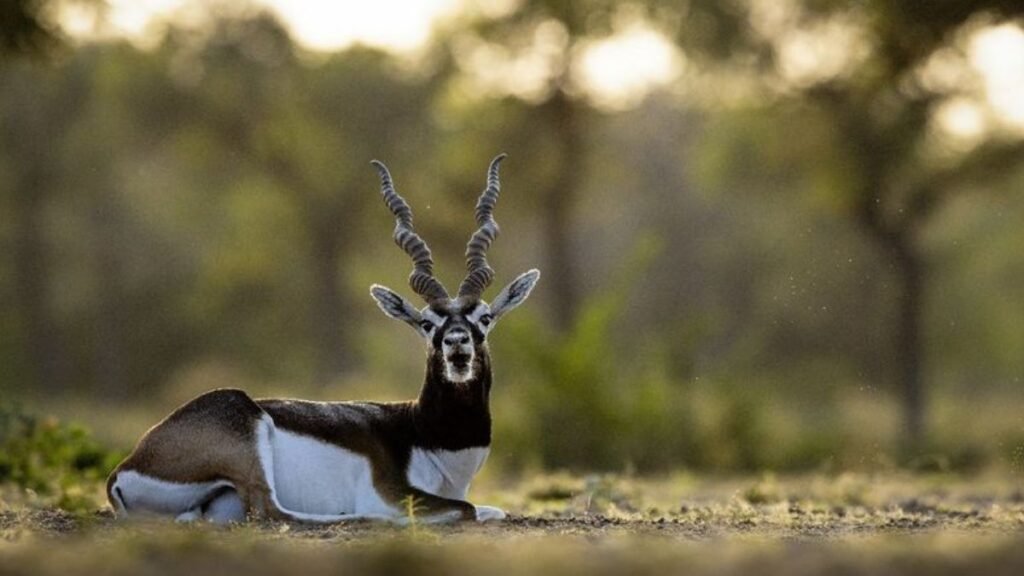
The density of blackbuck at Velavadar is extraordinary. More than 3,000 individuals inhabit 34 square kilometres a population density that produces the immediate, constant, everywhere-you-look sightings that more famous wildlife parks often cannot provide. There is nowhere in India where a visitor is guaranteed to see blackbuck in the numbers and at the proximity that Velavadar offers. The open grassland means that there is no vegetation to obstruct views, no forest canopy to conceal the herds. You see blackbuck from the moment you enter the park. You see them throughout your safari. You see them on the horizon and at arm’s length from the safari vehicle.
The Indian Wolf — Velavadar’s Most Elusive Predator
Blackbuck National Park at Velavadar harbours one of India’s healthiest and most consistently viewable Indian wolf (Canis lupus pallipes) populations. The Indian wolf is a subspecies of grey wolf found specifically on the Indian subcontinent smaller than European and North American wolves, legged for running in open grassland rather than through forest, and adapted to the prey species of India’s plains. At Velavadar, it is the blackbuck that is the wolf’s primary quarry.
Watching wolves hunt blackbuck at Velavadar is one of the most dramatic wildlife experiences that any Indian national park offers. The wolves are visible at the park’s edges in the early morning and late afternoon coursing through the grassland in pairs or small family groups, their movement low and purposeful. When a hunt begins, the interaction between the wolf’s speed and strategy and the blackbuck’s explosive acceleration and ability to change direction is extraordinary to watch: a natural performance of millions of years of co-evolution.
The best time for wolf sightings is the early morning arriving at the park for the 7 AM safari opening and heading immediately toward the areas where wolf tracks or recent sightings have been reported by the guide. Wolves are significantly more active in the cool morning hours than in the midday heat. Evening is also productive. Midday wolf sightings, in the heat of the day, are more rare. The sound of wolves howling in chorus as the temperature drops at dusk one of the most affecting sounds in Indian wildlife is one of Velavadar’s signature experiences.
The World’s Largest Harrier Roost — A Global Bird Record
Among ornithologists and serious birdwatchers worldwide, Velavadar is known less for its blackbuck than for a bird that most casual visitors have never heard of: the harrier. Specifically, Velavadar is recognised as one of the world’s largest roosting sites for harriers the Montagu’s Harrier (Circus pygargus), the Pallid Harrier (Circus macrourus), and the Hen Harrier (Circus cyaneus) medium-sized raptors that migrate from their breeding grounds in Central Asia, Siberia, and Europe to winter in the Indian subcontinent.
Each evening, from November through February, thousands of harriers come in to roost in the Velavadar grassland spiralling down from the sky in waves as the temperature drops and the light fails, landing in the tall grass to spend the night in the same grassland that the blackbuck also use. At dawn, they lift off in a mass departure that creates one of the most spectacular avian events in India: thousands of medium-sized raptors rising simultaneously from the grassland into the morning sky.
The numbers are genuinely extraordinary. Multiple winter counts have documented tens of thousands of harriers roosting at Velavadar in peak winter months numbers that rival or exceed any other harrier roost on the planet. This makes Velavadar a site of global conservation significance for the harrier species, and it draws birdwatchers from across the world specifically for this event. For a visitor whose primary interest is birds rather than mammals, Velavadar in November-February for the harrier roost is one of the finest birding experiences available in India.
Also Read: Tulsi Shyam Temple, Amreli
Birdwatching at Velavadar — 140+ Species
The Lesser Florican — Monsoon Breeding Display
The Lesser Florican (Sypheotides indicus) is the smallest member of the bustard family and one of India’s most critically endangered birds. Endemic to the Indian subcontinent and dependent on open grassland habitat, the Lesser Florican has suffered catastrophic population decline due to habitat loss the conversion of grassland to agriculture has eliminated most of its breeding range. Velavadar is one of the most important remaining breeding sites for the species.
The Lesser Florican’s monsoon breeding display is one of the most unusual spectacles in Indian wildlife. The male performs a jumping display in the monsoon-green grassland leaping repeatedly into the air above the grass to attract females and establish territory, its black head visible above the vegetation with each jump. The display season runs from approximately July to September. Visiting Velavadar during the monsoon specifically to see the Lesser Florican’s breeding display is a niche but rewarding wildlife experience.
Cranes, Flamingos, and Migratory Waterbirds
The seasonal wetlands, saline flats, and Gulf of Khambhat coastline that border Velavadar support a different and equally rich bird community from the grassland. During the winter months, the wetland fringes attract:
- Demoiselle Cranes – India’s most numerous wintering crane; large flocks visible at the park’s edges in November and December
- Common Cranes – larger than Demoiselle Cranes; also winter in large numbers
- Sarus Cranes — the world’s tallest flying bird; resident in Gujarat and visible year-round
- Flamingos – using the saline mudflats at the Gulf of Khambhat margin for feeding
- Pelicans – Great White Pelicans and Spot-billed Pelicans using the coastal wetlands
- Painted Storks and White Storks – large wading birds in the seasonal pools
- Greater Spotted Eagles and Steppe Eagles -large raptors wintering from their Siberian and Central Asian breeding grounds
Raptors and Grassland Birds
Beyond the harriers, Velavadar’s raptor assemblage during winter is exceptional: Short-eared Owls, Long-eared Owls, Eastern Imperial Eagles, and multiple falcon and kite species all occur in numbers. The open grassland provides the unobstructed hunting ground that these species require, and the density of small mammals and birds provides the prey base that supports such a concentrated raptor community.
The Bhal Ecosystem — Why Velavadar Is So Rich
The extraordinary biodiversity of Velavadar in a relatively small area (34 square kilometres) is a function of the diversity of habitats within and immediately adjacent to the park. The core grassland the pale gold tall and short grass sward that is the blackbuck’s primary domain transitions at the park’s margins into several distinct habitats:
- Saline flats (bannis) to the south: Low-lying areas that hold water temporarily during the monsoon and dry out to a salt crust in summer; these provide unique habitat for species adapted to saline grassland and attract flamingos and other saltwater-tolerant birds
- Seasonal rivers (Parvalia and Alang): The two rivers that border the park provide water and riverine vegetation that support a different species community from the open grassland; riparian birds and crocodiles use the river margins
- Gulf of Khambhat coastal margin: The tidal mudflats and coastal marshes immediately east of the park support enormous numbers of migratory waterbirds using the coastal route between Siberia and the Indian Ocean
- Agricultural land surrounds: The farmland at the park’s edges is regularly visited by blackbuck feeding on crops, by wolves hunting at the agricultural margin, and by raptors hunting the rodent populations of the farmed fields
The Safari Experience at Velavadar
Vehicle Safari — The Standard Format
The standard way to experience Velavadar is by guided vehicle safari a jeep or similar open 4WD vehicle with a mandatory guide (hired at the park entrance) driving through the core grassland. The open landscape means that wildlife sightings begin immediately and are constant: blackbuck appear within minutes of entering the park and are present throughout. The guide’s knowledge of wolf movement patterns and harrier roost locations significantly enhances the experience.
Timing Your Safari
Morning safaris (commencing at approximately 7 AM) are decisively better than evening safaris for most species. The early morning light on the golden grassland is the best photography light of the day low, directional, and warm. Wolves are most active in the morning. Harriers lift off from their roost in the morning. Blackbuck males are most active with territorial displays in the cooler morning air. The afternoon safari (3 PM to 6 PM) is also good the evening light is beautiful and wolf activity increases again as the temperature drops but the morning remains the priority for most wildlife photographers.
What to Bring
Binoculars are essential for Velavadar the open grassland means that many sightings will be at medium to long range, and binoculars transform a distant dark smudge into a blackbuck male with the full visual detail of his coat and horns. Camera with long telephoto lens (400mm minimum for birds; 200-300mm workable for mammals at closer ranges). Water bottle (the grassland can be hot even in winter once the sun is up). Light jacket for morning safaris in December-January (6-8 AM can be genuinely cool). Sober, nature-coloured clothing.
Best Time to Visit Velavadar
| Month / Season | What You See | Conditions |
| October–November | Blackbuck herds, wolves, early harrier arrivals, crane influx | Pleasant and cooling; ideal for most visitors |
| December–January | Peak harrier roost (thousands daily), wolves, dense blackbuck herds | Cool to cold mornings (8–25°C); best birding months |
| February–March | Wolves, harriers departing, blackbuck rutting activity beginning | Warming but still comfortable; excellent overall |
| April–June (Summer) | Quiet; blackbuck present; most birds gone; less wildlife | Hot (up to 40°C+); suitable only for early morning |
| July–September (Monsoon) | Lesser Florican breeding display (monsoon speciality!); park may be partially closed | Wet; check park access before visiting |
The single best period for a comprehensive Velavadar experience is mid-November to mid-February: the harrier roost is at peak numbers, crane and flamingo populations are high, the grassland is dry and easy to navigate, the morning temperatures are cool enough for prolonged outdoor wildlife watching, and the blackbuck and wolf populations are in active, visible condition.
How to Reach Velavadar Blackbuck National Park
| From | Distance | Mode | Approx. Time |
| Bhavnagar city | ~42–47 km | Car / Taxi | ~1 hour |
| Bhavnagar Airport | ~34–50 km | Taxi | ~45–60 minutes |
| Bhavnagar Terminus (railway) | ~45–47 km | Taxi / Bus | ~1 hour |
| Ahmedabad | ~150–170 km | Car / Bus to Bhavnagar + taxi | ~3–3.5 hours |
| Vadodara | ~200 km | Car | ~4 hours |
| Surat | ~280 km | Car | ~5 hours |
| Lothal (Harappan site) | ~60 km | Car | ~1.5 hours |
| Palitana (Shatrunjaya) | ~110 km via Bhavnagar | Car | ~2.5 hours |
From Ahmedabad, Velavadar is best reached by private car or hired taxi — take the Ahmedabad-Bhavnagar road/expressway and then the turnoff toward Velavadar. From Bhavnagar, hire a taxi from the city centre (~1 hour, approximately ₹800-1,200 one-way). Navigate to ‘Blackbuck National Park, Velavadar’ on Google Maps.
Nearby Attractions to Combine with Velavadar
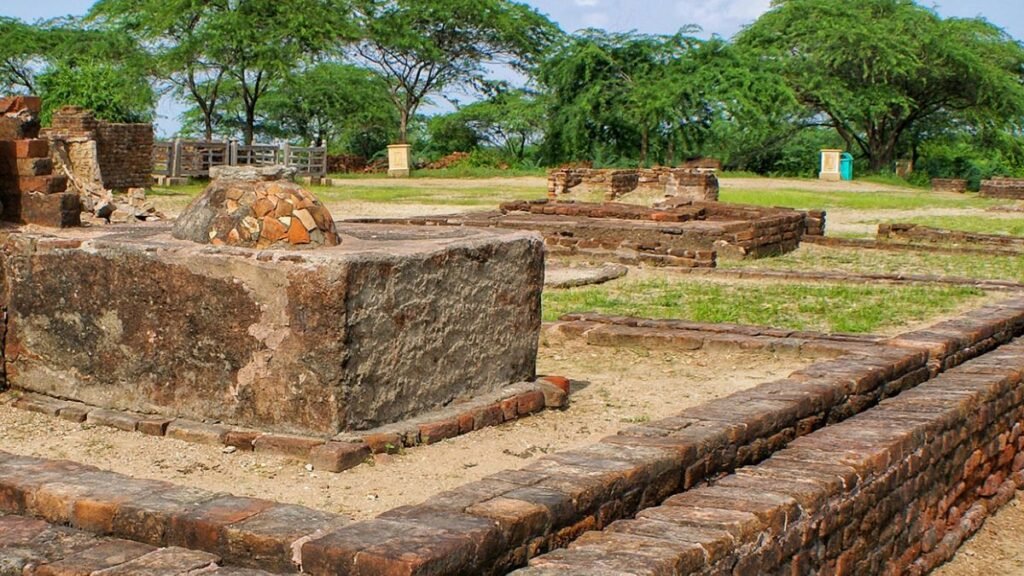
- Lothal (Harappan Archaeological Site) ~60 km | One of India’s most significant Indus Valley Civilization sites the ancient port city of Lothal, with its brick dockyard, granary, and city plan that give a tangible sense of urban life 4,500 years ago. A UNESCO Tentative World Heritage Site. Read our full TravelRoach guide.
- Palitana and Shatrunjaya Hill ~110 km via Bhavnagar | The most sacred Jain pilgrimage in the world — 863 temples on two summits of Shatrunjaya Hill. A full day’s pilgrimage that pairs powerfully with Velavadar’s nature experience in a 2-day Bhavnagar-area itinerary. Read our full TravelRoach guide.
- Bhavnagar city ~42–47 km | Nilambag Palace (heritage hotel), Barton Museum, Takhteshwar Temple (hilltop Shiva temple with Gulf of Khambhat views). The city is a natural base for both Velavadar and Palitana.
- Khodiyar Mandir, Rajpara ~40 km from Bhavnagar | The Khodiyar Mata temple on the banks of the Tataniya Dharo lake the ancestral clan goddess of the Gohil Rajputs. Read our full TravelRoach guide.
Also Read: Narayan Sarovar, Kutch
Practical Tips for Visiting Velavadar
- Arrive at the park gate at 7 AM sharp -the morning safari is the single most productive wildlife session of the day. Arriving 15 minutes early allows you to hire your guide and be first into the park at opening.
- Hire a knowledgeable guide -guides at Velavadar are mandatory and their knowledge of wolf movement patterns, harrier roost locations, and seasonal species locations is genuinely valuable. The guide transforms a good safari into an excellent one.
- Binoculars are essential – the open grassland produces many sightings at range. Bring your own pair or hire from the park entrance if none are available.
- For the harrier roost – ask your guide specifically to take you to the roost site at or before sunrise; the spectacle of thousands of harriers lifting off simultaneously is the most memorable single wildlife event at Velavadar and requires correct timing.
- For wolves – be in the park at first light and ask your guide for the most recent wolf sighting locations; wolves follow regular routes through the park and knowledgeable guides know where to look.
- Carry water and sunscreen – the open grassland offers no shade; even in winter the midday sun is strong.
- Accommodation near the park is basic – the Forest Department guest house is the most atmospheric option and should be booked well in advance (through the Gujarat Forest Department). Bhavnagar (42-47 km) offers a wider range of hotels as a comfortable base.
Frequently Asked Questions (FAQs)
Velavadar Blackbuck National Park in Bhavnagar district, Gujarat, is famous for three primary reasons: it hosts one of the world’s largest concentrations of blackbuck (over 3,000 individuals in 34 square kilometres), giving visitors guaranteed, close-range sightings of these spectacular black-and-white antelopes in the open golden grassland; it harbours one of India’s healthiest Indian wolf populations, with regular morning sightings of wolves hunting blackbuck across the open terrain; and it is globally recognised as one of the world’s largest roosting sites for harriers (Montagu’s, Pallid, and Hen Harriers), with thousands of harriers roosting in the grassland in winter. The endangered Lesser Florican also breeds here during the monsoon.
The best overall season is October to March. For blackbuck: year-round, but October to March for the most comfortable conditions and active male territorial behaviour. For Indian wolves: October to March; best at early morning 7 AM safari opening. For harriers (global record roost): November to February; arrive at the roost site at dawn for the spectacle of thousands of birds lifting off simultaneously. For the Lesser Florican: July to September (monsoon breeding display) confirm park access during monsoon before visiting. For crane species (Demoiselle, Common, Sarus): November to February. For flamingos and coastal waterbirds: October to March.
From Ahmedabad, Velavadar Blackbuck National Park is approximately 150 to 170 km about 3 to 3.5 hours by car. Take the Ahmedabad-Bhavnagar road to Bhavnagar, then continue to Velavadar. From Bhavnagar (42-47 km from the park), hire a taxi for the final leg (~1 hour). Navigate to ‘Blackbuck National Park, Velavadar, Gujarat’ on Google Maps. From Bhavnagar Terminus (railway station), a taxi to the park costs approximately ₹800-1,200. Bhavnagar Airport is also served by flights from major cities; from the airport, the park is approximately 34-50 km by taxi.
Velavadar National Park operates two safari sessions daily: morning safaris commencing at approximately 7:00 AM until noon, and evening safaris from 3:00 PM to 6:00 PM. Entry fees are approximately ₹200-300 for Indian nationals and approximately ₹2,000 for foreign nationals (confirm current rates at the park gate or through the Gujarat Forest Department, as fees are subject to revision). A guide hire fee and vehicle charge apply additionally to the entry fee. Guides are mandatory.
Velavadar is globally recognised as one of the world’s largest roosting sites for harriers medium-sized raptors from the genus Circus. Three species roost here in winter: the Montagu’s Harrier, the Pallid Harrier, and the Hen Harrier, all of which migrate from breeding grounds in Central Asia, Siberia, and Europe to winter in India. From November through February, thousands of these birds come to roost in the Velavadar grassland each evening and lift off en masse at dawn. Winter counts have documented tens of thousands of harriers at peak numbers making the dawn roost departure one of the most spectacular avian events in India and drawing birdwatchers from across the world specifically for this experience.
Yes – Velavadar is genuinely suitable for family visits and first-time wildlife tourists. The open grassland means that blackbuck sightings begin immediately and are constant throughout the safari, requiring no specialist tracking skills or special knowledge to enjoy. The sheer density of animals in the open grassland unlike the patience and forest navigation that more famous parks often require gives most visitors immediate, close, satisfying wildlife encounters. Children particularly respond to the spectacle of large blackbuck herds. The mandatory guide makes the experience educational and accessible.
Beyond blackbuck, Velavadar supports a rich mammal and bird community. Mammals include the Indian wolf (one of India’s healthiest populations), nilgai (blue bull India’s largest antelope), striped hyena, golden jackal, Indian fox, jungle cat, and wild boar. Birds include 140+ species: the globally significant harrier roost (thousands of Montagu’s, Pallid, and Hen Harriers in winter), the endangered Lesser Florican (monsoon breeding), Demoiselle and Common Cranes in large winter flocks, Sarus Cranes year-round, flamingos, pelicans, painted storks, and large raptors including Greater Spotted Eagles and Steppe Eagles.
Final Thoughts
India’s wildlife tourism is dominated by the forest Gir for lions, Corbett for tigers, Ranthambore for tigers, Kaziranga for rhinos. In the forest, the wildlife is hidden. You track, you wait, you look for the cat behind the vegetation. A sighting is a revelation because the animal was concealed and is now visible.
Velavadar is the opposite of this. Nothing is hidden. The grassland is open, the horizon is visible, and the blackbuck are everywhere moving, displaying, running, grazing, in herds of dozens and hundreds, the males black-and-white in the morning light with their spiralled horns visible against the pale gold. There are no trees to hide behind. There are no dense bushes to conceal the wolves. Everything is out in the open, performing, in the most literal landscape sense, on a stage without wings.
This is India’s African savannah equivalent. It doesn’t have lions, but it has wolves. It doesn’t have zebra, but it has blackbuck faster and more visually spectacular than any zebra. And it has, in winter, more harriers roosting in the same square kilometre than exist in most European countries in their entirety.
Velavadar is thirty-four square kilometres of some of the finest wildlife watching in India. Go early. Take the guide seriously. Watch where the wolves walk at dawn. See the harriers lift off.
