In the North Gujarat village of Modhera a name most people associate with one building alone, the magnificent 11th-century Sun Temple that draws photographers and history enthusiasts from around the world there stands a second, quieter, and in many ways equally significant temple. A few hundred metres from the ruins of the Sun Temple, on the banks of the same Pushpavati River, is the Shree Modheshwari Mata Temple: the shrine of the clan deity of the entire Modh community of Gujarat.
For most visitors who come to Modhera for the Sun Temple’s celebrated stone carvings and its UNESCO-tentative-list architecture, the Modheshwari Mata Temple is a footnote a quick stop on the way out, or a site glimpsed from a distance. But for the Modh Brahmins, Modh Patidars (Patels), Modh Vaishyas, and Modh Kshatriyas the various sub-communities that together form the Modh community of Gujarat, named for this very village the Modheshwari Mata Temple is not a footnote at all. It is the ancestral seat of their kuldevi (clan goddess), the place where, according to their tradition, the goddess herself emerged from fire to save their forebears from a demon, and the spiritual home to which Modh families across Gujarat, India, and the global diaspora trace their devotional lineage.
This TravelRoach guide covers the full founding legend of Modheshwari Mata, her connection to the eighteen-armed form known as Matangi, her relationship to the Sun Temple ruins beside her shrine, the Modh community’s wider network of Modheshwari temples across Gujarat, darshan timings, festivals, how to reach, and the natural way to combine this temple with the Sun Temple and the rest of Modhera’s remarkable heritage.
Modheshwari Mata Temple – Quick Information
| Detail | Information |
| Full Name | Shree Modheshwari Mata Temple (also Matangi Modheshwari Temple) |
| Location | Modhera village, on the banks of the Pushpavati River, Mehsana District, Gujarat |
| Adjacent To | The ruins of the ancient Modhera Sun Temple (built 1026-27 CE) |
| The Goddess | Devi Modheshwari a form of Devi Parvati/Durga; also identified as Matangi |
| Iconography | Depicted with EIGHTEEN ARMS, each holding a different weapon (trident, dagger, sword, khadga, kamandal, conch, mace, pasha, danda, damaru, and more) |
| Kuldevi Of | The entire Modh community of Gujarat Modh Brahmins, Modh Patidars (Patels), Modh Vaishyas, and Modh Kshatriyas |
| The Legend | Devi Shree Mata (daughter of Lord Brahma) summoned Matangi from fire breathed in anger to defeat the demon Karnat, who was tormenting the Brahmins of Modhera (then called Dharmaranya) |
| Town’s Ancient Name | Dharmaranya associated with Lord Rama performing a yagna here to atone for killing the Brahmin Ravana |
| Annual Celebration | Maha Sud Teras the Hindu calendar day marking Matangi’s victory over Karnat; celebrated with major fanfare at all Modheshwari temples |
| Network of Temples | Other Modheshwari temples exist in Chanasama (Patan), Ahmedabad, Vadodara, Bhavnagar, Surat, Bharuch, Bhuj, Kapadwanj, Khedbrahma, Sendarda (Junagadh), Tera (Kutch), Ujjain, and Jhabua (MP) but Modhera is the original and most prominent |
| Entry Fee | Free — no entry fee for darshan |
| Darshan Timings | 5:00 AM – 9:00 PM (Matangi Modheshwari Temple) |
| Facilities | Restaurant/canteen on premises, ample parking, clean and well-maintained grounds |
| Distance from Mehsana | ~25–26 km (~35–40 minutes) |
| Distance from Patan | ~35 km |
| Distance from Becharaji (Bahuchar Mata) | ~25 km |
| Distance from Ahmedabad | ~98–99 km (~1.5–2 hours) |
| Distance from Gandhinagar | ~83 km |
| Nearest Railway Stations | Mehsana Junction (~26–28 km) and Patan (~35 km) |
| Nearest Airport | Ahmedabad SVP International Airport (~95–99 km) |
The Legend of Modheshwari Mata — Fire, the Demon Karnat, and the Birth of Matangi
Dharmaranya – The Ancient Name of Modhera
Before it was called Modhera, the village carried the name Dharmaranya the forest of righteousness and Hindu tradition connects the site to one of the most significant episodes in the Ramayana. According to this tradition, Lord Rama performed a yagna (sacred fire ritual) at this location specifically to cleanse himself of the sin of killing Ravana who, despite being the antagonist of the Ramayana, was himself a Brahmin by birth. The structure Rama is said to have built here was known as Modherak, a name that, over the centuries, evolved into Modhera. This Puranic-age association gives the village a layer of sacred history that predates even the Sun Temple and the Modheshwari legend by a considerable span of mythological time.
The Demon Karnat and the Brahmins’ Plea
The specific founding legend of Modheshwari Mata begins in this ancient Dharmaranya. A demon (asur) named Karnat began tormenting the Brahmin community living in the village causing havoc, fear, and suffering that the Brahmins had no ordinary means of resisting. With no other recourse, they turned to prayer, calling upon the local goddess Shree Mata described in this tradition as the daughter of Lord Brahma himself to protect them from Karnat’s destruction.
The Goddess Who Breathed Fire – The Birth of Matangi
Devi Shree Mata, hearing the Brahmins’ desperate plea, became intensely agitated by the demon’s tyranny. Her anger manifested in a way that is central to the entire Modheshwari tradition: she began breathing fire. And from that fire emerged a new divine form Matangi, a goddess with eighteen arms, each arm carrying a different weapon. This is the moment, in the Modh community’s devotional memory, when Modheshwari Mata as she is known today came into being: not as a separate, independently existing deity, but as the fierce manifestation that Shree Mata’s own divine fury produced specifically to answer this crisis.
A fierce battle followed between Matangi and Karnat. Wielding her eighteen weapons trident, dagger, sword, khadga, kamandal, conch shell, mace, pasha (noose), danda (staff), damaru (drum), and more Matangi defeated and killed the demon, ending his reign of terror over the Brahmin community of Dharmaranya.
Also Read: Shree Bahuchar Mata Temple: Gujarat’s Unique Shakti Peetha
From Matangi to Modheshwari — The Clan Adopts Its Goddess
Following Karnat’s defeat, the Brahmin community of the village celebrated their deliverance and formally accepted Matangi as Modheshwari literally, the goddess of Modhera adopting her as their kuldevi, their hereditary clan deity. This act of adoption is the foundational moment for what would become, over subsequent centuries, the Modh community: the various Gujarati castes and sub-castes (Brahmin, Patidar/Patel, Vaishya, and Kshatriya among them) who trace their lineage and their devotional identity back to this village and this goddess, and who carry the name Modh as a mark of that connection.
This origin story explains something distinctive about Modheshwari Mata within Gujarat’s broader landscape of goddess worship: she is not primarily a Shakti Peetha tied to the cosmic dismemberment legend of Devi Sati, nor a goddess defined chiefly by geographic or natural features. She is, first and foremost, a lineage goddess born from a specific community’s crisis and devotion, and carried forward through that same community’s identity across the centuries since.
Devi Modheshwari’s Eighteen Arms — Understanding the Iconography
The most visually distinctive feature of Devi Modheshwari’s depiction is her eighteen arms a number considerably exceeding even the four, eight, or ten arms more commonly seen in depictions of other major Hindu goddesses. Each of the eighteen arms holds a different weapon or sacred object, the complete inventory including (according to devotional accounts) the trishul (trident), a dagger, a sword, the khadga (a specific curved sword), kamandal (a water vessel associated with ascetics), shankha (conch shell), gada (mace), pasha (noose), danda (staff/rod), damaru (the small two-headed drum associated with Shiva), and several additional weapons and implements.
This extensive multiplication of arms and weapons is iconographically significant: it visually communicates the totality of divine power mobilised in a single moment of righteous fury the goddess who can simultaneously wield every weapon necessary to eliminate a threat, leaving the demon no avenue of escape or defence. For devotees, the eighteen-armed form is a continuous reminder of the goddess’s capacity for complete protection that whatever danger threatens her devotees, some weapon among her eighteen is suited to meet it.
The Temple Today — Setting, Architecture, and the Sun Temple Beside It
Beside the Pushpavati and Beside the Ruins
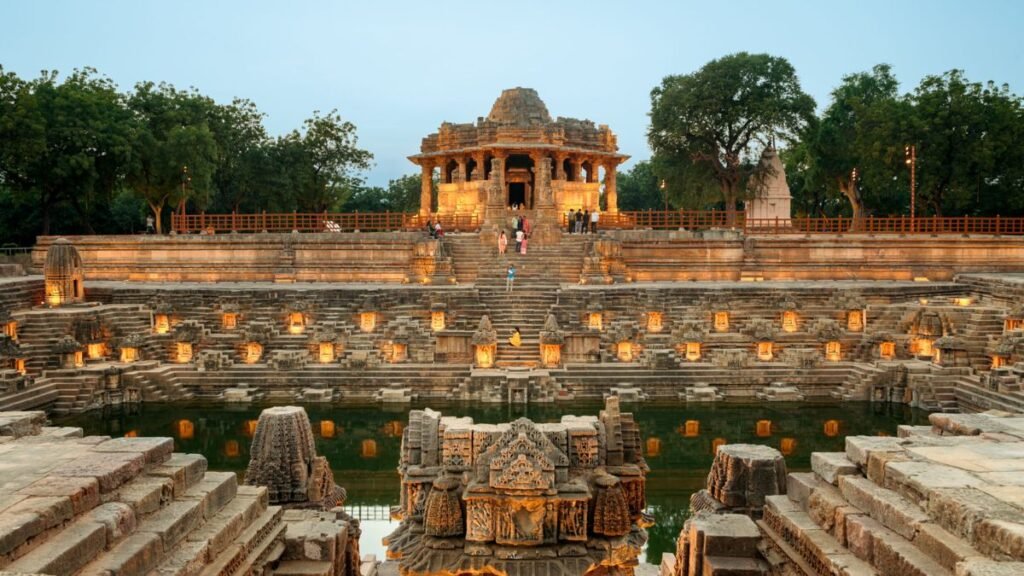
The Shree Modheshwari Mata Temple stands on the banks of the Pushpavati River, in the immediate vicinity of the ruined ancient temple dedicated to Bhagwan Surya (the Sun God) a separate, older shrine that predates even the famous 1026-27 CE Sun Temple complex for which Modhera is internationally known. This Surya temple, now in ruins, can be seen from a distance from the Modheshwari complex, and devotees are still observed offering prayers toward the Surya ruins from afar even though no formal worship infrastructure remains at that specific shrine.
This juxtaposition the maintained, actively worshipped Modheshwari temple standing immediately beside the weathered remains of an ancient solar shrine creates one of Modhera’s most evocative visual and devotional contrasts. Two different traditions of sacred power, one continuously living and one reduced to ruin, share the same riverside ground.
A Well-Maintained, Peaceful Complex
Visitors consistently describe the Modheshwari Mata Temple grounds as historical, clean, and peaceful a well-kept complex with ample parking and a calm, contemplative atmosphere despite its significance to a very large community. Trees surround the temple structure, and the overall architectural character is described as beautiful and substantial befitting a temple that serves as the spiritual anchor for an entire clan network spanning the state and beyond.
A restaurant or canteen is available on the temple premises, serving tea, coffee, and light snacks a practical convenience for the considerable number of pilgrims who travel from across Gujarat to visit, often combining their Modheshwari darshan with a Sun Temple visit on the same trip.
Also Read: Rani Ki Vav Patan
The Modh Community — A Goddess Carried Across Gujarat
What makes Modheshwari Mata distinctive among Gujarat’s many goddess traditions is the breadth and structure of her devotional network. Because she is specifically the kuldevi of the Modh community rather than a goddess tied to a single geographic Shakti Peetha or a single caste temples dedicated to her have been established by Modh families wherever they have settled across Gujarat and beyond, while the original Modhera temple retains its status as the spiritual source and most prominent shrine.
Beyond Modhera, notable Modheshwari temples exist at Chanasama in Patan district (itself an ancient temple), and in Ahmedabad, Vadodara, Bhavnagar, Surat, Bharuch, Bhuj, Kapadwanj, Khedbrahma, Sendarda (Junagadh district), and Tera (Kutch) within Gujarat as well as in Ujjain and Jhabua in neighbouring Madhya Pradesh, reflecting the historical migration patterns of Modh families beyond Gujarat’s borders. Most of these additional temples are of comparatively recent origin, established as local devotional centres for Modh families settled in those cities, while the original Modhera shrine remains the ancestral point of reference for the entire network.
Festivals at Modheshwari Mata Temple
Maha Sud Teras — The Day Matangi Emerged
The single most important annual observance connected to Devi Modheshwari is Maha Sud Teras the thirteenth day of the bright fortnight of the Hindu month of Magha (typically falling in January or February). This date marks the anniversary of Matangi’s emergence from Shree Mata’s fire and her subsequent victory over the demon Karnat. The Modh community celebrates this day with considerable fanfare at Modhera and at Modheshwari temples across Gujarat simultaneously a coordinated, community-wide festival day that reinforces the sense of shared identity and shared devotional lineage across geographically dispersed Modh families.
Navratri
As with virtually every major goddess temple in Gujarat, Navratri the nine-night festival of the Divine Mother is a significant period of heightened devotion and celebration at the Modheshwari Mata Temple. Both the autumn Ashvin Navratri and the spring Chaitra Navratri bring increased numbers of devotees, particularly from the Modh community making their pilgrimage to the ancestral shrine.
The Modhera Dance Festival — A Different Kind of Celebration
While not specifically a Modheshwari festival, visitors timing their trip to Modhera should be aware of the three-day Modhera Dance Festival, held annually during the third weekend of January, following the conclusion of the Uttarayan (kite festival) celebrations. This classical and folk dance festival, staged against the backdrop of the nearby Sun Temple, draws cultural tourism to the village and can be combined with a Modheshwari Mata darshan during the same visit for those travelling to Modhera in January.
Best Time to Visit Modheshwari Mata Temple
October to February — Best Overall Season
The winter months offer the most comfortable conditions for visiting both the Modheshwari Mata Temple and the adjacent Sun Temple complex. North Gujarat from October to February sees pleasant temperatures of 15 to 27 degrees Celsius, making the riverside setting and the walk between the two temples genuinely enjoyable. This period also coincides with Maha Sud Teras (January/February) and the Modhera Dance Festival (third weekend of January), giving winter visitors the chance to combine darshan with cultural and festival experiences.
Early Morning — Peaceful Darshan
Arriving at or shortly after the 5:00 AM opening gives the most peaceful and unhurried darshan experience, before the temple receives its daily flow of pilgrims and before the Sun Temple complex opens to tourist crowds. The early morning light on the Pushpavati riverbank, with the temple grounds quiet and the ruined Surya shrine visible in the soft dawn light, is among the most atmospheric times to experience this site.
How to Reach Modheshwari Mata Temple, Modhera
| From | Distance | Mode | Approx. Time |
| Mehsana | ~25–26 km | Car / Bus / Shared Jeep | 35–40 minutes |
| Patan | ~35 km | Car / Bus | 45–50 minutes |
| Becharaji (Bahuchar Mata Temple) | ~25 km | Car | 30–35 minutes |
| Mehsana Junction Railway Station | ~26–28 km | Train + Car/Auto | ~40 minutes by road |
| Patan Railway Station | ~35 km | Train + Car/Auto | ~50 minutes by road |
| Gandhinagar | ~83 km | Car | 1.5 hours |
| Ahmedabad | ~98–99 km | Car / Bus | 1.5–2 hours |
| Ahmedabad Airport (SVP) | ~95 km | Taxi / Car | 2 hours |
From Mehsana, the most common approach, take a State Transport bus or shared jeep toward Modhera (approximately 45 minutes) a private vehicle is the more convenient option for combining the temple visit with the Sun Temple and other nearby sites in a single day. From Patan, the drive takes a similar amount of time on a different approach road. Navigate to ‘Modheshwari Mata Temple, Modhera’ or ‘Matangi Modheshwari Temple’ on Google Maps. Autorickshaws serve as the main local mode of transport once in Modhera village, though a private vehicle remains the better choice for the full North Gujarat circuit.
Also Read: Ambaji Temple, Banaskantha
Combine with the North Gujarat Heritage Circuit
Modheshwari Mata Temple sits at the heart of one of North Gujarat’s richest single-day heritage circuits, alongside several sites TravelRoach has covered in detail:
- Modhera Sun Temple Same village | The magnificent 11th-century Solanki-era Sun Temple, built 1026-27 CE under King Bhima I one of India’s most celebrated medieval temple complexes, with its Surya Kund stepped reservoir and Sabha Mandapa pillared hall depicting the twelve Adityas. A few minutes’ walk from Modheshwari Mata Temple. Read our full TravelRoach guide.
- Bahuchar Mata Temple, Becharaji ~25 km | One of Gujarat’s three principal Shakti Peethas and the patron goddess temple of the hijra community a striking devotional contrast to Modheshwari’s clan-goddess identity. Read our full TravelRoach guide.
- Rani Ki Vav, Patan ~35 km | The UNESCO World Heritage stepwell, the symbol on India’s ₹100 note 11th-century Solanki-era stepwell architecture at its absolute finest. Read our full TravelRoach guide.
- Bohra Vad, Sidhpur ~45 km from Modhera | The extraordinary Victorian-Art Deco haveli neighbourhood of the Dawoodi Bohra community. Read our full TravelRoach guide.
Practical Tips for Visiting Modheshwari Mata Temple
- Combine with the Sun Temple – the two sites are a short walk apart; visiting both together is the natural and most rewarding way to experience Modhera. Plan the Modheshwari darshan either before or after your Sun Temple visit on the same trip.
- Dress modestly – covered shoulders and knees; women should carry a dupatta for the inner sanctum.
- Remove footwear at the temple entrance – footwear storage is typically available.
- Visit during Maha Sud Teras for the fullest devotional experience – if your travel dates allow flexibility, timing a visit to coincide with this January/February festival shows the temple at its most alive.
- Use the on-site canteen for a tea or light snack break – particularly useful if combining the visit with extended time at the adjacent Sun Temple.
- If you belong to or are visiting on behalf of a Modh family, ask locally about specific family or sub-clan rituals many Modh families maintain specific personal traditions connected to their ancestral shrine that go beyond general darshan practice.
- Private vehicle recommended for the full circuit combining Modheshwari Mata Temple, the Sun Temple, and potentially Becharaji or Patan in a single day is most practical with your own car or a hired taxi rather than relying on local buses between each stop.
Frequently Asked Questions (FAQs)
Modheshwari Mata (also worshipped as Matangi) is a form of Devi Parvati/Durga and is the kuldevi hereditary clan deity of the entire Modh community of Gujarat, which includes Modh Brahmins, Modh Patidars (Patels), Modh Vaishyas, and Modh Kshatriyas. According to the founding legend, when a demon named Karnat tormented the Brahmin residents of ancient Modhera (then called Dharmaranya), the goddess Shree Mata breathed fire in anger, from which emerged Matangi an eighteen-armed goddess who defeated and killed the demon. The grateful Brahmins adopted Matangi as Modheshwari, the goddess of Modhera, and built the temple in her honour. She is worshipped for protection, and Modh families across Gujarat and beyond consider her their ancestral spiritual protector.
Devi Modheshwari’s eighteen arms each holding a distinct weapon including a trident, dagger, sword, khadga, kamandal, conch shell, mace, pasha (noose), danda (staff), and damaru (drum) among others visually represent the totality of divine power mobilised in a single moment to defeat the demon Karnat. The unusually high number of arms, exceeding the four, eight, or ten arms more commonly seen in depictions of other Hindu goddesses, communicates complete and total protective capability: the goddess who can simultaneously wield every weapon necessary, leaving no avenue of escape for whatever threat confronts her devotees.
The Modheshwari Mata Temple stands a short distance from the famous Modhera Sun Temple, both located on the banks of the Pushpavati River in the same village. While the Sun Temple, built in 1026-27 CE under the Solanki king Bhima I, is dedicated to the Sun God Surya and is internationally celebrated for its architecture, the Modheshwari Mata Temple is also located beside the ruins of an even older, separate ancient Surya shrine that predates the famous complex. The two sites one a living, actively worshipped Shakti temple and the other a celebrated heritage monument with adjacent ancient ruins together make Modhera one of North Gujarat’s richest single-village heritage and pilgrimage destinations.
The Matangi Modheshwari Temple at Modhera is open for darshan from 5:00 AM to 9:00 PM daily. Entry is completely free. For the most peaceful experience, arrive at or shortly after opening time, before the temple receives its main daily flow of pilgrims and before the adjacent Sun Temple complex opens to tourist groups. The temple premises include a restaurant/canteen and ample parking for visitors.
Modheshwari Mata Temple in Modhera is approximately 25 to 26 km from Mehsana about 35 to 40 minutes by road. From Mehsana, take a State Transport bus or a shared jeep toward Modhera, or drive by private car or taxi for the most convenient and flexible option, particularly if combining the visit with the adjacent Sun Temple and other North Gujarat sites. From Patan, the temple is approximately 35 km away. The nearest railway stations are at Mehsana Junction and Patan; from either, a local taxi or auto-rickshaw covers the remaining distance to Modhera village.
Yes – because Modheshwari Mata is the kuldevi of the Modh community rather than a goddess tied to a single fixed geographic site, Modh families have established additional Modheshwari temples in various cities across Gujarat and beyond as they settled in those locations. Notable additional temples exist at Chanasama (Patan district, itself an ancient shrine), Ahmedabad, Vadodara, Bhavnagar, Surat, Bharuch, Bhuj, Kapadwanj, Khedbrahma, Sendarda (Junagadh district), Tera (Kutch), and even Ujjain and Jhabua in Madhya Pradesh. However, the original Modhera temple remains the most prominent and is regarded as the ancestral source of the entire network.
Maha Sud Teras is the thirteenth day of the bright fortnight of the Hindu month of Magha (typically falling in January or February), and it marks the anniversary of Matangi’s emergence from fire and her victory over the demon Karnat the founding event of the entire Modheshwari Mata tradition. The Modh community celebrates this day with major fanfare at the Modhera temple and at Modheshwari temples across Gujarat simultaneously. For visitors wanting to experience the temple at its most devotionally significant and most festively alive, timing a visit to coincide with Maha Sud Teras offers the fullest experience of this clan-deity tradition.
Final Thoughts
Modhera gives most visitors exactly one reason to come: the Sun Temple, with its carved stone and its centuries of Solanki-era craftsmanship, justly celebrated as one of India’s finest surviving medieval temple complexes. But a few hundred metres away, on the same riverbank, stands a second temple that an entire community of Gujaratis spread today across cities, states, and continents still calls home in the deepest sense available to a clan.
Modheshwari Mata is not a goddess of cosmic dismemberment or geological wonder. She is a goddess born from a specific community’s specific crisis from one act of divine fire breathed in anger at a demon’s cruelty, eighteen arms emerging to do what one act of fury required. The Brahmins of ancient Dharmaranya gave that fire a name and a home. Their descendants, scattered now across Ahmedabad and Vadodara and Surat and Ujjain and Jhabua, still return to this riverbank to remember where they came from.
If you are Modh, this is not a tourist stop. If you are not, it is still worth the few minutes’ walk from the Sun Temple gates a quieter, less photographed, but no less sincere expression of what it means for a community to keep faith with its own origin story for a thousand years.
