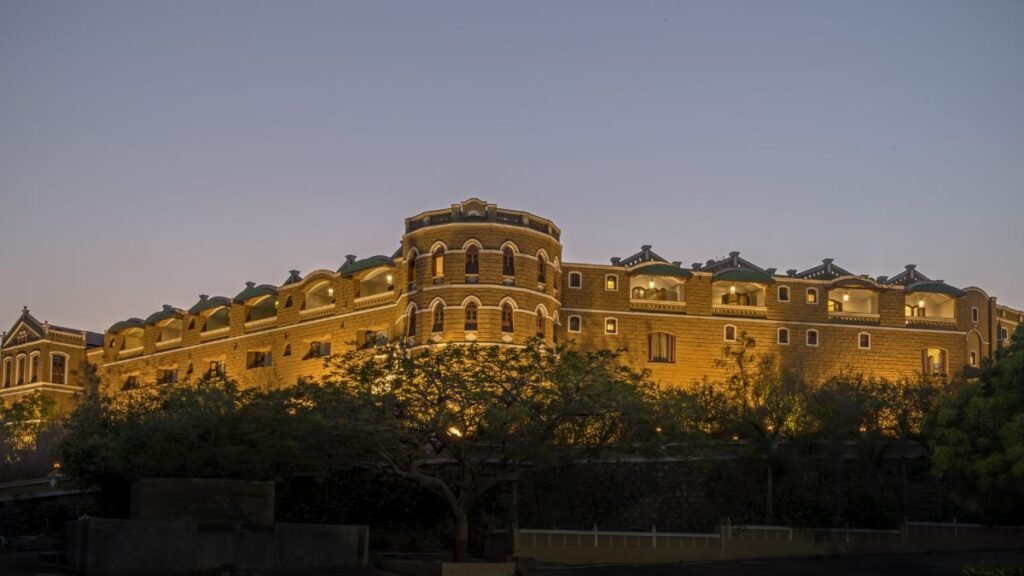
On Kalawad Road, roughly 14 to 20 kilometres west of Rajkot city, a hill rises 150 feet above the surrounding Khirasara village and on top of it stands a palace that, according to its own recorded history, refused to be built for a very long time. Not because of an enemy. Not because of money. Because, according to the legend that every visitor to Khirasara Palace eventually hears, the masonry itself kept collapsing every evening, no matter how skilled the builders or how many of them worked on it.
The story of how that problem was solved through the intervention of a wandering Sufi fakir named Nale-Sat-Pir is one of the most distinctive heritage legends in all of Saurashtra, and it is inseparable from the palace that today stands as Rajkot district’s only heritage hotel property: more than 450 years of recorded history, three significant ruling Thakores, two repelled attacks by the formidable Nawab of Junagadh, and a present-day life as a luxury heritage stay with 24 to 26 suites, multiple restaurants, swimming pools, and 360-degree views over the Kathiawar countryside.
This TravelRoach guide covers the full three-phase history of Khirasara State, the legend of the Sufi Pir and the collapsing castle, the military history of the palace’s repeated defences, its transformation into a heritage hotel, the facilities available today, how to reach it from Rajkot, and what to expect from a visit or a stay.
Khirasara Palace — Quick Information
| Detail | Information |
| Full Name | Heritage Khirasara Palace |
| Location | Khirasara village, off Kalawad Road, near Metoda GIDC, Lodhika Taluka, Rajkot District, Gujarat |
| Height | 150 feet above Khirasara village; ~117 feet above sea level |
| History | More than 450 years of recorded history |
| Origin | An offshoot/appendage of the Dhrol State a Seventh Class princely state of Kathiawar |
| Three Historical Phases | Thakore Bhimaji (acquired Khirasara), Thakore Ranmalji (built the palace), Thakore Sursinhji (modern restoration) |
| Built By | Thakore Ranmalji during the era of the Ghori Empire |
| The Legend | Masonry collapsed nightly during construction until a Sufi fakir, Nale-Sat-Pir, was consulted and a shrine built for him on site |
| Military History | Repelled two attacks by Mohbatkhan, Nawab of Junagadh; also withstood an attack by Meraman Khawas of Jamnagar |
| War Memorabilia | Two captured cannons from Junagadh’s artillery mounted at the eastern gate; a large ceremonial Kettledrum (Nagaru) in the treasury |
| Sufi Shrine | Tombs of Nale-Sat-Pir and his descendants Aaras Mahmad Pir and Hakimbai still present on the grounds |
| Current Status | Operating as Heritage Khirasara Palace a luxury heritage hotel and wedding venue |
| Property Area | Approximately 7 acres |
| Suites | 24 to 26 suites many overlooking a water body or the surrounding countryside |
| On-Site Temples | Mata Temple and Mahadev Temple within the palace grounds |
| Dining Venues | Wind N Waves, 24-Hr Coffee Shop, Sheesh Mahal, Multi-Cuisine Restaurant, Deep Mahal (candlelight dining), Jal Vihaar (pool-view café) |
| Facilities | Indoor and outdoor swimming pools, spa, massage room, lawns and gardens, EV charging, free parking |
| Distance from Rajkot Bus Station | ~18.7 km |
| Distance from Rajkot Railway Station | ~19–22 km |
| Distance from Rajkot Airport | ~47 km |
| Nearby Landmarks | ISKCON Rajkot, Sri Sri Radha Neelmadhav Dham, Asharamji Bapu Ashram (all within ~15 minutes) |
The History of Khirasara — Three Rulers, 450 Years
Phase One — Thakore Bhimaji and the Founding of the Taluka
The Khirasara Taluka was a Seventh Class princely state an offshoot of the larger Dhrol State, one of the many small princely territories that made up the intricate political landscape of Kathiawar (the historical name for the Saurashtra peninsula) before independence. The story begins with Shree Kaloji, the ruler of Dhrol, who had seven sons: Sangoji the eldest, Bhimaji the second, and Junoji the third, along with four others.
When Kaloji died, Sangoji succeeded to the throne (Gaadi) of Dhrol, while his brothers Bhimaji and Junoji were provided with smaller landholdings of their own a common practice in princely succession across Kathiawar’s many small states, where the eldest son inherited the primary throne while younger sons received appendage territories. Sangoji was later killed fighting against a Mohammedan army from the neighbouring Nawanagar State.
With Sangoji’s death, succession should have passed to Bhimaji as the next eldest brother. In an act that the Khirasara Palace’s own historical record describes as a rare example of humility, Bhimaji chose to abdicate the Dhrol throne in favour of his younger brother Junoji, content instead with his own smaller territory: the Khirasara Castle and twelve surrounding villages. At this point in history, Khirasara was still a modest, small castle nothing close to the grand structure that would later rise on the hilltop.
Also Read: Virpur Jalaram Bapa Temple
Phase Two — Thakore Ranmalji and the Castle That Wouldn’t Stand
It was Thakore Ranmalji an illustrious descendant of Thakore Bhimaji, ruling during the era of the Ghori Empire’s regional influence who transformed Khirasara from a modest castle into the grand palace that defines the site today. Ranmalji began an ambitious restoration and expansion of Khirasara Castle, employing 350 masons in the construction effort.
What followed has become Khirasara’s most famous and most retold legend. Despite the sustained and skilled efforts of 350 workers, the masonry being constructed would mysteriously collapse every evening undoing each day’s progress without explanation. No engineering failure, no structural flaw, no obvious cause could account for it. The construction had become impossible by entirely conventional means.
Thakore Ranmalji sought out Nale-Sat-Pir, a Sufi fakir from Sindh who was dwelling nearby, to the north of the castle site, and asked him about the mysterious nightly collapses. The Pir’s response, as recorded in the palace’s own history, was both cryptic and profound: he told Ranmalji that the world is a forest full of dangers and difficulties a beguiling place, a maze and that if the Thakore wanted his castle to remain unbeaten, he must, for Allah’s sake, construct an enchanting place at the site. Only then, the Pir said, would the worldly structure last forever and the ruler be blessed.
Ranmalji interpreted the Pir’s esoteric instruction and built a grand structure to the north of the castle large enough to house two to four hundred people specifically to honour and accommodate the Sufi fakir and his retinue. The Pir and his followers lived in this dedicated space for many years, and from that point forward, the castle’s construction held. It remained, in the language of the palace’s own historical account, unbeaten.
The Wars — Junagadh, Jamnagar, and a Castle That Never Fell
Once the construction problem was resolved, Khirasara Castle entered a period of considerable regional significance and, inevitably, considerable envy from neighbouring powers. The restored and strengthened castle attracted the disfavour, distrust, and envy of nearby rulers, most notably Mohbatkhan, the Nawab of Junagadh one of the most powerful princely states in all of Kathiawar.
Mohbatkhan attacked Khirasara Castle on two separate occasions. On both occasions, his forces could not overcome the combination of Thakore Ranmalji’s strategic skill and the bravery of the castle’s defenders. As a permanent record of these victories, two cannons captured from the Junagadh artillery were mounted at the castle’s eastern gate, where according to the palace’s own account they remain to this day.
On a separate occasion, Meraman Khawas of Jamnagar another significant regional military figure also attacked Khirasara. The castle again remained undefeated. In commemoration of these victories, a large ceremonial kettledrum (Nagaru), reportedly weighing two and a half mounds (an old Indian unit of weight, with one mound traditionally equivalent to roughly 37 kilograms, suggesting a drum of considerable physical scale), was placed in the state treasury as a symbol of triumph.
Despite the military strength that these repeated victories demonstrated, Thakore Ranmalji is remembered in the palace’s own historical tradition not primarily as a conqueror but as a loving and kind ruler who, despite having the opportunity to expand his territory at the expense of his neighbours, chose instead to remain friendly with the surrounding states. Ranmalji is recorded as having died at Gomta village, in the territory of the neighbouring Gondal State a detail that itself reflects the close, if occasionally contentious, relationships between Kathiawar’s many small princely territories.
Also Read: Shree Khodiyar Mata Mandir, Rajpara, Bhavnagar
Phase Three – Thakore Sursinhji and Modern Development
The seventh generation ruler of Khirasara, Thakore Sursinhji, undertook the effort to resurrect and rebuild the palace in a later period, continuing what the palace’s own historical record describes as the great tradition of his forefathers. Sursinhji worked to regain the honour and prosperity of Khirasara through practical, development-focused governance improving conditions for farmers, increasing agricultural production, and establishing agencies for the benefit of the common people.
Sursinhji’s tenure is also recorded as the period during which Khirasara was introduced to post-independence development and progress situating the palace’s modern history within the broader transformation that affected all of Gujarat’s former princely states after 1947, as they transitioned from independent or semi-independent rule into integrated administrative units of the new Indian republic.
Khirasara Palace Today – Heritage Hotel and Wedding Venue
From Princely Seat to Heritage Property
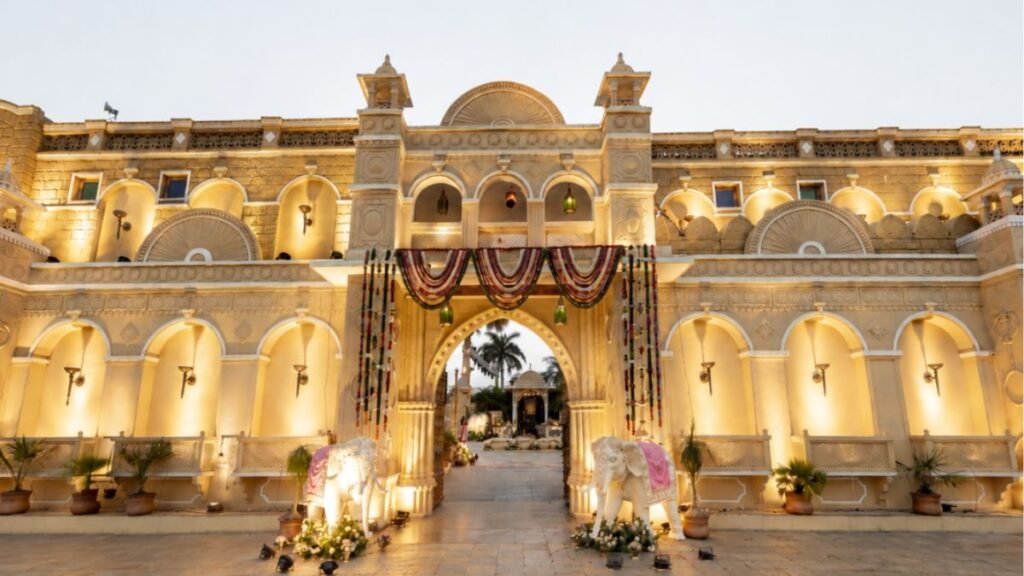
Khirasara Palace today operates as the Heritage Khirasara Palace described as the only heritage hotel and dining property of its kind in the Rajkot region. The palace, spread across approximately 7 acres atop its hilltop position, has been adapted for contemporary hospitality while retaining the architectural character and historical atmosphere of its 450-year past. The property offers 24 to 26 suites, many of which overlook a water body or the surrounding Kathiawar countryside, providing the kind of panoramic, elevated views that the original hilltop site was selected for in the first place.
Guest reviews consistently note the property’s distinctive combination of heritage atmosphere, spacious well-appointed rooms, attentive staff, and the genuine sense of having stepped into a different era of Kathiawar’s royal past. The 360-degree views from the hilltop position looking out over the agricultural countryside surrounding Khirasara village at different times of day are repeatedly cited as one of the property’s most memorable features.
Dining at Khirasara Palace
The Heritage Khirasara Palace offers a notably wide range of dining venues for a heritage property of its size, reflecting its current role as both a tourist destination and a popular wedding and event venue:
- Multi-Cuisine Restaurant – the primary dining venue, with a specialty in traditional Gujarati and Kathiawari cuisine alongside continental and other Indian regional dishes
- Sheesh Mahal – a more atmospheric dining setting, the name evoking the historic ‘palace of mirrors’ tradition found in several Gujarat and Rajasthan royal residences
- Deep Mahal – the dedicated candlelight dining venue for romantic or special-occasion meals
- Wind N Waves – another distinct dining venue within the property
- Jal Vihaar – the pool-view café, ideal for casual dining with views of the swimming pool and gardens
- 24-Hour Coffee Shop – for guests requiring dining or refreshment outside standard restaurant hours
Facilities and Activities
Beyond dining, the Heritage Khirasara Palace offers a substantial range of recreational facilities: an indoor swimming pool and an outdoor swimming pool (frequently mentioned by guests as a highlight particularly the Akshay Ghat swimming pool and the Jal Vihar pool and spa combination), a dedicated spa and massage room, extensive lawns and gardens maintained to a high standard, and on-site temples a Mata Temple and a Mahadev Temple that allow guests to maintain their devotional practice during their stay. EV charging stations and free private parking are also available, reflecting the property’s adaptation to contemporary guest expectations alongside its historical character.
The Sufi Shrine – A Living Piece of the Legend
One of the most unusual aspects of visiting Khirasara Palace today is that the legend of Nale-Sat-Pir is not merely a story told to guests it has a physical, visitable presence on the property. The tombs of Nale-Sat-Pir and his descendants, Aaras Mahmad Pir and Hakimbai, remain on the palace grounds to this day, in the structure that Thakore Ranmalji built specifically to house the Pir and his retinue. For visitors interested in the historical legend, visiting this shrine and understanding its connection to the castle’s construction story adds a dimension to the palace visit that goes beyond standard heritage-hotel sightseeing a genuine piece of 16th/17th-century Sufi devotional history, physically present within a Hindu princely state’s fortress.
Why Visit Khirasara Palace – What Makes It Distinctive
Rajkot district has no shortage of heritage attractions, but Khirasara Palace occupies a particular niche: it is the region’s primary heritage hotel experience the closest thing Rajkot has to the grand palace-hotel tradition that cities like Udaipur, Jodhpur, and Jaipur in neighbouring Rajasthan have made world-famous. For visitors who want to experience a genuine multi-century Kathiawar princely residence, rather than simply view one from outside as a heritage monument, Khirasara Palace offers the rare opportunity to actually stay within the walls of a 450-year-old fortress.
The combination of the legend (the collapsing castle and the Sufi Pir’s intervention), the military history (two repelled Junagadh attacks, captured cannons still mounted at the gate), and the contemporary luxury (pools, spa, multiple dining venues, panoramic hilltop views) gives Khirasara Palace a layered appeal that pure heritage monuments or pure luxury resorts individually cannot match. It functions simultaneously as a historical site worth understanding and a comfortable, even indulgent, place to actually spend a night or two.
Best Time to Visit Khirasara Palace
October to February – Best Overall Season
The winter months offer the most comfortable conditions for enjoying Khirasara Palace’s outdoor features the lawns, gardens, and the 360-degree hilltop views. Rajkot district from October to February has pleasant temperatures of 15 to 27 degrees Celsius, ideal for walking the grounds, visiting the on-site temples and the Sufi shrine, and enjoying meals at the outdoor or pool-view dining venues.
Monsoon — Dramatic Hilltop Views
The monsoon season transforms the Kathiawar countryside visible from the palace’s hilltop position into an intensely green landscape, and the 150-foot elevation provides dramatic views of rain moving across the surrounding plains. For visitors who enjoy monsoon atmosphere clouds at eye level, distant rain visible across the agricultural land below a monsoon stay at Khirasara has its own particular beauty, though outdoor activity may be more limited.
Wedding Season – Plan Around the Crowds
Khirasara Palace is a popular wedding and event venue. If visiting specifically for a quiet heritage stay rather than to attend a function, check with the property whether any large weddings or events are scheduled during your intended dates, as the property’s atmosphere and guest experience can differ significantly during major event periods.
How to Reach Khirasara Palace
| From | Distance | Mode | Approx. Time |
| Rajkot city centre | ~14–20 km | Car / Taxi via Kalawad Road | 25–35 minutes |
| Rajkot Bus Station | ~18.7 km | Car / Taxi | 30 minutes |
| Rajkot Railway Station | ~19–22 km | Car / Taxi | 30–35 minutes |
| Rajkot International Airport | ~47 km | Taxi / Cab | 50–60 minutes |
| Metoda GIDC Industrial Area | ~5 km | Car | 10 minutes |
| ISKCON Rajkot | ~15 minutes drive | Car | 15 minutes |
| Jamnagar | ~90 km | Car | 1.5–2 hours |
| Ahmedabad | ~220 km | Car / Bus | 4 hours |
Khirasara Palace is located off Kalawad Road, near the Metoda GIDC industrial area, in Lodhika Taluka of Rajkot district. The most practical way to reach the palace is by private car or taxi from Rajkot city. Navigate to ‘Heritage Khirasara Palace’ on Google Maps. The property offers airport pick-up services for guests staying overnight confirm this when booking accommodation.
Also Read: Best Restaurants in Rajkot
Nearby Attractions to Combine with Khirasara Palace
- ISKCON Rajkot (Sri Sri Radha Neelmadhav Dham) ~15 minutes | A significant Krishna consciousness temple complex near Khirasara, popular for its architecture and devotional atmosphere.
- Rajkot City ~14–20 km | Alfred High School (attended by Mahatma Gandhi), Rajkot Museum, Watson Museum, and one of Gujarat’s finest café and restaurant scenes. Read our full TravelRoach guides: travelroach.com/best-restaurants-in-rajkot/ and travelroach.com/top-cafes-in-rajkot-for-every-mood/
- Jalaram Bapa Temple, Virpur ~75–80 km | The beloved saint’s temple known for feeding 10,000 people free daily for over 200 years. Read our full TravelRoach guide.
- Khodaldham Temple, Kagvad ~40–45 km | One of the most significant new Shakti temple complexes in Saurashtra, dedicated to Khodal Maa.
Frequently Asked Questions (FAQs)
Khirasara Palace has more than 450 years of recorded history across three phases. It began as a small castle when Thakore Bhimaji, of the Dhrol State’s ruling family, took it as his appendage territory after abdicating the Dhrol throne in favour of his younger brother Junoji. The palace was substantially built by Thakore Ranmalji, an illustrious descendant of Bhimaji, during the era of the Ghori Empire. Ranmalji’s construction famously faced a mysterious problem the masonry kept collapsing nightly which was resolved after consulting a Sufi fakir, Nale-Sat-Pir, and building a dedicated structure for him on the site. The seventh-generation ruler, Thakore Sursinhji, later restored and modernised the palace, introducing it to post-independence development.
According to the palace’s own historical record, when Thakore Ranmalji began construction with 350 masons, the masonry mysteriously collapsed every evening despite sustained skilled effort. Ranmalji consulted Nale-Sat-Pir, a Sufi fakir from Sindh dwelling near the castle, who told him that to keep his castle unbeaten, he must construct an enchanting place for Allah’s sake. Ranmalji built a grand structure to the north of the castle, large enough to house 200 to 400 people, specifically to honour the Pir and his retinue. From that point, the castle’s construction held, and it remained undefeated through multiple subsequent military attacks. The tombs of the Pir and his descendants, Aaras Mahmad Pir and Hakimbai, remain on the property to this day.
No – according to its recorded history, Khirasara Castle remained undefeated through every attack it faced. Mohbatkhan, the powerful Nawab of Junagadh, attacked the castle on two separate occasions and was repelled both times. Meraman Khawas of Jamnagar also attacked Khirasara and was unsuccessful. As permanent records of these victories, two cannons captured from Junagadh’s artillery were mounted at the castle’s eastern gate, where they reportedly remain today, and a large ceremonial kettledrum was placed in the state treasury as a symbol of triumph.
Yes – Khirasara Palace operates today as the Heritage Khirasara Palace, a luxury heritage hotel offering 24 to 26 suites across a 7-acre property. It is described as the only heritage hotel and dining property of its kind in the Rajkot region. Facilities include indoor and outdoor swimming pools, a spa, multiple dining venues (including candlelight dining at Deep Mahal and a pool-view café at Jal Vihaar), extensive lawns and gardens, and on-site Mata and Mahadev temples. The property is also a popular wedding and event venue. Book accommodation directly through the property’s official channels or major hotel booking platforms.
Khirasara Palace is approximately 14 to 20 km from Rajkot city, off Kalawad Road near the Metoda GIDC industrial area in Lodhika Taluka. By car or taxi, the journey takes approximately 25 to 35 minutes. From Rajkot Bus Station, the distance is approximately 18.7 km; from Rajkot Railway Station, approximately 19 to 22 km. From Rajkot International Airport, the distance is approximately 47 km, taking 50 to 60 minutes. The property offers airport pick-up services for overnight guests confirm this when booking. Navigate to ‘Heritage Khirasara Palace’ on Google Maps for accurate directions.
Heritage Khirasara Palace offers an unusually wide range of dining venues for a property of its scale: a Multi-Cuisine Restaurant specialising in traditional Gujarati and Kathiawari cuisine alongside continental and Indian regional dishes; Sheesh Mahal, an atmospheric heritage-style dining venue; Deep Mahal, a dedicated candlelight dining area for special occasions; Wind N Waves; Jal Vihaar, a pool-view café; and a 24-hour coffee shop. This range reflects the property’s dual role as both a heritage tourist destination and a popular wedding and event venue.
Khirasara Palace can be visited as a day trip from Rajkot for lunch or dinner at one of its restaurants, a walk through the gardens, and a visit to the on-site Sufi shrine and temples many visitors do exactly this, particularly those interested in the palace’s history without committing to an overnight stay. However, the property’s full character the panoramic hilltop views at sunrise and sunset, the swimming pools, the spa, and the genuine atmosphere of staying within a 450-year-old fortress is best experienced with an overnight stay. Both options are viable depending on your time and interest.
Final Thoughts
Every old building in Kathiawar seems to carry a story that blends documented history with something closer to folklore and Khirasara Palace tells one of the best. A castle that would not stand. Three hundred and fifty masons defeated by something no engineer could explain. A wandering Sufi fakir who gave a riddle instead of an answer, and a Hindu Thakore who built him a home rather than dismiss him, and from that act of respect, a fortress that no army could ever take.
Four hundred and fifty years later, the tombs are still there. The cannons captured from Junagadh are still mounted at the gate. The kettledrum from the Jamnagar victory is somewhere in what was once the treasury. And the palace that would not be built has become, of all things, a place where people go for a quiet weekend, a wedding, a swim, and a candlelit dinner at Deep Mahal.
History does not always end where you expect it to. Sometimes a fortress built to withstand armies ends up withstanding nothing more dramatic than a wedding party and a poolside breakfast and that, too, is a kind of victory.
Have you visited or stayed at Khirasara Palace? Share your experience the view from your suite, the legend as told by the staff, the meal at Sheesh Mahal in the comments. TravelRoach would love to hear from every Rajkot heritage explorer.
