Deep in the Gir forest in the same forest that is the last home of the Asiatic lion there is a temple that most visitors to Gujarat never find. It is on the Dhari-Una road in Amreli district, approximately 66 kilometres from Sasan Gir and 45 kilometres from Diu. The approach road runs through the Gir forest itself: the kind of road where, in the early morning or at dusk, peacocks cross in front of your vehicle and sambhar deer watch from the treeline.
At the end of this forest road, you park, and you climb 100 steep steps through the trees to reach a 700-year-old temple of Lord Krishna. And at the base of those steps, where the path meets the forest floor, three natural hot springs emerge from the earth. The first is warm. The second is hotter. The third is boiling you can see steam rising from the water in the cool forest air. The springs are rich with sulphur. The Puranas call them Taptodak hot water. Pilgrims believe that bathing in them heals skin diseases, gout, and rheumatism.
Tulsishyam is one of Gujarat’s most unusual destinations: equal parts pilgrimage site, natural wonder, and wildlife encounter. This TravelRoach guide covers the legend, the temple, the three hot springs, the gravity hill phenomenon, the Rukmini Devi Temple, the 200-cow Gaushala, the free meals, timings, festivals, how to reach, and why this hidden corner of Amreli is worth the forest road drive.
Tulsi Shyam Temple — Quick Information
| Detail | Information |
| Full Name | Tulsishyam Temple / Tulsi Shyam Mandir |
| Address | Dhari-Tulsi Shyam Road, near Dhari, Amreli District, Gujarat (Dhudhala Gir area) |
| Setting | Inside Gir National Park forest – one of India’s most biodiverse wildlife reserves |
| Dedicated To | Lord Krishna (Shyam) – worshipped here as Tulsishyam (Lord who conquered the demon Tul) |
| Temple Age | ~700 years old |
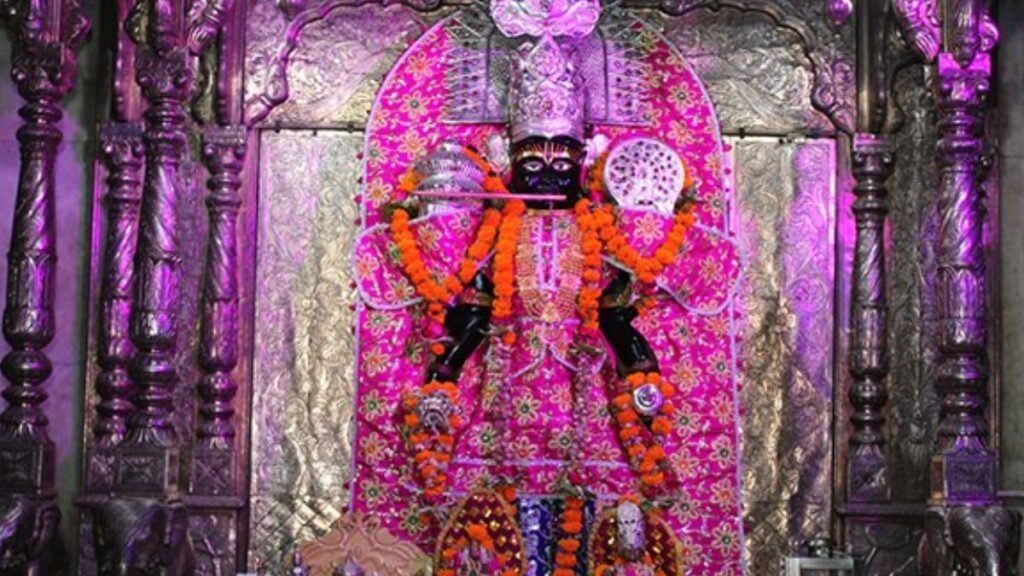
| Idol Age | ~3,000 years old – made of black stone; the murti is considered extremely ancient |
| Steps to Temple | 100 steep steps from the parking area to the main sanctum |
| Hot Springs | Three sulphur hot springs (Taptodak) at the base – warm, hot, and boiling |
| Springs Medicinal Use | Believed to cure skin diseases, gout, and rheumatism; sulphur-rich water |
| Gravity Hill | A stretch of road near the temple where vehicles appear to roll uphill in neutral gear |
| Rukmini Devi Temple | A 700-year-old temple dedicated to Rukmini (Krishna’s wife) on a nearby hillock — 100 steps; black marble idol |
| Gaushala | More than 200 cows maintained at the temple |
| Free Meals | Lunch and dinner available free to all visitors |
| Entry Fee | Free – no entry fee |
| Accommodation | Government guest house available for overnight stays |
| Annual Fair | September – yearly fair at the temple |
| Tulsivivah Festival | October/November – celebration of the marriage of Lord Vishnu with Sati Vrinda (Tulsi) |
| Wildlife on the Way | Lions, sambhar deer, peacocks possible along the forest approach road |
| Distance from Una | ~29 km |
| Distance from Diu | ~45 km |
| Distance from Sasan Gir | ~66 km |
| Distance from Amreli city | ~76 km |
| Distance from Junagadh | ~170 km |
| Best Season | November to March – cool weather + best wildlife sighting conditions |
The Legend – Krishna, the Demon Tul, and the Name Tulsishyam
The Name and Its Origin
The name Tulsishyam contains the complete identity of this sacred site within its two syllables. Tulsi in one reading, the sacred Tulsi plant (holy basil), among the most revered plants in Vaishnavism, offered to Vishnu/Krishna in every daily worship across India. In the other reading, the demon Tul, whose defeat at this location by Lord Krishna gives the place its name. Shyam one of Lord Krishna’s most beloved epithets: the dark one, the one of luminous dark complexion, who is Lord Krishna in his most intimate and beloved form.
The founding legend of Tulsishyam combines both readings. Lord Krishna Shyam came to this location and defeated a demon named Tul in battle. The place where Shyam killed Tul became Tulsishyam: the spot of Krishna’s victory over the demon, the consecrated forest clearing where the divine warrior accomplished his act of liberation, and where his presence has remained concentrated ever since.
The 3,000-Year-Old Idol
The principal idol of Lord Krishna (Tulsishyam) enshrined in the main sanctum is believed to be approximately 3,000 years old one of the most ancient murtis in active worship in Gujarat. Made of black stone, the idol’s colouring reflects Krishna’s own character as Shyam the dark one and the material’s antiquity adds a quality of concentrated sacred time to the darshan. Standing before an idol that people have worshipped for three millennia is a different experience from standing before a recently installed murti. The centuries of prayer have accumulated in the object itself.
The Puranic Connection – Taptodak
The hot springs at Tulsishyam are mentioned in the Hindu Puranas under the name Taptodak from Tapta (heated, scalding) and Udak (water). The Puranic acknowledgement of this specific site’s hot water springs gives the location a place in India’s ancient sacred geography that predates the 700-year-old temple structure. The hot springs were known and venerated long before the medieval temple was built above them. They are part of the reason the forest clearing at Tulsishyam was identified as sacred in the first place.
The Hot Springs – Taptodak and the Three Temperatures
Three Springs, Three Temperatures
The three hot sulphur springs at Tulsishyam are among the most extraordinary natural phenomena at any pilgrimage site in Gujarat. They emerge from the earth at the base of the temple hill, and their most remarkable characteristic is not simply that they are hot but that the three springs have three different temperatures each one distinctly hotter than the previous.
- The First Spring: Warm water – comfortable for bathing; devotees soak and wade; the temperature is noticeable but not uncomfortable
- The Second Spring: Noticeably hotter – requires acclimatisation; more therapeutically intense; dedicated bathers immerse here
- The Third Spring: Boiling water – steam visibly rising; too hot for immersion; used for heating water, observational, and ritual purposes
The progression from warm to hot to boiling across three closely spaced springs is geologically unusual and devotionally significant. The three-stage structure reinforces the concept of a graduated approach to divine heat the earthly heat of the springs understood as an analogue for the spiritual heat (tapas) of devotional practice.
The Sulphur Content and Medicinal Claims
The springs are rich in natural sulphur the distinctive rotten-egg smell of sulphur is detectable near the springs, and the yellowish tinge of sulphur deposits is visible on the rocks around the spring sources. In traditional Indian medicine (Ayurveda) and in the empirical folk knowledge that accumulates around active medicinal springs, sulphur-rich water is believed to be therapeutic for skin conditions, joint pain, gout, and rheumatism.
The medicinal claims for the Tulsishyam springs are not unique to this site sulphur hot springs worldwide have been used for their therapeutic properties for thousands of years. The combination of the heat (which increases circulation and opens pores) and the sulphur content (which has demonstrated antimicrobial and anti-inflammatory properties) creates a therapeutic environment that modern science partially endorses. Pilgrims who have bathed in the springs report relief from persistent skin conditions and joint pain that had not responded to other treatments.
Bathing in the Springs – What to Know
Bathing in the first and second springs is the primary practical activity associated with the hot springs. The warm first spring is most accessible for families and children. The second spring, being hotter, is for devotees specifically seeking the more intensive therapeutic experience. The third spring is generally not for bathing.
Appropriate modest attire for bathing as expected at a sacred site in a public setting. Separate bathing arrangements for men and women may be available or expected; confirm on arrival. Carry a change of clothes and a towel. The springs are most energising in the cool morning or evening air, when the contrast between the forest temperature and the spring water temperature is most pronounced.
The Gravity Hill – Vehicles That Roll Uphill
Among the many unusual features of the Tulsishyam temple complex, one of the most talked-about and most frequently verified by visitors is the gravity hill phenomenon near the temple approach road. On a specific stretch of road near the temple, vehicles placed in neutral gear appear to roll uphill against the apparent slope, against the direction that gravity should pull them, against every physical intuition.
This ‘magnetic hill’ or ‘gravity hill’ effect is found at several locations across the world and has been extensively studied. The scientific explanation is an optical illusion the surrounding landscape creates a visual context that makes a slight downhill slope appear to be an uphill slope. The vehicle is actually rolling downhill, but the visual information suggests it is rolling up. The effect is entirely consistent with known optical phenomena and requires no extraordinary explanation.
That said, the experience of seeing your parked vehicle apparently rolling uphill regardless of what you intellectually know about optical illusions is genuinely strange and genuinely enjoyable. Visitors consistently rate the gravity hill among the most memorable parts of the Tulsishyam visit. It is the kind of thing that makes you doubt your eyes even when your mind has already explained it.
The Rukmini Devi Temple – Krishna’s Wife in the Forest
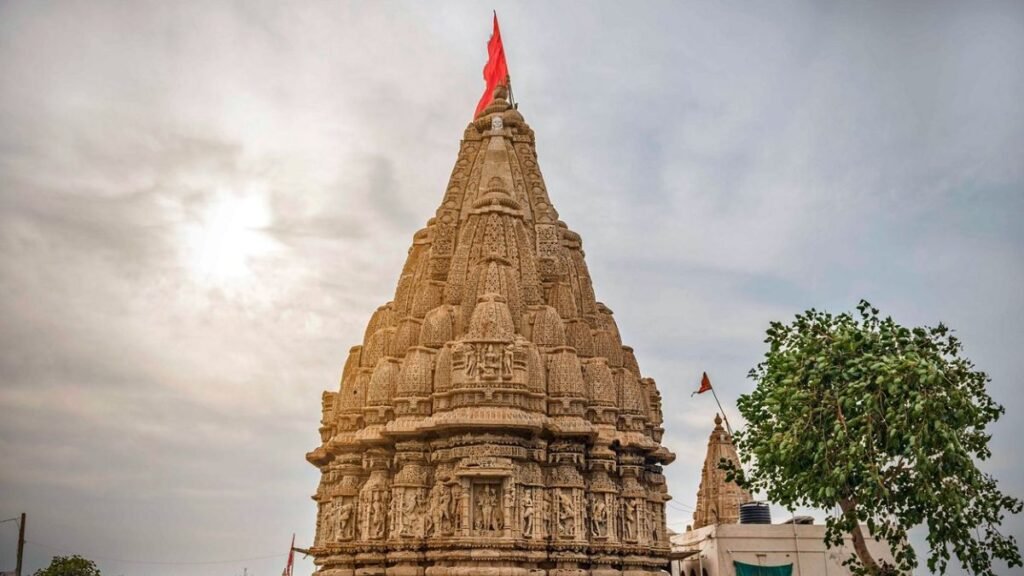
Near the main Tulsishyam temple, on a small hillock, stands the Rukmini Devi Temple a 700-year-old shrine dedicated to Rukmini, the principal wife of Lord Krishna and the embodiment of Lakshmi in the Vaishnava tradition. Rukmini’s story is one of the most celebrated in the Krishna narrative: she sent a secret letter to Krishna asking him to come and abduct her before her family could marry her to the ruler of Chedi. Krishna arrived just in time, carried Rukmini away, and married her establishing the standard for a particular form of love marriage in the Indian devotional imagination.
The Rukmini Devi Temple at Tulsishyam requires its own separate climb of approximately 100 steps to reach a smaller, quieter ascent than the main temple, leading to an intimate shrine whose idol of Rukmini is made of black marble and stands approximately two feet tall. A small idol of Lord Krishna is also present near the Rukmini idol. The temple is peaceful few visitors make the second climb to Rukmini Devi, which means you will often have it to yourself and the view from the hillock over the surrounding Gir forest is one of the finest natural views available at the Tulsishyam complex.
The Gir Forest Drive – Wildlife on the Way to the Temple
The journey to Tulsishyam is itself an experience. The approach road passes through the Gir forest one of India’s most important and most successful wildlife conservation areas, home to the world’s last free-ranging population of Asiatic lions. While the main safari zone for lion sightings is centred around Sasan Gir, the broader forest area that encompasses the Tulsishyam road also carries the possibility of wildlife encounters.
- Peacocks – visible with high frequency along the Gir forest roads, particularly in the morning and late afternoon hours
- Sambhar deer – large, forest deer that are one of the lion’s primary prey species in Gir; often visible from the forest roads
- Spotted deer (Chital) – smaller, more abundant deer species
- Asiatic lion – possible, though less likely than on the main safari routes; Gir forest roads occasionally produce lion sightings
- Various bird species – the Gir forest is rich in birdlife including raptors, kingfishers, and multiple wading species
The forest drive to Tulsishyam is best done in the early morning (starting from Una or Diu before 6 AM) for the maximum wildlife encounter probability. The road is single-lane through much of the forest and the early morning light on the forest canopy is beautiful. Pack a camera with a good zoom lens. Drive slowly. The temple at the end of the road will be there when you arrive – the forest around the road is the gift of the journey.
Also Read: Gir National Park Safari Guide
Festivals at Tulsi Shyam Temple
The Annual Fair – September
A yearly fair is organised at the Tulsishyam temple in September drawing visitors from across the Amreli and Junagadh district region. The fair combines devotional celebration with the commercial and social activity of a traditional rural mela. September is also the tail end of the monsoon season, when the forest surrounding the temple is at its most lushly green making the fair a visually beautiful event in addition to a devotionally significant one.
Tulsivivah – October/November
The Tulsivivah festival celebrated in October or November (the 11th or 12th day of Kartika month, Devuthani Ekadashi / Prabodhini Ekadashi) is the most theologically important festival at the Tulsishyam temple. Tulsivivah celebrates the marriage of Lord Vishnu with Sati Vrinda the goddess who takes the form of the Tulsi plant (holy basil) which in Vaishnava tradition marks the end of the Chaturmas (the four-month period during which auspicious events including marriages are traditionally not performed). The Tulsivivah at Tulsishyam has a particular resonance given the temple’s name and the mythological connection between Tulsi, Vishnu/Krishna, and the forest location.
Best Time to Visit Tulsi Shyam Temple
November to March – Best Overall Season
The winter months are optimal for Tulsishyam for multiple reasons simultaneously. The weather in this part of South Saurashtra is pleasant 18 to 27 degrees Celsius and the cool forest air in contrast with the hot springs creates the most pleasurable hot spring bathing experience of the year. The wildlife sighting probability on the forest drive is highest in November to February when animals are more visible at forest edges. The forest is not overly dense with monsoon growth, allowing better views. November to February is the definitive Tulsishyam season.
Early Morning – The Essential Timing
Regardless of season, an early morning arrival at Tulsishyam is essential. The forest road to the temple at dawn the peacocks, the deer, the quality of the early light through the canopy is the best version of the journey. The hot springs at dawn, with steam rising from the boiling third spring in the cool morning air, are at their most atmospheric. And the temple, reached after the 100-step climb in the morning freshness, is at its most peaceful before the daytime pilgrims arrive.
Monsoon – Beautiful but Check Road Conditions
The monsoon (June to September) transforms the Gir forest into an intense, dripping, heavily green landscape of great beauty. The hot springs continue to flow. The temple is accessible. However, the forest roads can become difficult in heavy rainfall, the wildlife is less visible in the dense monsoon vegetation, and the hot spring bathing experience is less dramatic in warm humid monsoon conditions. Confirm road conditions locally before a monsoon visit.
How to Reach Tulsi Shyam Temple
| From | Distance | Mode | Approx. Time |
| Una | ~29 km | Car / Private Vehicle / Bus | 45 minutes |
| Diu | ~45 km | Car / Taxi | 1 hour |
| Diu Airport | ~45 km | Flight + Taxi | 1 hour |
| Sasan Gir (Lion Safaris) | ~66 km | Car | 1.5 hours |
| Amreli city | ~76 km | Car | 1.5 hours |
| Veraval / Somnath | ~100 km | Car | 2 hours |
| Junagadh city | ~170 km | Car | 3 hours |
| Porbandar | ~150 km | Car | 3 hours |
| Ahmedabad | ~380–400 km | Car / Train to Una + local | 7+ hours |
Tulsi Shyam Temple is best reached by private vehicle. The nearest town is Una (~29 km) or Dhari (on the Dhari-Una road). From Una or Diu, taxis and private vehicles can take you directly to Tulsishyam on the Dhari-Una forest road. State transport buses also serve the route — ask locally for the current bus schedule from Una to Tulsishyam. Navigate to ‘Tulsishyam Temple’ or ‘Tulsi Shyam Hot Springs’ on Google Maps.
Also Read: Junagadh Travel Guide: Top Places, Girnar & Things To Do
Practical Information for Your Tulsi Shyam Visit
- Carry a change of clothes and a towel for the hot springs the bathing experience is the primary activity at the site; most pilgrims bring appropriate change-of-clothes.
- 100 steps for both the main temple and Rukmini Devi Temple the climb is not difficult for fit adults but may be challenging for elderly visitors. There is no ropeway or lift. Plan accordingly.
- Free meals available lunch and dinner are served to all visitors free of cost. The Gaushala (with 200+ cows) reflects the temple’s commitment to traditional hospitality.
- Overnight accommodation a government guest house is available near the temple. Book in advance for the September fair and Tulsivivah festival periods.
- Drive slowly on the forest road the Gir forest road to Tulsishyam passes through lion territory. Follow all forest road protocols: do not stop in the middle of the road, do not exit your vehicle in the forest section, drive at moderate speed.
- Best photography opportunities the boiling third spring with steam rising (especially in cool morning air), the forest approach road at dawn, the view from the Rukmini Devi hillock, and the 100-step approach through the trees.
- Combine with Gir National Park safari Sasan Gir is 66 km away. A Gir lion safari combined with a Tulsishyam visit makes for one of Gujarat’s most unusual and most complete single-day nature-and-pilgrimage experiences. Two completely different kinds of power: the Asiatic lion in his natural habitat, and the ancient forest temple with its sulphur springs.
Also Read: Prabhas Patan Museum Somnath
Nearby Attractions to Combine with Tulsi Shyam Temple
- Sasan Gir National Park ~66 km | The only home of the Asiatic lion; jeep safaris through the sal forest to track the world’s last free-ranging Asiatic lion population. An extraordinary wildlife experience. Book safaris in advance.
- Diu ~45 km | The former Portuguese colony island off the south Saurashtra coast St. Paul’s Church, Diu Fort, Nagoa Beach, and the distinct Portuguese-Indian cultural character of this union territory. Read our full TravelRoach guide.
- Somnath Temple ~100 km via Veraval | The first and most important Jyotirlinga the sacred city of Somnath on the Arabian Sea cliff. Read our full TravelRoach guide.
- Junagadh ~170 km | Girnar Hill (10,000 steps), Uparkot Fort, Mahabat Maqbara, Ashoka’s Rock Edicts. Read our full TravelRoach guide.
Frequently Asked Questions (FAQs)
Tulsi Shyam Temple (Tulsishyam Mandir) in Amreli district, Gujarat, is famous for three distinctive features: its location deep inside the Gir National Park forest India’s last lion habitat; the three sulphur hot springs (called Taptodak in the Puranas) on the temple premises with progressive temperatures of warm, hot, and boiling water, believed to cure skin diseases, gout, and rheumatism; and the gravity hill phenomenon near the temple approach road where vehicles appear to roll uphill in neutral gear. The temple itself is dedicated to Lord Krishna (Tulsishyam) and its principal idol is believed to be 3,000 years old, housed in a 700-year-old temple structure. Entry is free and the temple provides free meals to all visitors.
The three hot sulphur springs at Tulsishyam are known as Taptodak hot water in the Puranas. They emerge from the earth at the base of the temple hill and have three distinct temperature zones: the first spring is warm and comfortable for bathing; the second is noticeably hotter; and the third spring is boiling with visible steam rising from the water surface. All three springs are rich in natural sulphur. In the tradition of Indian medicinal knowledge, bathing in the sulphur-rich warm and hot springs is believed to be therapeutic for skin diseases, joint conditions, gout, and rheumatism. The springs are one of the primary reasons devotees and tourists make the journey to the otherwise remote forest location.
A stretch of road near the Tulsi Shyam Temple is known as a gravity hill or magnetic hill a location where vehicles placed in neutral gear appear to roll uphill against the direction of gravity. This effect, found at several locations worldwide, is a well-documented optical illusion: the surrounding forest and terrain create a visual context that makes a slight downhill slope appear to be uphill, so the vehicle rolling downhill appears to be rolling up. The effect is consistent with known optical phenomena and does not require a supernatural explanation. However, experiencing it directly watching your car apparently roll uphill is genuinely strange and memorable regardless of the scientific explanation.
Tulsi Shyam Temple is approximately 45 km from Diu one of the shortest distances from any major nearby tourist destination. From Diu, take the road toward Una (~25 km) and then follow the Dhari-Una road through the Gir forest to Tulsishyam (~20 km further). The total journey takes approximately 1 hour by private vehicle. Taxis are available from Diu for the full round trip. The forest road through Gir is well-maintained but single-lane in sections. Drive slowly and enjoy the wildlife along the way.
The principal idol of Lord Krishna (Tulsishyam) at the main sanctum is believed to be approximately 3,000 years old making it one of the most ancient murtis in active worship anywhere in Gujarat. The idol is made of black stone, reflecting Krishna’s identity as Shyam (the dark one). While the 700-year-old temple structure was built in the medieval period, the idol it houses predates the building significantly. The antiquity of the idol and the centuries of prayer that have been offered before it give the darshan at Tulsishyam a quality of depth and accumulated sacred time that more recently installed murtis cannot have.
Yes – the Tulsi Shyam Temple is located within or immediately adjacent to the Gir forest area, the protected landscape that constitutes Gir National Park and the surrounding Gir Wildlife Sanctuary. The approach road to the temple runs through the forest, and the possibility of encountering wildlife including peacocks, sambhar deer, and occasionally Asiatic lions exists on the forest drive. The temple itself is in a forest clearing within this protected landscape. Visitors should follow all forest road protocols: no stopping in the middle of the forest road, no exiting the vehicle in the forest section, moderate driving speed, and respect for the protected environment.
The most important attractions near Tulsi Shyam Temple are: Sasan Gir National Park (~66 km) the primary Gir lion safari zone where jeep safaris track the Asiatic lion; Diu (~45 km) the former Portuguese colony island with beaches, Fort Diu, St. Paul’s Church, and a distinctive colonial character; Somnath Temple (~100 km via Veraval) the first Jyotirlinga on the Arabian Sea; and Junagadh (~170 km) with Girnar Hill’s 10,000 steps, Uparkot Fort, and the famous Mahabat Maqbara. The most natural single-day combination is Tulsi Shyam Temple (morning) + Diu (afternoon) or, for wildlife enthusiasts, a Gir lion safari (morning) + Tulsi Shyam (afternoon/evening).
Final Thoughts
Gujarat has temples in cities, temples on hilltops, temples on islands, temples in deserts, and temples by the sea. Tulsishyam is the temple in the forest. The lion’s forest.
You get there by driving slowly on a forest road where peacocks cross without urgency and where, if you are fortunate, the shape of a lion in the grass at the treeline makes you stop breathing for a moment. You park. You walk to three springs that emerge from the earth in three temperatures, the hottest one steaming in the cool forest air. You climb 100 steps through trees to reach a 700-year-old temple that houses an idol three thousand years old. You have darshan. You eat the free meal. You climb another 100 steps to visit Rukmini Devi on her hillock. You look at the forest from above.
Then you park your car on the gravity hill and watch it roll uphill for a moment, your eyes insisting on something your mind already knows is impossible.
Then you drive back through the forest, slowly, watching for lions.
Tulsishyam is not on most itineraries. It should be on yours.
