In a small town near Gondal in Rajkot district, in a region of Gujarat known for its religious and cultural heritage, there is a temple that has been feeding people every single day for over 200 years. Not occasionally. Not on festivals. Every day, twice a day once at lunch, once at dinner the Annakshetra at Virpur’s Jalaram Bapa Temple serves khichdi and kadhi to all who come. Approximately 10,000 people eat here every day. No one is turned away. No one pays. And since the year 2000, the temple has also stopped accepting donations of any kind making it, by the account of those who know it best, the only temple in the world that neither charges nor accepts money, and yet feeds ten thousand people daily without interruption.
The man responsible for this tradition is Jalaram Bapa Shree Jalaram Pradhan Thakkar born in Virpur in 1799, died in 1881 at the age of 81. He was a devotee of Lord Rama of an extraordinarily total kind: a man who considered feeding the hungry not a charitable act but a sacred one, who welcomed sadhus, saints, the needy, and the curious with identical hospitality regardless of their identity or religion, and whose life was a continuous demonstration that the highest act of devotion to God is the service of human beings.
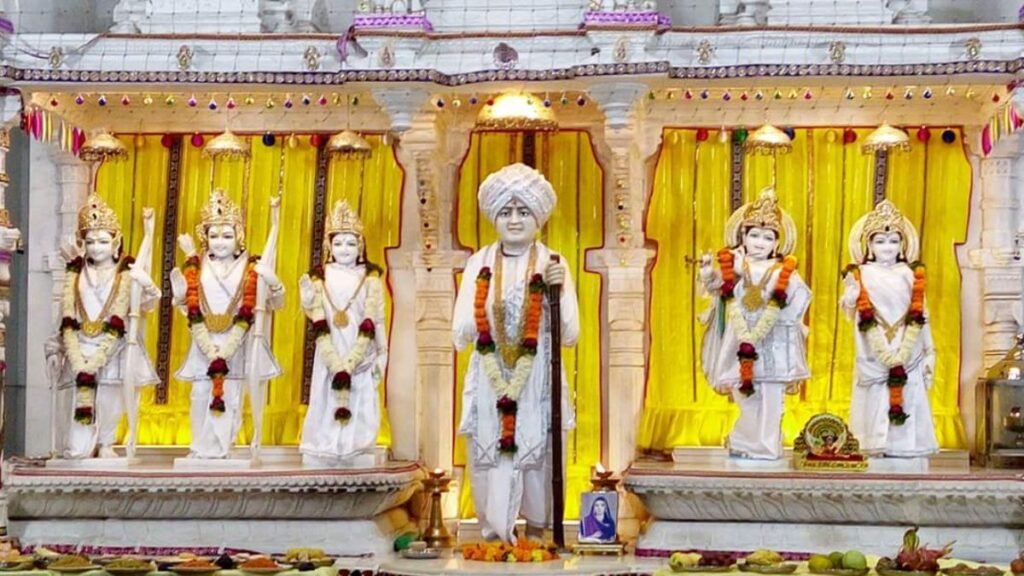
The temple at Virpur is not a building erected after Bapa’s death to honour his memory. It is the house where he lived. The room where he prayed still has the idols of Rama, Sita, Lakshmana, and Hanuman that he worshipped. His sacred Jholi (alms bag) and Danda (staff) are there. His Samadhi is there. This guide covers the full story of Jalaram Bapa’s life, the legends that define his identity, the temple’s distinctive practices, darshan timings, festivals, how to reach from Rajkot, and all practical information for a complete visit.
Jalaram Bapa Temple, Virpur – Quick Information
| Detail | Information |
| Full Name | Shree Jalaram Bapa Mandir (Jalaram Bapa Temple) |
| Location | Virpur village, near Gondal, Rajkot District, Gujarat |
| The Temple | The actual house where Jalaram Bapa lived not a later-built memorial structure |
| Deity / Saint | Shree Jalaram Bapa (Jalaram Pradhan Thakkar) born November 14, 1799; died February 23, 1881 |
| Primary Devotion | Lord Rama the temple holds the idols of Rama, Sita, Lakshmana, and Hanuman that Bapa worshipped |
| Sacred Objects | The Jholi (alms bag) and Danda (staff) of Jalaram Bapa believed to be divine gifts |
| Most Distinctive Feature | Free khichdi-kadhi prasad twice daily for ~10,000 people — 200+ years without interruption |
| Donation Policy | NO DONATIONS ACCEPTED since the year 2000 unique worldwide |
| Entry Fee | Free – no entry fee for darshan |
| Darshan Timings | 7:00 AM – 12:30 PM and 4:00 PM – 8:30 PM (open every day of the year) |
| Aarti Timings | 7:30 AM (Mangala Aarti), 9:00 AM (Sringarti Aarti), 7:30 PM (Evening Aarti) |
| Free Meals | Khichdi and Kadhi served free twice daily at the Annakshetra/Bhojnalaya |
| Free Accommodation | Dharamshala available for pilgrims free of cost |
| Thursday | Most auspicious weekly day for Jalaram devotees larger than usual darshan |
| Most Important Festival | Jalaram Jayanti — 7th Shukla Paksha of Kartika month (November) |
| Other Festivals | Death Anniversary (Feb 23), Ram Navami, Hanuman Jayanti, Diwali, Janmashtami |
| Sites Within Complex | Main shrine (Bapa’s house), Sacred Jholi and Danda, Samadhi of Jalaram Bapa, Samadhi of Jetha Bapa, Virpara Nath Mandir |
| Distance from Rajkot | ~60 km (~1 to 1.5 hours by road) |
| Distance from Rajkot Airport | ~57 km (~1 hour) |
| Distance from Junagadh | ~46 km (~50 minutes) |
| Distance from Ahmedabad | ~275 km (~4.5–5 hours) |
| Nearest Railway | Virpur Railway Station – just ~1 km from the temple; well connected to Rajkot and Gondal |
Jalaram Bapa – The Life of the Saint of Virpur
Birth and Family – November 14, 1799
Jalaram Pradhan Thakkar universally known as Jalaram Bapa was born on November 14, 1799, in Virpur village, Rajkot district, Gujarat. He was born one week after Diwali, in the Kartika month a timing that his devotees find deeply meaningful given his lifelong devotion to Lord Rama, who is associated with the Diwali festival. His father was Pradhan Thakkar and his mother was Rajbai Thakkar, both from the Lohana community.
Rajbai Thakkar, his mother, played a decisive role in shaping his character. She was a deeply religious woman whose household was always open to sadhus and saints the tradition of the day held that no saint should leave Virpur without receiving the hospitality of Rajbai’s home. In the oral tradition around Jalaram Bapa, it is said that a visiting saint once told Rajbai that her son would become a famous person teaching the importance of duty, devotion, and virtuous action. From his earliest years, young Jalaram absorbed the practice of welcoming others from his mother the root of everything the temple at Virpur has since become.
Also Read: Kashtabhanjan Dev Temple Sarangpur
The Spiritual Turning Point – Guru Bhojalram
As a young man, Jalaram showed more interest in religious devotion than in the family’s business a spiritual inclination that worried his father but did not, as in many such stories, produce conflict. At the age of 16 he was married to Virbai, a woman who would become his lifelong companion in his service work and would be known in her own right as Virbai Maa a figure of devotion and practical seva (service) alongside her husband.
At the age of 18, Jalaram became a disciple of Shri Bhojalram of Fatehpur a significant Vaishnava saint of the Saurashtra region. Under his guru’s influence and with his guru’s blessing, Jalaram Bapa made the decision that would define the rest of his life and establish his legacy: he established the Sadavrat.
The Sadavrat – Feeding the World for 200 Years
Sadavrat – from Sada (always, continuously) and Vrat (vow, commitment) is the tradition Jalaram Bapa established of providing continuous free food to all who came to his door. In the Hindu and Jain traditions of Gujarat, the feeding of sadhus, saints, and the needy is considered a sacred act Anna Daan (gift of food) is among the highest forms of charity. Jalaram Bapa took this tradition to a different level entirely.
He began by feeding the sadhus and wandering saints who passed through Virpur. As his reputation grew as word spread that at Jalaram Bapa’s door no one was turned away and no one needed to pay the numbers coming to eat increased. By the time of his maturity, the Sadavrat had become a fully established community institution: a kitchen running every day, two meals served, all comers welcome. This tradition established in Bapa’s own lifetime, in his own home has now continued without interruption for over 200 years. The kitchen has not closed. The khichdi and kadhi have not stopped.
Hospitality Without Borders – The Arabs of the Rajkot Thakore
Among the many stories of Jalaram Bapa’s life, one is particularly celebrated for what it reveals about the breadth of his hospitality. Four Arab men in the service of the Thakore (ruler) of Rajkot once came to Virpur. Their Arabic identity and Muslim faith were known. Jalaram Bapa welcomed them and fed them with exactly the same warmth and generosity as he extended to Hindu sadhus and pilgrims. The Arabs were astonished. In the social and religious context of 19th-century Saurashtra, such unconditional welcome across religious lines was unusual. The story is remembered as evidence that Bapa’s service was genuinely universal it was not conditional on the identity of the person being served.
The Sacred Jholi and Danda – The Divine Gifts
Two objects at the Jalaram Bapa Temple are among the most revered in all of Gujarat’s devotional landscape: the Jholi (alms bag) and the Danda (walking staff) that Bapa carried. The tradition around these objects holds that they were given to Bapa as divine gifts in the version told at Virpur, they were received from a visiting sadhu who Bapa served with exceptional generosity and who turned out to be a divine presence in disguise.
The Jholi and Danda are displayed in the main shrine of the temple, where they have been preserved for more than a century after Bapa’s passing. Devotees consider darshan of these objects standing before the bag and staff that Bapa carried throughout his life of service as one of the most powerful experiences the temple offers. The objects are simple: a plain cloth bag, a wooden staff. Their power lies entirely in what they represent: a life of continuous, unconditional service, carried out until the very end.
Passing -February 23, 1881
Jalaram Bapa passed from the mortal world on February 23, 1881 at approximately 81 years of age. He had spent those 81 years in the same village where he was born, in the same house, living in the same spirit of total service that his mother had modelled for him as a child. He had never sought to build a large institution or accumulate followers or property. He had simply fed people every day and welcomed everyone who came. The scale of the institution that grew around this simple practice the 10,000 daily meals, the millions of annual pilgrims, the temple complex that now covers the old house is the posthumous measure of what consistent, genuine service produces over time.
The Temple – Bapa’s House as Sacred Space
The Main Shrine -Living in His Rooms
The Jalaram Bapa Temple at Virpur is not, in the conventional sense, a temple. It is a house the actual home where Jalaram Bapa was born, lived, worked, and died. The main shrine represents and preserves the rooms and spaces of that house as they were during his lifetime. Walking into the main shrine at Virpur is walking into the spaces where Bapa prayed, cooked, received visitors, and served.
At the centre of the shrine are the idols of Rama, Sita, Lakshmana, and Hanuman the specific deities that Jalaram Bapa worshipped throughout his life. These are his idols, in his room, in the arrangement he kept them. The quality of intimate connection between the devotee’s darshan and the saint’s own devotional practice is rarely available at temples of this significance, because most temples are built after the saint’s death to honour their memory. At Virpur, the saint’s presence saturates the space itself.
The Jholi and Danda – The Objects That Tell His Story
The sacred Jholi (alms bag) and Danda (walking staff) of Jalaram Bapa are displayed in the temple the physical objects he carried throughout his life. For devotees, these are not museum exhibits but living sacred presences. The Jholi is associated with the saint’s practice of receiving alms (giving your bag to a visiting sadhu, receiving it back, finding it miraculously full) the specific tradition of Vaishnava mendicancy that Bapa embodied and transformed through his particular quality of faith.
Also Read: Shree Siddhivinayak Temple, Mehmedabad
Samadhi of Jalaram Bapa
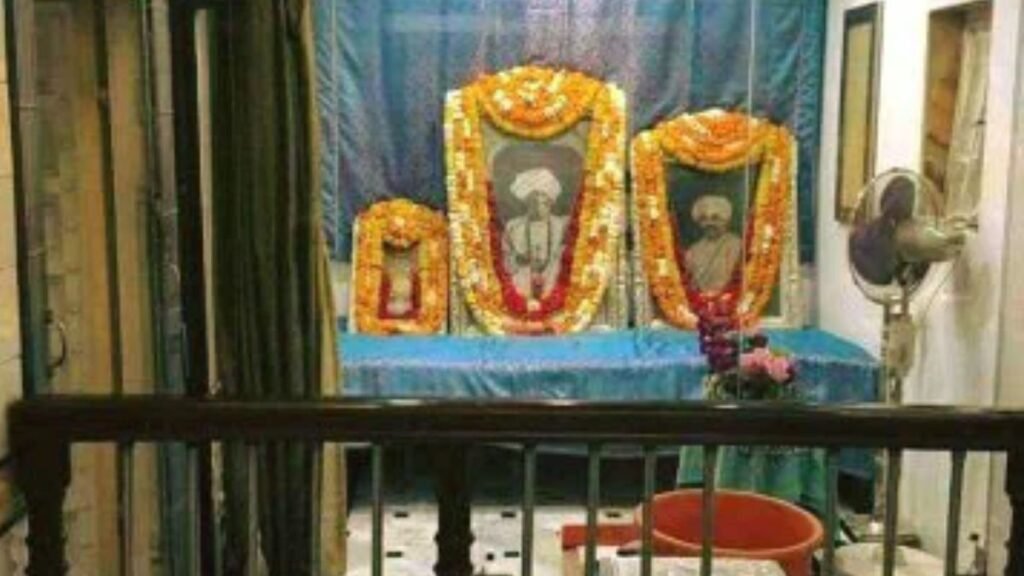
The Samadhi the sacred memorial marking the place where Jalaram Bapa’s earthly remains were interred is within the temple complex. For Jalaram devotees, the Samadhi is the most concentrated point of the saint’s presence on earth. Sitting before the Samadhi, many devotees describe an experience of direct connection with Bapa the particular quality of presence that these memorials have in the Hindu devotional tradition, where the saint’s spiritual energy is understood to continue at the site of the Samadhi for the benefit of those who come with sincerity.
Samadhi of Jetha Bapa and Virpara Nath Mandir
Near the main temple complex stands the Samadhi of Jetha Bapa a respected associate of Jalaram Bapa whose memorial is also venerated by pilgrims visiting Virpur. The Virpara Nath Mandir, another sacred site within the Virpur pilgrimage complex, is known for the beautiful hymns sung by sadhus during evening prayers the sound of devotional music in the evening air of this small Saurashtra town creates an atmosphere that devotees describe as among the most peaceful in all of Gujarat.
The No-Donation Policy – A Principle Unique in the World
Since the year 2000, the Jalaram Bapa Temple at Virpur has not accepted any donation. Not from individuals. Not from organisations. Not from corporations or trusts. No money, no gold, no goods offered as donation are accepted at the temple.
This policy in a country and a tradition where temple donations are a fundamental part of devotional practice and where major temples receive hundreds of crores of rupees annually is genuinely extraordinary. The temple feeds approximately 10,000 people per day from its own resources, maintains its dharamshala for free pilgrim accommodation, and sustains the entire Virpur pilgrimage infrastructure all without accepting a single rupee of external donation.
How does this work? The temple trust manages its resources from the accumulated endowment built up over the decades before 2000, from the productive agricultural land associated with the trust, and from the internal management of the complex’s resources. The details of the trust’s financial model are not publicly detailed, but the outcome is clear and has been consistent for 25 years: the temple gives and does not receive.
For many devotees, this policy is itself a spiritual statement as significant as the daily khichdi-kadhi. The no-donation rule says: this place is not asking you for anything. It is only giving. Come. Eat. Go. That is all.
The Khichdi-Kadhi Prasad – 10,000 Meals Every Day
The free khichdi-kadhi prasad at Virpur’s Annakshetra (food hall) is the most famous aspect of the Jalaram Bapa Temple for practical visitors. Khichdi the classic Gujarati dish of rice and yellow dal cooked together, simple, nourishing, and infinitely comforting and kadhi the tangy, turmeric-yellow yogurt-and-besan curry are served together as the prasad (sacred food) of Jalaram Bapa twice daily.
The Sadavrat that Bapa established 200+ years ago continues in the Annakshetra without modification to its essential character. The food is the same simple, sustaining combination. The service is to all comers. The numbers have grown from the handful of sadhus that Bapa fed in his own kitchen to the 10,000 daily who now eat in the large dining halls of the complex but the principle is unchanged.
For pilgrims visiting Virpur, the khichdi-kadhi at the Annakshetra is not merely a free meal. It is an act of participation in a 200-year-old sacred tradition. You are eating the same food that Bapa himself served to sadhus and strangers and Arabs and merchants and everyone else who came to his door in the 19th century. The continuity is real. Sit down, eat, and understand that this particular meal has been served without interruption for longer than most people’s family histories.
Festivals at Jalaram Bapa Temple
Jalaram Jayanti – The Most Important Festival
Jalaram Jayanti the birthday celebration of Shree Jalaram Bapa is the single most important festival in the Virpur calendar. Observed on the 7th day of the Shukla Paksha (bright fortnight) of the Kartika month which falls approximately in November this festival draws millions of devotees to Virpur from across Gujarat, India, and the global Gujarati diaspora. The entire Virpur town is transformed: the streets are packed, the temple complex overflows, special arrangements for food and accommodation are made far beyond the normal Annakshetra capacity, and the atmosphere is one of concentrated collective celebration.
Jalaram Jayanti is the day when the scale of Bapa’s following normally expressed in the daily 10,000 meals becomes visible in a single concentrated moment. The crowds who come, the distances they travel, and the devotion they bring make Jalaram Jayanti one of the most significant pilgrimage gatherings in Saurashtra.
Death Anniversary – February 23
The death anniversary of Jalaram Bapa on February 23 is observed each year with pilgrimage gatherings, special prayers, and devotional programmes. For many devotees, the death anniversary is as important as the birth anniversary the moment of a saint’s leaving the mortal world is understood as the moment of their final liberation, the completion of their journey, and therefore a sacred occasion to mark with devotion.
Thursdays – The Weekly Auspicious Day
Thursday is the most auspicious day of the week for Jalaram Bapa devotees — the day when many regular worshippers observe a fast and visit the temple for special prayers. The Thursday darshan at Virpur is significantly larger than on other weekdays. For those planning a quiet weekday visit, Tuesday to Wednesday mornings offer the most peaceful darshan conditions.
Other Festivals
Ram Navami (celebrating Lord Rama’s birth the primary deity of Jalaram Bapa) and Hanuman Jayanti are both particularly significant at this Vaishnava-tradition temple. Diwali has a special connection Bapa was born just after Diwali, in the week following the festival of lights, creating an annual emotional resonance. Janmashtami and Maha Shivaratri are also celebrated.
Best Time to Visit Jalaram Temple Virpur
October to February – Best Overall Season
The winter months offer the most comfortable visiting conditions. Rajkot district from October to February is pleasant 15 to 27 degrees Celsius and the temple’s open courtyards and the walk between the various sites within the Virpur complex are enjoyable in the cool air. The Annakshetra meal in winter sitting in the open dining hall with warm khichdi-kadhi in your hands is one of the most grounding experiences the temple offers.
Jalaram Jayanti (November) – For the Festival
If experiencing Virpur at its most alive when millions of Jalaram devotees gather from across Gujarat and the diaspora visit during Jalaram Jayanti. Logistics require careful advance planning: accommodation in Rajkot (60 km) rather than Virpur itself (which fills completely), early arrival for shorter darshan queues, and patience for the crowd scale. The atmosphere of Jalaram Jayanti at Virpur is one of the most powerful collective devotional experiences in all of Gujarat.
Tuesday to Thursday Mornings – Peaceful Darshan
For a quiet, contemplative darshan time alone with the idols, the Jholi-Danda, and the Samadhi visit on a Tuesday, Wednesday, or Thursday morning (7:00 to 9:00 AM). These early morning hours, with the Mangala Aarti at 7:30 AM, are when Virpur’s temple is at its most undisturbed. The scent of incense, the sound of the morning aarti, and the small groups of early pilgrims create an atmosphere that large crowds cannot replicate.
How to Reach Jalaram Temple, Virpur
| From | Distance | Mode | Approx. Time |
| Rajkot city | ~60 km | Car / Bus / Train to Virpur Station | 1 to 1.5 hours |
| Rajkot Railway Station | ~60 km | Train to Virpur Station + walk (~1 km) | ~1 hour by train |
| Rajkot Airport | ~57 km | Taxi / Cab | 1 hour |
| Virpur Railway Station | ~1 km | Walking / Auto-rickshaw | 5 minutes from station |
| Gondal | ~20 km | Car / Bus | 25–30 minutes |
| Junagadh | ~46 km | Car / Bus | 50 minutes |
| Somnath | ~125 km | Car | 2.5 hours |
| Ahmedabad | ~275 km | Car / Bus / Train to Rajkot + local | 4.5–5 hours |
Virpur has its own railway station approximately 1 km from the temple on the Rajkot-Gondal-Junagadh railway line. Express trains from Rajkot to Junagadh and beyond stop at Virpur. This makes the train journey from Rajkot to Virpur one of the simplest connections to the temple for those without private vehicles. From Virpur station, the temple is within easy walking distance or a short auto-rickshaw ride.
Nearby Attractions to Combine with Virpur
- Gondal ~20 km | The historic royal town of the Gondal Rajputs — Gondal Palace, the working museum of vintage royal vehicles, and the clean-and-ordered town that the progressive Gondal rulers created. A pleasant heritage stop on the way to or from Virpur.
- Rajkot ~60 km | The main city of Saurashtra — the Alfred High School attended by Mahatma Gandhi, the Rajkot Museum, Rashtriya Shala, Atkot Wildlife Sanctuary, and one of Gujarat’s finest café and restaurant scenes. Our full guide: travelroach.com/best-restaurants-in-rajkot/ and travelroach.com/top-cafes-in-rajkot-for-every-mood/
- Khodaldham Temple, Kagvad ~25 km | The grand new temple complex dedicated to Goddess Khodal Maa with its impressive architecture and huge fair during major festivals. Kagvad Khodaldham is one of the five most important Khodal Maa temples in Gujarat.
- Junagadh ~46 km | Girnar Hill (10,000 steps), Uparkot Fort, Mahabat Maqbara, Ashoka’s Rock Edicts — one of Saurashtra’s most historically and spiritually significant cities. Read our full TravelRoach guide.
Also Read: Top 10 Places for Food Lovers
Practical Tips for Visiting Jalaram Temple, Virpur
- Arrive for the morning aarti at 7:30 AM – the Mangala Aarti on a quiet weekday morning is the most devotionally concentrated experience Virpur offers. The small group of early devotees, the scent of incense, the morning light through the shrine windows this is Virpur at its essential best.
- Eat the khichdi-kadhi prasad – do not visit Virpur without eating at the Annakshetra. Arrive 15 minutes before the lunch service to secure a comfortable seat. The meal is simple, nourishing, and the experience of eating Jalaram Bapa’s prasad with thousands of other pilgrims is irreplaceable.
- Do not attempt to donate – the temple does not accept donations. Do not insist or look for a donation box. There is none. Accept this policy with the respect it deserves.
- Dress modestly – covered shoulders and knees; remove footwear at the temple entrance.
- Virpur Railway Station is 1 km from the temple -taking the train from Rajkot is a comfortable, practical option that many pilgrims use.
- Advance accommodation booking for Jalaram Jayanti – the dharamshala fills completely during the festival; book directly with the temple trust for accommodation. For festival visits, many pilgrims stay in Rajkot (60 km) and make a day trip.
- Thursdays are busier – if seeking a quiet darshan, avoid Thursdays and come on Tuesday or Wednesday mornings instead.
Frequently Asked Questions (FAQs)
Jalaram Bapa Temple in Virpur, Rajkot district, is famous for three things above all: first, it is the actual house where the beloved Gujarati saint Shree Jalaram Bapa (1799–1881) was born, lived, and died not a later-built memorial but the saint’s own home, preserving his idols, his sacred Jholi and Danda, and his Samadhi. Second, the temple’s Annakshetra has served free khichdi and kadhi prasad to all comers approximately 10,000 people daily for more than 200 years without interruption, continuing the Sadavrat tradition Bapa himself established. Third, since the year 2000, the temple has not accepted any donation of any kind, making it unique among major religious institutions globally.
The Jalaram Bapa Temple Trust made the decision in the year 2000 to stop accepting all forms of donation money, gold, goods, or any other offering. The reasoning reflects the temple’s core spiritual identity: Jalaram Bapa’s life was one of unconditional giving without expectation of return. A temple honouring that life should embody the same principle. The no-donation policy is understood as the institutional expression of Bapa’s own spirit the temple gives and does not receive. The trust manages its resources through its own endowment and agricultural land to sustain the 10,000 daily free meals and the free accommodation for pilgrims. The policy has been maintained for 25 years.
Jalaram Bapa Temple is open every single day of the year no weekly or seasonal closure. Darshan timings are 7:00 AM to 12:30 PM and 4:00 PM to 8:30 PM. Aarti is performed three times daily: 7:30 AM (Mangala Aarti), 9:00 AM, and 7:30 PM. The morning session arriving by 7:00 AM for the Mangala Aarti is the most peaceful and devotionally concentrated time. Thursdays are the busiest non-festival days. Entry is completely free. No donations are accepted.
The Sadavrat is the tradition of continuous free feeding established by Jalaram Bapa himself during his lifetime. ‘Sada’ means always or continuously; ‘Vrat’ means vow or commitment. Bapa’s Sadavrat was his personal vow to always feed whoever came to his door sadhus, saints, the needy, and all travellers regardless of their identity, religion, or social status. This tradition has been maintained without interruption for more than 200 years in the Annakshetra of the Jalaram Bapa Temple. Approximately 10,000 people eat the free khichdi-kadhi prasad every day. The service runs twice daily at lunch and dinner time.
Virpur is approximately 60 km from Rajkot about 1 to 1.5 hours by road. Regular ST buses and private buses run from Rajkot to Virpur. By train, Virpur has its own railway station (Virpur Junction) approximately 1 km from the temple trains on the Rajkot-Gondal-Junagadh line stop here. From Rajkot Railway Station, the train journey takes approximately 1 hour. Virpur is also accessible from Junagadh (46 km, 50 minutes) and from Gondal (20 km, 25 minutes).
The Jholi (alms bag) and Danda (walking staff) of Jalaram Bapa are the most sacred physical objects at the Virpur temple. They are believed to be divine gifts received by Bapa during his life of service in the devotional tradition, they were given to him by a visiting sadhu who turned out to be a divine presence testing Bapa’s generosity. Bapa gave the Jholi and Danda willingly when asked; their return and the miraculous properties subsequently associated with them established their sacred status. These objects are displayed in the main shrine and their darshan is a central part of the Virpur pilgrimage experience.
Jalaram Jayanti the birthday of Shree Jalaram Bapa is celebrated on the 7th day of the Shukla Paksha (bright fortnight) of the Kartika month, which falls in November. This is the most important festival at Virpur and draws millions of devotees from across Gujarat and the global Gujarati diaspora. For a Jalaram Jayanti visit: book accommodation in Rajkot (60 km, more available) rather than Virpur itself which fills completely; arrive at Virpur very early in the morning for shorter darshan queues; be prepared for the scale of the crowd and for significant time at the temple; the Annakshetra will be serving meals throughout the day in expanded capacity. Despite the crowds, Jalaram Jayanti is one of the most powerful devotional experiences available in Gujarat.
Final Thoughts
There is a kitchen in a small town in Rajkot district that has been running for more than 200 years. Every day for 200 years, twice a day, it has cooked khichdi and kadhi and given it to whoever came. It started with one man in his own house. It now feeds 10,000 people daily. It accepts no money. It turns no one away.
Jalaram Bapa spent 81 years in the same village, in the same house, doing the same thing. He did not travel to spread a teaching. He did not write a text or build a movement. He cooked, he served, he fed, he welcomed — every day, with the same attentiveness to the person in front of him. The Arabs from Rajkot. The sadhus from distant places. The needy villagers. Everyone equally. The house where he did this is the temple you visit today.
Go for the Mangala Aarti at 7:30 AM. Have darshan of the idols and the Jholi-Danda. Sit at the Samadhi for a few minutes. Then go to the Annakshetra and eat the khichdi-kadhi. The food is prasad. The meal is a 200-year-old tradition. And the kitchen that produced it has never closed.
