There is a hill in Bhavnagar district of Gujarat that is called the City of Gods. Shatrunjaya Hill, rising above the town of Palitana, carries on its two summits 863 marble temples the largest and most magnificent temple complex in the Jain world. These temples were not built at once. They accumulated over 900 years, from the 11th century to the present, constructed by successive rulers, wealthy merchants, devout families, and entire communities who poured their resources and their devotion into stone.
No one sleeps on the hill. The temples are built as the divine’s abode human beings are welcome as pilgrims but not as residents. Every evening before sunset, all pilgrims descend. The priests descend. The hill is closed. The gods remain. The next morning, before first light, the pilgrims begin their ascent again.
Palitana and Shatrunjaya Hill together constitute Jainism’s supreme pilgrimage site the Teerth Raj, the King of all Pilgrimages. Every Jain is expected to visit at least once in a lifetime. Twenty-three of the twenty-four Jain Tirthankaras are believed to have attained salvation here. Bhagwan Rishabhanatha the first Tirthankara and founder of the Jain path is believed to have meditated under the Rayan tree at the summit and delivered his first sermon from the hilltop. This TravelRoach guide covers the complete story, the climb, the temples, the rules, and everything you need to plan a meaningful visit.
Palitana and Shatrunjaya Hill – Quick Information
| Detail | Information |
| Location | Palitana town, Bhavnagar District, Gujarat 51 km southwest of Bhavnagar city |
| Palitana Former Name | Padliptapur now nicknamed ‘City of Temples’ |
| Sacred Hill | Shatrunjaya Hill (also Shetrunjay) |
| Name Meaning | ‘Shatrunjaya’ = Place of Victory Over Inner Enemies (inner enemies = lust, anger, greed, pride, attachment, aversion) |
| Total Temples | 863 marble temples (all Shwetambar Jain except one Digambar) |
| Built Over | 900 years (11th century CE to present) |
| Significance | Teerth Raj King of Pilgrimages; 23 of 24 Tirthankaras attained salvation here |
| Principal Temple | Rishabhanatha (Adinath) Temple dedicated to the first Tirthankara |
| Temple Groups | Organised into ‘Tunks’ (enclosures) each with central and subsidiary temples |
| Steps | ~3,500 stone steps from the base (Taleti) to the summit |
| No Vehicles | No motorised vehicles allowed on the hill everyone must climb on foot |
| No Overnight Stay | No one may stay overnight on the hill, including priests all must descend before sunset |
| Entry Fee | Free – no entry fee for climbing the hill or visiting the temples |
| Temple Timings | 6:00 AM – 6:00 PM (all must descend before sunset; hill closed overnight) |
| Hill Closed | During monsoon months (July–August) the hill is typically closed |
| Monsoon Closure | Confirm current season status before visiting in July–September |
| Doli (Palanquin) | Available for those who cannot climb carriers available at the base (Taleti) |
| Palitana’s Unique Status | World’s first and only city with a legal ban on all animal slaughter fully vegetarian city since 2014 |
| Dress Code | Modest; white or light-coloured clothing preferred by Jain pilgrims; no leather items on the hill |
| Distance from Bhavnagar | ~51 km (~1.5 hours by road) |
| Distance from Ahmedabad | ~215 km (~4–5 hours by road) |
| Distance from Rajkot | ~200 km (~4 hours) |
| Nearest Railway | Palitana Railway Station (within town) |
| Nearest Airport | Bhavnagar Airport (~51 km); Ahmedabad Airport (~215 km) |
| Best Season | November to February — cool weather makes the 3,500-step climb manageable |
The Significance of Shatrunjaya – Jainism’s Supreme Pilgrimage
Teerth Raj – The King of All Pilgrimages
In the Jain devotional tradition, Shatrunjaya holds the title of Teerth Raj King of all Pilgrimages. This is not a casual designation. Jainism has hundreds of sacred sites across the Indian subcontinent. But among all of them, Shatrunjaya and Shikharji (in Jharkhand) are considered the holiest of the holy. Shatrunjaya is specifically described as the place where the greatest possible spiritual merit can be accumulated where the barriers between the sincere pilgrim and liberation are thinnest.
The reason for this pre-eminence is rooted in the deepest belief of the Jain tradition: that 23 of the 24 Jain Tirthankaras the enlightened beings who have crossed the ocean of rebirth and shown others the path to liberation attained their final salvation (moksha) from this hill. Only Neminatha, the 22nd Tirthankara, achieved liberation elsewhere. Every other great soul in the Jain cosmic timeline is connected to Shatrunjaya. To stand on this hill is to stand on the summit of Jainism’s entire sacred geography.
Bhagwan Rishabhanatha – The First Tirthankara’s Connection
The most fundamental connection to Shatrunjaya is through Bhagwan Rishabhanatha also called Adinath the first Tirthankara of the current cosmic cycle. Rishabhanatha holds in Jainism a position analogous to that of a founding prophet: the being who, having achieved omniscience and liberation himself, first taught the Jain path to humanity in the current era. He is revered as the first teacher of the path of non-violence, truth, non-attachment, and spiritual discipline.
According to Jain tradition, Bhagwan Rishabhanatha meditated beneath the Rayan tree at the very summit of Shatrunjaya Hill. It was here that he entered the state of deep contemplation that preceded his final enlightenment. And it was from the summit of Shatrunjaya that he delivered his first sermon the first public teaching of the Jain path in the current cosmic cycle. The hill itself was sanctified by this first sermon. Every subsequent act of worship on this hill is a repetition and continuation of that original teaching.
The Name – Victory Over Inner Enemies
The name Shatrunjaya from the Sanskrit Shatru (enemy) and Jaya (victory) means the place of victory over enemies. But in the Jain tradition, the ‘enemies’ are internal, not external. The Jain path identifies four primary inner enemies that bind the soul to the cycle of rebirth: kama (desire), krodha (anger), lobha (greed), and mana (pride), along with maya (attachment) and moha (delusion). The ‘victory’ celebrated at Shatrunjaya is not a military triumph but a spiritual one the victory of the soul over its own passions and attachments, the liberation that the great Tirthankaras achieved and that every sincere Jain pilgrim aspires to.
The History of the Palitana Temples – 900 Years of Construction
Ancient Origins – Before the Historical Record
The Jain tradition associates Shatrunjaya with the spiritual activities of Bhagwan Rishabhanatha, which places the site’s sacred history in a timeframe that precedes recorded human history. The first temples on the hill are believed to have been built by Pundarika a disciple of the first Tirthankara in mythological time. The Jain texts record the hill as sacred from the very beginnings of the tradition.
The first historically documented construction on Shatrunjaya was by Kumarpal Solanki the great Jain patron and Gujarat Solanki king of the 12th century. Kumarpal was a devout Jain under the spiritual influence of Hemachandracharya, the great Jain scholar-saint of Patan. Under his patronage, the first major stone temples were constructed on the hill, beginning the physical temple city that would accumulate over the following nine centuries.
Also Read: Hastagiri Jain Tirth, Bhavnagar
The 1311 Destruction and Restoration
In 1311 CE, Turkish Muslim invaders under the command of Alauddin Khilji’s general Malik Kafur attacked and destroyed the temples on Shatrunjaya Hill. The saint Jinaprabhasuri then approximately 50 years old was presiding over the temples at the time. The destruction was severe, but the Jain community’s determination to restore the site was equally powerful. Under subsequent Jain merchant patronage particularly the wealthy Jain trading communities of Gujarat who had enormous resources at their command the temples were rebuilt and expanded significantly.
The rebuilding after the 1311 destruction represents the second major phase of Palitana’s construction history. It was in this period that many of the most celebrated temples currently standing on the hill were built funded by wealthy Jain families of Ahmedabad, Surat, and other Gujarat trading centres who considered the patronage of temple construction among the highest expressions of their faith and their resources.
Centuries of Continuous Patronage
The construction at Shatrunjaya has never fully stopped since its historical beginning in the 11th century. Successive generations of Jain merchants, rulers, and community organisations have continued to build, renovate, and maintain the temple complex. The result 863 marble temples of varying age, style, and scale, grouped into an extraordinary urban landscape of courtyards, gateways, and shrines is the product of nine centuries of continuous devotional investment.
The Shethia family of Gujarat representing the wealthy Jain mercantile tradition has been among the most significant patrons over the centuries. Individual temples on the hill commemorate the names of the families who built them, creating a permanent record in stone of who gave what and when. Walking through the tunks of Shatrunjaya is walking through the financial and devotional biography of Gujarat’s Jain community across nine centuries.
The Climb – 3,500 Steps and a Spiritual Journey
The Physical Reality
The ascent of Shatrunjaya Hill from the Taleti (base area) to the main temple complex at the summit involves approximately 3,500 stone steps. This is not a gentle stroll. The steps rise steeply through the hillside, and the full ascent and descent even at a moderate pace typically takes between 3 and 6 hours depending on how much time you spend in the temples at the top and how many stops you make en route. For first-time visitors and those who are not regularly active, the climb should be taken slowly, with frequent rest stops, and with a genuinely early start to complete the descent before the heat of midday.
Every pilgrim must climb on foot or in a doli (palanquin carried by human bearers). No motorised vehicles are permitted on the hill at any point. This rule is absolute and reflects the Jain principle of equanimity: the hill must be approached through genuine physical effort. The body’s participation in the climb is part of the spiritual act.
Starting the Climb – The Taleti
The base area Taleti is where the climb begins. From the main road through Palitana town, follow the signs and the flow of pilgrims toward the Taleti. The Taleti has facilities: small shops selling puja materials (flowers, coconuts, camphor, incense) and cold water, doli (palanquin) operators, and small tea stalls. Arrive at the Taleti at least 30 minutes before you plan to begin climbing to purchase your puja materials, sort out footwear (you will need to carry your shoes while inside the temples a small cloth bag is useful), and prepare for the ascent.
The Climb Itself – What to Expect at Each Stage
The stone steps rise steadily from the Taleti. In the early morning, the pre-dawn darkness of the first hour gives way to a gradual lightening of the sky as you climb. The cooler air of the morning and the quiet of early pilgrims makes the early-morning start deeply atmospheric. As you ascend, the plains of Saurashtra spread out behind and below you.
Partway up the hill, you will pass the Angar Pir Dargah a Muslim shrine dedicated to a Sufi saint. This is one of Palitana’s most quietly powerful moments: a Muslim sacred space on a Jain pilgrimage hill, with pilgrims of both communities paying their respects. The shrine is open to all and most Jain pilgrims pause to offer a moment of respect as they pass a small, daily, unremarked act of interfaith coexistence on the sacred hill.
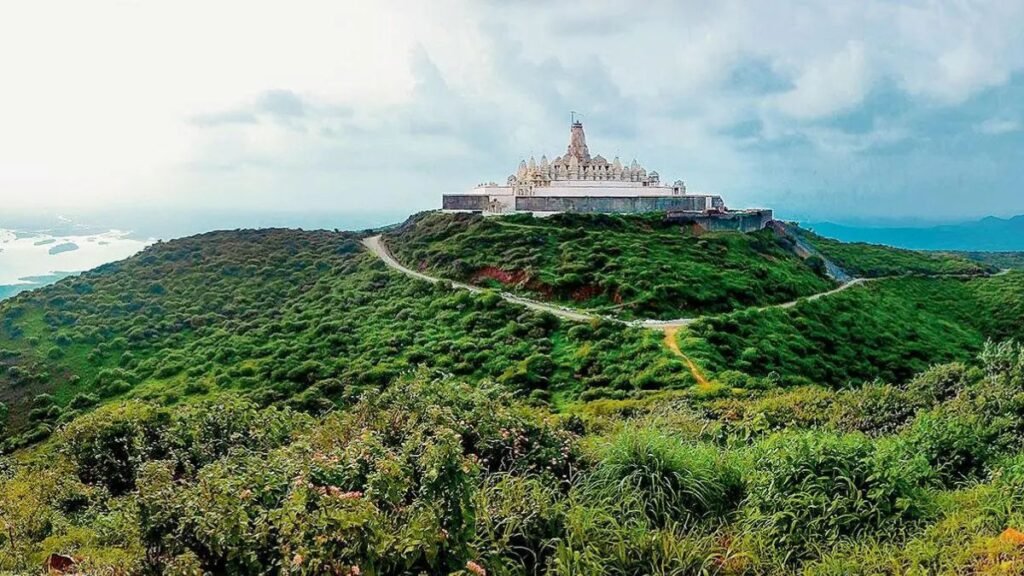
As you approach the main complex at the summit, the scale of what has been built here begins to become apparent. The marble towers of temple after temple rise against the sky. The sound of bells, conch shells, and the chanting of Jain prayers drifts down from the complex above. The air smells of camphor and incense.
The Summit – 863 Temples and the View
The summit of Shatrunjaya is not a single temple it is a city. A city with gates, streets, courtyards, towers, and hundreds of buildings, all of marble, all carved to varying degrees of extraordinary complexity, all dedicated to different Tirthankaras or Jain spiritual figures. Walking through the summit complex is a genuinely disorienting experience at first — the scale is larger than you expect, the variety is greater than any single visit can absorb, and every direction offers a new view of carved marble against the sky.
The panoramic view from the summit is extraordinary. The Bhavnagar plains spread out to the northeast. The Shetrunjaya River glints in the morning sun. In clear winter weather, you can see Bhavnagar city and, on the finest days, the coast of the Gulf of Khambhat. The combination of the temple complex overhead and the Saurashtra landscape below creates a visual of rare beauty.
The Temples – Key Structures at the Summit
The Tunks – Jain Temple Enclosures
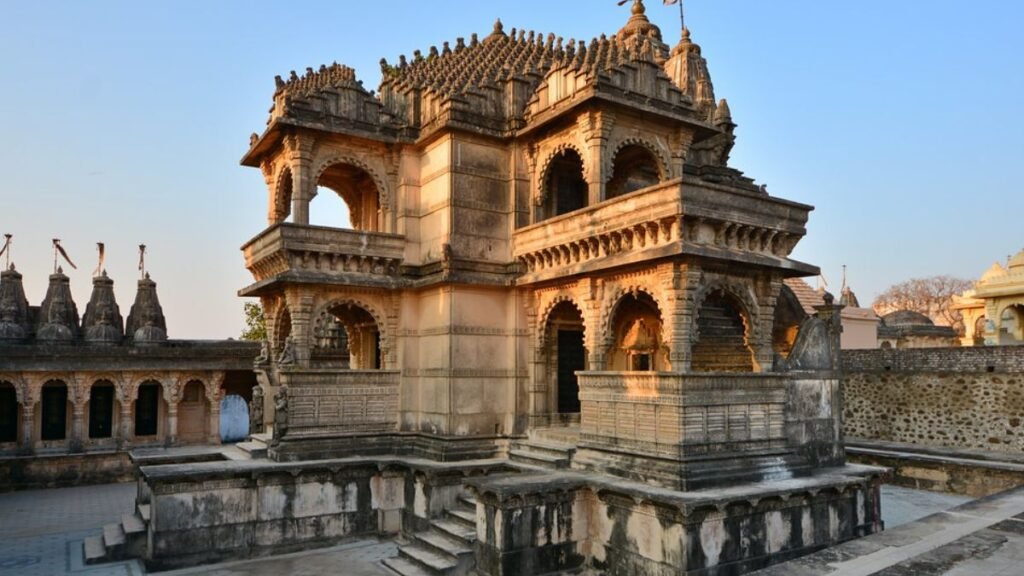
The 863 temples on Shatrunjaya are not scattered randomly but organised into groups called tunks (also written tuks) enclosed temple precincts, each with a main temple at its centre and a ring of smaller subsidiary temples and shrines around it. Each tunk is entered through its own gateway, and within the enclosure the scale of the individual tunk creates an intimate, concentrated sacred space.
The tunk system creates the layered quality of the summit complex as you move from tunk to tunk, you move between different enclosures, each with its own atmosphere, its own carving programme, and its own patron history. The experience is cumulative: each tunk adds to the total devotional environment of the hill rather than competing with it.
The Rishabhanatha (Adinath) Temple – The Most Sacred
The most important temple on Shatrunjaya Hill is the Rishabhanatha Temple dedicated to Bhagwan Rishabhanatha (Adinath), the first Tirthankara. This is the first temple most pilgrims seek after reaching the summit and the one they spend the most time in. The idol of Rishabhanatha within the sanctum is the focus of the hill’s primary devotional energy. The architecture of the Rishabhanatha temple complex represents some of the finest marble carving on the hill the combination of age, quality, and concentrated devotion gives the temple an atmosphere that even non-Jain visitors consistently describe as uniquely powerful.
The Chaumukha Temple – Four-Faced, Architecturally Extraordinary
The Chaumukha Temple literally the ‘four-faced temple’ is named for its principal idol, which faces all four cardinal directions simultaneously. This architectural concept the deity seeing all directions, embodying omniscient awareness is the same theological principle as the Chaturmukha temples elsewhere in the Jain tradition. The Chaumukha at Shatrunjaya is considered one of the most architecturally significant and visually striking temples on the hill, with carving of exceptional density and quality.
The Kumarapalaka Temple
Built under the patronage of King Kumarapala the Solanki ruler who was Jainism’s greatest royal patron in medieval Gujarat the Kumarapalaka Temple is one of the oldest historical structures on the hill and one of the most celebrated. The temple’s significance is both architectural and historical: it represents the first major act of royal patronage that began the formal construction programme at Shatrunjaya.
The Angar Pir Dargah – The Muslim Shrine on the Jain Hill
Among the most remarkable features of the Shatrunjaya pilgrimage is the presence of the Angar Pir Dargah the shrine of a Muslim Sufi saint on the hillside, about midway through the climb. The Dargah is visited by pilgrims of multiple faiths, and Jain pilgrims typically pay a moment of respect as they pass on the way to the summit. The co-existence of this Muslim shrine within the world’s most important Jain pilgrimage visited and respected by both communities is one of Gujarat’s most quietly extraordinary examples of interfaith coexistence.
Also Read: Nishkalank Mahadev Temple, Bhavnagar
Palitana – The World’s Only Fully Vegetarian City
Palitana holds a distinction unique in the world: in 2014, following a 200-day fast undertaken by Jain monks and nuns demanding the protection of animal life in the pilgrim city, the Gujarat government declared Palitana a completely vegetarian town the first and only city anywhere in the world to have a legal ban on all animal slaughter, fishing, and the sale of non-vegetarian food.
All slaughterhouses, fishing operations, and non-vegetarian food establishments were closed. The decision was controversial nationally and internationally questions were raised about the rights of the non-Jain minority who lived and worked in the town but it reflected the depth of the Jain community’s commitment to the principle of ahimsa (non-violence) and the sanctity of Palitana as Jainism’s holiest city.
For visitors, this means that all restaurants and food establishments in Palitana serve strictly vegetarian and satvik (Jain-compliant) food no onion, garlic, or root vegetables in most establishments, in addition to no meat. This is the food landscape of a genuinely devout Jain city, and the experience of eating in Palitana the simplicity, the freshness, the flavour of food prepared without stimulants is part of the complete pilgrimage experience.
The Sacred Rule – No One Stays the Night
One of the most extraordinary and distinctive rules of Shatrunjaya is that no human being is permitted to stay on the hill overnight. Not pilgrims. Not priests. Not the caretakers. Not anyone. At sunset, the temples are locked, the hill is cleared, and all human presence is removed. The hill belongs, through the night, to the divine.
This rule is rooted in the Jain belief that Shatrunjaya Hill is literally the abode of liberated souls not a place where liberated beings once visited, but the place where they actually dwell, in their perfected spiritual state, after achieving moksha. The presence of sleeping, dreaming, bodily human beings on this sacred ground through the night would be a form of desecration an intrusion of the profane into the purely divine space.
The practical effect of this rule is that every morning, the pilgrimage begins again from the base. The gates open, the pilgrims start their ascent in the pre-dawn darkness, the temples are unlocked, and the day’s devotional programme begins. The rhythmic quality of this daily recommencement the hill empty all night, suddenly alive with pilgrims at dawn gives Shatrunjaya a temporal pulsing quality that is entirely its own.
Best Time to Visit Palitana and Shatrunjaya Hill
November to February – The Only Season for Comfortable Climbing
This is the undisputed best and, in practical terms, the only comfortable window for climbing Shatrunjaya Hill. The weather in Bhavnagar district during November to February is cool 15 to 25 degrees Celsius at the base, and noticeably cooler on the hilltop. The 3,500-step climb in these conditions is demanding but manageable. The morning air as you begin the pre-dawn ascent in December or January is crisp and invigorating. The pilgrimage community is at its most active during this period, and the atmosphere on the hill is correspondingly rich and alive.
March to May – Hot, Not Recommended for Climbing
The approach of summer makes the climb increasingly uncomfortable from March onward and genuinely arduous in April and May when temperatures can exceed 40 degrees Celsius. If you must visit in this period, begin the climb no later than 5:30 AM and complete your descent before 10:00 AM. The stone steps, fully exposed to the sun, absorb and radiate intense heat by mid-morning. This is not a theoretical caution heat exhaustion on the Shatrunjaya climb has caused serious incidents.
Monsoon (July to September) – Hill Typically Closed
The Shatrunjaya Hill and its temples are typically closed to all pilgrims during the monsoon months primarily July and August due to the risk of slippery steps, flash flooding, and lightning on the exposed hilltop. The closure period is confirmed annually by the temple trust management. Always confirm the current monsoon closure status before planning a visit in July, August, or early September.
Early Morning – Always the Right Time of Day
Regardless of season, the prescribed and practically best time to begin the Shatrunjaya climb is before dawn ideally starting at the Taleti by 5:00 to 5:30 AM in winter. This puts you at the summit for the morning aarti as the sun rises, allows you to complete the full temple circuit in the morning coolness, and ensures you are descending before the heat of midday. Many serious pilgrims set out in the complete darkness, guided by the string of lights on the steps and the sound of other pilgrims ahead and behind them. This pre-dawn climb is one of the most spiritually intense experiences Palitana offers.
How to Reach Palitana
| From | Distance | Mode | Approx. Time |
| Bhavnagar city | ~51 km | Car / Bus / Train to Palitana | 1–1.5 hours |
| Ahmedabad | ~215 km | Car / Bus to Palitana (via Bhavnagar) | 4–5 hours |
| Rajkot | ~200 km | Car / Bus | 4 hours |
| Vadodara | ~250 km | Car / Bus | 5–6 hours |
| Bhavnagar Airport | ~51 km | Flight + Taxi/Bus | 1–1.5 hours |
| Ahmedabad Airport | ~215 km | Flight + Taxi/Bus | 4–5 hours |
| Surat | ~290 km | Car | 5.5 hours |
By Road
From Bhavnagar (51 km), the drive to Palitana takes approximately 1 to 1.5 hours on the state highway. GSRTC buses run between Bhavnagar and Palitana regularly. From Ahmedabad, take the highway toward Bhavnagar and then continue to Palitana approximately 215 km and 4 to 5 hours.
By Train
Palitana has its own railway station on a branch line from Bhavnagar. Trains run between Bhavnagar and Palitana, making the train a practical option for pilgrims arriving by rail from the north. From Palitana station, the Taleti (base of the hill) is accessible by local auto-rickshaw or a short walk.
By Air
Bhavnagar Airport has flights from Mumbai and is approximately 51 km from Palitana. From the airport, hire a taxi directly to Palitana. Ahmedabad Airport (215 km) is the larger hub for international visitors.
Where to Stay in Palitana
- Jain Dharamshalas – The primary accommodation in Palitana. Multiple Shwetambar Jain dharamshalas near the Taleti provide clean, affordable rooms, hall dormitories, and community kitchen facilities serving satvik Jain food. These are the preferred accommodation for Jain pilgrims. Rates are very low. Advance booking recommended for Kartik Purnima and peak season.
- Digambar Jain Dharamshala – For Digambar Jain pilgrims, the dedicated Digambar dharamshala provides appropriate facilities.
- Budget Hotels – A limited number of basic hotels in Palitana town provide accommodation outside the dharamshala system. All serve strictly vegetarian food in accordance with Palitana’s vegetarian city status.
- Bhavnagar City Hotels – For those who want more comfort and a wider range of options, staying in Bhavnagar (51 km) and making an early-morning trip to Palitana is a practical alternative. Bhavnagar has multiple mid-range and comfortable hotels.
Rules and Etiquette on Shatrunjaya Hill
- No leather items on the hill – in accordance with Jain principles of ahimsa, leather goods (shoes, bags, belts) are not permitted on the hill. Wear cloth or rubber footwear. Carry a cloth bag for your possessions.
- Remove footwear before entering the inner sanctum of each temple – carry a small cloth bag to hold your shoes while inside.
- No non-vegetarian food, alcohol, or smoking anywhere in Palitana or on the hill.
- Dress modestly – light coloured or white clothing is traditional for Jain pilgrims. Shorts and sleeveless are not appropriate.
- Maintain silence or low voices inside the temple sanctums – the atmosphere of meditation and prayer must be respected.
- Menstruating women traditionally do not climb – this is a traditional Jain rule for the hill; non-Jain visitors should be aware of this norm and approach it with sensitivity.
- No photography inside the inner sanctums of the temples – check with temple staff before photographing anywhere within the complex.
- Descend before sunset – all pilgrims must leave the hill before the gates close at sunset. Do not linger at the summit in the late afternoon.
Also Read: Top 10 Restaurants in Bhavnagar
Practical Tips for the Shatrunjaya Climb
- Start as early as possible – pre-dawn departure (5:00 to 5:30 AM) is ideal in winter. This is not an exaggeration. The summit experience in the golden-hour morning light, before the bulk of weekend pilgrims arrive, is categorically different from the midday experience.
- Carry water – at least 1.5 litres per person for the ascent and descent. Dehydration is the primary physical risk on the climb. Water points exist partway up but carry your own for reliability.
- Wear comfortable, flat shoes with good grip – the steps are smooth sandstone in places and can be slippery, particularly in the morning when dew is present. Rubber-soled flat shoes or sneakers are ideal.
- Pack light – carry only what you absolutely need. Every extra kilo of weight is felt over 3,500 steps. Leave large bags at your accommodation.
- Doli (palanquin) for those who cannot climb – human-carried palanquins are available from the Taleti for elderly pilgrims, those with health conditions, and children. Negotiate the rate before setting out. The bearers are experienced and the service is safe.
- No rush at the top – allow at least 2 hours at the summit to visit the key temples properly. Many pilgrims spend 3 to 4 hours at the top. The investment of the climb deserves unhurried attention.
- Puja materials – available from stalls at the Taleti. Flowers, coconut, camphor, and incense are standard offerings. The offerings must be performed in the prescribed sequence for each temple.
- Guides – a local Jain guide enhances the experience significantly. They know the history of each tunk, the specific deities in each temple, and the correct order of temple visitation. Fees are modest.
Nearby Attractions to Combine with Palitana
- Bhavnagar city ~51 km | Nilambag Palace, Takhteshwar Temple, Gaurishankar Lake. A pleasant heritage city worth a few hours.
- Hastagiri Jain Tirth ~25 km from Palitana | Another important Jain tirth near Bhavnagar Gujarat’s tallest Jain temple complex with 72 devkulikas, connected to the story of Bharat Chakravartin. Read our full TravelRoach guide.
- Velavadar Blackbuck National Park ~65 km | One of India’s finest wildlife reserves; the sanctuary that hosts the world’s most significant blackbuck population. Also home to wolves, hyenas, and wintering harrier birds.
- Nishkalank Mahadev Temple, Koliyak ~60 km | The extraordinary sea temple accessible only at low tide, on the banks of the Gulf of Khambhat. Read our full TravelRoach guide.
- Alang Ship Breaking Yard ~50 km | The world’s largest ship-breaking yard, where enormous ocean-going vessels are manually dismantled. A visually spectacular industrial landscape unlike anything else in Gujarat.
Frequently Asked Questions (FAQs)
Shatrunjaya Hill in Palitana, Bhavnagar district, is Jainism’s holiest pilgrimage site the Teerth Raj or King of Pilgrimages. It is home to 863 marble temples, making it the largest Jain temple complex in the world. The hill is believed to be the site where 23 of the 24 Jain Tirthankaras attained liberation, and where Bhagwan Rishabhanatha (the first Tirthankara) meditated and delivered his first sermon. Every Jain is expected to make at least one pilgrimage to Palitana in their lifetime. The temples were built over 900 years from the 11th century to the present. Palitana town itself is the world’s only legally vegetarian city, with all animal slaughter banned since 2014.
There are approximately 3,500 stone steps from the base area (Taleti) to the summit of Shatrunjaya Hill. The climb is steep and sustained the full ascent and descent typically takes between 3 and 6 hours depending on pace, rest stops, and time spent in the temples. No motorised vehicles are allowed on the hill. For those who cannot climb, human-carried palanquins (doli) are available from the Taleti base area. The best time to start the climb is before dawn by 5:00 to 5:30 AM in winter months.
The rule prohibiting overnight stays on Shatrunjaya Hill which applies to all pilgrims including priests and caretakers is rooted in the Jain belief that the hill is literally the abode of liberated souls. The Tirthankaras and other great souls who achieved moksha from this hill are understood to dwell here in their perfected spiritual state. The presence of ordinary human beings through the night would be an intrusion into this sacred space. As a result, the temples are locked at sunset, all humans descend, and the hill belongs entirely to the divine through the night. The next morning, the pilgrimage begins again from the base.
November to February is the only comfortable season for climbing Shatrunjaya Hill. The 3,500-step ascent in cool winter weather (15 to 25 degrees Celsius) is demanding but manageable. From March onward, temperatures rise significantly and the climb becomes genuinely arduous in April and May. The hill is typically closed during the monsoon (July to August). Within the winter season, the ideal time of day is before dawn starting the climb by 5:00 to 5:30 AM puts you at the summit for the morning aarti, completes the temple circuit in the cool morning hours, and ensures you are descending before the midday heat.
Yes. In 2014, following a 200-day fast by Jain monks and nuns demanding the protection of animal life in the pilgrim city, the Gujarat government officially declared Palitana a vegetarian town the first and only city in the world with a legal ban on all animal slaughter, fishing operations, and the sale of non-vegetarian food. All food establishments in Palitana serve strictly vegetarian food. Most Jain establishments serve satvik food without onion, garlic, or root vegetables in accordance with Jain dietary principles.
From Ahmedabad, Palitana is approximately 215 km about 4 to 5 hours by road. Drive via the Ahmedabad-Bhavnagar National Highway to Bhavnagar (195 km) and then continue on the state highway for the remaining 51 km to Palitana. GSRTC buses run between Ahmedabad and Palitana. By train, take a service from Ahmedabad to Bhavnagar Junction, then a connecting train to Palitana Railway Station. Bhavnagar Airport (51 km from Palitana) has domestic flights from Mumbai.
Carry at least 1.5 litres of water per person dehydration is the primary physical risk on the climb and water points on the route may be unreliable. Wear flat, rubber-soled shoes with good grip the stone steps are smooth in places and can be slippery in the morning. Pack light: carry only puja materials (flowers, coconut, camphor, incense available at the Taleti base), your water, and a small cloth bag for your shoes (required inside temple sanctums). No leather items on the hill. Wear modest, light-coloured clothing. Bring cash for doli service, puja materials, and guide fees. Eat a light breakfast before the climb but avoid a heavy meal.
Final Thoughts
The world has many mountains with temples. India alone has dozens. But there is nowhere else on earth where 863 hand-carved marble temples have been placed on a single hill over nine centuries, where every stone has been paid for by a specific family whose name you can often still read on the gateway, where the most refined minds of Jain philosophy and the most gifted craftsmen of Gujarat’s stone-carving tradition came together in an act of sustained collective devotion that has no real parallel.
Shatrunjaya is not comfortable. The 3,500 steps are real steps. The pre-dawn start is genuinely pre-dawn. The sun, if you are late, is genuinely hot. The rules about leather and overnight stays and dietary restrictions are genuinely observed.
And none of that is incidental. The discomfort is part of the point. The Jain tradition holds that liberation requires effort — not passive reception but active practice. The pilgrimage to Shatrunjaya begins with the body and arrives somewhere else entirely. The people who have been climbing these steps since the 11th century understood this. You will understand it too, somewhere around the 2,000th step, when the plains of Saurashtra have spread out below you and the marble towers are appearing above. Have you visited Palitana and Shatrunjaya Hill? Share your climb story, your favourite tunk, your pre-dawn departure memory, or the view from the top in the comments TravelRoach would love to hear from every Jain pilgrim and every Gujarat traveller who has made this extraordinary ascent.
