Every year, more than 12.5 million pilgrims make their way to a small temple town in the Aravalli Hills of North Gujarat, near the border with Rajasthan. Some come by train to Abu Road and take taxis up the hill roads. Some drive from Ahmedabad, a 185-km journey through the flat heartland of Gujarat into the rocky, forested landscape of Banaskantha. And some hundreds of thousands of them walk. They walk from Vadnagar in Mehsana district, a journey of nearly 200 kilometres on foot, covering 30 to 40 kilometres each day for five to seven days, sleeping on the roadside, singing devotional songs, and carrying with them nothing more than a bag and a faith.
All of them are walking to Ambaji.
Ambaji Temple dedicated to Goddess Amba, a form of Shakti, the divine feminine energy is one of India’s 51 Shakti Peethas, one of Gujarat’s most important pilgrimage sites, and one of the country’s most visited temples. Its most extraordinary feature is also its most unusual: there is no idol in the inner sanctum. Where most temples place a sculpted image of their deity at the sacred centre, Ambaji’s sanctum holds only the Shri Visa Yantra a sacred geometric diagram, gold-plated and partially veiled believed to embody the presence of the goddess herself. The deity here is not represented. She is present.
This TravelRoach guide covers everything: the Shakti Peetha legend, the Shri Yantra, the architecture, Gabbar Hill, the Bhadarvi Poonam foot pilgrimage, Navratri, darshan timings, how to reach, and all the nearby attractions.
Ambaji Temple – Quick Information
| Detail | Information |
| Full Name | Shri Arasuri Ambaji Mata Temple (Ambaji Mata Mandir) |
| Location | Ambaji village, Danta Taluka, Banaskantha District, North Gujarat |
| Near | Gujarat–Rajasthan border; ~45 km from Mount Abu; ~20 km from Abu Road |
| Altitude | ~480 metres (1,600 feet) above sea level |
| Sacred Range | Arasur Parvat in the Aravalli Hills |
| Deity | Goddess Amba (Arasuri Amba) a form of Shakti / Durga |
| Shakti Peetha | One of the 51 Shakti Peethas believed to mark where Goddess Sati’s heart fell |
| Unique Feature | NO traditional idol devotees worship the sacred Shri Visa Yantra |
| The Sacred Yantra | Shri Visa Yantra gold-plated, partially veiled; believed to fulfil all sincere wishes |
| Temple Built | Origins pre-Vedic; present structure around 7th century CE; multiple renovations |
| Managed By | Shri Arasuri Ambaji Mata Devasthan Trust (since 1963) |
| Annual Pilgrims | Over 125 lakh (12.5 million) per year |
| Darshan Morning | 7:00 AM – 11:30 AM |
| Darshan Afternoon | 12:30 PM – 4:30 PM |
| Darshan Evening | 6:30 PM – 9:00 PM |
| Entry Fee | Free – no entry fee for darshan |
| Puja Charges | ₹100 – ₹400 for specific special pujas |
| Main Festival | Bhadarvi Poonam Mela full moon of Bhadrapada (August–September) |
| Sacred Hill | Gabbar Parvat (Gabbar Hill) 4 km from main temple; ropeway available |
| Sacred Pond | Mansarovar – used for ritual bathing during festivals |
| Distance from Ahmedabad | ~180–185 km (~3.5–4 hours) |
| Distance from Palanpur | ~65 km (~1.5 hours) |
| Nearest Railway Station | Abu Road Station (~20–22 km) on Delhi–Mumbai main line |
| Nearest Airport | Udaipur Airport (~120 km); Ahmedabad Airport (~180 km) |
The Shakti Peetha – Why Ambaji is Spiritually Supreme
The 51 Shakti Peethas – Sacred Sites of the Divine Feminine
In the Shakta tradition of Hinduism the stream of devotion centred on the Divine Mother in her various forms the 51 Shakti Peethas are the most sacred sites on earth. Their origin lies in one of Hinduism’s most poignant myths: the story of Sati, the first incarnation of the goddess, and her act of self-immolation.
Sati was the daughter of Daksha, a powerful king and progenitor. She married Lord Shiva against her father’s wishes. Daksha, humiliated and furious, organised a great yajna (ritual sacrifice) to which he deliberately did not invite Shiva. Sati attended despite Shiva’s warnings and was publicly insulted by her father. Unable to bear the dishonour to her husband, she entered the yajna fire and gave up her life.
Shiva, overwhelmed with grief, picked up Sati’s body and began to wander the cosmos in inconsolable sorrow, carrying her remains. The universe was in disorder the divine masculine, without its divine feminine complement, had lost its equilibrium. To end this cosmic disruption and release Shiva from his grief, Lord Vishnu used his Sudarshana Chakra to sever Sati’s body as Shiva wandered. The body parts fell to earth at different points across the subcontinent. Each place where a part fell became a Shakti Peetha a site of divine feminine power.
At Ambaji, it is believed that Sati’s heart the seat of devotion, emotion, and love fell on the Arasur Parvat. This makes Ambaji among the most emotionally resonant of all the Shakti Peethas. The heart of the goddess is here. This is not simply a sacred site. It is the place where the most intimate part of the divine fell to earth.
Also Read: Idar Fort, Sabarkantha
Ambaji’s Place in the Shakti Peetha Network
Of the 51 Shakti Peethas distributed across the Indian subcontinent from Kamakhya in Assam to Kanyakumari in Tamil Nadu Ambaji in Gujarat holds a position of particular importance for the devotees of western India. Gujarat and Rajasthan’s Shakta tradition has Ambaji as its pre-eminent sacred centre. The temple draws pilgrims not just from North Gujarat and Rajasthan but from across India and from the Gujarati diaspora worldwide.
In 2024, the Gujarat government organised the 51 Shakti Peeth Parikrama Mahotsav at Ambaji a special event linking all 51 peethas symbolically to Ambaji as their representative centre. Over 15 lakh devotees participated. This event underscored Ambaji’s position not just as one among 51 sacred sites but as the contemporary centre of Shakti pilgrimage in western India.
The Shri Visa Yantra – The Most Unusual Sanctum in India
In virtually every major Hindu temple in India, the sanctum sanctorum contains an idol a sculpted image of the deity that has been ritually consecrated and is the focus of all worship. Ambaji is categorically different. The inner sanctum of Ambaji Temple has no idol. Instead, devotees come to worship the Shri Visa Yantra a sacred geometric diagram that is understood in the Shakta tradition as the actual body and presence of the goddess herself.
A yantra is a sacred geometric figure a precise arrangement of shapes, lines, and symbols that, in the Tantric tradition, is understood to be a physical embodiment of divine energy rather than merely a representation of it. The Shri Visa Yantra at Ambaji is gold-plated and is kept partially veiled from direct view devotees experience it through the filter of devotional sight, in an act that is itself a form of meditation. The very withholding of a direct visual is part of the spiritual teaching: the divine cannot be fully seen, only approached.
The tradition holds that all the sincere wishes of the mind can be fulfilled by seeing the Paras Peepli the sacred Yantra at Ambaji Temple. This belief drives the extraordinary pilgrim numbers: people come from across India not to see a beautiful idol or an impressive building but to stand in the presence of a geometric embodiment of cosmic power and bring their deepest wishes before it.
History and Architecture of Ambaji Temple
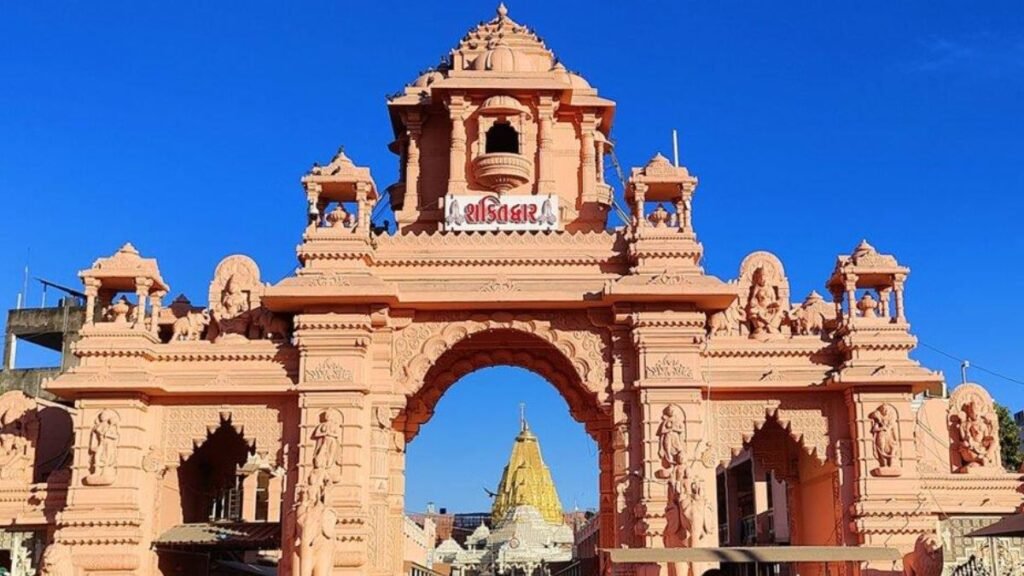
Ancient Origins
The sacred site at Ambaji is believed to predate formal temple construction by centuries Shakti worship in this area is thought to extend into pre-Vedic times. The location is at the origin of the legendary Vedic river Saraswati one of the three sacred rivers of the Vedas which adds a profound layer of antiquity to the site’s spiritual identity.
The present temple structure began taking shape around the 7th century CE, constructed by Nagar Brahmins. The site’s importance was recognised across multiple dynasties: a stone inscription from 1584 records significant repairs; a copper plate from 1762 records further repairs by the Thakor of Tintoi. In the 13th century, the temple was damaged by raiders and subsequently rebuilt by the rulers of Idar State. For a period, Jain merchants managed the temple, and Vaishnava traders later undertook repairs. In 1963, the Shri Arasuri Ambaji Mata Devasthan Trust was formally constituted to manage the temple, and major renovation work in 1975 maintained the temple’s historical character while improving facilities for the growing number of pilgrims.
The Architecture – White Marble and a Gold Spire
The Ambaji Temple is a white marble structure crowned by a gold-plated shikhara (spire) a visual that glows in the afternoon sun and is visible from a considerable distance against the Aravalli hill backdrop. The architectural style is traditional Gujarati with intricate stone carvings and marble work that reflect the skilled craftsmanship of the region.
The temple complex has multiple gates Lion Gate (Sinha Dvara) and Peacock Gate (Mayur Gate) among them each marking a transition from the outside world into the sacred space. The complex includes a large open courtyard where pilgrims gather, wait, and offer prayers. The inner sanctum, where the Shri Visa Yantra is enshrined, is the smallest and most concentrated space the sacred core to which the entire architectural programme leads.
Mansarovar – The Sacred Pond
Within the temple complex is Mansarovar a sacred pond whose waters are used for ritual bathing by devotees, particularly during festivals. The Mansarovar is associated in devotional tradition with purification and the washing away of sins. During the Bhadarvi Poonam and Navratri festivals, the pond is the site of bathing rituals that form part of the complete pilgrimage experience.
Gabbar Hill – The Original Seat of the Goddess
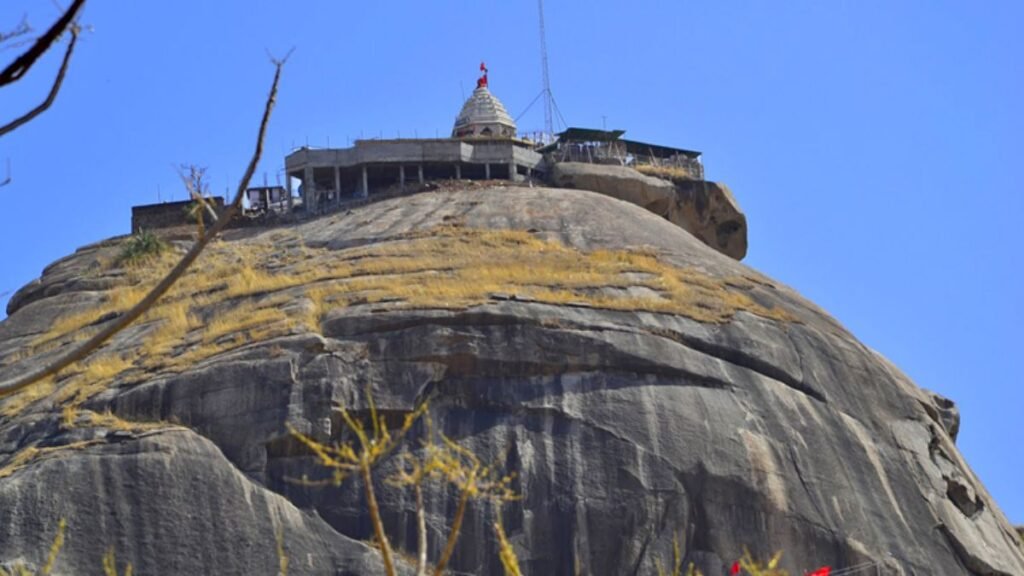
The Sacred Hill 4 km Away
The most spiritually significant location in the Ambaji pilgrimage complex is not the main temple building but a hill 4 kilometres away: Gabbar Parvat, known as Gabbar Hill. According to tradition, Gabbar Hill is the original seat of the goddess the place where Goddess Amba first appeared and where her divine presence is most immediately and powerfully felt. Many devout pilgrims consider Gabbar Hill the true centre of the Ambaji pilgrimage, with the main temple as its downstream expression.
Lord Rama is said to have climbed Gabbar Hill and prayed to Goddess Amba here before the battle against Ravana seeking the strength and blessing that would allow him to rescue Sita and defeat the demon king. This association with the Ramayana narrative adds another layer of mythological depth to an already extraordinarily rich sacred site.
Also Read: Nishkalank Mahadev Temple
The 999 Steps
The traditional ascent to the top of Gabbar Hill involves climbing 999 stone steps a number that is not merely practical but symbolic. The climb is considered an act of devotion in itself each step a part of the prayer. The ascent through the rocky, forested Aravalli terrain, with the plains of North Gujarat spreading out below as you climb higher, is a physically demanding but deeply rewarding experience. The views from the top panoramic across the Aravalli Hills, with the main Ambaji Temple visible in the distance below — are among the finest in North Gujarat.
The Ropeway – For Those Who Cannot Climb
A ropeway service is available for visitors who cannot manage the 999 steps elderly pilgrims, families with young children, or those with physical limitations. The ropeway is a practical addition that has made Gabbar Hill accessible to a much wider range of devotees. Even those who take the ropeway should spend time at the top in meditation or prayer the summit has a quality of quiet power that the main temple, busy with pilgrims, cannot always provide.
Festivals at Ambaji – The Most Important Events
Bhadarvi Poonam Mela – The Greatest Pilgrimage in Gujarat
The Bhadarvi Poonam Mela is the most important annual event at Ambaji Temple and one of the most extraordinary religious gatherings in Gujarat. Held on the full moon (Poonam) of the Hindu month of Bhadrapada typically falling in August or September the mela draws millions of pilgrims over several days. The Ambaji Temple complex and the surrounding town are transformed by the density and devotion of the gathered crowd.
What makes Bhadarvi Poonam particularly extraordinary is the foot pilgrimage. Each year, hundreds of thousands of devotees walk on foot to Ambaji from Vadnagar in Mehsana district a journey of approximately 180 to 200 kilometres. The walk takes five to seven days, with pilgrims covering 30 to 40 kilometres per day, sleeping on the roadside or at improvised camps, and sustained by the devotional energy of the collective journey. The sight of the roads leading to Ambaji filled with pilgrims walking chanting, singing, carrying flags and banners, moving through the Aravalli hills in a human river of devotion is one of the most powerful images in Gujarat’s religious life.
During the Bhadarvi Poonam, the temple operates for continuous extended darshan hours. The main night of the full moon the Poonam night is when the temple is at its most intense, most illuminated, and most devotionally charged. Plan all logistics around this if attending: accommodation in Ambaji fills up weeks in advance, the roads approaching the town become severely congested, and queues for darshan can be extremely long.
Navratri – Nine Nights of Goddess Worship
Navratri at Ambaji is one of Gujarat’s most celebrated festival experiences. The nine nights of devotion to the Goddess with Garba, aarti, and continuous pilgrimage are observed here with a scale and intensity that reflects Ambaji’s position as Gujarat’s supreme Shakti Peetha. The temple is elaborately illuminated, the courtyard becomes the venue for Garba and Dandiya, and special darshan arrangements allow more devotees to view the sacred Yantra during the festival period.
Navratri draws its own enormous crowd to Ambaji separate from the Bhadarvi Poonam pilgrims. The Navratri visitors are often families and younger devotees who come for the festival experience as much as the pilgrimage. The town of Ambaji transforms during Navratri hotels and dharamshalas are full, the market is alive at all hours, and the temple glows through the night.
Other Major Festivals
- Diwali – Celebrated with special illumination of the temple and fireworks in the town
- Mahanavami – The ninth and final day of Navratri; the most auspicious single day of the festival season
- Janmashtami – Krishna’s birth anniversary; observed with devotion at the town’s temples
- 51 Shakti Peeth Parikrama Mahotsav – A Gujarat government initiative connecting Ambaji symbolically to all 51 Shakti Peethas; draws lakhs of devotees when held
Darshan at Ambaji – What to Expect
Ambaji Temple receives pilgrims throughout the day in three darshan sessions, with a midday break for ritual maintenance:
| Session | Timings | Notes |
| Morning Darshan | 7:00 AM – 11:30 AM | Most peaceful; ideal time for focused darshan of the Shri Visa Yantra |
| Afternoon Darshan | 12:30 PM – 4:30 PM | After the midday ritual break; less crowded than peak evening |
| Evening Darshan | 6:30 PM – 9:00 PM | Most atmospheric; evening aarti is especially powerful |
| Special Puja | ₹100 – ₹400 per puja | Various specific pujas available; book at the Devasthan Trust counter |
| Entry Fee | Free | No ticket or payment required for regular darshan |
| Festival Darshan | Extended hours | During Bhadarvi Poonam and Navratri, hours are extended confirm locally |
During peak festival periods — especially Bhadarvi Poonam — queue management systems are in place and darshan may take several hours from queue entry to sanctum viewing. Plan your time accordingly. Arriving well before the morning session opens (by 6:30 AM) on a non-festival weekday gives the most comfortable and reflective darshan experience.
Best Time to Visit Ambaji Temple
October to March – Best Overall Season
The winter months are the most comfortable for a visit to Ambaji. The Aravalli Hills have cooler temperatures from October to February pleasant for the Gabbar Hill climb and for extended time in the temple complex. The temple is active and devotionally vibrant year-round but not overwhelmingly crowded on weekday visits in this season. November and December visits combine comfortable weather with relatively manageable queue times.
Bhadarvi Poonam (August / September) – For the Mela
If experiencing the full scale and intensity of Ambaji pilgrimage is your goal, attend the Bhadarvi Poonam Mela. This is the most important and most attended event at the temple and one of India’s most extraordinary religious gatherings. Be prepared for very large crowds, extended darshan queues, and limited accommodation availability. Book accommodation at least a month in advance and plan to arrive a day before the Poonam night.
Navratri (September / October) – For the Festival
Navratri at Ambaji is deeply celebrated and draws its own massive crowd separate from the Bhadarvi pilgrims. If you want the festival experience — Garba, illuminated temple, nine nights of continuous devotion this is the window. Again, advance booking of accommodation is essential.
Weekday Mornings – Best for Peaceful Darshan
If your primary purpose is a quiet, focused darshan of the Shri Visa Yantra without crowd pressure, visit on a Tuesday or Wednesday morning in November, December, or January. Arrive by 6:30 AM for the morning session opening. This gives you the most meditative, reflective experience Ambaji offers.
How to Reach Ambaji Temple
| From | Distance | Mode | Approx. Time |
| Ahmedabad | ~180–185 km | Car / Bus (via Mehsana–Palanpur highway) | 3.5–4 hours |
| Palanpur | ~65 km | Car / Bus | 1.5 hours |
| Abu Road (Railway Station) | ~20–22 km | Train + Taxi/Bus | 30 minutes from station |
| Mount Abu | ~45 km | Car / Taxi | 1 hour |
| Udaipur (Rajasthan) | ~120 km | Car / Bus | 2.5 hours |
| Mehsana | ~120 km | Car / Bus | 2.5 hours |
| Gandhinagar | ~195 km | Car / Bus | 4 hours |
| Rajkot | ~290 km | Car | 5 hours |
| Udaipur Airport | ~120 km | Flight + Taxi | 2.5 hours |
| Ahmedabad Airport | ~180 km | Flight + Taxi/Bus | 3.5–4 hours |
By Road — Private Vehicle or GSRTC Bus
The most convenient way to reach Ambaji from Ahmedabad is by private car or hired taxi via the Ahmedabad-Mehsana-Palanpur National Highway, then taking the state road toward Ambaji. GSRTC buses run regularly from Ahmedabad, Mehsana, Palanpur, and Himmatnagar to Ambaji. Private luxury buses also run on the major festival weekends. The drive from Ahmedabad through the Aravalli foothills as you approach Ambaji is scenic and becomes increasingly forested and elevated.
By Train — Abu Road Station
Abu Road Railway Station, on the main Delhi–Mumbai Western Railway line, is approximately 20 to 22 km from Ambaji. Multiple express trains stop at Abu Road from Ahmedabad (approximately 3 to 3.5 hours), Mumbai (approximately 12 hours), Delhi, and Jaipur. From Abu Road station, hire a local taxi or take a shared jeep for the 20 to 22 km journey to Ambaji. This is the most practical public transport option for visitors from outside Gujarat.
By Air
The nearest commercial airport with significant connectivity is Udaipur Airport (Maharana Pratap Airport) in Rajasthan, approximately 120 km from Ambaji. From Udaipur, taxis are available to Ambaji (~2.5 hours). Ahmedabad Airport (~180 km) has much broader flight connectivity from across India and is a practical option for those flying into Gujarat before making the road journey.
Nearby Attractions to Combine with Ambaji
- Gabbar Hill (Gabbar Parvat) ~4 km | The original seat of the goddess; 999 steps to the top with ropeway available; panoramic Aravalli views; Lord Rama’s prayer site. Essential addition to any Ambaji visit.
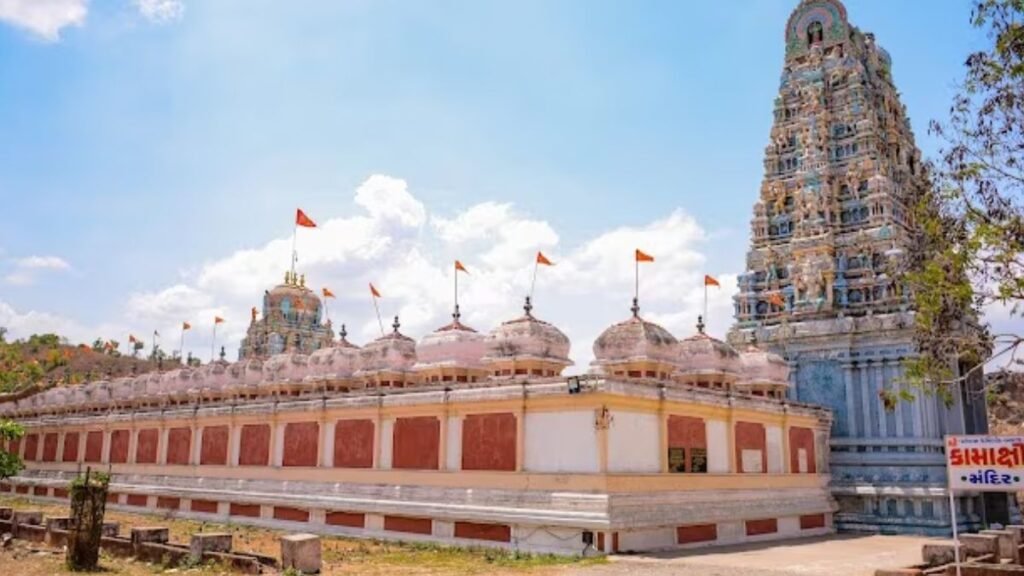
- Kamakshi Mandir Near Ambaji town | A calm South Indian-style temple a few minutes from the main Ambaji temple. Architecturally distinctive and particularly good for meditative peace when the main temple is crowded.
- Mount Abu ~45 km | Rajasthan’s only hill station — scenic, cool, and home to the extraordinary Dilwara Temples (11th–13th century Jain temples with marble carvings considered the finest in the world). A perfect 2-day Ambaji + Mount Abu itinerary.
- Dilwara Temples, Mount Abu ~45 km | Five Jain temples dating from the 11th to the 13th century; the carved marble interiors — particularly the Vimal Vasahi and Luna Vasahi temples — are universally acknowledged as the pinnacle of Indian marble carving. Among the most beautiful buildings in India. Free entry (foreigners: small fee).
- Kumbharia Jain Temples ~60 km | A group of five ancient Jain temples near Danta in Banaskantha district, built in the same Solanki period as the Dilwara temples. Less visited but architecturally significant.
- Abu Road ~22 km | The gateway town for both Ambaji and Mount Abu. Has practical facilities for travellers food, accommodation, and the railway station. A useful logistical base.
Also Read: Zarwani Waterfall, Narmada
Practical Tips for Visiting Ambaji Temple
- Arrive early – be at the temple complex by 6:30 AM for the morning session opening; this is the most peaceful and least crowded darshan window of the day.
- Remove footwear before the temple complex – footwear storage is available near the main gates. The marble courtyard floor requires bare feet.
- Dress modestly – women should cover the head before entering the main sanctum; men should wear full trousers (no shorts); both should avoid sleeveless clothing.
- During Bhadarvi Poonam and Navratri – book accommodation at least 4 to 6 weeks in advance. Hotels in Ambaji, Abu Road, and Mount Abu all fill up completely.
- The Gabbar Hill ropeway is recommended for those with knee issues or who cannot climb 999 steps but if physically able, the climb is rewarding and part of the devotional experience.
- Carry water for Gabbar Hill – there are tea stalls on the way up but no reliable water sources at the summit.
- Special puja bookings – if you want a specific puja performed at the sanctum, book at the Devasthan Trust counter upon arrival. Rates are ₹100 to ₹400 depending on the puja type.
- No photography inside the main sanctum respect the sanctity of the Shri Visa Yantra. The exterior, courtyard, and Gabbar Hill offer excellent photography opportunities.
- Combine with Mount Abu – the 45 km drive from Ambaji to Mount Abu (Rajasthan) and the Dilwara Temples is one of the finest heritage day trips in North Gujarat/South Rajasthan.
Frequently Asked Questions (FAQs)
Ambaji Temple is one of India’s 51 Shakti Peethas the most sacred sites in the Shakta tradition of Hinduism. It is believed to mark the spot where Goddess Sati’s heart fell when Lord Vishnu severed her body as Lord Shiva wandered the cosmos in grief after her death. The heart the seat of devotion and love falling at Ambaji makes the site one of the most emotionally resonant of all 51 Peethas. The temple draws over 12.5 million pilgrims annually and is the supreme centre of Shakti pilgrimage in Gujarat and Rajasthan. Its most extraordinary feature is that the sanctum contains no idol only the sacred Shri Visa Yantra, a geometric embodiment of the goddess’s presence.
The Shri Visa Yantra (also called Shri Visa Yantra or Shri Yantra) is the sacred object enshrined in the inner sanctum of Ambaji Temple in place of a traditional idol. In the Shakta Tantric tradition, a yantra is a sacred geometric diagram that is understood to be a physical embodiment of divine energy not a representation of the goddess but her actual presence in geometric form. The Yantra at Ambaji is gold-plated and partially veiled from direct view. Devotional tradition holds that all sincere wishes can be fulfilled by seeing the Paras Peepli the sacred Yantra which is why pilgrims travel hundreds of kilometres specifically to stand before it.
Ambaji Temple is open for darshan in three daily sessions: morning from 7:00 AM to 11:30 AM, afternoon from 12:30 PM to 4:30 PM, and evening from 6:30 PM to 9:00 PM. The temple closes for approximately one to two hours at midday and in the early evening for ritual maintenance. Entry for regular darshan is free. Special pujas can be booked at the Devasthan Trust counter for ₹100 to ₹400 depending on the puja type. During Bhadarvi Poonam and Navratri festivals, darshan hours are extended confirm current timings locally before visiting.
Gabbar Hill (Gabbar Parvat) is a sacred hill located approximately 4 km from the main Ambaji Temple and is considered the original seat of Goddess Amba — the place where she first appeared. Lord Rama is said to have prayed here before the battle against Ravana. The traditional ascent involves climbing 999 stone steps; a ropeway service is also available for those who cannot manage the climb. From the top, panoramic views of the Aravalli Hills are spectacular. Many pilgrims consider Gabbar Hill spiritually even more potent than the main temple and make it an essential part of the Ambaji pilgrimage. Auto-rickshaws and taxis from Ambaji town cover the 4 km to the Gabbar Hill base.
The Bhadarvi Poonam Mela is the most important annual festival at Ambaji Temple held on the full moon (Poonam) of the Hindu month of Bhadrapada, which falls in August or September. It is one of Gujarat’s largest and most attended religious gatherings, drawing millions of pilgrims. The most extraordinary aspect is the foot pilgrimage: hundreds of thousands of devotees walk from Vadnagar in Mehsana district nearly 200 km to Ambaji on foot, covering 30 to 40 km daily over 5 to 7 days. The full moon night itself sees extended darshan, illuminated temples, and a devotional atmosphere of extraordinary intensity. Book accommodation 4 to 6 weeks in advance if attending.
From Ahmedabad, Ambaji Temple is approximately 180 to 185 km about 3.5 to 4 hours by road via the Mehsana-Palanpur national highway. GSRTC state buses run regularly from Ahmedabad and are a comfortable, affordable option. By train, take any service from Ahmedabad to Abu Road Railway Station (~3 to 3.5 hours) and then hire a taxi for the 20 to 22 km journey to Ambaji. Private taxis and tour operators also run day trips and overnight trips from Ahmedabad to Ambaji. If coming from outside India or from far-off Indian cities, fly into Ahmedabad or Udaipur both airports are within 120 to 180 km of Ambaji.
Yes and this is one of the finest 2-day itineraries in the Gujarat-Rajasthan border region. Ambaji and Mount Abu are only 45 km apart about 1 hour by road. Day 1: Ambaji darshan in the morning, Gabbar Hill in the late morning, Kamakshi Mandir, and drive to Mount Abu in the evening. Day 2: Dilwara Temples (the world’s finest marble Jain temples, rated by architectural historians as among the most beautiful buildings in India), the lake, Guru Shikhar (the highest point in the Aravalli Range), and return via Ambaji or Abu Road. This 2-day circuit gives you the most spiritually and architecturally rich experience available in North Gujarat and South Rajasthan.
Final Thoughts
The pilgrims who walk 200 kilometres on foot to stand before a gold-plated geometric diagram in a marble temple in the Aravalli Hills are telling us something. They are not walking toward a beautiful building or a famous idol. They are walking toward a presence toward the place where, according to the deepest tradition of the Shakta faith, the goddess’s heart fell to earth.
Ambaji is not the most visually spectacular temple in Gujarat. There are grander architectural statements, more elaborately carved sanctums, more touristic infrastructure at other major pilgrimage sites. What Ambaji has and what no other site in Gujarat quite replicates is the weight of twelve and a half million annual acts of faith, the sound of hundreds of thousands of feet on the road in the Bhadrapada month, and the quality of silence inside a sanctum that holds not an idol but a Yantra, not an image but a presence.
Go for the darshan. Climb Gabbar Hill. If you can, go during Bhadarvi Poonam and stand on the road at dawn and watch the pilgrims walk past. Then you will know what Ambaji is.
