Gujarat’s coastline is long and varied from the tidal flats of Kutch to the rocky volcanic shores of Saurashtra. But among the state’s beaches, Tithal stands apart for a reason that is immediately visible the moment you step onto it: the sand is black. Not grey, not dark beige genuinely, deeply black, created over millennia by the erosion of basalt rocks from the nearby Sahyadri hills into the Arabian Sea.
Tithal Beach in Valsad district, South Gujarat, is the closest good beach to cities like Surat, Navsari, Vapi, and the broader Mumbai-Ahmedabad corridor. Just 4 to 6 kilometres from Valsad railway station one of the busiest stations on the Western Railway mainline Tithal is genuinely easy to reach. And at sunset, when the golden rays of the Arabian Sea catch the black sand and turn it to a shifting bronze, it is genuinely difficult to believe you are looking at the same beach that looks unremarkable in the harsh midday light.
This TravelRoach guide covers everything the black sand story, the Sai Baba and Swaminarayan temples, activities and food, the best sunset timing, how to reach, safety tips, and nearby attractions including the extraordinary Udvada Parsi fire temple.
Tithal Beach – Quick Information
| Detail | Information |
| Location | 4–6 km west of Valsad town, on the Arabian Sea, Valsad District, South Gujarat |
| Most Distinctive Feature | Black sand caused by erosion of basalt rocks from the nearby Sahyadri hills |
| Beach Type | Open sandy shoreline on the Arabian Sea good for walks, sunsets, photography |
| Entry Fee | No entry fee the beach is free to visit |
| Parking | Available near the beach for approximately ₹10–20 |
| Best Time of Day | 4:00 PM – 7:00 PM sunset is the primary experience at Tithal |
| Best Season | November to February (19–27°C); October to March overall |
| Temples at Tithal | Shri Sai Baba Temple (1.5 km south) and Shri Swaminarayan Temple / BAPS (1.6 km north) |
| Distance from Valsad | ~4–6 km (12–15 minutes by road) |
| Distance from Surat | ~95 km (~2 hours) |
| Distance from Mumbai | ~196 km (~3.5 hours via NH48) |
| Distance from Ahmedabad | ~336 km (~5 hours) |
| Distance from Navsari | ~30 km (~40 minutes) |
| Distance from Vapi | ~30 km (~40 minutes) |
| Nearest Railway Station | Valsad Station (BL) major station on the Western Railway mainline |
| Nearest Airport | Surat Airport (~99 km) |
| Safety Note | Coral reefs in deeper water do not swim beyond the safe zone marked by lifeguards |
| Weekend Warning | Evenings after 5 PM on weekends can be very crowded families should prefer weekdays |
About Tithal Beach and Valsad
The Black Sand – What Makes Tithal Unique
The defining characteristic of Tithal Beach is a phenomenon that most beach-goers in India have never encountered: black sand. While most beaches in Gujarat and India are covered in white, cream, or golden sand, Tithal’s shoreline is carpeted in dark, almost obsidian-coloured granules that feel different, look different, and behave differently from typical beach sand.
The black sand at Tithal is the result of geological processes that have been working for millions of years. The Sahyadri (Western Ghats) mountain range which forms the eastern boundary of the coastal plain running through South Gujarat is composed significantly of basalt, a dark volcanic rock. As the rivers flowing west from the Sahyadris carry sediment to the Arabian Sea, and as coastal erosion brings the basalt rocks into contact with the waves, the basalt breaks down over millennia into dark granules. These dark sand particles, being denser and heavier than typical quartz sand, settle and concentrate along specific stretches of the South Gujarat coastline and Tithal is the most prominent of these black sand accumulations.
Beyond its visual appeal, the black sand at Tithal has a practical characteristic that visitors quickly notice: it absorbs heat more efficiently than white sand, becoming noticeably warm in the afternoon sun. This also means the sand releases its heat more slowly in the evening creating a warm, comfortable surface for sitting even after the sun has set. However, it also means midday visits to Tithal in summer can involve sand that is uncomfortably hot underfoot. Slippers are strongly recommended for afternoon visits.
Valsad – The City Behind the Beach
Valsad is the headquarters of Valsad district in South Gujarat a mid-sized city on the Western Railway mainline that most people pass through on trains between Mumbai and Ahmedabad without stopping. That is their loss, because the Valsad district around the city contains some of South Gujarat’s most rewarding destinations.
Valsad district is famous across India for two fruits: the Hafus (Alphonso) mango and the chikoo (sapodilla). The district’s orchards, particularly between January and June, are some of the most productive fruit-growing landscapes in the country. Fresh Alfonso mangoes and chikoo are available directly from farms and roadside vendors during their respective seasons and are genuinely worth stopping for.
The broader Valsad district also has significant Parsi cultural heritage the ancient Irashah Atash Behram at Udvada (approximately 40 km from Valsad), one of the most sacred Zoroastrian fire temples in the world, has been burning continuously since 721 CE and is the most important pilgrimage site for Parsis worldwide. Wilson Hills, a small hill station in the district near Dharampur, is another lesser-known but genuinely pleasant destination.
Also Read: Vansda National Park, Navsari: Complete Guide to Gujarat’s Hidden Rainforest
The Beach Experience – What to Expect
The Shoreline
Tithal Beach is a wide, open stretch of the Arabian Sea coastline running roughly north to south. The beach is broad at low tide, the sand extends considerably from the waterline to the vegetation at the beach’s edge and the black sand gives it a dramatic visual character that is unlike any beach in North or Central Gujarat. The beach is lined by coconut palms and casuarina trees, whose shade provides relief during hotter visits.
The waves at Tithal are generally moderate not as wild as the monsoon-swept beaches of the Saurashtra coast, but with enough energy to create an enjoyable sound backdrop. The sea itself is the colour of deep blue-grey glass, particularly in the late afternoon as the light shifts toward the west.
The Sunset – The Main Event
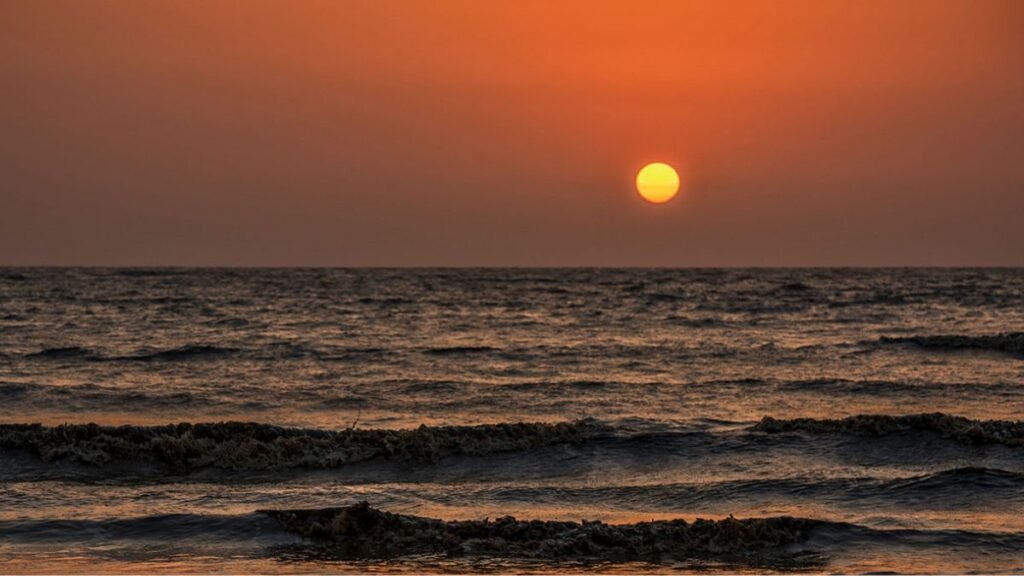
Every conversation about Tithal Beach eventually arrives at the sunset. The west-facing orientation of the beach means that the sun sets directly over the Arabian Sea visible as a perfect disc descending toward the horizon with nothing between it and the water. As the sun drops, its light hits the black sand from a shallow angle, and something remarkable happens: the sand appears to glow. The dark granules catch the warm evening light and reflect it back as bronze, amber, and deep gold colours that are completely unlike anything you see on a pale-sand beach at the same time of day.
The Tithal sunset has become the beach’s defining photographic moment and is why the beach fills up from late afternoon on weekends. Plan to arrive by 5 PM to find a good spot. The golden hour here roughly 5:30 to 6:30 PM in winter months is genuinely extraordinary. Photographers should bring their best lens and arrive hungry for compositions.
Swimming and Water Safety
Swimming at Tithal Beach is possible but requires care. The beach has lifeguards during busy periods, but the Arabian Sea here has some specific hazards:
- Coral reefs exist in the deeper water offshore – cuts from coral are painful and can be serious. Do not wade or swim beyond the clearly safe shallow zone.
- The waterline can be further from the parking and sitting areas than expected – particularly at low tide – and the distance varies significantly with the tide.
- During the monsoon (June to September), swimming is strongly not recommended waves are powerful and currents unpredictable.
- Senior citizens and children should stay in the shallowest water only and always within the supervised zone when lifeguards are present.
Temples at Tithal – Spirituality by the Sea
1. Shri Sai Baba Temple (1.5 km South of Main Beach)
The Shri Sai Baba Temple at Tithal is one of the most visited and highly regarded Sai Baba temples in South Gujarat. Located approximately 1.5 kilometres south of the main beach area, the temple overlooks the Arabian Sea and has a commanding setting on the coastal edge. The temple is famous for its daily prayers (aartis), which draw devotees from Valsad, Surat, Navsari, Vapi, and from as far as Mumbai. Pilgrims from across India make dedicated visits to this particular Sai Baba temple testimony to the spiritual reputation it has built over its existence.
The combination of the sea setting, the daily aarti atmosphere, and the devotional energy of the visiting pilgrims makes the Sai Baba temple at Tithal a genuinely moving experience even for visitors who come primarily for the beach. Thursday is considered the most auspicious day for a Sai Baba visit; the temple is busiest on Thursdays.
2. Shri Swaminarayan Temple / BAPS Temple (1.6 km North)
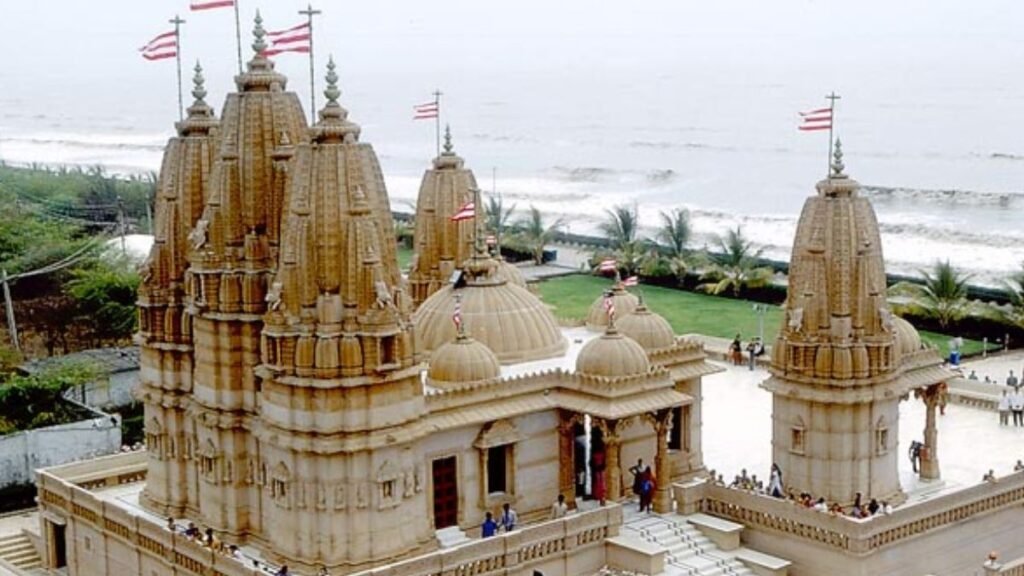
At the northern end of Tithal, approximately 1.6 kilometres from the main beach area, stands the Shri Swaminarayan Temple a BAPS Swaminarayan temple overlooking the Arabian Sea. The temple is notable for its beautiful hand-carved stone carvings a hallmark of BAPS temple construction and its dramatic coastal setting. As with all BAPS temples, the premises are scrupulously clean and well-maintained. The view of the Arabian Sea from the temple is one of the most peaceful on the South Gujarat coast.
The BAPS Swaminarayan movement has a large following in South Gujarat, and the Tithal temple draws devotees from across the region. It is located at the extreme northern end of the Tithal beach stretch accessible by a walk along the beach from the main area or by road. Modest dress is required inside the temple complex.
3. Shantidham Aradhana Kendra
Close to the seashore near the main beach area, Shantidham Aradhana Kendra is a spiritual centre and meditation facility. It offers a serene environment for those seeking quiet reflection away from the beach activity. The facility is particularly appreciated by visitors who come to Tithal not just for the beach experience but for spiritual peace by the sea.
What to Eat at Tithal Beach – The Street Food Guide
No visit to Tithal Beach is complete without working through its excellent beach-side street food. The food stalls and vendors along the beach and near the entrance create a lively, aromatic food scene that is distinctly South Gujarati in character. Here is what to eat:
Must-Try Beach Snacks
- Dabeli – South Gujarat and Saurashtra’s most beloved street snack. A spiced, mashed potato filling served in a bread roll and loaded with sweet tamarind chutney, mint chutney, sev, pomegranate seeds, and roasted peanuts. Tithal’s dabeli vendors are particularly well-regarded.
- Bhajiya (Pakora) – Hot, crispy Gujarati fritters made with onion, methi, batata, and mirchi served fresh off the tawa with green chutney. Essential accompaniment to the sea breeze.
- Bhel Chaat – A tangy, crunchy mix of puffed rice, sev, onion, tomato, boiled potato, and chutneys. Light, refreshing, and perfect for a beach snack.
- Sweet Corn – Roasted on charcoal with lime and masala. The smell of roasting corn drifting along the beach is one of the defining olfactory memories of a Tithal visit.
- Star Fruit (Kamrakh) with Chaat Masala – A Tithal specialty that surprises most first-time visitors. Fresh star fruit sliced and dressed with salt, red chilli powder, and chaat masala. Tangy, crunchy, and completely addictive.
- Fresh Coconut Water – Chilled coconut water straight from the coconut, available from vendors throughout the beach. The perfect natural hydration after walking in the sun.
- Boiled Corn (Cholai) – Tender boiled corn with butter, lime, and masala. A step gentler on the palate than the charcoal-roasted version.
All food at Tithal Beach is predominantly vegetarian, in keeping with Gujarati food culture. Prices are very affordable expect to spend ₹20 to ₹60 per item. The food is at its best in the early evening, when the vendors are freshly restocked and the cooking smells blend with the sea air.
Shopping Near the Beach
At the entrance to the beach, small stalls sell trinkets, accessories, small toys, and souvenirs. These are popular with families, particularly children and women looking for costume jewellery and quirky souvenirs. Nothing expensive or particularly artisanal but a pleasant browse while waiting for the main beach crowd to thin out.
Also Read: Mahuva Beach Bhavnagar
Things to Do at Tithal Beach
1. Sunset Walk and Photography
The single most recommended activity at Tithal is a leisurely walk along the black sand shoreline in the golden hour roughly 5:30 to 6:30 PM in winter months. Walk southward from the main beach entrance toward the Sai Baba Temple direction, or northward toward the Swaminarayan Temple. Both directions give you wide, open views of the Arabian Sea on your right and the black-sand shoreline ahead. The photography at this time particularly the reflections in the wet sand at the tide line is exceptional.
2. Camel Rides
Camel rides along the beach are available from operators on the sand near the main beach entrance. Camel rides are popular with families, particularly with young children who are experiencing the beach for the first time. A camel silhouetted against the sunset at Tithal is one of the most enduringly popular photography subjects on the beach.
3. Water Sports
During the appropriate season (October to May), water sports operators set up at Tithal Beach offering jet ski rides, banana boat rides, and other motorised water activities. These are popular with younger visitors and groups. Always check that operators have properly maintained equipment and life jackets before participating. Water sports are suspended during the monsoon (June to September) when sea conditions are unsafe.
4. Temple Visits
A combined visit to both the Sai Baba Temple (south) and the Swaminarayan Temple (north) makes for a complete Tithal spiritual circuit alongside the beach. Walking between the two temples along the coastal path gives you continuous sea views. Allow 30 to 45 minutes at each temple for a respectful and unhurried visit.
5. Swimming and Sea Wading
Wading in the shallows ankle to knee depth is perfectly enjoyable and safe in calm conditions. The black sand visible through the clear shallow water creates an unusual visual that children particularly love. Deeper swimming should only be attempted by confident swimmers and always within the safe zones marked by lifeguards. See the safety notes in the earlier section.
6. Beach Picnic
Tithal is a very popular picnic destination for Gujarati families from Surat, Navsari, Vapi, and Valsad. The beach is wide enough that families can spread out without crowding. Pack your own food (the Tithal beach stalls are good but may be crowded on weekends), bring a mat, and settle in for a few hours. The ideal picnic window is 3 PM to 6 PM, catching the afternoon sea breeze and sunset.
Best Time to Visit Tithal Beach
November to February – Best Season
This is the ideal time to visit Tithal Beach. Temperatures range from 19 to 27 degrees Celsius comfortable for beach walks, swimming, and extended outdoor time. The sea is calm and the visibility is excellent. Sunsets are particularly vivid in the winter months when the atmosphere is clear of the monsoon haze. This is also the peak tourist season for South Gujarat, so the beach is lively but not overwhelmingly crowded on weekdays.
October to March – Broadly Good
The broader October to March window is generally pleasant at Tithal. October still has residual warmth from the post-monsoon period and the beach is fresh and green from the rains. March evenings can begin to feel warmer toward the end of the month, but mornings are still comfortable.
Monsoon (June to September) -Dramatic but Different
The monsoon brings a completely different Tithal Beach the sea is dramatic and powerful, the sky is often cloudy and turbulent, and the surrounding landscape is intensely green. Swimming and water sports are suspended and the beach can be unsafe during storm surges. However, for photographers and those who appreciate the raw power of the monsoon sea, a dry-day visit between showers offers unforgettable imagery. The beach is largely empty on monsoon days solitude by the dramatic Arabian Sea.
April to June – Hot, Best for Early Morning
South Gujarat summer can be hot and humid. The black sand at Tithal absorbs and retains heat significantly — afternoon visits in May and June on the black sand can be uncomfortable without footwear. If visiting in summer, plan exclusively for early morning (7 to 10 AM) when temperatures are manageable and the beach is quiet. The sea is calm during this period and early morning light is beautiful.
Best Time of Day – 4:30 PM to 7:00 PM Year-Round
Regardless of season, the most celebrated time at Tithal Beach is the late afternoon into sunset. The combination of cooling sea breeze, golden light hitting the black sand, and the sun dropping into the Arabian Sea makes the 4:30 to 6:30 PM window the Tithal experience that most visitors come specifically for. Arrive by 4:30 PM to get a good position before the crowds build.
How to Reach Tithal Beach, Valsad
| From | Distance | Mode | Approx. Time |
| Valsad city / Railway Station | ~4–6 km | Auto-rickshaw (~₹60–100) / GSRTC bus / Taxi | 12–15 minutes |
| Surat | ~95 km | Car / Train to Valsad + Auto | 2 hours |
| Navsari | ~30 km | Car / Train to Valsad + Auto | 40–50 minutes |
| Vapi | ~30 km | Car / Train to Valsad + Auto | 40–50 minutes |
| Mumbai | ~196 km via NH48 | Car / Train to Valsad + Auto | 3.5–4 hours |
| Ahmedabad | ~336 km | Car / Train to Valsad + Auto | 5–5.5 hours |
| Surat Airport | ~99 km | Flight + Taxi | 2 hours |
By Train — The Easiest Option
Valsad Railway Station (BL) is one of the major stations on the Western Railway mainline between Mumbai and Ahmedabad. Express and superfast trains from Mumbai (approximately 3 hours), Surat (approximately 1 hour), Navsari (approximately 20 minutes), and Ahmedabad (approximately 5 hours) all stop at Valsad. This makes Tithal Beach one of the most train-accessible beaches in Gujarat you can be on the beach within 15 minutes of stepping off the train.
From Valsad station, take a local auto-rickshaw directly to Tithal Beach (approximately ₹60 to ₹100) or board a GSRTC bus from the central bus stand to Tithal. The bus fare is very affordable. Auto-rickshaws are abundantly available outside the station exit at all hours.
By Road
Tithal Beach is on the western side of Valsad city, approximately 4 to 6 km by road. From NH48 (the Mumbai-Ahmedabad highway), take the Valsad exit and follow the road westward through the city toward the beach. Parking is available near the beach entrance for ₹10 to ₹20. The road to Tithal is narrow in the final section avoid bringing large vehicles on weekends when the approach road can become congested.
By Bus – GSRTC
Gujarat State Road Transport Corporation buses run from Valsad central bus stand to Tithal Beach at regular intervals. This is the most affordable public transport option. From larger cities like Surat, Navsari, or Vapi, take a GSRTC service to Valsad and then change to the Tithal Beach bus or auto.
By Air
The nearest commercial airport is Surat Airport (STV), approximately 99 km from Tithal Beach. Flights connect Surat to Mumbai, Delhi, Hyderabad, Bengaluru, and other cities. From Surat airport, hire a taxi directly to Valsad/Tithal (approximately 2 hours). Mumbai Airport is approximately 186 km via NH48.
Also Read: Shivrajpur Beach, Dwarka
Where to Stay Near Tithal Beach
- Hotels near Tithal Beach – Several guesthouses and small hotels are located within 1 to 2 km of the beach, catering primarily to weekend visitors and Gujarati families. Basic to mid-range options at affordable prices.
- Valsad City Hotels – For better range and amenities, hotels in Valsad city (4 to 6 km from the beach) offer more options. Given the short distance, staying in Valsad city and making multiple beach visits is a practical approach.
- Dharamshalas – Budget pilgrim accommodation is available near the Sai Baba and Swaminarayan temples for those visiting specifically for the temples.
- Surat (~95 km) – For those combining Tithal with Surat city sightseeing or arriving by air, Surat has a wide range of hotels from budget to premium. Tithal Beach is a comfortable 2-hour drive from Surat – ideal as a day trip from the city.
Travel Tips for Tithal Beach
- Wear slippers – the black sand absorbs heat significantly and can be very hot underfoot in the afternoon. Flip-flops or beach sandals are essential, particularly between March and October.
- Arrive by 4:30 PM on weekdays for the sunset – this gives you a good position before the evening crowd. On weekends, arrive 30 minutes earlier.
- Avoid weekend evenings after 5 PM if travelling with young children or senior family members – the crowd can become loud and the beach busy with youngsters. Weekday visits are significantly more peaceful.
- Do not swim beyond the safe zone – coral reefs in the deeper water can cause serious cuts. Stay in the shallow, lifeguard-supervised areas.
- The beach is free but carry cash for food, parking, and water sports – most vendors accept cash only.
- Combine with the Sai Baba Temple and Swaminarayan Temple – a complete Tithal visit includes both temples and the beach, which together give you the full character of the place.
- If visiting in summer – plan exclusively for morning hours (7 to 10 AM) and bring water, sunscreen (SPF 50+), and a hat. The black sand retains heat and reflected light from the dark surface can be intense.
- Carry a bag for your waste – the beach’s beauty is best maintained when visitors take responsibility for their litter. Dustbins are available near the beach entrance.
- Plan for alphonso mangoes (April to June) – Valsad district produces exceptional Hafus (Alphonso) mangoes. If visiting in mango season, buy directly from roadside vendors or orchards on the drive – they are significantly better and cheaper than anything available in cities.
Nearby Attractions to Combine with Tithal Beach
- Udvada Iranshah Atash Behram ~40 km | The most sacred Zoroastrian fire temple in the world. The eternal flame at the Iranshah Atash Behram in Udvada has been burning continuously since 721 CE. It is the holiest pilgrimage site for Parsis worldwide. The village of Udvada itself is a remarkably well-preserved example of traditional Parsi coastal community architecture.
- Udvada Beach ~40 km | A quieter, less-visited beach near Udvada village. Combine with the Iranshah Atash Behram visit for a peaceful coastal day.
- Nargol Beach ~54 km | An even quieter and more secluded beach than Tithal, largely unknown to mainstream tourists. Perfect for those seeking solitude and natural beauty without the beach-day crowds.
- Wilson Hills ~30 km near Dharampur | A small hill station in Valsad district with panoramic views, pleasant climate, and forest walks. A gentle, low-key contrast to the beach experience.
- Parnera Hill ~25 km | A notable hill near Valsad with a Parnera Fort at the summit. Good views and a short trek for those who want some elevation after the flat beach.
- Vansda National Park ~90–100 km | Gujarat’s densest forest in Navsari district — if extending the trip northward. Read our full guide on TravelRoach.
Frequently Asked Questions (FAQs)
The black sand at Tithal Beach is caused by the natural erosion of basalt rocks from the nearby Sahyadri (Western Ghats) mountain range. Basalt is a dark volcanic rock, and as rivers carry sediment from the Sahyadri hills westward into the Arabian Sea, and as coastal wave action erodes basalt outcrops along the shoreline, the rock breaks down into dark granules. These dense, dark particles settle along specific stretches of the South Gujarat coast and Tithal is the most prominent and well-known of these black sand beaches. There are very few natural black sand beaches in India, making Tithal a genuinely rare geological and scenic phenomenon.
No, Tithal Beach itself is free to enter there is no entry fee for the beach. You pay a nominal parking fee of approximately ₹10 to ₹20 if you arrive by private vehicle. Water sports activities (jet ski, banana boat, etc.) have their own separate charges paid to the operators on the beach. The Sai Baba Temple and Swaminarayan Temple are also free to visit. The food stalls and vendors at the beach are the primary spending opportunity budget ₹100 to ₹200 for a satisfying evening of beach snacks.
The best overall season is November to February when temperatures range from 19 to 27 degrees Celsius. November, December, and January are particularly pleasant the beach is cool, the Arabian Sea is calm, and the sunsets are exceptionally vivid in the clear winter atmosphere. The best time of day for the primary Tithal experience is the late afternoon arriving by 4:30 PM and staying through the sunset (approximately 6:00 to 6:30 PM in winter). This is when the black sand catches the golden light and the beach is at its most beautiful and atmospheric.
From Surat, Tithal Beach is approximately 95 km away — about 2 hours by road. The most convenient option is to take a train from Surat to Valsad (approximately 1 hour on Western Railway express trains) and then an auto-rickshaw from Valsad station to the beach (12 to 15 minutes, approximately ₹60 to ₹100). Alternatively, drive or hire a taxi from Surat via NH48 to Valsad and then follow the road westward to the beach. GSRTC buses also run from Surat to Valsad frequently.
Swimming in the shallow areas at Tithal Beach is generally safe during the calm season (October to May). However, there are important cautions: coral reefs exist in the deeper offshore water and can cause serious cuts do not swim beyond the safe shallow zone. During the monsoon (June to September), the sea is rough and swimming is strongly not recommended. Always check whether lifeguards are on duty and follow their instructions. Children should be supervised and should only wade in ankle-to-knee depth water. Senior citizens are advised to stay on the beach rather than entering the water.
Tithal Beach has a lively street food scene run by local vendors. Must-try items include: dabeli (South Gujarat’s signature spiced potato snack in a bread roll with chutneys and sev), bhajiya (Gujarati deep-fried fritters), bhel chaat, charcoal-roasted sweet corn with masala, star fruit (kamrakh) with chaat masala, fresh coconut water, and boiled corn. All food is vegetarian. Prices are very affordable most items cost between ₹20 and ₹60. The food is at its best in the early evening when vendors are fresh and the aromas blend beautifully with the sea air.
There are three major spiritual sites at Tithal: the Shri Sai Baba Temple, located 1.5 km south of the main beach and overlooking the Arabian Sea one of the most visited Sai Baba temples in South Gujarat, famous for its daily prayers and drawing pilgrims from across India; the Shri Swaminarayan Temple (BAPS), located 1.6 km north of the main beach, overlooking the sea and known for its beautiful hand-carved stone architecture; and the Shantidham Aradhana Kendra, a spiritual centre and meditation facility close to the main beach shoreline. Thursday is particularly auspicious for visiting the Sai Baba Temple.
Final Thoughts
Gujarat’s beaches are underrated by most of India’s travel community and Tithal is underrated even within Gujarat. It is not a glamorous or developed beach resort. It does not have international-standard facilities or Instagram-famous boardwalks. What it has is something simpler and, in its own way, more memorable: a genuinely rare stretch of black sand on the Arabian Sea, two temples worth visiting, street food worth eating, and a sunset that takes a moment of ordinary evening and turns it into something you describe to people for years afterward.
Take the train from Surat or Mumbai. Get off at Valsad. Take the auto-rickshaw west. Buy a dabeli. Sit on the black sand. Wait for the sun to drop. That is the Tithal formula and it works every time.
