Here’s the question almost every first-time visitor asks: if Rukmini was Krishna’s chief queen, why does her temple stand two kilometres outside Dwarka instead of beside his?
The answer is one of the most quietly moving stories in Gujarat’s Pilgrimage Sites circuit and it explains why the Rukmini Devi Temple in Dwarka has a ritual you won’t find at any other temple in the state. Here, the prasad is water.
This guide covers the temple’s history and 12th-century carvings, the Durvasa legend, the jal daan tradition, darshan timings, entry details, how to reach, temple etiquette, and how to fit it into your wider Dwarka pilgrimage written for pilgrims, families, heritage travellers and anyone planning their first Dwarka trip.
Quick Facts: Rukmini Devi Temple at a Glance
| Detail | Information |
| Location | Dwarka–Okha highway, outskirts of Dwarka, Devbhumi Dwarka district |
| Dedicated to | Goddess Rukmini, chief queen of Lord Krishna, revered as a form of Mahalakshmi |
| Distance from Dwarkadhish Temple | Approx. 2–3 km |
| Present structure | 12th century CE; tradition holds the site is far older |
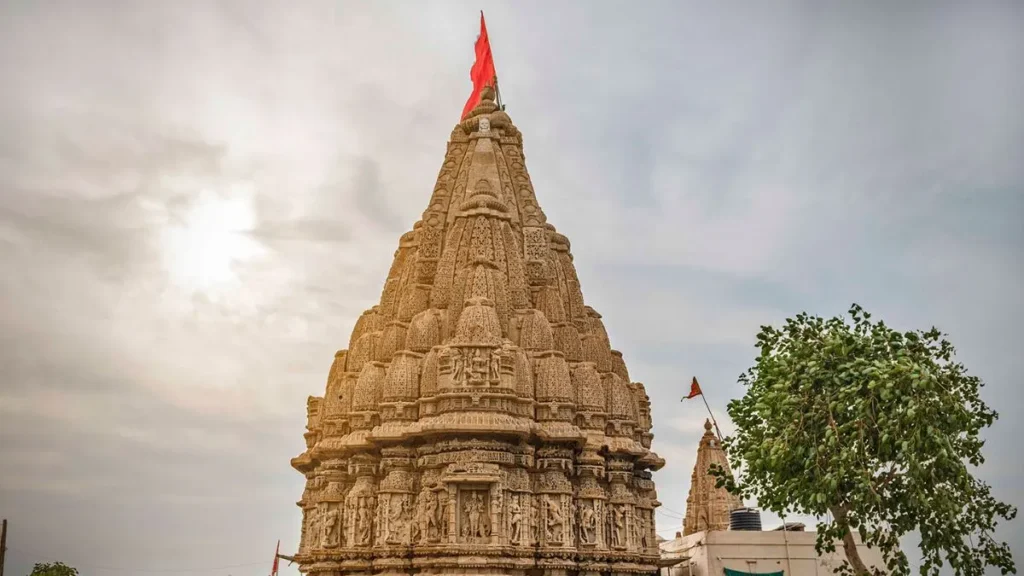
| Architecture | Nagara style with a tiered shikhara and richly carved exterior |
| Entry fee | Free |
| Darshan timings | Approx. 6:00 AM–12:00 PM and 4:00 PM–9:00 PM (verify locally) |
| Time needed | 45 minutes to 1.5 hours |
| Signature ritual | Jal daan donation of drinking water |
| Best time to visit | October to February |
The Legend: Why Rukmini’s Temple Stands Apart
The story goes like this.
Krishna and Rukmini went to invite Sage Durvasa famous throughout the epics for his volcanic temper to dine with them at Dwarka. Durvasa accepted, but with a condition: no horses, no bulls. The divine couple would pull his chariot themselves.
They agreed. Somewhere along that hard road under the Saurashtra sun, Rukmini became unbearably thirsty. Krishna pressed his toe into the earth and the Ganga sprang up from the ground.
Rukmini drank. And in her thirst, she forgot to offer the water to the sage first.
Durvasa took it as an insult and cursed her: she would live apart from her husband. That, devotees say, is why Krishna’s Dwarkadhish Temple stands in the heart of the city while Rukmini’s shrine sits alone on the outskirts.
There’s a second half to the curse that matters even more here. Durvasa is also said to have cursed the land itself that Dwarka would remain parched, its water turned salty and its soil barren. Anyone who has tasted the groundwater around Dwarka understands why that story has held on for so long.
Jal Daan: Why Water Is the Prasad Here
This is what makes Rukmini Devi Temple genuinely unlike anywhere else you’ll visit in Gujarat.
At most temples you receive sweets, fruit or panjiri. At Rukmini Devi Temple, the main prasad is water offered first to the goddess, then given to devotees.
And the offering runs both ways. Pilgrims are encouraged to perform jal daan: donating drinking water to the temple according to their means. The practice ties directly back to Durvasa’s second curse, in a region where fresh water genuinely is scarce and the surrounding water is saline.
How to participate:
- Ask at the temple about the current jal daan arrangement contributions are typically made at the temple office
- Give what you can. There’s no fixed amount, and no obligation
- Understand what you’re doing: in a parched coastal district, donating drinking water isn’t symbolic. It’s practical charity wearing the clothes of ritual
It’s a small thing. It’s also, arguably, the most meaningful ten minutes of the entire Dwarka circuit.
The Architecture: What to Actually Look At
Most visitors do darshan and leave in fifteen minutes. Slow down the carvings are the reason art historians come here.
The present structure dates to around the 12th century CE, built in the Nagara style with a tall tiered shikhara. Local tradition places worship at the site far earlier, with figures of 2,000 to 2,500 years commonly repeated.
Three things worth examining:
- The exterior sculpture panels – deities carved across the outer walls, showing the range of a workshop operating at full confidence.
- The naratharas – bands of carved human figures running around the base of the tower.
- The gajatharas – panels of carved elephants beneath them, a classic feature of temple bases across western India.
The sanctum itself is modest and houses the image of Rukmini, richly adorned. The contrast is deliberate and effective: an ornate outer shell, a quiet centre.
Temple Etiquette and What to Expect
Read this before you go, particularly if it’s your first temple visit in Gujarat.
- Dress modestly. Shoulders and knees covered for all visitors. This is a functioning place of worship, not a monument.
- Remove footwear before entering. Leave shoes at the designated stand.
- Ask before photographing. Photography rules vary and may be restricted inside the sanctum. Never photograph people at prayer without permission.
- Expect a short visit. Unlike Dwarkadhish, crowds here are usually manageable. Even in season, darshan rarely takes long.
- Carry small change for jal daan and the shoe stand.
- Mobile phones should be silenced. Many temples ask you to leave them outside the sanctum.
- Facilities are basic. Use the restroom in town before you set out.
How to Reach Rukmini Devi Temple, Dwarka
The Rukmini Devi Temple sits just off the Dwarka–Okha highway on the edge of town, and it’s an easy addition to any Dwarka itinerary.
From Dwarka Town
Roughly 2–3 km from Dwarkadhish Temple – about 10 minutes by auto-rickshaw. Autos are readily available near the main temple and most drivers know it as “Rukmini Mandir.” Expect a modest fare; agree it before you start.
Most Dwarka darshan taxi packages include this temple alongside Nageshwar and Bet Dwarka. If you’re hiring for a half day, confirm it’s on the list.
By Train
Dwarka Railway Station is the nearest railhead, roughly 4–5 km away, on the Ahmedabad–Okha line with connections from Rajkot, Jamnagar and Ahmedabad. Take an auto from the station.
By Air
Jamnagar Airport is the closest, approximately 130–140 km away, about 2.5–3 hours by road. Rajkot (Hirasar) and Porbandar are the alternatives.
By Road
- From Jamnagar: approx. 130–140 km, 2.5–3 hours
- From Rajkot: approx. 220–235 km, 4–4.5 hours
- From Ahmedabad: approx. 440–450 km, 8–9 hours
- From Somnath: approx. 230–250 km, 4.5–5 hours
Roads through Saurashtra are generally good. Most pilgrims combine Dwarka with Somnath on a wider circuit.
Best Time to Visit
October to February is the clear season. Coastal Saurashtra winters are dry and pleasant, and this is when Dwarka’s pilgrim traffic is at its most comfortable rather than its most punishing.
- October–February (Winter) – Best overall. Comfortable days, manageable crowds, ideal for walking the temple exterior.
- July–September (Monsoon) – Green and atmospheric, but humid, with occasional heavy rain along the coast.
- March–June (Summer) – Very hot and exposed. If you must, go for the 6 AM opening or the evening slot.
Best time of day: Early morning, right after opening. The light falls beautifully on the carved exterior, the air is still cool, and you’ll often have the place close to yourself.
Festival note: Janmashtami transforms Dwarka entirely extraordinary atmosphere, but expect very heavy crowds and book accommodation months ahead.
Where to Eat in Dwarka
Dwarka is a pilgrimage town, which shapes the food: overwhelmingly vegetarian, no alcohol, and a strong Gujarati thali culture.
Near Dwarkadhish Temple – A cluster of thali restaurants and simple Gujarati eateries. Unlimited veg thali typically runs around ₹250–450 for two. Straightforward, filling, dependable.
Dwarka’s pendas – The town is known for its milk-based sweets, and penda is the thing to buy. Pick some up near the main temple as prasad or to carry home.
Kathiawadi options – Look for bajra rotla with garlic chutney, sev tameta, kadhi and chhaas. This is Saurashtra’s home cooking and it travels well onto a thali.
One practical note – carry your own drinking water. Given the region’s salinity, most visitors prefer bottled or filtered water throughout their Dwarka stay.
Places to Visit Near Rukmini Devi Temple
| Place | Why Visit | Best For | Distance |
| Dwarkadhish Temple (Jagat Mandir) | The heart of the Dwarka pilgrimage, one of the Char Dham | Everyone | ~2–3 km |
| Gomti Ghat & Sudama Setu | Riverside ghats and the pedestrian bridge across the Gomti creek | Families, photographers | ~3 km |
| Nageshwar Jyotirlinga | One of the twelve Jyotirlingas, with the towering Shiva statue | Pilgrims | ~20–22 km |
| Bet Dwarka | Island temple complex reached by ferry from Okha | Pilgrims, families | ~30 km |
| Dwarka Lighthouse | Climb for wide views over the Arabian Sea coastline | Sunset seekers | ~3 km |
| Gopi Talav | Pond associated with the gopis, known for its distinctive yellow clay | Devotees | ~20 km |
Suggested Dwarka Darshan Day Plan
6:00 AM – Dwarkadhish Temple for mangla aarti.
8:00 AM – Breakfast in town.
9:00 AM – Rukmini Devi Temple darshan, jal daan, and time with the carvings.
10:30 AM – Nageshwar Jyotirlinga.
12:30 PM – Gujarati thali lunch.
2:30 PM – Ferry to Bet Dwarka from Okha.
6:00 PM – Return for evening aarti at Dwarkadhish, or sunset at Gomti Ghat.
Frequently Asked Questions (FAQs)
According to legend, Sage Durvasa cursed Rukmini to live separately from Krishna. This is traditionally given as the reason her temple stands around 2–3 km from Dwarkadhish Temple.
The temple generally opens around 6:00 AM–12:00 PM and 4:00 PM–9:00 PM. Timings may change during festivals, so confirm locally before visiting.
No. Darshan is generally free for visitors. Devotees can optionally contribute to the temple’s jal daan tradition.
Jal daan means donating drinking water. It is associated with the temple’s traditional story and remains an important devotional practice for visitors.
Around 45 minutes to 1.5 hours is usually enough for darshan and exploring the temple’s architecture and carvings.
Yes. The temple is an important part of a Dwarka pilgrimage and offers beautiful traditional carvings in a quieter setting than the main Dwarkadhish Temple.
Final Thoughts
Rukmini Devi Temple in Dwarka rewards visitors who arrive knowing the story. A queen cursed to live apart from her husband, a land cursed to go thirsty, and a temple that turned both into a tradition of giving water to strangers. Come early, dress respectfully, walk the exterior slowly, and consider making a jal daan before you go.
Have you visited Rukmini Devi Temple on your Dwarka trip? Share your experience in the comments and tell Travel Roach which stop on the Dwarka circuit moved you most. Your recommendation could help fellow travellers discover another meaningful place in Dwarka.
